SEO Competitor Analysis: A Step-by-Step Guide

Fabio Bergmann
To analyze your competitors' SEO strategies, identify the sites that actually rank for your target queries, then compare their keywords, content, backlinks, and technical health against yours. Validate every gap in Google Search Console, benchmark AI Overview and chatbot citations for the same queries, and re-run the check on a fixed cadence.
A competitor outranks you on your core keyword and you can't see why. The eight steps below diagnose it.
Before You Start: What You Need for a Competitor SEO Analysis
A competitor SEO analysis needs four inputs: Google Search Console for first-party data on your own site, one keyword and backlink research tool, a shortlist of 5-10 queries where rivals outrank you, and a way to check AI answers for those same queries. AI Overviews and chat answers now compete with blue links for attention.
Search Console is the anchor. Its performance reports show how often people saw and clicked your pages and which queries sent traffic. Google recommends treating Search Console as a first-party source when you evaluate SEO tools, because third-party tools have no access to Google's internal ranking data. Everything else in this workflow gets checked against it.
- Google Search Console, for your own site's performance data
- A third-party tool that reports competitor keywords and backlinks. Semrush, for example, says its competitor analysis tools show keywords, backlinks, and traffic trends in one view.
- 5-10 target queries you want to win
- A method for checking AI Overviews and chat answers. Manual works for a start. A tracker scales. See our setup guide for monitoring your brand in AI search.
Step 1: Define what SEO competitor analysis actually covers
SEO competitor analysis is the systematic review of sites that rank for your target keywords, explaining how they earn those rankings. HubSpot breaks the explanation into five levers: keyword targeting, content quality, backlink authority, technical health, and SERP feature capture. The goal: copy what works, skip what doesn't.
The output is a diagnosis. A list of who ranks above you tells you nothing. A list of why they rank tells you what to build next. BrightEdge frames competitive analysis as identifying the players who compete with your content for organic traffic. That definition is about traffic, not who sells the same product. Scope covers four layers: on-page, off-page, technical, and AI-answer visibility.
Step 2: Separate your real search competitors from your business competitors
Real search competitors are the domains on page one for your money keywords, and they often overlap little with the rivals on your sales slides. Review sites, listicles, and forum threads regularly outrank direct competitors. Those are the pages you have to beat, so build your competitor set from the SERP, not the sales deck.
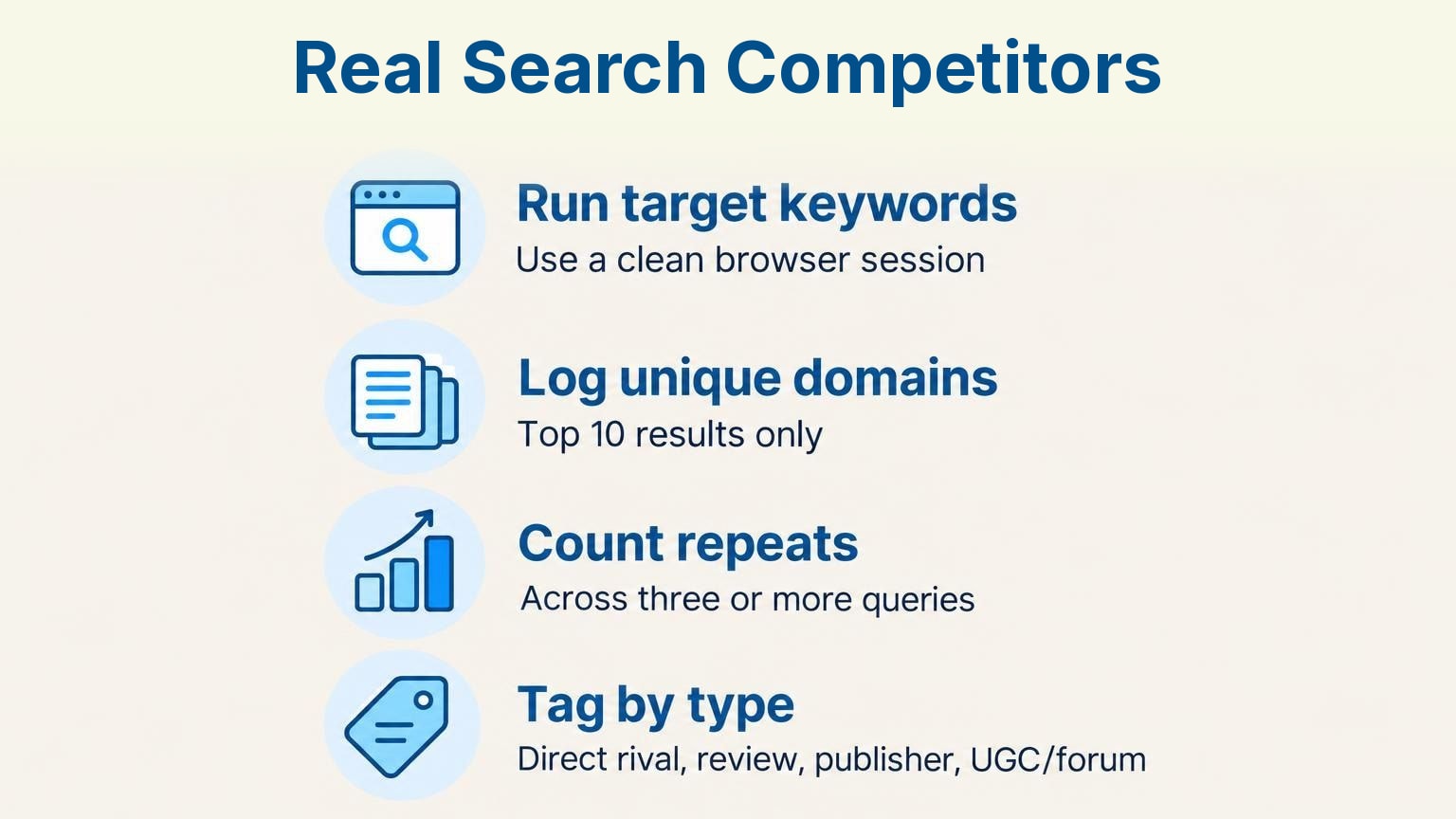
Infographic: Real Search Competitors — Run target keywords, Log unique domains, Count repeats, Tag by type
HubSpot gives a clear example. A search for "best CRM software" can surface a G2 review page, a Forbes Advisor listicle, and a Reddit thread before any SaaS rival appears.
- Run your top 10-15 target keywords in a clean browser session.
- Log every unique domain in the top 10, with the query it ranked for.
- Count repeats. Domains that appear across three or more queries are your recurring search competitors.
- Tag each domain by type: direct rival, review platform, publisher, or UGC/forum.
Business competitors inform pricing and positioning. Search competitors inform ranking strategy. Mix the two and outreach and content budget chase the wrong domains.
Step 3: Compare the metrics that explain why they rank
Five metrics map to the levers behind ranking differences between you and a search competitor: keyword overlap, backlink profile, content depth, technical health, and traffic trend direction. Compare them side by side, not one domain at a time. Domain-comparison and daily-monitoring tools make that practical.
- Keyword overlap: queries they rank for that you don't.
- Backlinks: referring domains and authority, not raw link count.
- Content depth: headings, related keywords, questions answered, and length versus your page.
- Technical health: canonicals, meta descriptions, hreflang, HTTPS, and page speed. Conductor's content guidance audits these elements.
- Trend direction: climbing or flat. A single snapshot hides momentum.
No single tool covers every metric. Most teams combine two or three from the table below.
| Tool | What it compares | Domains side by side | Update frequency |
|---|---|---|---|
| Semrush Compare Domains | SEO and PPC growth | Up to 5 | Not published |
| Semrush Competitor Analysis | Keywords, paid strategy, backlinks, traffic trends, AI-answer visibility | Not published | Not published |
| Ahrefs Site Explorer | Keyword, traffic, and backlink changes; growth trends | Not published | Daily |
| Ahrefs AI Overviews tracker | AI Overviews share of voice vs competitors | Not published | Daily |
| Conductor Competitive Content Analysis | Audience, journey stage, metadata, headings, questions, body copy, length | Not published | Not published |
| Google Search Console | Your own impressions, clicks, CTR, average position, queries | Your site only | Very recent data may be preliminary |
Sources: Semrush Compare Domains, Semrush Competitor Analysis, Ahrefs Site Explorer, Ahrefs AI Overviews tracker, Conductor, Search Console Performance report, Search Console overview.
Step 4: Run a keyword and content gap analysis
Keyword and content gap analysis lists the organic keywords a competitor ranks for and you don't. Each one is a candidate topic. Ahrefs' Content Gap tool is built for this: it surfaces keywords other sites rank for that your target site misses, which also exposes their content strategy.
The report gives you the "what." A manual pass gives you the "how."
- Export gap keywords for your 3-5 recurring search competitors.
- Filter to keywords where two or more competitors rank. Shared gaps signal real demand.
- Open the top 3-5 ranking pages per keyword. Note headings, subtopics, questions answered, and length.
- Check intent. A gap is sometimes a missing format, like a comparison page or a template, not a missing topic.
For category-level gaps, use share-of-voice reporting. BrightEdge's Share of Voice shows how much of a keyword group you occupy versus other sites, exposing whole clusters you've left uncovered.
Step 5: Run a backlink gap analysis
Backlink gap analysis finds links your competitors earned and you didn't, which makes them realistic outreach targets. Ahrefs defines it as finding great links your competitors have that you don't, then judging whether similar links would help your site. The judging step matters. Many gap links aren't worth chasing.
- Pull backlink profiles for your 3-5 closest search competitors.
- Filter for referring domains that link to two or more of them but not to you.
- Score each domain on topical relevance and authority before contacting anyone.
- Prioritize editorial mentions and resource pages. Skip low-quality directories.
A domain linking to three competitors already covers your category. Warmest pitch you'll send.
Step 6: Validate findings against Google's own first-party data
Google Search Console is the check on every third-party estimate: treat tool numbers as direction, not proof, and confirm your own performance before changing strategy. Google says third-party tools can't access its internal ranking data and can't guarantee results, and advises checking tool advice against official guidance.
The Performance report gives impressions, clicks, CTR, average position, and query-level data for your site. Use it to answer three questions:
- Did the "lost" keywords a tool flagged actually lose clicks, or did only the estimate move?
- Are gap keywords already earning impressions at position 11-30? Faster wins than net-new pages.
- Did CTR drop while position held? That points to a SERP feature change, not a competitor overtaking you.
One caveat: Google notes that very recent Search data may be preliminary, and the Performance chart blends Search and Discover. Don't react to a day-old dip. Google's documentation also filters vendor pitches. Search Essentials states there is no cost to appear in Google Search results, whatever an agency or tool promises.
Step 7: Extend the analysis to AI search visibility
AI search visibility now belongs in competitor analysis. An Ahrefs analysis of 25 million AI Overview keywords found AI Overviews had grown by 116% since Google's March Core Update. Analysis that stops at blue links misses a growing slice of the SERP. Benchmark AI citation share the same way you benchmark rankings.
Classic ranking work still feeds AI visibility. Ahrefs found that 76% of 1.9 million AI Overview citations also ranked in Google's top 10, with a median position of 2 for top-cited URLs. The competitors dominating your top three are the likeliest to own the Overview too.
Ahrefs measured CTR drops of 34.5% from AI Overviews in its own analysis. Pew Research Center found users clicked a traditional result in 8% of visits with an AI summary, versus 15% without one. If a competitor owns the Overview, your position-2 ranking is worth less.
The Ahrefs AI Overviews tracker compares Overview share of voice against competitors, with daily tracking. Overviews are one surface. ChatGPT, Gemini, Claude, and Perplexity each recommend brands differently. Our roundup of AI search visibility tools compares trackers that cover them.
Step 8: Set a refresh cadence instead of treating this as a one-off
SEO competitor analysis needs a fixed refresh cadence, not a one-off audit. Conductor states it should run continuously because SERPs are highly dynamic. In practice: a monthly baseline, plus event-triggered re-runs after core updates, competitor content pushes, or shifts in your AI citation share.
- Rankings and keyword gaps: monthly in stable niches.
- Event triggers: re-run immediately after a Google core update, a competitor content cluster launch, or a move in AI Overview citation share.
- Backlink gaps: quarterly. Monthly if outreach is active.
- AI visibility: daily or weekly. Overview coverage moves faster than a quarterly audit.
A single audit captures one moment. Setup once, then let tracking run.
Free vs Paid Tools: When Each Is Enough
Free tooling covers a single-domain audit. Search Console plus manual SERP checks will validate one hypothesis or run an occasional gap check. Paid suites earn their cost when you need daily change alerts, comparisons across three or more domains, automated backlink gaps, or AI visibility across several platforms at once.
Search Console is free and authoritative for your own site, but shows nothing about competitors. Pair it with a third-party tool for gap work. Solo founders and occasional auditors can stay on free tiers. Agencies and teams needing daily alerts generally can't. Semrush's five-domain comparison and Ahrefs' daily monitoring exist because manual checks don't scale past a few rivals.
AI visibility is where free options thin out fastest. Our guides to free AI visibility checkers and free SEO software map where they run out.
Sightkick: running competitor analysis across Google and AI search on autopilot
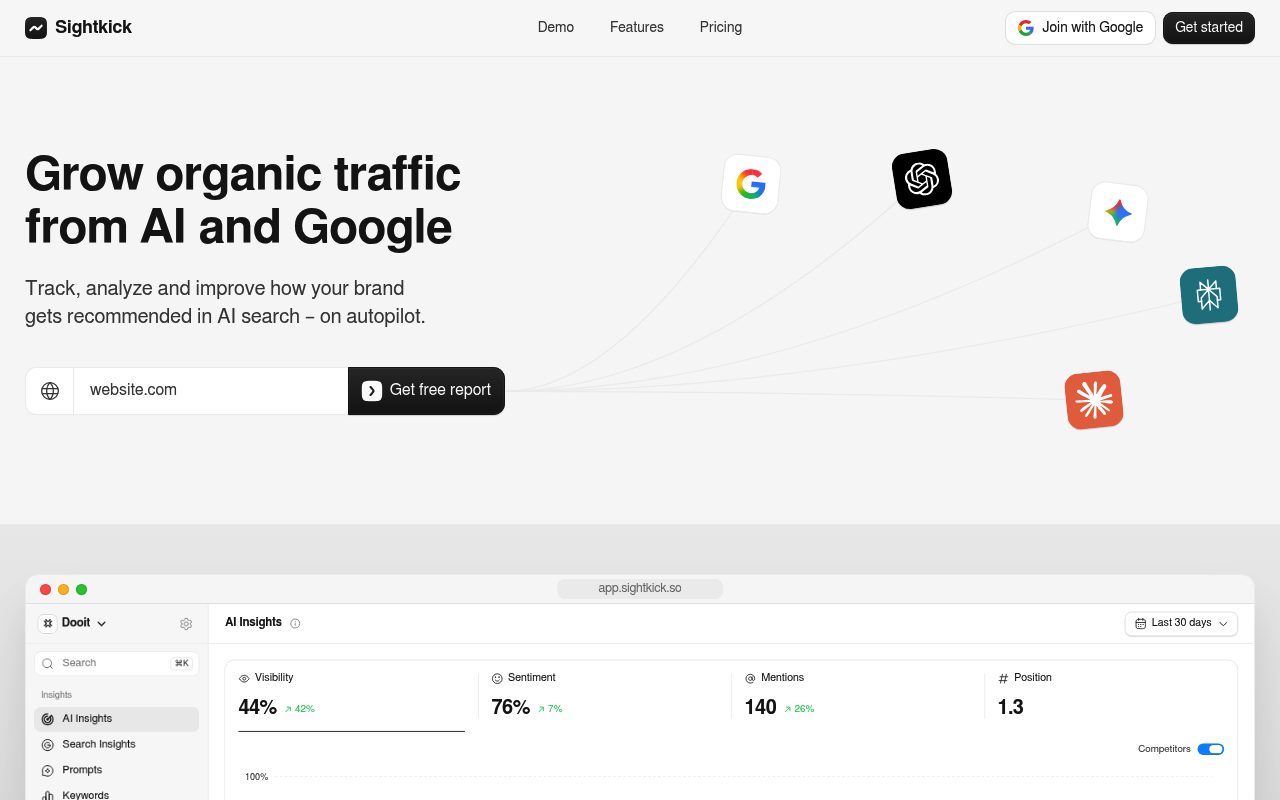
Screenshot: Sightkick homepage, September 2026.
Sightkick, our own product, automates the recurring AI-visibility parts of this workflow. It runs prompts across 4 AI models daily and records which brands get recommended, tracking visibility, sentiment, mentions, and position across ChatGPT, Gemini, Google AI Overviews, Google AI Mode, Claude, Perplexity, and Reddit.
Disclosure: Sightkick is our product.
- Baseline. A free brand visibility report shows visibility percentage, sentiment score, mention count, and average AI recommendation position relative to competitors.
- AI checks. Daily prompts cover Step 7 and the AI part of Step 8 without manual re-checks.
- Citation sources. Cited sources are classified as UGC, Editorial, Yours, or Competitor, showing where rivals win AI recommendations.
- Gap closing. The Articles engine researches, writes, scores, adds images, links, and schema, and publishes to your CMS daily. The Backlinks engine finds pages AI already cites, verifies owner contact details, sends pitches and follow-ups, and confirms live links.
- Access. Stated setup time is 2 minutes, with a 7-day free trial. Sightkick MCP exposes 29 tools to Claude, ChatGPT, Cursor, OpenClaw, and Codex.
Keep Search Console as your first-party check on Google performance. Step 6 still applies.
Frequently asked questions
These SEO competitor analysis FAQs cover the questions teams ask most: how to analyze competitors' SEO strategies, how to check a competitor's SEO, the step-by-step stages of the process, the 80/20 rule, tool choice, and how to find real search competitors. Each answer stands alone and points back to the relevant step above.
How do I analyze my competitors' SEO strategies?
Find the domains that rank for your target queries, then compare their keyword targeting, content, backlinks, technical health, and SERP feature capture against yours. Confirm gaps in Search Console, add AI Overview and chatbot citations to the benchmark, and repeat on a schedule. Steps 2-8 walk through each stage.
How to check competitors' SEO?
Use a third-party tool. Search Console only reports on your own site. Semrush says its competitor analysis tools show a competitor's keywords, paid strategy, backlinks, traffic trends, and AI-answer visibility in one view. Pair that with manual SERP checks for your target queries.
What are the step-by-step stages of a complete SEO competitor analysis process?
HubSpot outlines five stages: identify true search competitors, run a keyword gap analysis, evaluate the SERP and search intent, analyze competitor content, and benchmark backlink profiles. This guide adds three: validate findings in Search Console, extend the benchmark to AI search, and set a refresh cadence.
What is the 80/20 rule in SEO?
In competitor analysis, the 80/20 rule means putting most effort into the small share of competitor keywords, pages, and backlinks that drive most of their traffic and authority. Don't match every gap. Start with high-overlap, high-intent queries and the most-linked pages behind them.
What is the best tool for competitor analysis in SEO?
No single tool covers everything. Semrush and Ahrefs handle keyword, backlink, and domain comparison for classic SEO. Dedicated AI-visibility trackers cover AI Overviews and chat-platform citations. Most teams pair one keyword/backlink suite with Search Console and an AI tracker.
How do I find out who my real SEO competitors are?
Search your actual target keywords and log which domains repeat in the top 10. Ignore who you assume your rivals are. Review sites, listicles, and forums frequently outrank direct competitors on commercial queries, so they belong in your benchmark set.