 Join with Google
AI Share of Voice: How to Measure It (Step-by-Step)

Fabio Bergmann
How do you measure AI share of voice? Run a fixed set of category prompts across ChatGPT, Gemini, Google AI Overviews, and Google AI Mode. Tag every brand mention and citation. Divide your brand's count by the category total and multiply by 100. Repeat on a fixed schedule and benchmark the result against named competitors.
What you need before you measure AI share of voice
Measuring AI share of voice takes four inputs before the first prompt runs: a list of category prompts, repeatable runs across AI models, a tagging method for mentions and citations, and a named competitor list. If any one is missing, the percentage can't be repeated or compared over time.
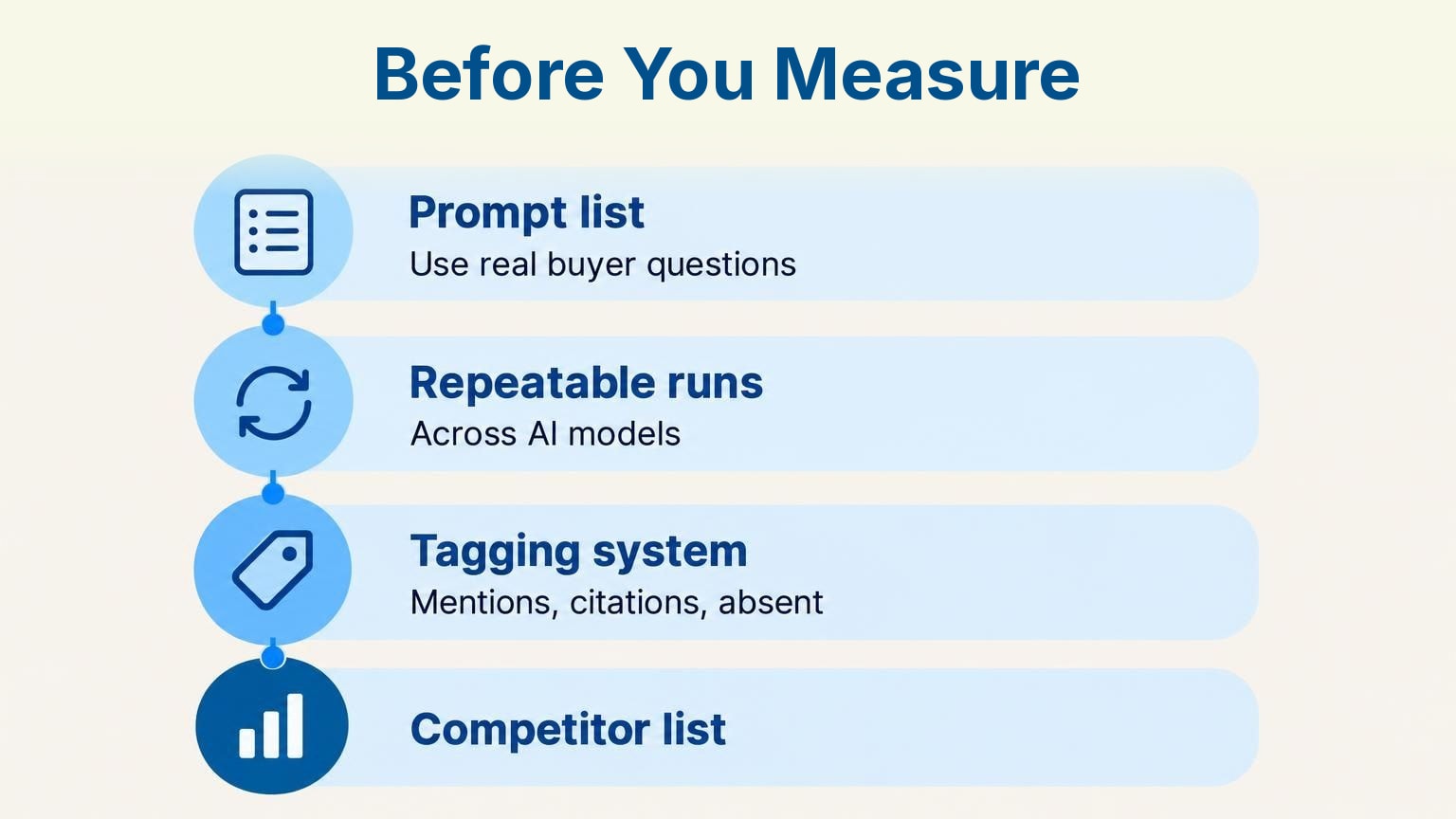
Infographic: Before You Measure – Prompt list, Repeatable runs, Tagging system, Competitor list
Conductor defines AI share of voice as how often your brand is mentioned or cited in AI-generated responses compared with competitors. Each part of that definition maps to an input:
- Prompt list. Use real buyer questions, such as "best CRM for a 10-person sales team". Branded queries like "is [your brand] good" inflate the number and say nothing about competitive standing.
- Repeatable runs. Run the same prompts across ChatGPT, Gemini, and Google AI Overviews/AI Mode, more than once.
- Tagging system. Record whether your brand is named in the answer text, linked as a source, both, or absent.
- Competitor list. Name the rivals you benchmark against. Share of voice is relative, so you need a denominator.
Step 1: Define what counts as a mention versus a citation
Pick one metric before counting anything, because mentions and citations are separate measures. Mention-based share of voice tracks how often your brand name appears in the answer text. Citation-based share of voice tracks how often your pages are linked as a source. Conductor treats these as distinct metrics, and Semrush data shows they often diverge.
Conductor tracks AI share of voice in two distinct ways: mention-based SOV is your share of the conversation; citation-based SOV is your share of the authoritative sources driving AI traffic. The two show up independently.
The gap is large. Semrush's ghost-citations study found that 62% of AI citations do not lead to a brand mention. The platforms also behave in opposite directions:
| Platform | Named brands in answer text | Cited brands as a source | Implication for SOV tracking |
|---|---|---|---|
| ChatGPT | 20.7% | 87% | Citation SOV overstates brand recall |
| Gemini | 83.7% | 21.4% | Mention SOV overstates source authority |
Sources: Semrush, The Ghost Citations Study
Measured by citations, a brand can look dominant on ChatGPT and still go unnamed in the answers buyers read. Match the metric to the goal:
- Brand awareness: make mention-based SOV primary.
- Referral traffic: make citation-based SOV primary.
Log both. Report one.
Step 2: Build a prompt set sized for reliable results
Picture a team tracking ten prompts. One reshuffled answer swings their share of voice by double digits overnight, and nobody can tell signal from noise. More prompts fix that, because larger panels smooth out answer variability. Start with 50 to 100 prompts per category, then expand once the baseline holds steady.
Scale matters at the benchmark level too. Semrush's 2026 AI Visibility Index grew from an initial 2,500-prompt analysis to 126 million U.S. AI search prompts analyzed from January through April 2026. One category doesn't need that volume. It needs enough prompts that a single answer can't move the number.
Prompt count also unlocks a second metric: prompt coverage, the percentage of tracked prompts your brand appears in. Appear in 15 of 50 tracked prompts and coverage is 30%.
- Pull 50 to 100 buyer questions from sales calls, support tickets, review sites, and "People also ask" boxes.
- Tag each prompt by funnel stage: discovery ("what tools do X"), comparison ("A vs. B"), ready-to-buy ("best X for Y pricing").
- Freeze the wording. Editing prompts mid-series breaks trend comparability.
- Rerun the full set daily or weekly. AI answers change, so one snapshot is not a trend.
Step 3: Calculate your share-of-voice percentage
Divide your brand's mentions or citations by the category total, then multiply by 100. Twenty-five brand mentions out of 100 category mentions is 25%. Run the formula separately per platform and per metric type, never as one blended number, so the AI share-of-voice percentage stays comparable week to week.
That 25% example comes from HubSpot, which defines the metric as the percentage of brand mentions in AI answers that belong to your company versus others in your category. Semrush applies the identical ratio: 10 mentions out of a category total of 100 is 10%.
Ahrefs uses a different denominator. In Brand Radar, share of voice is a brand's percentage of impressions versus other tracked brands, and impressions come from summing Google search volumes of prompts where the brand appears in an AI answer. High-demand prompts weigh more: one appearance on a 10,000-volume prompt outweighs ten on near-zero-volume ones. Use mention counts for conversational presence. Use impression-weighted share when demand matters more than frequency.
What a 50% share of voice means
Half of all tracked category mentions or citations, say 50 of 100, belong to your brand. It does not mean you appear in half the prompts. A brand mentioned three times in each of 20 answers can hold high mention share with low prompt coverage. Track both numbers.
Is there a 30% rule?
No industry-defined 30% rule exists in AI search. We use roughly 30% as a working flag: when a single competitor holds that much of a tracked category, treat it as a dominant incumbent and point content and backlink effort at the prompts it owns.
Step 4: Benchmark against named competitors and the category average
Competitor benchmarking turns a raw share-of-voice score into a market position. Run the identical prompt panel for every named rival, calculate the same ratio for each, and compare against the category average. Google's Merchant Center AI performance insights already do this for shopping queries, showing competitors' average share beside your own.
Google's report benchmarks brand visibility across AI Mode, AI Overviews, and the Gemini app on shopping journeys. Share of voice there is your AI impressions divided by total impressions across your defined competitors and your own results for related queries. The competitor average shows whether you sit above or below the market standard.
The more useful design choice is segmentation. Google breaks visibility into three shopping stages: discovery, evaluation, and ready to buy. A blended number hides funnel leaks. A brand can lead discovery prompts and vanish at evaluation. Copy this structure outside Merchant Center too, which is why Step 2 tags prompts by funnel stage.
Coverage is limited. The insights currently serve English-language queries for Merchant Center accounts in Australia, Canada, India, New Zealand, and the United States, on shopping journeys only. SaaS and B2B brands still need third-party tracking such as Ahrefs Brand Radar, Semrush, or Conductor. Our comparison of AI search visibility tools covers how they differ (disclosure: Sightkick, our product, competes in that category).
Step 5: Separate AI share of voice from traditional share of voice
Search rankings and AI answers measure different things. Traditional share of voice counts ranked positions and ad impressions in a fixed results list. The AI version counts presence inside a synthesized answer: mentions, citations, and sentiment, with no ranked list at all. Yext recommends tracking both, because AI citations shape brand standing independently of rankings.
Yext argues traditional share of voice should extend into AI to show where a brand stands and which visibility gaps to close. A page ranking first on Google can still be absent from the AI Overview above it.
Frequency is only one axis. Yext frames AI visibility as how often, how accurately, and how favorably AI engines describe your brand. Most SOV setups count the first and ignore the other two. An answer calling your brand "expensive and hard to set up" still counts as a mention, and so does one quoting last year's pricing. Log sentiment and factual accuracy beside each mention, so a rising share of negative or wrong mentions doesn't read as progress.
Step 6: Track share of voice by platform and over time, and connect it to outcomes
Four platforms produce four different results. Measure share of voice separately on ChatGPT, Gemini, Google AI Overviews, and Google AI Mode, log it at least weekly, and read the trend line rather than any single score. Then compare weeks where share of voice rose against AI referral sessions and conversions.
Platform behavior diverges. Gemini cites brands as a source only 21.4% of the time. ChatGPT names brands in text only 20.7% of the time. A brand can lead mention share on Gemini and trail on ChatGPT with the same content. Averaging the two hides both facts.
- Chart share of voice per platform as a weekly trend line.
- In analytics, segment referral sessions from AI platforms such as chatgpt.com and gemini.google.com.
- Overlay the two series. Look for share-of-voice gains followed by referral and conversion lifts.
- If share of voice rises with no traffic change, check whether the gains are mentions without citations. Those drive recall, not clicks.
Source type is the last layer, and the one that turns measurement into action. Classify every cited page as user-generated (Reddit, forums), editorial (publications, review sites), owned (your domain), or competitor. The split shows how much of your AI presence you control. The editorial pages already cited for your prompts are also your shortest path to more citation share: AI engines already trust them, so a mention or link there feeds answers directly. Treat that list as your outreach queue. Our setup guide for monitoring your brand in AI search covers the tracking configuration.
Running this measurement with Sightkick
- Baseline: a free brand visibility report shows visibility percentage, sentiment score, mention count, and average AI recommendation position.
- Source types: cited sources are classified as UGC, Editorial, Yours (owned), or Competitor, the split from Step 6.
- Outreach: a Backlinks engine finds pages already cited by AI, verifies owner contact details, sends pitches and follow-ups, and confirms links went live.
- Cost: 3-day free trial, quoted 2-minute setup, one plan at $79 per month (pricing).
Default coverage is 3 models. Daily tracking on all four requires the add-on.
Frequently asked questions
Four questions come up most when teams start measuring AI share of voice: what the metric means, how to read a 50% score, how to measure chatbots specifically, and whether a 30% rule exists. The short answers below match the six-step workflow above.
What does AI share of voice mean?
The percentage of brand mentions or citations in AI-generated answers that belong to your company versus every other brand tracked in the same category and prompt set, measured across models such as ChatGPT, Gemini, and Google AI Overviews.
What does 50% share of voice mean?
Your brand holds half of all tracked mentions or citations across the category's prompt set. It does not mean you appear in half the prompts; coverage and mention share can differ.
How do I measure my brand's share of voice across AI chatbot responses specifically?
Run the same prompt panel on each chatbot separately (ChatGPT, Gemini, Perplexity). Tag each response for brand mentions in text versus source citations, then divide your mentions by total category mentions per platform. Keep platforms separate, because citation and mention rates vary sharply by chatbot.
Is there a "30% rule" for AI share of voice?
No formally defined 30% rule exists. A single competitor holding roughly 30% or more of tracked category mentions signals a dominant incumbent, which makes 30% a useful working threshold for prioritizing content and outreach, not an industry standard.
Next step: write 50 buyer-intent prompts for your category, run them on ChatGPT and Gemini this week, and log mentions, citations, sentiment, and accuracy separately for your brand and three named competitors.