 Join with Google
Schema Markup for AI Search: Step-by-Step Setup Guide

Fabio Bergmann
To add schema markup for AI search visibility, choose types that match your visible content, generate JSON-LD in your CMS or page templates, connect related entities, and validate the published pages. Schema helps describe content; it does not guarantee AI citations. Check crawler access and measure recommendations separately.
By Fabio Bergmann, Founder of Sightkick
Before You Start: What You Need
Schema setup needs access to page templates or a CMS plugin, a page inventory, and a validation workflow. Set the expectation first: Google requires no special schema.org markup for AI Overviews or AI Mode. Markup describes content. It is not an admission ticket to AI answers.
- Editing access: identify where your CMS generates page-specific JSON-LD, whether through a plugin or template code.
- Page inventory: separate articles, product pages, instructional guides, and FAQ pages before assigning types.
- Validation workflow: keep Google’s Rich Results Test and the Schema Markup Validator available.
Budget for maintaining visible content, not just markup. Google’s AI optimization guide warns against overfocusing on structured data, because it is not required for generative AI search.
Step 1: Understand what schema markup actually does before you add it
Schema markup describes the content your page already contains. Google says structured data helps it understand page content and display richer Search results. Those are documented benefits. A higher probability of receiving a chatbot citation is a separate outcome, not an established consequence of adding markup.
For a software guide, distinguish the article from its author and publisher. For a product page, distinguish the product description from its price. Define what exists, which facts describe it, and how the objects relate. Start there, not with a plugin’s list of available schema types.
Step 2: Know how AI engines actually use (and don't use) your markup
AI search documentation describes different mechanisms for different tasks, not a universal schema-to-citation pipeline. OpenAI documents structured metadata as an input for shopping results and source synthesis as a search capability. Neither establishes that adding an Article block improves an editorial page’s citation probability.
For ChatGPT shopping, OpenAI says product selection can consider structured metadata from first-party and third-party providers, including price and product description.
ChatGPT reads and synthesizes content across multiple online sources and produces cited, structured outputs.
Structured output is not evidence of schema ingestion. The statement describes the answer ChatGPT produces, not a markup requirement for the source page.
ChatGPT ranks search results using multiple factors intended to help users find relevant, reliable information. Placement is not guaranteed.
Keep separate acceptance checks: valid markup, supported Google rich-result eligibility, and observed AI mentions or citations. Passing the first check does not prove either of the others.
Step 3: Choose the schema types worth your time
Choose schema types by the page’s actual purpose, not by a promised AI ranking benefit. Start with Article for editorial content and evaluate Product for product information. Add identity relationships where they clarify the publisher or author. Treat FAQPage and HowTo as content descriptions, with separate checks for Google feature support.
- Article: Schema.org defines Article for articles, including news articles and investigative reports. Use it for an editorial guide rather than forcing every page into the same template.
- Product: Google says Product markup can support richer appearances in Search, Images, and Lens. Its ecommerce guidance also says structured data can improve understanding of price, discount, and shipping costs. Do not manufacture fields for details the page lacks.
- FAQPage: Schema.org defines it as a page presenting frequently asked questions. Google’s FAQ eligibility guidance says FAQ rich results show regularly only for well-known, authoritative government and health websites.
- HowTo: Schema.org defines HowTo as sequential instructions for achieving a result. Google’s August 2023 announcement restricted How-To rich results to desktop, excluding mobile. That dated restriction is not a current availability guarantee.
For Organization or Person identity, reserve sameAs for a reference that unambiguously identifies the same entity, such as its official website or Wikidata entry. An industry-related page is not an identity reference.
Step 4: Implement with JSON-LD, not microdata
Use JSON-LD for new template-based implementations when your site supports it. Google recommends JSON-LD because it is the easiest format to implement and maintain at scale. Put generation logic in the CMS template. Populate each page’s fields from its own content instead of copying a static block everywhere.
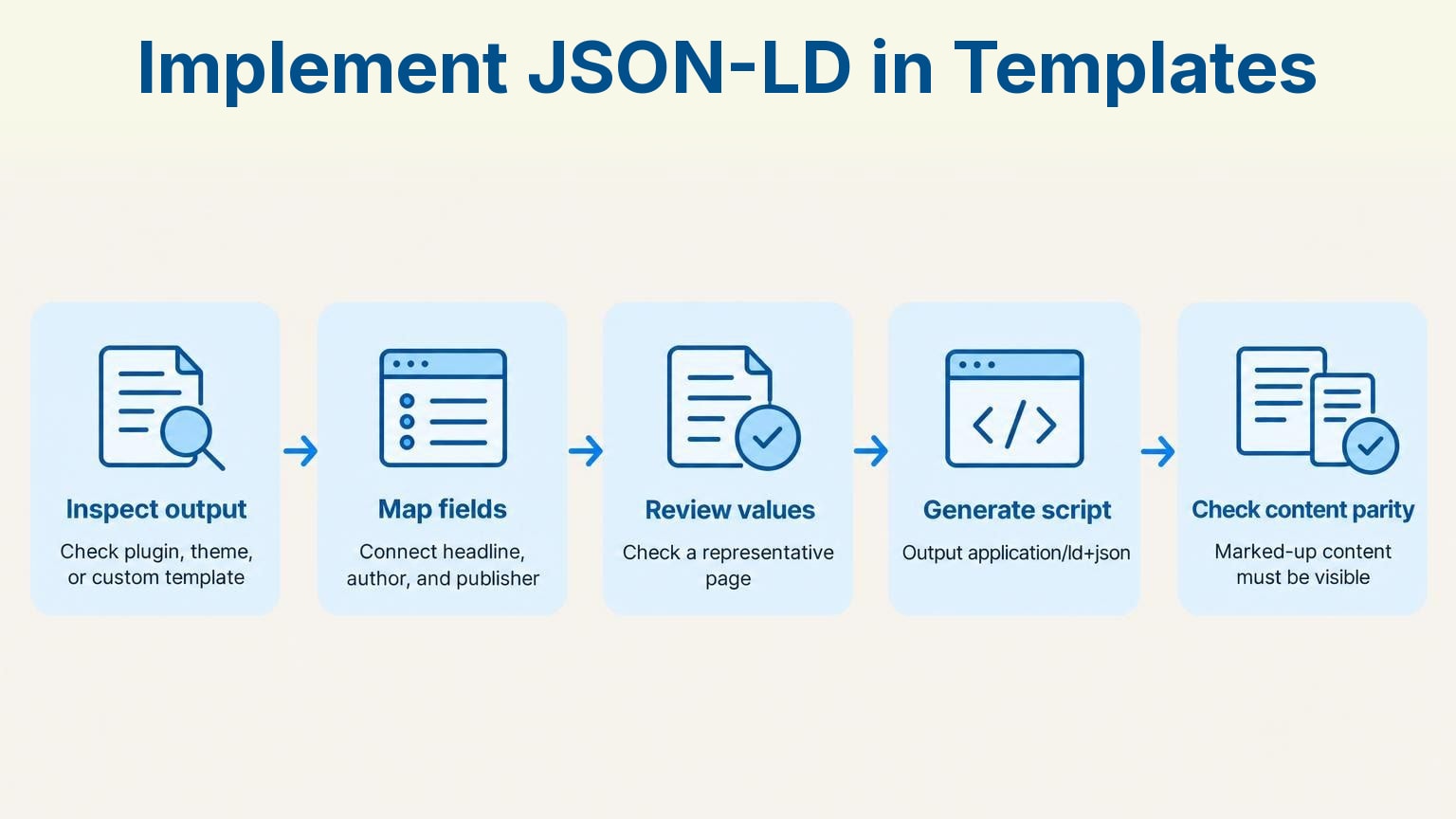
Process infographic: Implement JSON-LD in Templates – Inspect output, Map fields, Review values, Generate script, Check content parity
- Inspect existing output. Identify whether a plugin, theme, or custom template already emits structured data before adding another generator.
- Map fields. Connect the article’s headline, author, and publisher to the corresponding page content. Review the values on a representative page.
- Generate the script. Configure the template to output a
scriptelement withtype="application/ld+json". - Check content parity. Google’s AI guidance says marked-up content must also be visible on the page, and the markup must be validated.
Microdata and RDFa remain supported formats. JSON-LD is recommended, not mandatory. Replace legacy data-vocabulary.org markup: Google says it is no longer eligible for rich-result features.
Step 5: Validate your markup before and after publishing
Schema validation needs separate checks for Google features and vocabulary correctness. Run Google’s Rich Results Test first, then use the Schema Markup Validator for schema.org checks without Google-specific warnings. Test generated code before release and the live page after publishing. Check crawler access separately; validators do not establish searchbot access.
- Check Google features. Follow Google’s validator workflow. The Rich Results Test can also preview a Search feature in some cases.
- Check the vocabulary. Use the Schema Markup Validator when a legitimate type has no corresponding Google rich-result feature.
- Compare against the page. Verify the author, headline, product description, and commercial details against visible content.
- Repeat after changes. Recheck representative pages after a CMS, plugin, or template update.
A valid block can still have no visible Search effect. Google says unused structured data does not cause Search problems, but it also produces no visible effect.
OpenAI says any public website can appear in ChatGPT search. To support discovery, surfacing, and clear citations and links, allow OAI-SearchBot access. Crawl permission alone is insufficient: confirm that your host or CDN also permits OpenAI’s published searchbot IP addresses.
Step 6: Model entities and relationships, not just page types
Entity modeling connects the objects a page describes instead of leaving isolated schema blocks. Schema.org describes its data model as a graph structure: entities connect through named properties. Model the organization, author, and article as distinct objects, then connect them explicitly. The deliverable is a coherent description, not a proven citation boost.
For a software company’s guide, use this implementation plan:
- Assign identities. Give the publisher and author consistent
@idreferences, such as#organizationand#author, within the page’s graph. - Connect the article. Reference the author through
authorand the publishing organization throughpublisher. - Audit identity links. Attach
sameAsto the entity it identifies. Do not attach the founder’s profile to the company object.
Keep relationships precise. An article’s citation to another company does not make the companies the same entity. Product ownership is also different from identity equivalence.
Step 7: Avoid the mistakes that waste schema effort
Schema work needs a defined purpose beyond “more AI visibility.” Distinguish descriptive accuracy, Google feature eligibility, crawler access, and observed recommendations. Fix the failing layer directly. Adding FAQ blocks, identity links, or product fields that do not describe the page does not resolve an access problem or establish a citation benefit.
- Wrong objective: do not turn optional structured-data guidance into a mandatory AI checklist.
- Wrong feature expectation: check current feature support before budgeting implementation work around a rich-result appearance.
- Wrong content: remove invented prices, unsupported identity links, and fields copied from unrelated pages.
- Wrong diagnosis: investigate access failures at the crawler and infrastructure layers, not in the JSON-LD template.
Sightkick: checking how your schema-backed pages perform in AI answers
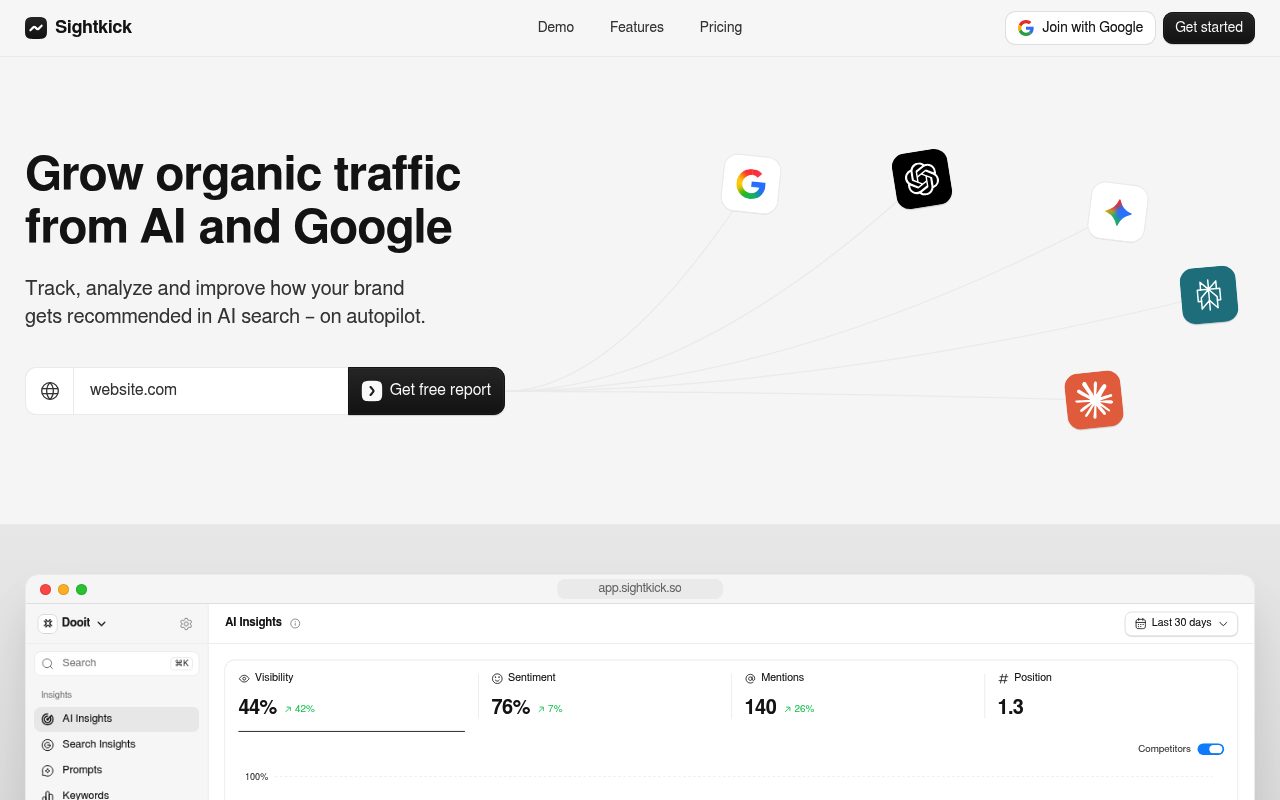
Screenshot: Sightkick homepage, October 2026.
Sightkick tracks outcomes that schema validators do not measure: brand visibility, mentions, sentiment, recommendation position, and citation sources. Establish a baseline before publishing, then monitor tracked prompts and source classifications. Separate a brand mention from a citation to an owned page. Neither proves that schema caused the result.
Disclosure: Sightkick is our product.
- Establish a baseline. Sightkick’s Free Brand Visibility Report shows visibility percentage, sentiment, mention count, and average AI recommendation position relative to competitors.
- Track prompts daily. Sightkick runs every tracked prompt daily in three AI models, with a fourth available as an add-on. Tracked platforms include ChatGPT, Gemini, Google AI Overviews, and Google AI Mode.
- Inspect citation sources. Review the UGC, Editorial, Yours, and Competitor classifications to distinguish owned sources from external sources. Check whether a recommendation cites your page or another publisher’s coverage.
- Maintain publishing. Sightkick’s Articles engine researches, writes, scores, adds images, links, and schema, and publishes to a CMS on a daily schedule.
Record deployment dates alongside visibility changes. If a publishing run changes copy, links, images, and schema together, the resulting visibility change cannot isolate schema’s contribution. A validator pass is an implementation result. An observed recommendation is a visibility result. Keep both records.
Frequently asked questions
Schema markup for AI search raises separate questions about citations, rich-result eligibility, and implementation tools. Use documentation to establish what a system supports, validators to check generated markup, and observed answers to measure visibility. No single test answers all of those questions.
Does adding schema markup directly improve citations in ChatGPT or Perplexity answers?
The cited documentation does not establish a direct citation increase for either system. OpenAI documents multiple ranking factors and no guaranteed placement. Use schema to describe content accurately. Measure citations rather than assuming successful validation changes recommendation probability.
Is schema markup for AI search different from optimizing for traditional rich snippets?
The vocabulary can be the same; the success criteria differ. Google rich-result testing checks supported Search features. Entity modeling checks whether objects and relationships are described coherently. Neither check measures whether an AI answer cites the page.
What tools help manage schema markup without hand-coding every page?
Use a CMS plugin or template generator for JSON-LD, Google’s Rich Results Test for supported Search features, and the Schema Markup Validator for schema.org validation. Configure generation per page type. Review actual output whenever the template changes.
If markup misdescribes the page, fix the template. If valid pages remain absent from AI answers, investigate access and measure visibility separately.
Try Sightkick free with its 3-day trial to establish your AI visibility baseline.