 Join with Google
How to Rank on Perplexity: A Step-by-Step Guide

Fabio Bergmann
Ranking on Perplexity is the practice of earning inline citations inside Perplexity's AI-generated answers. Every query triggers live web research and produces one synthesized response. Brands get cited by publishing fact-dense pages that answer questions directly, matching the research depth of Search, Pro Search, or Deep Research, and checking citations repeatedly instead of tracking a fixed position.
What you need before you start
Ranking on Perplexity means earning inline citations in its answers, not a slot on a results page. Before changing anything, you need three things: published, fact-dense content on a publicly accessible site, a decision on which Perplexity mode you're targeting, and a baseline record of which of your pages already get cited.
Perplexity's own hub describes the product this way:
"an AI answer engine that researches the open web in real time and returns concise, cited answers" (Perplexity)
That definition sets the rules. Perplexity says every answer is grounded in real-time web sources and carries inline citations. The target is a citation inside the answer, not a position in a list of links.
- Confirm your key pages are publicly accessible.
- Pick a target mode: free core Search or Pro Search. Step 1 explains why they pull differently.
- Run your top 10-20 target queries and log which domains get cited. That log is your baseline.
Step 1: Understand how Perplexity selects and displays sources
Perplexity selects sources by running real-time web research for each query and synthesizing one cited answer. Step 1 is learning the three research depths behind that process (core Search, Pro Search, and Deep Research) because each one widens the source pool and sets a different bar for which pages get pulled.
Perplexity's enterprise walkthrough says it shows the sources used when a query is submitted, and that each answer section displays its own sources. So citations are assigned per section, not per answer. The table below shows how the source pool changes at each depth.
| Mode | Research pass | Citation behavior | Access |
|---|---|---|---|
| Search (core) | Real-time web research for summaries, short comparisons, and multi-source questions | Inline citations on every answer | Free core search |
| Pro Search | Multiple searches across articles, academic papers, forums, videos, and more | Direct links to original sources; 10x as many citations per answer | Pro at $20/month or $200/year; very limited for free users |
| Deep Research | Dozens of searches across hundreds of sources | Benchmarked on rubrics including citations to primary source documents | Not published |
Sources: Perplexity hub, Search vs Computer, What is Pro Search, What is Perplexity Pro, Plan comparison, Perplexity Search, DRACO benchmark.
Takeaway: Perplexity's DRACO benchmark rubrics include citations to primary source documents. Writing pages as primary sources, with original data stated plainly, aligns with how Perplexity evaluates its deepest mode.
Step 2: Structure content the way Perplexity's citation engine can extract it
Structuring for Perplexity means writing self-contained answer blocks. Perplexity says its Search product is best for understanding and returns cited results, so rewrite each section so its opening paragraph answers one question completely. A paragraph that stands alone can be cited without its surrounding context.
The same Perplexity guide says Search handles summaries, short comparisons, focused research, and complex multi-source questions. Each format calls for a different shape of passage:
- Summaries: a 40-60 word direct answer at the top of each section.
- Comparisons: tables with named products compared on the same attributes.
- Focused research: specific numbers, dates, and named sources, stated once.
- Multi-source questions: sections that stand alone when extracted, with the subject named in the first sentence.
Pro Search raises the bar because it synthesizes from what Perplexity calls a diverse, high-quality set of sources. Thin rewrites of competitor pages add nothing to that set. Google applies the same standard, asking whether content provides original information, reporting, research, or analysis. One editorial discipline serves both engines. Our guide on ranking in Google AI Overviews covers the overlap.
Step 3: Apply Perplexity's own prompting framework when testing your content
Five elements make a strong prompt in Perplexity's prompting guidance: instruction, context, input, keywords, and output format. Use them in reverse as a QA check. Write your target query as a well-formed prompt, run it, and see whether your page satisfies each element. The result is a repeatable test instead of guesswork about competitor citations.
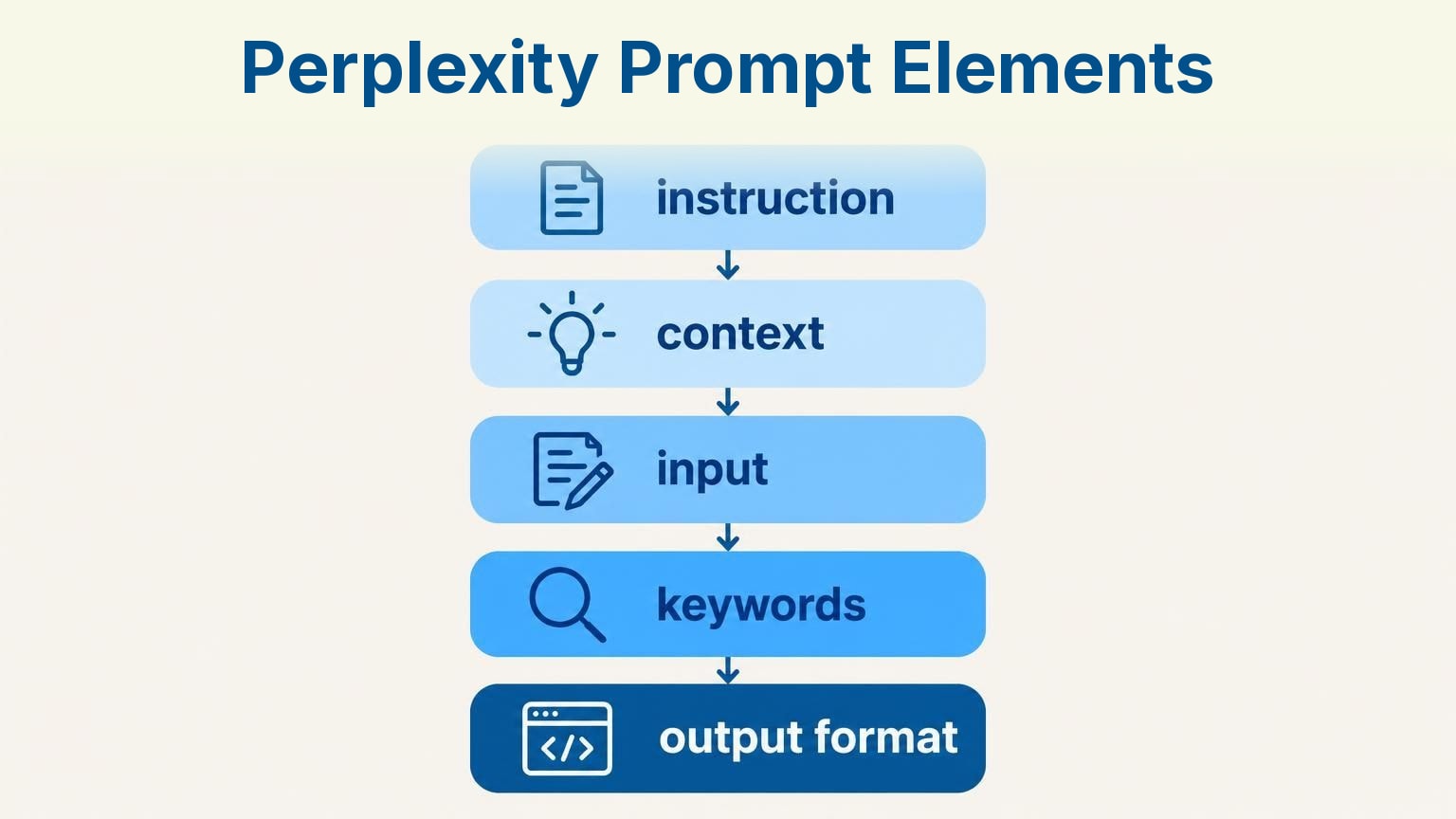
Infographic: Perplexity Prompt Elements – instruction, context, input, keywords, output format
- Write the query the way a buyer would, with all five elements, following Perplexity's prompting tips.
- Run the prompt in Perplexity and record every cited domain.
- Open the top cited page and match its structure against yours. Does it state the keywords early? Does it deliver the requested output format, such as a list, table, or comparison?
- Fix the gaps, then re-run the prompt. Perplexity's guidance says to be specific, give context, and test and refine. Treat your content the same way.
Step 4: Know how Perplexity's ranking model differs from Google's
Google and Perplexity score different units. Google ranks individual pages against each other and returns a list of links. Perplexity researches each query in real time and returns one synthesized, cited answer. Track the two engines separately, because a Google position doesn't tell you whether Perplexity cites the same page.
Google states that its ranking systems are designed to work on the page level. Its guide adds that good site-wide signals don't guarantee every page ranks highly, and poor ones don't sink every page. Perplexity, by its own description, researches each query in real time instead.
The practical read: optimize each page to answer its query directly, and measure citations query by query rather than inferring them from Google rankings. For the ChatGPT side of the same question, see how ChatGPT rankings work.
Step 5: Set realistic expectations for citation volume and failure modes
Perplexity publishes no official score, so measure success as consistent citation for your target queries across free Search and Pro Search. The realistic risk is dilution: your page appears as one of several sources rather than the lead citation, which is the expected shape of a multi-source answer engine.
Plan tier changes the field. Perplexity says free users get "practically unlimited basic searches" but a very limited amount of Pro Searches. Pro answers include 10x as many citations per answer. Where those extra slots come from matters:
"The system then conducts multiple searches across the web, drawing from articles, academic papers, forums, videos, and more" (Perplexity)
Your own domain is one slot. Forums, editorial articles, and videos compete for the rest, and any of them can name your brand. The angle most guides miss: win the citations you don't own. A forum thread or editorial review that Pro Search already pulls can carry your brand into the answer even when your page isn't cited.
"Ranking #1" is the wrong goal. The benchmark is appearing again and again across repeated runs, on your pages and on the third-party pages Perplexity trusts.
Step 6: Monitor your citations inside Perplexity on an ongoing basis
Perplexity citations need ongoing monitoring because every query is researched live, so a citation earned last month carries no guarantee for next month. A recurring audit tells you whether your brand still appears, what sentiment surrounds it, and which pages are displacing you in the same answers.
- Run a fixed prompt set on a schedule, weekly at minimum. Answers vary with wording and focus mode.
- Classify every cited source as UGC, editorial, your own domain, or a competitor. The mix shows where Perplexity pulls from, and which third-party pages to target per Step 5.
- Flag any prompt where you dropped out, then compare the replacement page against yours using the Step 3 test.
- Log sentiment alongside presence. A negative mention still counts as a citation.
Our brand monitoring setup guide covers the routine across engines.
Sightkick: tracking and growing Perplexity citations on autopilot
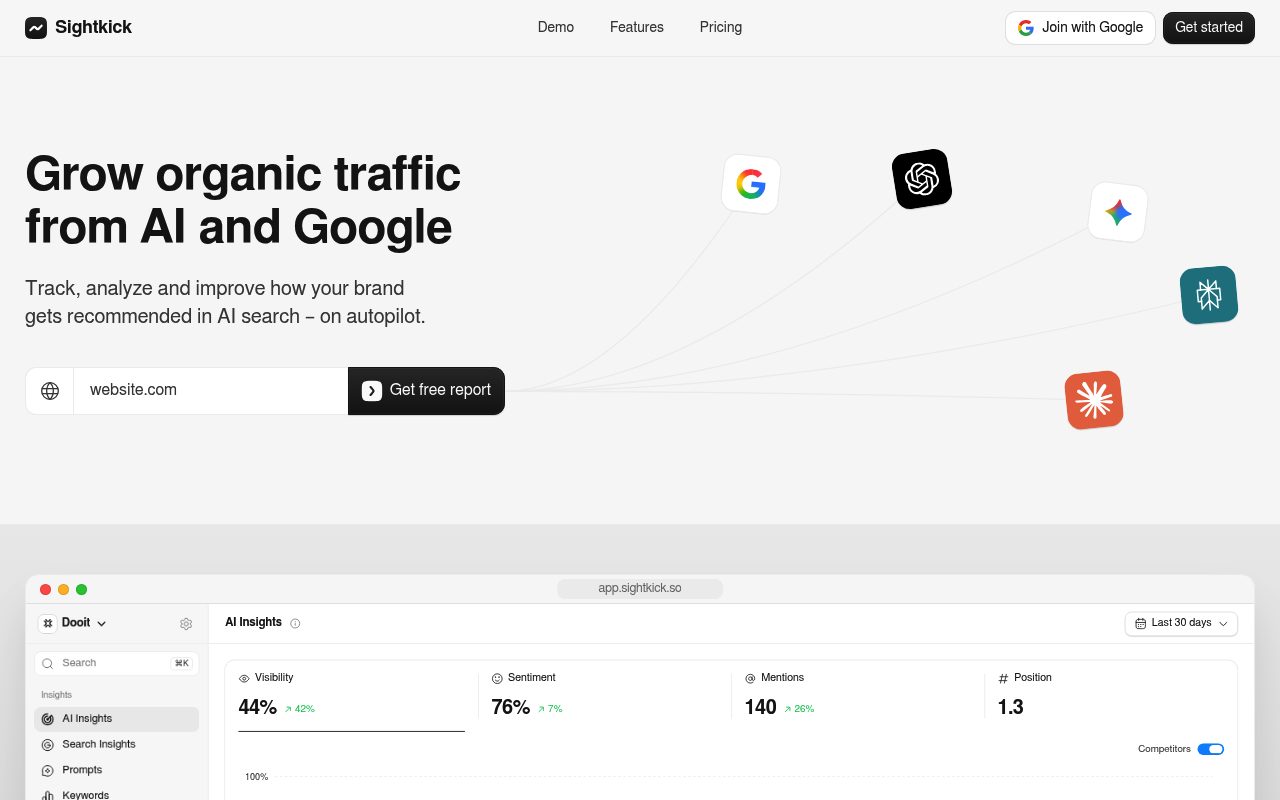
Screenshot: Sightkick homepage, October 2026.
Sightkick, our own product, is a tracking and content platform that automates parts of the Step 2, 5, and 6 routine. It runs tracked prompts daily, records which brands get recommended, and classifies citation sources by type. Its listed tracked surfaces don't include Perplexity, so treat it as a complement to manual Perplexity checks.
- Tracking: every tracked prompt runs daily in 3 AI models (a 4th is an add-on) across ChatGPT, Gemini, Google AI Overviews, and Google AI Mode, with sources classified as UGC, Editorial, Yours, or Competitor.
- Third-party citations: the Backlinks engine finds pages AI already cites, verifies owner contacts, sends pitches and follow-ups, and confirms links went live. That's the Step 5 angle, automated.
- Content: the Articles engine researches, writes, scores, and publishes to your CMS on a daily schedule.
One plan is $79/month with a 3-day free trial. Details on the pricing page.
Frequently asked questions
Perplexity ranking questions come down to mechanics: what Perplexity is, how it differs from Google, and what counts as success. The answers below stick to what Perplexity and Google state directly.
How does Perplexity rank among other AI search tools?
Perplexity calls itself "the world's first answer engine," built around real-time web research with sources and citations in every answer. For a broader tool comparison, see our AI search visibility tools ranking.
Is Perplexity likely to fail as a platform?
Perplexity's documentation shows continued investment in Pro Search and Deep Research, plus Enterprise features such as SOC 2 Type II, SAML SSO, SCIM provisioning, and data retention controls. It also says Pro and Enterprise queries are not used to train third-party models. For content strategy, the more relevant risk is your page falling out of citation rotation.
What counts as a good Perplexity score for a brand?
Perplexity publishes no scoring system. A good result is consistent citation across your target queries over repeated runs, with favorable sentiment and placement among the cited sources rather than at the bottom.
What's the real difference between Perplexity and Google ranking factors?
Google ranks individual pages against each other using page-level signals and returns a list of links. Perplexity returns one synthesized, cited answer per query, so the metric to track is whether your page appears among the cited sources.
One honest limitation: Perplexity citation monitoring is a moving target, because every query is re-researched live. Treat it as a recurring process, not a one-time fix.
To see your current AI visibility before starting, get a free brand visibility report.