ChatGPT Rankings 2026: How AI Visibility Really Works

Fabio Bergmann
ChatGPT rankings are the probabilistic pattern of which brands, pages, and sources ChatGPT mentions or cites when it answers a prompt. No fixed position list exists. Visibility depends on crawl eligibility for OAI-SearchBot, which model and mode is answering, and whether trusted third-party pages already reference your brand in ways the system can retrieve and verify.
By Fabio Bergmann, Founder of Sightkick
What You Need Before You Start
ChatGPT optimization needs three inputs before any tactic: a crawlable site that permits OAI-SearchBot, a baseline of how ChatGPT currently cites you and your competitors, and clarity on which model and mode is answering. Search-enabled answers and training-only answers behave differently, so the same prompt can produce different results.
- Crawler access. OpenAI states that sites blocking OAI-SearchBot will not be shown in ChatGPT search answers. The only exception is navigational links.
- Mode awareness. With search or deep research on, ChatGPT pulls live web sources. Without it, the model answers from what it learned during training.
- A baseline. Record mention count, sentiment, average position, and cited domains before changing anything. Our brand monitoring setup guide covers the manual version.
- Verification habits. ChatGPT citations can be incomplete, outdated, or incorrect, per OpenAI. Presence alone isn't enough. Check what the citation actually says about you.
Step 1: Confirm Your Site Is Crawlable by OAI-SearchBot
Crawl eligibility is a binary gate. If OAI-SearchBot can't reach your pages, or your host blocks OpenAI's published IP ranges, ChatGPT won't summarize or cite you in search answers. You may still appear as a bare navigational link. Fix robots.txt and CDN rules first. Everything else depends on this step.
OpenAI's publisher FAQ says any public website can appear in ChatGPT search, and that sites should not block OAI-SearchBot to improve inclusion in summaries and snippets. Robots.txt is only half the check:
“To make a website eligible for inclusion, allow OAI-Searchbot to crawl the site and confirm that the website host or content delivery network allows traffic from OpenAI’s published searchbot IP addresses.” (OpenAI Help Center, ChatGPT Search)
- Open
/robots.txtand confirm noDisallowrule targetsOAI-SearchBotor a wildcard that catches it. - Check Cloudflare, Fastly, Akamai, or your host's WAF for bot-fight modes that challenge unknown crawlers.
- Allowlist OpenAI's published searchbot IP addresses at the firewall or CDN level.
- Retest from server logs. Look for OAI-SearchBot requests returning 200, not 403 or challenge pages.
Passing this step earns eligibility. Nothing more. It doesn't boost position.
Step 2: Understand Which Model Version Is Actually Answering
GPT-5 is OpenAI's current flagship for ChatGPT, routing each query between a fast model and a deeper reasoning model based on complexity, tool needs, and intent. API-based trackers may call older models with different accuracy. The model and mode answering your target prompts set the factual precision and citation behavior you should expect.
OpenAI calls GPT-5 its best AI system yet and reports its responses are about 45% less likely to contain a factual error than GPT-4o with web search enabled, on prompts representative of ChatGPT production traffic.
| Model / mode | OpenAI's positioning | Published accuracy data |
|---|---|---|
| GPT-5 | Best AI system yet; routes between efficient and reasoning models | About 45% fewer factual errors than GPT-4o with web search |
| GPT-4.1 | Smartest non-reasoning model; GPT-5 recommended for complex tasks | Not published |
| GPT-4o | Matches GPT-4 Turbo on English text and code; faster, 50% cheaper API | BrowseComp: 0.6% without browsing, 1.9% with browsing |
| Deep Research | Accesses and cites real-time web sources | BrowseComp: 51.5% |
Sources: OpenAI GPT-5, OpenAI GPT-4.1 docs, OpenAI GPT-4o, OpenAI BrowseComp, OpenAI Help Center
Mode outweighs version. On BrowseComp, browsing moved GPT-4o from 0.6% to just 1.9%. Deep Research hit 51.5%. Same question, different retrieval depth, different sources surfaced. A brand check run through a GPT-4o API wrapper won't match what a GPT-5 user sees in the app. Log model and mode with every result.
Step 3: Weigh Whether ChatGPT Is Still Your Best Target
ChatGPT remains the main target for referral volume. Statcounter put its share of worldwide AI chatbot referrals at 79.4% in August 2026, against 10.9% for Gemini and 4.31% for Perplexity. For model quality, "best" depends on the task: Claude and Gemini lead specific vendor-published benchmarks.
Scale backs the share. OpenAI reported over 700 million weekly active users by July 2025, and later said ChatGPT serves more than 800 million users every week.
Referral share moved in a year. The moves decide where effort goes.
| Chatbot | June 2025 | August 2026 |
|---|---|---|
| ChatGPT | 79.8% | 79.4% |
| Google Gemini | 2% | 10.9% |
| Perplexity | 11.8% | 4.31% |
| Microsoft Copilot | 5.2% | 2.79% |
| Claude | 0.5% | 2.57% |
| DeepSeek | 0.8% | 0.02% |
Sources: Statcounter, June 2025, Statcounter live data, August 2026
ChatGPT held steady. Gemini grew about fivefold. Perplexity lost more than half its share. A ChatGPT-only strategy leaves Gemini's 10.9% and Perplexity's 4.31% referral share untracked.
ChatGPT vs. Claude vs. Gemini in practice
Anthropic reports Claude Opus 4.1 reached 74.5% on SWE-bench Verified, improving on Opus 4 for agentic tasks, coding, and reasoning. Google says its Gemini 2.5 Pro preview led LMArena at 1470 and WebDevArena at 1443. Both are vendor-published results.
- ChatGPT: largest referral share and user base. Consumer reach and brand discovery.
- Claude: strong published coding results. Relevant if your buyers are developers asking for tool picks.
- Gemini: leading arena scores and the fastest referral growth in the table above.
Verdict: optimize for ChatGPT first on volume. Track Gemini and Claude because your buyers may already ask them the questions that matter to you.
Step 4: Check Independent Benchmarks Before Trusting Vendor Claims
Vendor "best model" announcements are self-graded, so cross-check them against independent leaderboards. OpenRouter ranks models by real tokens processed through its API by millions of developers. That usage signal reflects what developers actually choose, not what a lab chose to test. Pair it with task benchmarks.
OpenRouter describes its page as live LLM rankings by real-world usage. Its methodology counts prompt and completion tokens, aggregates them into daily UTC buckets per model variant, and excludes private requests. Usage measures adoption, not answer quality.
- Check OpenRouter for where developers route traffic this month.
- Check LMArena and WebDevArena for head-to-head preference scores.
- Check task-specific results (SWE-bench for coding, BrowseComp for browsing research) that match your buyers' query types.
- Discount any score only the vendor has published.
Step 5: Map How ChatGPT Decides What to Cite
ChatGPT decides what to cite from two layers: what the model learned in training from public web content, third-party data, and human or user input, plus live sources it retrieves when search is on. Pages that state facts clearly and are easy to extract are the ones that get quoted.
OpenAI lists those as the three primary sources behind its foundation models. Training-mode visibility is slow to change. Search-mode visibility responds to what is on the web today.
Citation was designed in. OpenAI's WebGPT research states the model "is trained to cite its sources, which makes it easier to give feedback to improve factual accuracy." A system built to show sources favors pages whose claims it can point to.
Google's guidance lines up for AI Overviews and AI Mode:
“The best practices for SEO continue to be relevant because our generative AI features on Google Search are rooted in our core Search ranking and quality systems.” (Google Search Central, AI optimization guide)
Google frames that guidance around visibility in generative AI search. Classic authority and quality signals still decide which pages AI surfaces pull from.
Step 6: Fix Structure and Earn Citations to Improve Standing
ChatGPT visibility improves two ways once your site is crawlable. Write pages retrieval systems can extract cleanly, and get your brand onto third-party pages AI already cites. Owned content proves what you do. Editorial and user-generated mentions give the model independent confirmation, the evidence citation-driven answers lean on.
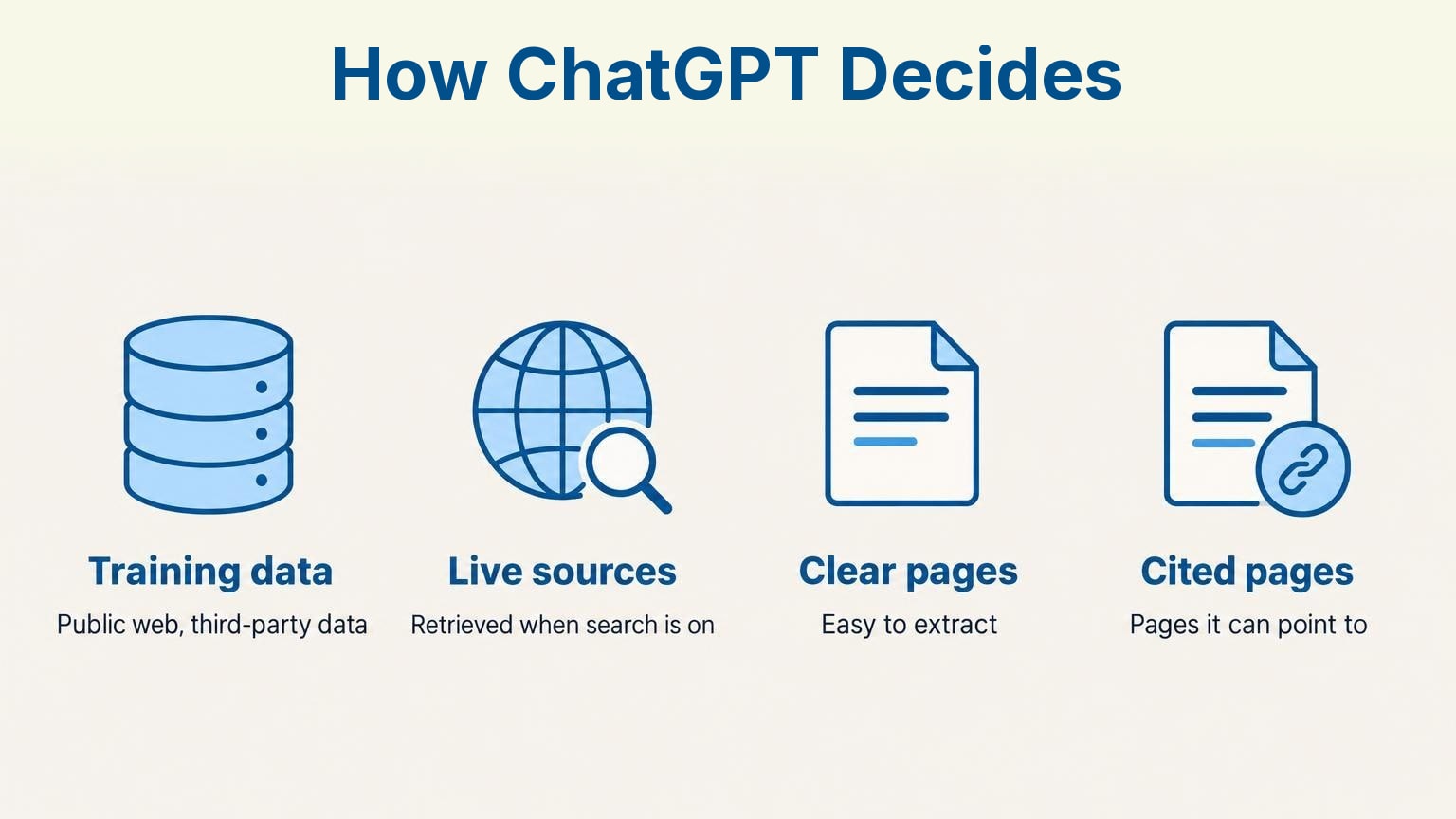
Infographic: How ChatGPT Decides – Training data, Live sources, Clear pages, Cited pages
- Lead with the answer. A 40-60 word direct answer under each heading. Descriptive H2s, lists, and tables for specs and comparisons.
- Add structured data. Organization, Product, FAQPage, and Article schema make entities and facts machine-readable.
- Classify cited sources. Sort every domain ChatGPT cites for your prompts into editorial (reviews, "best of" lists), UGC (Reddit, forums, review sites), your own pages, and competitor pages. Editorial and UGC gaps are usually the biggest opportunity.
- Pitch pages already cited. A listicle ChatGPT already references beats a fresh domain it has never seen.
- Recheck on a schedule. OpenAI's own usage study drew on 1.5 million conversations. One manual prompt check is a sample of one. Daily tracking across prompts and models shows the trend.
For tooling, our roundup of AI search visibility tools compares trackers, and the GEO audit guide covers one-time audits.
Sightkick: Tracking and Improving Your ChatGPT Rankings on Autopilot
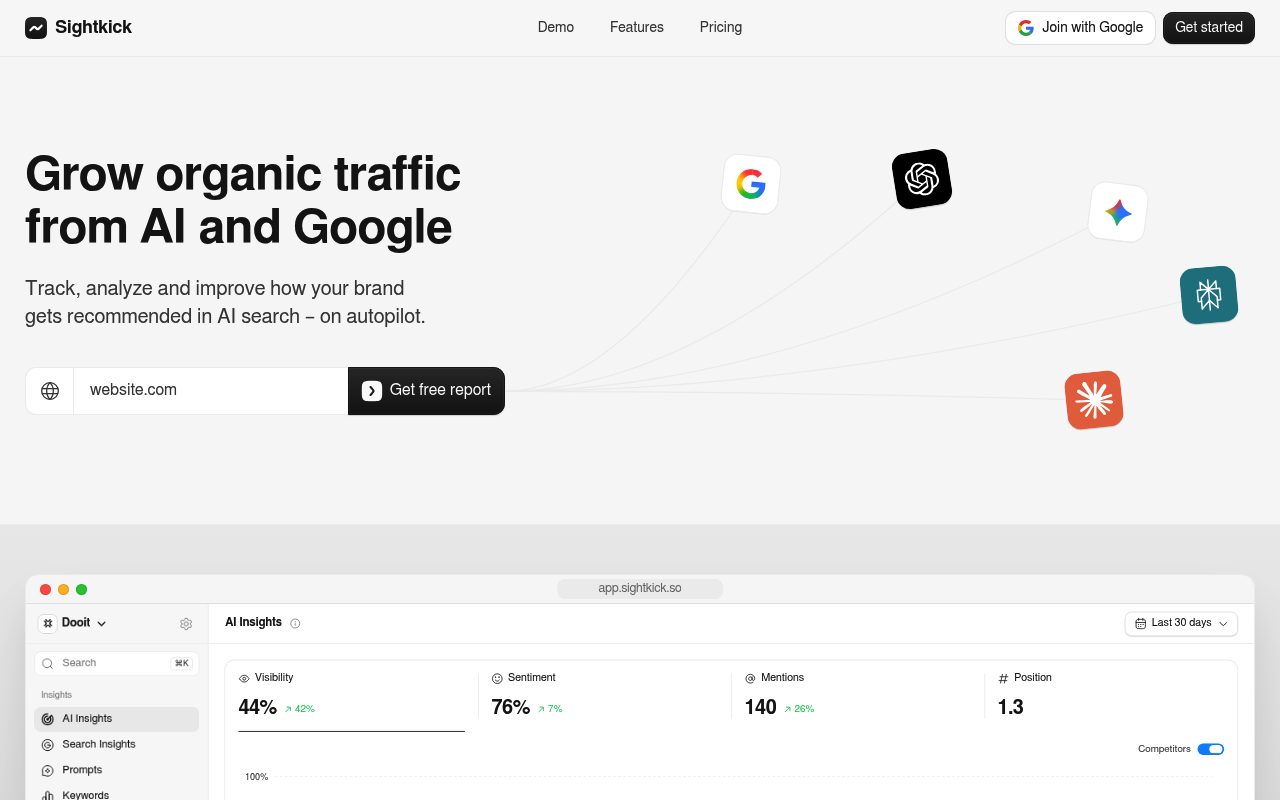
Screenshot: Sightkick homepage, September 2026.
Disclosure: Sightkick is our product.
Sightkick automates the tracking, content, and citation steps above. The platform runs prompts across 4 AI models daily and records which brands are recommended. The Articles and Backlinks engines publish content and pursue placements on pages AI already cites. Sightkick lists setup at 2 minutes. Setup once, runs forever.
- Get the baseline. The free brand visibility report shows visibility percentage, sentiment score, mention count, and average AI recommendation position against competitors.
- Track daily. Visibility, sentiment, mentions, and position across ChatGPT, Gemini, Google AI Overviews, Google AI Mode, Claude, Perplexity, and Reddit, simultaneously.
- Read the citation mix. Cited sources are classified as UGC, Editorial, Yours, or Competitor, which maps directly to Step 6.
- Fill content gaps. The Articles engine researches, writes, scores, adds images, links, and schema, then publishes to your CMS daily.
- Earn cited placements. The Backlinks engine finds pages AI already cites, verifies owner contact details, sends pitches and follow-ups, and confirms links went live. Teams working inside agents can use Sightkick MCP's 29 tools in Claude, ChatGPT, Cursor, OpenClaw, and Codex.
Plans and the 7-day free trial are on the pricing page.
Frequently asked questions
ChatGPT ranking questions cluster around four issues: which model is answering, how chatbots are compared, whether 2025 usage data still holds, and where app-store charts fit. Short answers below, drawn only from OpenAI, Statcounter, OpenRouter, Anthropic, and Google publications cited in this article.
Which GPT version should I assume is answering when I check my ChatGPT rankings?
Assume GPT-5 for current ChatGPT app checks. OpenAI calls it its best system, and it routes between fast and reasoning models automatically. API integrations and legacy tools may call older models such as GPT-4o, which scored 1.9% on BrowseComp even with browsing. Record the model with every check.
What criteria and metrics are used to rank ChatGPT against other AI chatbots?
Four published metric types: referral share to websites (Statcounter: ChatGPT at 79.4% in August 2026), real-world usage (OpenRouter token counts), head-to-head preference scores (LMArena, WebDevArena), and task benchmarks such as SWE-bench Verified and BrowseComp. Weekly users add a scale signal. No single metric captures both reach and answer quality.
How is ChatGPT ranked on app store charts like the Apple App Store and Google Play?
None of the OpenAI, Statcounter, or OpenRouter data cited here reports Apple App Store or Google Play chart positions. Treat app-chart rank as a separate signal from referral share or usage.
Is there one AI model that's simply better than ChatGPT for citations?
No single model wins everywhere. ChatGPT leads referral volume at roughly 79% share. Anthropic reports Claude Opus 4.1 at 74.5% on SWE-bench Verified, and Google says Gemini 2.5 Pro topped LMArena. Better depends on the task. Visibility strategy should follow where your buyers ask.
Do ChatGPT usage statistics from 2025 still matter for 2026 visibility decisions?
Yes. OpenAI reported 700 million weekly users by July 2025 and later more than 800 million. Statcounter still showed ChatGPT at 79.4% of chatbot referrals in August 2026. The opportunity hasn't shrunk. Gemini's growth is what changed, which makes multi-model tracking worth the effort.
To see where ChatGPT, Gemini, Claude, and Perplexity currently place your brand against competitors, book a free brand visibility report.