 Join with Google
What Is Query Fan-Out? How AI Search Really Works

Fabio Bergmann
Your SaaS product appears in an AI answer, but the customer’s prompt never names your category. Query fan-out helps explain why: an AI search system turns one question into multiple related searches, retrieves evidence across those subtopics, and combines the results into an answer. Visibility can start with a supporting question.
By Fabio Bergmann, Founder of Sightkick
Key takeaways
Query fan-out changes the unit of content planning: map the questions behind a decision, not just the original keyword. Keep proposed sub-queries, observed retrieval queries, and brand recommendation outcomes separate. Each supports a different action. A plausible content map is not a record of what an AI system searched.
- Google documents fan-out in AI Mode and AI Overviews. Usage figures establish reach, not how often fan-out occurs.
- Content mapping needs question clusters, page assignments, and supporting evidence.
- Observed grounding queries inform briefs and citation targets. Label hypothetical sub-queries separately.
- Measure recommendation outcomes without treating them as proof of a specific retrieval path.
What is query fan-out in AI search?
Query fan-out converts one user question into several related searches before generating an answer. Google defines the mechanism as model-generated, concurrent, related queries that request more information and fetch relevant results. The original prompt starts the process; the retrieval queries address the information needed to answer it.
Search Engine Land says a prompt can trigger dozens of related searches to address intent, context, and follow-up needs. That is a possible scale, not a fixed query count for every answer.
For example, “Which customer support platform fits a small SaaS team?” could require evidence about pricing, integrations, and setup. Those are illustrative retrieval needs, not an observed Google query trace.
How does query fan-out actually work step by step?
Query fan-out follows a retrieval sequence: decompose the question, search the subtopics, retrieve evidence, and generate a response. Google says AI Mode searches subtopics simultaneously across multiple data sources. Decomposition defines the smaller questions. Multi-query retrieval gathers their answers. Synthesis uses the retrieved material to address the original request.
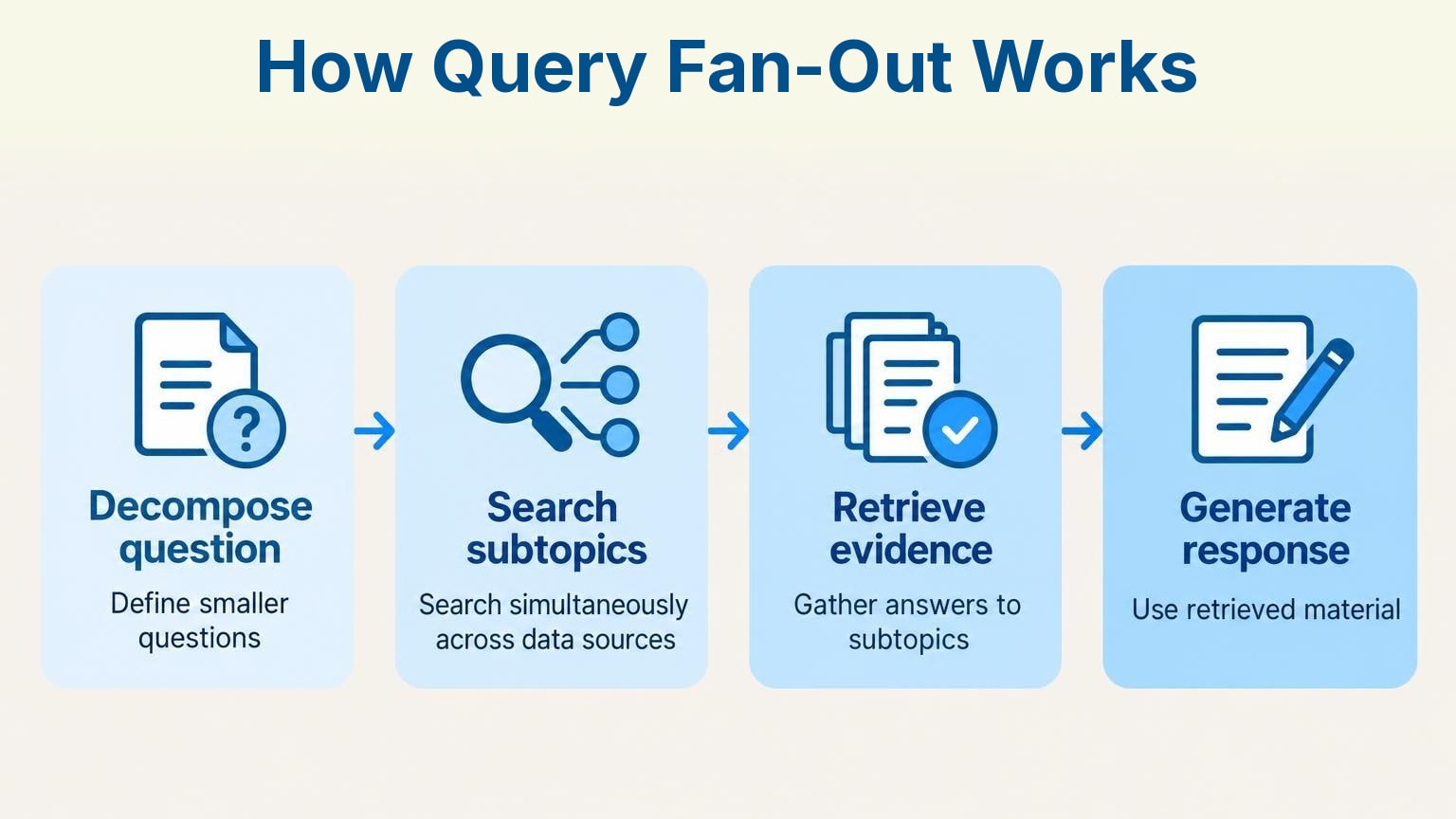
Process infographic: How Query Fan-Out Works – Decompose question, Search subtopics, Retrieve evidence, Generate response
Query decomposition
Query decomposition splits a complex question into smaller, answerable questions. For the support-platform example: What does the product cost? Does it support the required integration? What does migration involve? Treat that breakdown as a content hypothesis until retrieval reporting confirms it.
Multi-query retrieval
Multi-query retrieval runs several searches and combines their results. Google says its generative features use core Search ranking and quality systems, with retrieval-augmented generation fetching relevant, up-to-date web pages before response generation.
- Receive the user’s question.
- Generate related information requests.
- Retrieve evidence across the subtopics.
- Use that evidence to compose the answer.
Why do Google AI Mode and AI Overviews rely on query fan-out?
Google uses query fan-out to gather evidence for questions with several information needs. AI Mode can answer complex, multi-part questions that previously required multiple searches. Google says AI Mode and AI Overviews may search related subtopics and data sources to develop responses, rather than relying only on the original wording.
Capability is not inevitability. Google says these features may use query fan-out, not that every answer follows an identical retrieval path. Google also describes fan-out as enabling deeper searching in AI Mode than traditional Search. Build coverage around information needs; do not assume a fixed sequence of searches.
How big is query fan-out's impact — what do the usage numbers show?
AI Overviews and AI Mode usage figures establish the reach of products that may use query fan-out. Those figures do not measure fan-out frequency, citation probability, or traffic available to a publisher. Keep audience size, query growth, and query length separate when deciding what the numbers support.
- October 28, 2024: Google’s AI Overviews expansion brought reported reach to more than 1 billion monthly users.
- May 2025: AI Overviews were available in more than 200 countries and territories and more than 40 languages.
- June 2026: Google reported over 2.5 billion monthly users for AI Overviews.
- AI Mode: Google reported more than one billion monthly users, queries more than doubling each quarter since launch, and average searches triple the length of traditional Search queries.
Use these figures to justify measuring AI visibility. Do not add the audiences together: the announcements do not establish an unduplicated audience across AI Mode and AI Overviews.
Is query fan-out unique to Google, or do other AI platforms use it too?
Query fan-out is not unique to Google. Microsoft describes one human prompt becoming multiple retrieval and grounding queries, run in parallel and synthesized into one response. That establishes a comparable retrieval pattern outside Google. The shared mechanism does not establish identical implementations or reporting across AI products.
Microsoft documents this parallel retrieval process. Keep the user’s task separate from the searches used to support it. Compare platforms through available evidence, not an assumed universal query trace.
How should fan-out change keyword research and content mapping?
Fan-out content mapping should connect a buying question to its supporting questions, evidence, and destination pages. Search Engine Land says AI systems increasingly expand prompts into sub-queries, retrieve information across multiple angles, and synthesize responses. Plan coverage around that multi-angle retrieval, rather than assigning a page to every keyword variation.
The same guidance favors sources that support multiple related questions within a topic. Coverage means answering the decision, not increasing page count.
- Write the decision prompt. Example: “Which support platform fits a SaaS team that needs migration help?” Label it as a research prompt.
- List candidate sub-queries. Separate migration, integration compatibility, and pricing conditions. Mark each as hypothetical or observed.
- Assign a destination. Put pricing conditions on the pricing page. Put migration instructions in a migration guide. Connect the decision on the comparison page.
- Specify evidence. Require documented integration support, actual pricing terms, or a migration procedure. A heading alone does not answer the question.
- Record the gap. Assign an owner and destination before commissioning another article.
Keep keyword demand as a separate input. Demand does not prove AI retrieval. A citation does not, by itself, reveal the query that retrieved the page.
Do you need new structured data or schema to be picked up in query fan-out?
A dedicated fan-out schema requirement is not established by Google’s description of query fan-out. Google describes model-generated searches and retrieval grounded in core Search systems, not a new markup mechanism. Prioritize retrievable answers and evidence without treating a proposed AI-specific schema implementation as a documented prerequisite for inclusion.
Google’s account of Search-grounded retrieval provides the technical baseline. Ask any AI-specific markup proposal to identify its documented requirement.
Keep markup and coverage work separate in the backlog. Updating a migration procedure fixes missing evidence. Adding structured data is a different task; it does not complete the content gap.
How do you diagnose the actual sub-queries AI uses for your topic?
Observed grounding queries are the starting point where reporting is available. Microsoft’s Grounding queries table shows queries AI systems used to retrieve content before generating an answer. Use those records to replace hypotheses with observed phrases, then connect each observation to a page-level action without generalizing beyond the available report.
Microsoft says grounding queries reveal the key retrieval phrases behind cited content. Preserve the available relationships among prompt, query, and citation rather than flattening the records into a keyword list.
- Record the observation. Capture the grounding phrase, associated cited page where available, and observation date.
- Classify the need. Identify a comparison, implementation question, or product fact.
- Choose the action. Improve an existing section, create a distinct page, or investigate a cited third-party page for outreach.
- Write the brief. Include the observed query, destination URL, missing answer, and required evidence.
Maintain separate records for retrieval evidence and recommendation outcomes. A missing brand mention is an outcome gap, not proof of a missing sub-query. A content change followed by a new recommendation is worth reviewing, but does not establish which retrieval step caused it.
Sightkick: tracking which fan-out queries surface your brand
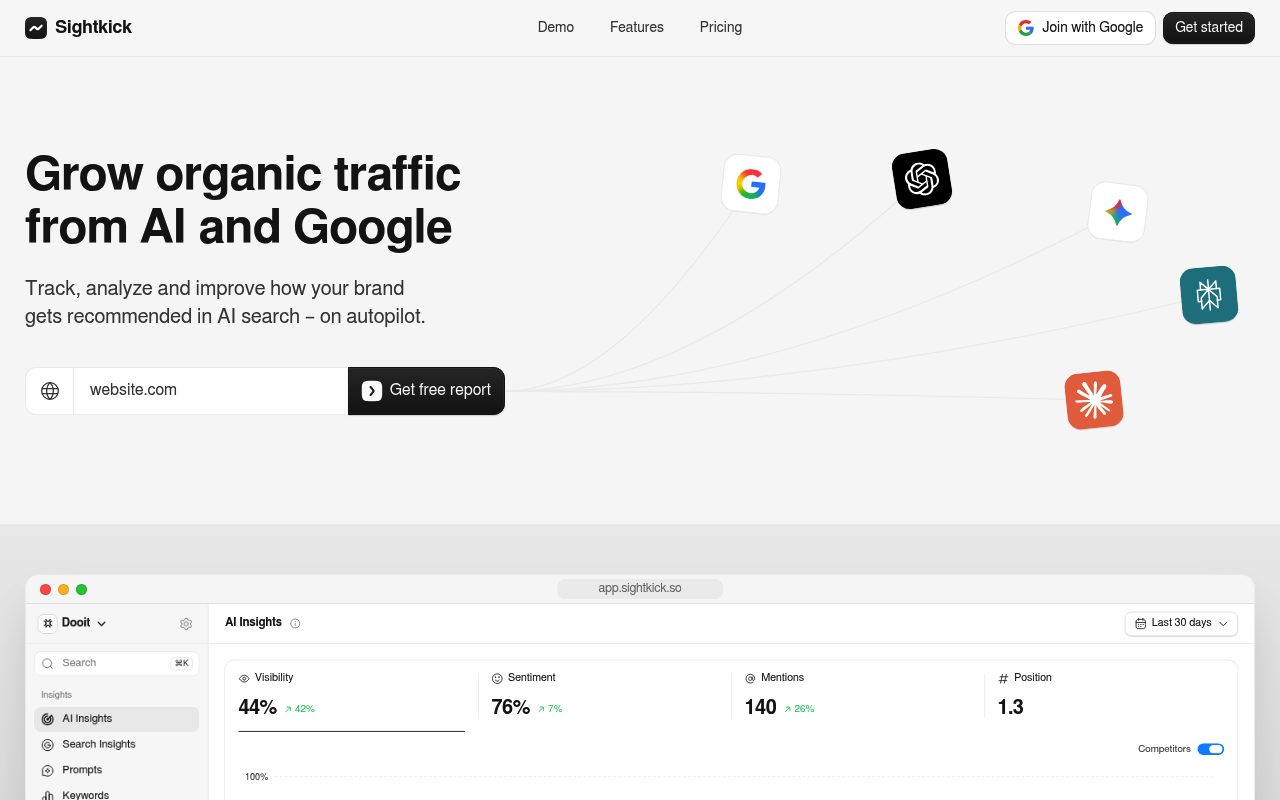
Screenshot: Sightkick homepage, October 2026.
Sightkick tracks brand recommendation outcomes across ChatGPT, Gemini, Google AI Overviews, and Google AI Mode: visibility, sentiment, mentions, position, and citation sources. Use those results alongside observed retrieval records, not as a substitute for them. The distinction matters: measuring where a brand appears is different from identifying which search retrieved it.
Disclosure: Sightkick is our product.
- Establish a baseline. Sightkick’s Free Brand Visibility Report shows visibility, sentiment, mentions, and average recommendation position relative to competitors.
- Track prompts daily. Sightkick runs every tracked prompt daily in three AI models; a fourth is an add-on. Recorded recommendations support continuous competitive benchmarking.
- Route work by source type. Sightkick classifies sources as UGC, Editorial, Yours, or Competitor. Use the categories to separate owned-page changes, third-party opportunities, and competitive review.
- Automate content production. The Articles engine researches, writes, scores, adds images, links, and schema, and publishes to a CMS on a daily schedule.
- Run citation-source outreach. The Backlinks engine finds pages AI already cites, verifies owner contact details, sends pitches and follow-ups, and confirms live backlinks.
Keep a record linking the target question, evidence change, source category, and subsequent recommendation outcome. That makes the next action explicit without presenting outcome tracking as a hidden-query trace.
Frequently asked questions
Query fan-out planning does not require a page for every possible sub-query or a large publishing operation. Start with a defined decision, document its supporting answers, and distinguish proposed coverage from observed retrieval. The questions below address workflow boundaries, page scope, and what smaller sites can reasonably infer.
Is query fan-out the same as query expansion in traditional SEO?
Not by definition alone. Query fan-out describes a retrieval workflow that can include question decomposition, multiple searches, and response synthesis. Adding related wording to a search does not, by itself, describe that complete process.
Does query fan-out mean I need separate pages for every sub-query?
No. Use a section when the question belongs on an existing page. Create a separate page when the answer needs a distinct purpose, evidence set, or user action. Assign the destination before adding another URL.
Can small sites still get cited despite query fan-out favoring broad coverage?
Google’s description provides neither a site-size threshold nor a citation guarantee. Start with a narrow decision cluster and document its answers fully. Measure actual citations instead of treating publishing volume as proof of eligibility.
Try Sightkick free for 3 days to establish your brand’s AI visibility baseline.