Generative Engine Optimization Service: What Actually Works

Fabio Bergmann
To optimize content for generative search engines, cover a topic's full cluster of related questions, earn off-page mentions AI models already cite, and monitor your brand across AI platforms daily. Skip the markup hacks Google says it ignores. Generated answers pull from many sources at once, so the goal is becoming a citable answer, not ranking a single page.
What does a generative engine optimization service actually do?
A generative engine optimization (GEO) service measures how AI models mention, rank, and describe your brand, then works to make that brand a citable answer inside generated responses. The job spans three fronts: continuous measurement, content that closes gaps, and off-page signals AI systems already cite.
Google's generative features assemble answers from multiple sources at once, surfacing article suggestions and site previews rather than a single ranking page. A GEO service works backward from that:
- Measure brand mentions, sentiment, and citation position across AI models over time.
- Close content gaps so the brand becomes an answer, not just a link.
- Build the off-page footprint of backlinks and mentions that AI systems draw on.
Google states plainly that many popular "AI SEO hacks" are not supported by how Search works. That matters before you spend a budget.
Which GEO tactics are myths, according to Google itself?
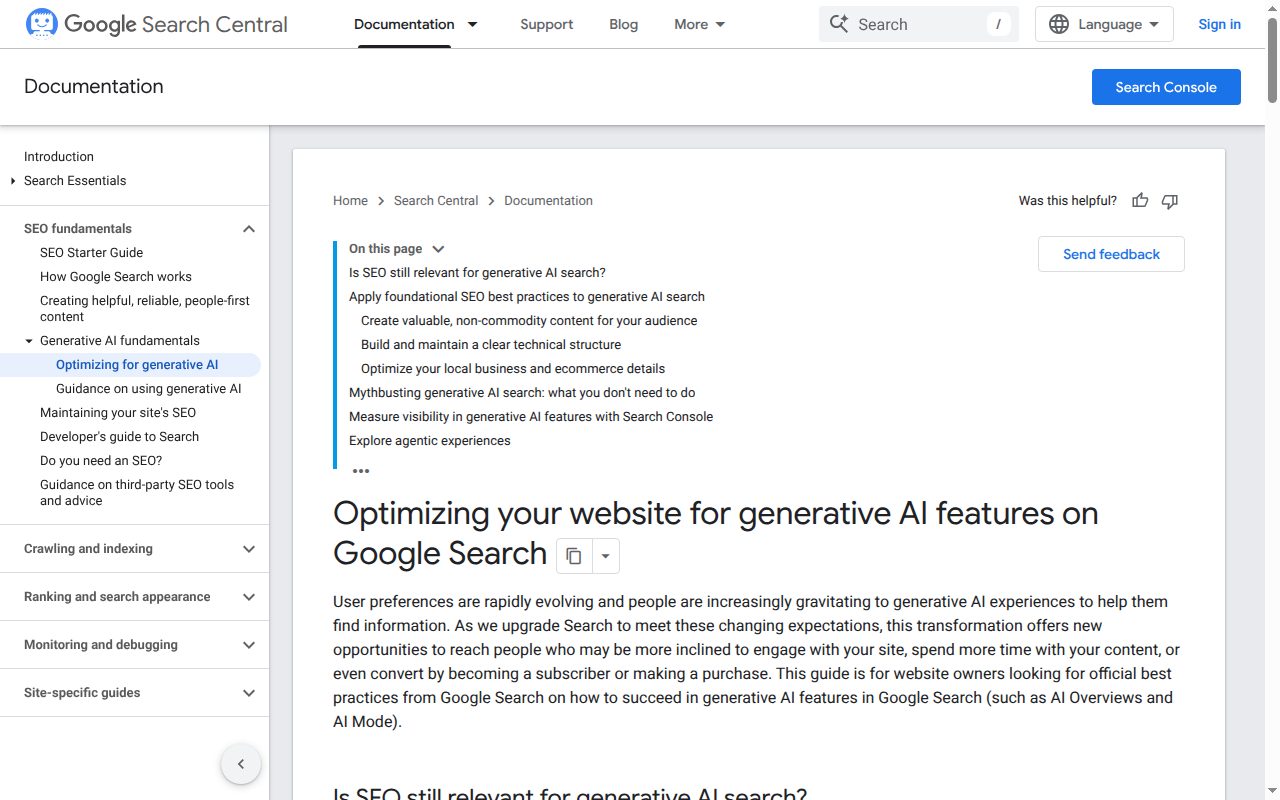
Screenshot: Google search page, September 2026.
Google directly debunks several widely-recommended GEO tactics. llms.txt files, AI-specific markup, content chunking, and rewriting copy "for AI" are all unnecessary. Google's systems parse full pages, understand synonyms and nuance, and need no special machine-readable format to surface content in AI Overviews or AI Mode.
Here is what Google's own guidance says to skip:
- No llms.txt or AI text files. Google Search does not use them.
- No ideal page length. There is no target word count. Write for the audience.
- No requirement to chunk content into tiny blocks. Google understands multiple topics on one page.
- No need to rewrite existing content for AI, since systems grasp synonyms and general meaning.
- Structured data still helps rich results but is not required for generative AI features.
The practical read: a service selling you Markdown conversions or a special schema for AI is selling work Google says you don't need.
How should content be structured to answer AI queries, not just keywords?
Content should cover a topic's full set of adjacent questions, not one head term. AI systems like Google AI Mode expand a single query into related sub-questions before generating an answer, a process called query fan-out. Structuring a page around the whole cluster gives AI more surface area to cite it accurately.
Google reports the average AI Mode search is triple the length of a traditional query, reflecting more complex, multi-part intent. Answers are then stitched from several sources. To be one of them, cover the cluster:
- Direct answer to the head term, stated first.
- Comparisons and alternatives a reader weighs next.
- Use cases, caveats, and edge questions that follow.
The shift is systems-level. Optimize for a set of related questions a real person chains together, not a single ranking phrase.
How volatile are AI Overviews, and how often should visibility be checked?

AI Overviews are unstable by design. Ahrefs found they change content 70% of the time between observations, with average persistence of just 2.15 days. A one-time visibility check goes stale fast. Brands need daily or near-daily monitoring to know whether they are cited today.
The exposure is already meaningful. Ahrefs measured AI Overviews on roughly 9.46% of desktop keywords across 590 million searched keywords, and by volume the share climbs to 12.8% or more. That is a large slice of traffic now mediated by generated answers.
The churn compounds the reach. Google's own read is that these features help: it says AI Search features make people more satisfied and searching more often. More search volume plus daily-changing answers means monitoring cadence matters as much as content quality. Daily tracking catches a drop before it compounds.
What off-page signals actually correlate with AI visibility?
Off-page presence outweighs page-level tweaks. Ahrefs found YouTube mentions correlate most strongly with AI visibility at approximately 0.737 across ChatGPT, AI Mode, and AI Overviews, with branded web mentions close behind at 0.66 to 0.71. Earning citations across video, editorial, and UGC sources appears to carry more weight than rewriting existing pages.
| Signal | Correlation with AI visibility |
|---|---|
| YouTube mentions | ~0.737 |
| Branded web mentions | 0.66–0.71 |
Sources: Ahrefs brand visibility correlations
Both the YouTube figure and the branded-mention range point the same direction: AI models lean on brand recognition. That measurement now runs at scale. Semrush's 2026 AI Visibility Index draws on 126 million real U.S. search prompts across 22 verticals. The unique angle here is not any single page edit but the pairing: track daily churn, then feed it with off-page mentions.
Sightkick: visibility tracking, content, and outreach on autopilot
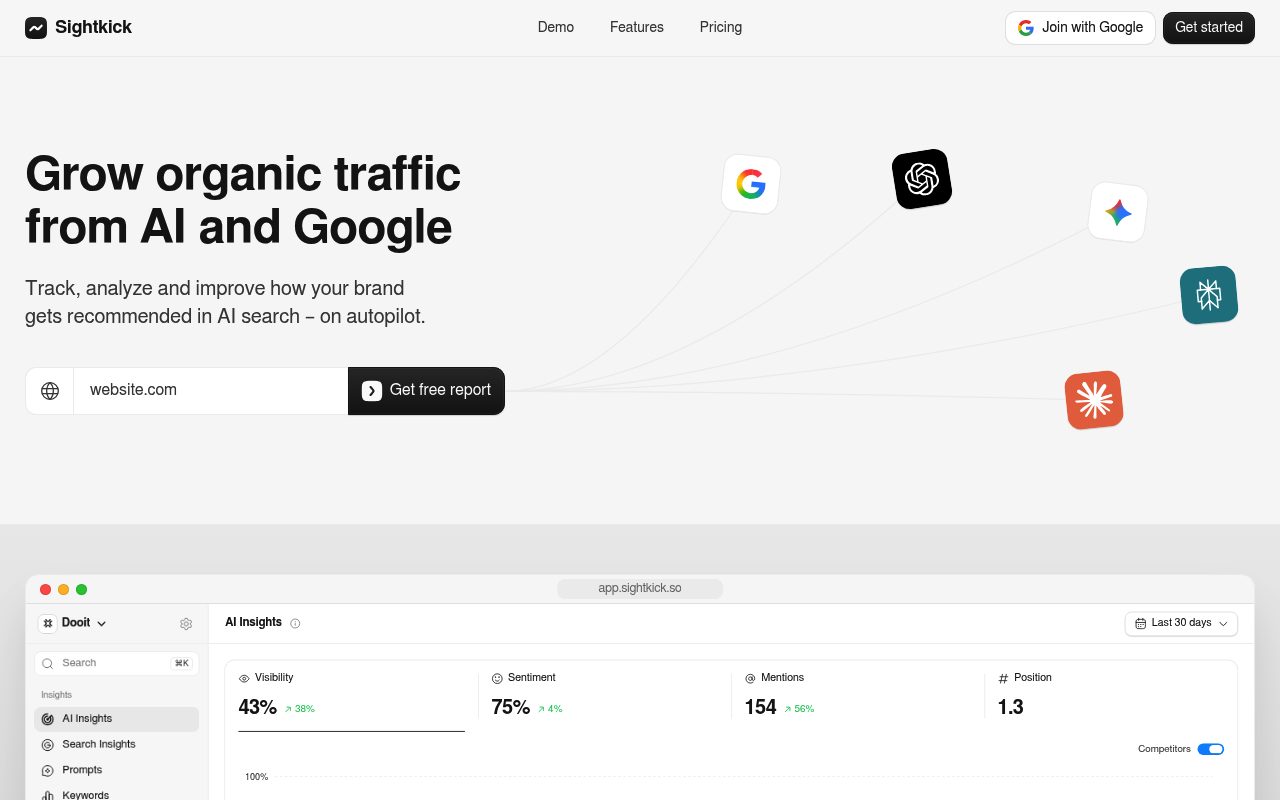
Screenshot: Sightkick website, September 2026.
Disclosure: Sightkick is our product.
Sightkick applies the two findings this guide leans on, monitoring cadence and off-page signals, by running daily prompts across four AI models, auto-publishing gap-filling articles, and pitching backlinks to pages AI already cites.
- The Insights engine runs prompts across 4 AI models daily, recording mentions, sentiment, ranking position, and winnable keywords. This targets the 2.15-day volatility directly.
- Citation sources are classified as UGC, Editorial, Yours, or Competitor, so you see where each recommendation originates.
- The Articles engine researches and writes articles with images, links, and schema, then publishes them to a CMS on a set schedule.
- The Backlinks engine finds pages AI already cites, verifies owner contacts, sends outreach and follow-ups, and confirms links go live, aimed at the branded-mention correlation.
- Sightkick tracks across ChatGPT, Gemini, Google AI Overviews, Google AI Mode, Claude, Perplexity, and Reddit at once. Setup runs about 2 minutes, with a 7-day free trial.
Sightkick is one option among several GEO tools; see our roundup of generative engine optimization tools for 2026 for the wider field. A free brand visibility report shows visibility percentage, sentiment score, mention count, and average AI recommendation position before you commit.
Frequently asked questions
Is generative engine optimization different from traditional SEO?
Generative engine optimization extends SEO rather than replacing it. Traditional ranking factors like authority and relevance still apply, but GEO adds tracking of AI-specific outputs — citations, sentiment, and position inside generated answers — across platforms like ChatGPT, Gemini, and Perplexity that standard SEO tools do not measure.
Do I need structured data or schema markup to appear in AI Overviews?
No. Google states structured data is not required for generative AI search features, though it still helps earn traditional rich results. Focus on clear, well-organized content rather than adding markup solely to influence AI citations.
How often should I check my brand's AI visibility?
Check daily or near-daily. Ahrefs found AI Overviews carry a 70% chance of changing between observations, so a monthly snapshot misses most real movement in citations and rankings. Periodic audits go stale before you act on them.
Google: many suggested hacks "are not effective or supported by how Google Search actually works."
A GEO service earns its keep by measuring AI citations continuously, filling content gaps around full question clusters, and building the off-page mentions AI models already cite. Not by chasing markup Google says it ignores.
To see where your brand stands across AI search, start a free trial of Sightkick or pull a free brand visibility report.