LLM Visibility Checker (2026): Track Brand Mentions in AI

Fabio Bergmann
An LLM visibility checker measures whether your brand appears in AI-generated answers from tools like ChatGPT, Perplexity, and Gemini, how often it gets cited, and where those citations rank inside a response.
Disclosure: Sightkick publishes this article and is one of the tools listed below.

Key takeaways
- An LLM visibility checker measures three separate layers: AI crawler access, brand mentions in answers, and downstream referral traffic. Most tools report only one.
- ChatGPT usage among U.S. adults hit 44% in 2026, 20 points above Gemini (24%) and about 1.8x Copilot (17%), so multi-model tracking beats single-tool checks.
- Perplexity applies source labels at the domain level, not per page, which changes publisher and content strategy.
- Sightkick runs prompts across ChatGPT, Gemini, Google AI Overviews, Google AI Mode, Claude, Perplexity, and Reddit daily, classifying citations as UGC, Editorial, Yours, or Competitor.
- A free brand visibility report and 7-day trial with 2-minute setup let you benchmark before committing.
What Is an LLM Visibility Checker and What Does It Actually Measure?
An LLM visibility checker measures three distinct layers: whether AI crawlers can access your page content, whether your brand gets mentioned or cited in generated answers, and whether those mentions drive referral traffic. Most tools report one layer, which is why visibility scores look inconsistent across platforms.
The three layers no single score captures
- Layer 1: accessibility. Hidden client-side or dynamically loaded content is invisible to AI agents even when humans see it. Adobe's Brand Visibility Chrome extension checks how much of a page LLMs can read versus what stays hidden.
- Layer 2: mention and citation. Did the model name your brand, and where does that citation rank? Adobe's LLM Optimizer is built to identify which owned content AI interfaces use to answer queries.
- Layer 3: referral impact. The layer most tools skip, and the one that ties visibility to revenue.
Layer 1 alone can hide most of a site. Adobe reported early access customers had 80% critical content visibility gaps. Its Recover Content Visibility dashboard surfaces three metrics (URLs, Estimated Content Gain, Avg Content Visibility) to quantify the problem.
How Can I Tell If My Brand Is Being Mentioned by ChatGPT or Perplexity?
Run the same prompts a real customer would ask across both tools, then read the citations. ChatGPT search shows inline citations you can click to inspect. Perplexity applies a source label to the whole domain, not the individual page, so one strong page can lift how the entire site is perceived.
OpenAI confirms ChatGPT search responses may include citations users can open, but also warns those results can be incomplete, outdated, or incorrect. Manual spot-checks understate the real picture. To become eligible for ChatGPT search, a site must allow OAI-Searchbot to crawl and permit traffic from OpenAI's published searchbot IP addresses.
Why domain-level labeling changes your strategy
Perplexity's source labels are applied to the whole website, not each page. So track site-wide citation patterns, not just page-by-page wins. Manual prompt-checking doesn't scale. That's the gap automated daily tracking closes. For a starting point, see our roundup of free AI visibility checkers and their limits.
How Does LLM Visibility Differ from Traditional Search Ranking?
Traditional search ranking measures position on a results page for a fixed query. LLM visibility measures whether a brand is named inside a generated answer that may synthesize dozens of sources per response. Rankings are positional and single-query. AI visibility is conversational, multi-source, and shifts with how a model phrases its own follow-ups.
- Traditional SEO: one URL, one query, one ranked position. Measurable and stable.
- AI visibility: a brand can be mentioned, paraphrased, or omitted depending on prompt phrasing and model version.
- Query fan-out: a single user question can trigger many underlying searches feeding one Google AI Overview or AI Mode answer.
Different surface, different playbook. The original Generative Engine Optimization paper defines GEO as a paradigm to improve content visibility in generative responses and reports visibility can be boosted by up to 40%. Our GEO audit guide breaks down the mechanics.
What's the Real Difference Between Content Gaps and Citation Gaps?
A content gap means AI can't access or parse your page. A citation gap means AI can access it but picks a competitor or UGC source instead. No ranking guide separates these, yet the fix differs completely. One is technical, the other is competitive.
- Content gap fix: expose server-rendered content, add schema, remove JS-dependent blocking of AI crawlers. Adobe notes AI agents can only cite content they can access.
- Citation gap fix: identify which competitor or UGC page wins the citation, then build content that out-answers it.
Classifying sources by type (UGC, Editorial, Yours, Competitor) turns a vague "we're not visible" problem into a structured, actionable map. This is the highest-leverage step in any LLM visibility audit and the one most tools skip.
Which Tools Track Whether Your Website Appears in LLM Responses?

The category includes Adobe LLM Optimizer/Brand Visibility, Otterly, Profound, Scrunch AI, AirOps, Rankscale AI, Promptwatch, and Sightkick (our product). Coverage varies: some check ChatGPT and Perplexity as a baseline, others add Gemini, Claude, Google AI Overviews, Google AI Mode, and Reddit. Verify each tool's current model list against its own docs.
Adobe's Brand Visibility Chrome extension shows how much of a webpage's content LLMs can access and what stays hidden. Its prompt library runs on a recurring basis to measure visibility over time, not as a one-off snapshot.
Sightkick tracks brand visibility, sentiment, mentions, and position across ChatGPT, Gemini, Google AI Overviews, Google AI Mode, Claude, Perplexity, and Reddit simultaneously. Sightkick MCP exposes 29 tools directly inside AI agents including Claude, ChatGPT, Cursor, OpenClaw, and Codex. Compare the field in our ranked list of AI search visibility tools.
How to Compare LLM Visibility Checkers
Compare tools on four criteria: model coverage, citation-source classification, update cadence, and whether they connect visibility to content and backlink action. These predict whether a tool changes outcomes or just reports them.
Model coverage matters most. A tool checking only ChatGPT misses the 24% of U.S. adults on Gemini and the 17% on Copilot, per Pew Research Center.
Pew Research Center found that 44% of U.S. adults said they ever use ChatGPT in 2026, up from 34% in 2025.
That 44% is 20 percentage points above Gemini (24%) and about 1.8x Copilot (17%): the clearest case for multi-model tracking over single-tool checks. Meta AI trailed at 14%. Also look for source-type classification over a flat mention count, and a trial length that lets you validate before spending budget.
Sightkick: Automated Visibility, Content, and Backlink Action
Sightkick is built for teams that want visibility tracking to trigger action. It runs prompts across 4 AI models daily, then feeds gaps into an Articles engine that auto-publishes content and a Backlinks engine that pitches sites AI already cites. Setup takes 2 minutes and includes a 7-day free trial.
The three-engine model: Insights, Articles, Backlinks
- Insights engine: daily prompts across ChatGPT, Gemini, Google AI Overviews and AI Mode, Claude, Perplexity, and Reddit, tracking mentions, sentiment, rankings, and winnable keywords.
- Articles engine: identifies content gaps, researches, writes, scores, adds images, links, and schema, then publishes to a CMS on schedule without manual input.
- Backlinks engine: finds pages AI already cites, verifies contact details, sends outreach and follow-ups, and confirms links went live.
- Sightkick MCP: 29 tools that plug into Claude, ChatGPT, Cursor, OpenClaw, and Codex for agent-native workflows.
Sightkick classifies every tracked citation as UGC, Editorial, Yours, or Competitor. Start with the free brand visibility report to see visibility percentage, sentiment score, mention count, and average AI recommendation position before trialing the full platform. See where it fits in our guide to AI SEO automation platforms.
Otterly: Lightweight Mention Monitoring
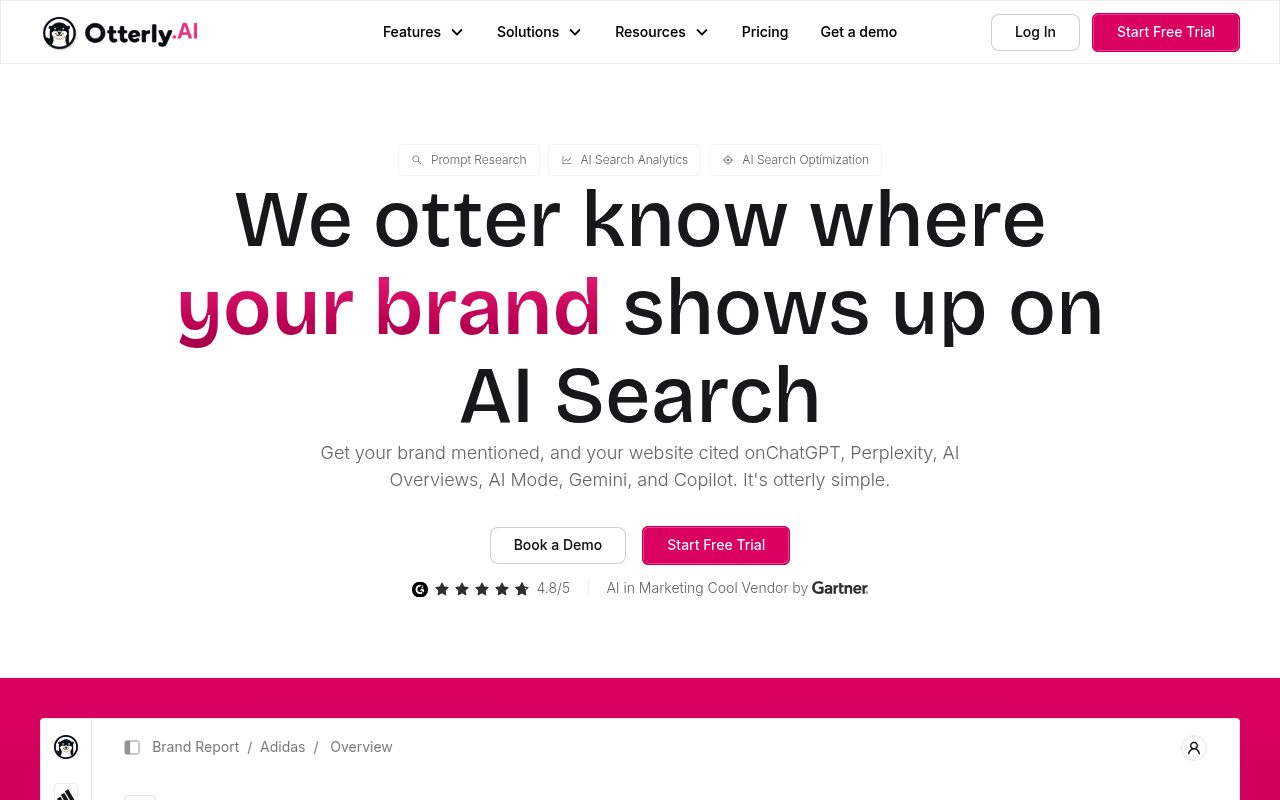
Screenshot: Otterly website, September 2026.
Otterly focuses on straightforward mention tracking, suiting teams that want a simple citation dashboard rather than a full content or backlink workflow. It's a reasonable starting point for small teams validating whether AI visibility monitoring is worth deeper investment. Check its current model coverage and cadence against your needs before committing.
- Good fit for small teams testing whether AI visibility monitoring pays off.
- Compare its model coverage against platforms tracking more sources at once.
- Confirm whether content or outreach automation is included.
Profound: Enterprise AI Search Analytics
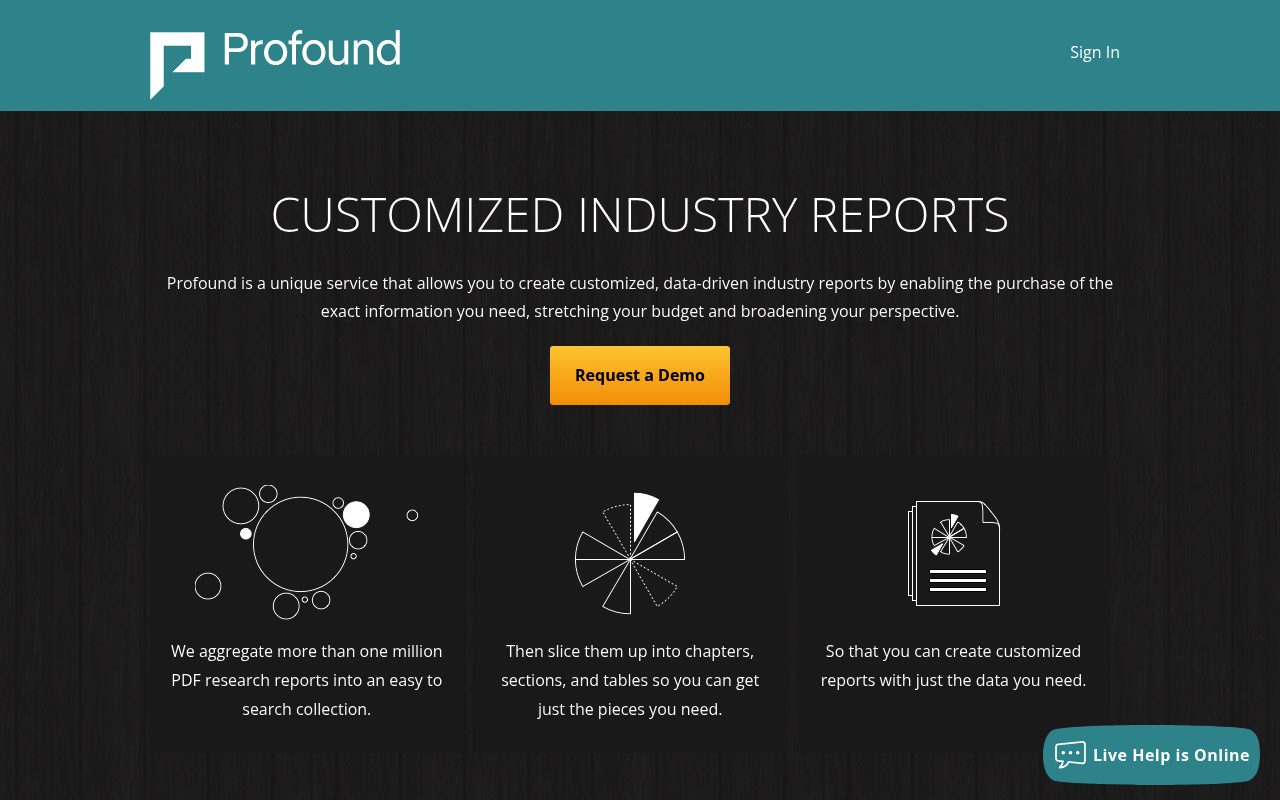
Screenshot: Profound website, September 2026.
Profound positions toward larger analytics teams wanting granular AI search reporting and competitive benchmarking. It suits enterprises with dedicated analysts who want raw data to build custom dashboards. Confirm onboarding and pricing fit your team before you buy.
- Strong for teams that want raw data to build custom dashboards.
- Weigh whether it closes the gap-to-content-to-backlink loop or reports on it.
- Check onboarding scope against your timeline.
Scrunch AI, AirOps, Rankscale AI, and Promptwatch: Where Each Fits
These four are worth evaluating against the same four criteria: model coverage, source classification, update cadence, and action layer. Verify each tool's current focus and specs against its own docs for your use case.
- Scrunch AI: check its model coverage and whether it addresses layer-1 accessibility.
- AirOps: confirm its mention-tracking depth and cadence.
- Rankscale AI: compare on update cadence and source classification.
- Promptwatch: confirm coverage and whether it pairs with a content or distribution engine.
How Often Should I Run an LLM Visibility Check?
Run checks daily, not weekly or monthly. Prompt libraries that measure visibility over time are built to run on a recurring basis, and AI answers shift as models retrain, re-crawl, and reweight sources. A single snapshot is stale by the time you act on it.
Adobe's prompt library runs on a recurring basis specifically to catch drift. Daily checks across 4 AI models let teams spot a competitor gaining a citation before it compounds. Pair cadence with source-type classification, so each check tells you why visibility moved, not only that it did. Weekly is the minimum viable cadence for smaller teams; daily is standard for competitive categories. Our setup guide for monitoring brand in AI search covers the workflow.
Comparison Table: Sightkick vs. Otterly, Profound, Scrunch AI, AirOps, Rankscale AI, Promptwatch
Sightkick tracks seven sources including Reddit, classifies citations by source type, runs daily, and adds content plus backlink automation. Compare each tool below on the same four criteria, then verify current specs against vendor docs.
| Tool | Model coverage | Source classification | Action layer | Cadence |
|---|---|---|---|---|
| Sightkick | 7 (ChatGPT, Gemini, AI Overviews, AI Mode, Claude, Perplexity, Reddit) | UGC / Editorial / Yours / Competitor | Articles + Backlinks automation | Daily |
| Otterly | Verify current coverage | Verify | Verify | Verify |
| Profound | Verify | Verify | Verify | Verify |
| Scrunch AI | Verify | Verify | Verify | Verify |
| AirOps | Verify | Verify | Verify | Verify |
| Rankscale AI | Verify | Verify | Verify | Verify |
| Promptwatch | Verify | Verify | Verify | Verify |
Sightkick offers a 7-day free trial with 2-minute setup and a free visibility report at entry. For the wider field, see our comparison of AI search optimization tools.
Frequently asked questions
What does an LLM visibility checker actually measure?
An LLM visibility checker measures three layers: whether AI crawlers can access your content, whether your brand is mentioned or cited in generated answers, and whether those citations drive referral traffic. Most tools report only mentions. A complete checker separates accessibility, citation, and traffic impact so you know which layer to fix.
How can I tell if my brand is being mentioned by ChatGPT or Perplexity?
Run representative customer prompts in both tools and read the citations directly. ChatGPT shows clickable inline sources, while Perplexity applies labels at the domain level. For ongoing tracking rather than manual spot-checks, a daily automated scan across both models catches mentions and drift you'd otherwise miss.
Is there a free LLM visibility checker?
Sightkick offers a free brand visibility report showing visibility percentage, sentiment score, mention count, and average AI recommendation position, with no long-term commitment. It's a practical entry point before deciding whether to run the full daily, multi-model monitoring platform.
What's a good LLM visibility checker for tracking multiple AI models at once?
Look for tools covering ChatGPT, Gemini, Google AI Overviews, Google AI Mode, Claude, Perplexity, and Reddit in one pass, since usage is fragmented. ChatGPT led U.S. adults at 44% in 2026, versus 24% for Gemini and 17% for Copilot. Sightkick runs daily prompts across all seven simultaneously.
How does LLM visibility differ from ranking in Google Search?
Google rankings are positional: one URL per query, per result page. LLM visibility is conversational. A brand can be named, paraphrased, or omitted depending on prompt phrasing, model version, and Google's own query fan-out feeding a single AI Overview or AI Mode answer from many underlying searches.
How often should I check my LLM visibility?
Daily is standard for competitive categories, since recurring prompt libraries are designed to catch visibility drift as models retrain and re-crawl sources. Weekly is a workable minimum for smaller teams. Monthly checks are usually too stale to act on before conditions shift again.
Want to see where you stand first? Start free with Sightkick: get your brand visibility report and daily multi-model tracking running in about two minutes.