 Join with Google
AI SEO Automation Platform: 9 Best Tools for 2026

Fabio Bergmann
An AI SEO automation platform is software that uses AI to run SEO tasks: tracking brand visibility across AI search engines, generating and publishing content, and building backlinks with minimal manual input. The strongest platforms automate multiple layers at once, not one.
Key takeaways
- 75% of SEOs already use AI to cut manual work, but full automation splits into three layers: tracking, content, and links.
- Most "AI SEO tools" automate one layer. Platforms that automate insights, articles, AND backlinks together are rare.
- AI visibility spans 7+ surfaces (ChatGPT, Gemini, AI Overviews, AI Mode, Claude, Perplexity, Reddit). Single-platform tracking is table stakes.
- Classifying citation sources as UGC, Editorial, Yours, or Competitor shows where AI recommendations originate. Most tools skip it.
- A 7-day free trial with 2-minute setup and a free visibility report is a low-risk way to benchmark first.
What Is an AI SEO Automation Platform?
An AI SEO automation platform is software that uses AI to handle SEO tasks: tracking brand visibility across AI search engines, generating and publishing content, and building backlinks with minimal manual input. Unlike single-purpose AI writing tools, the strongest platforms automate multiple workflow layers at once instead of assisting one task.
The distinction matters. A generic "AI SEO tool" drafts a blog post or flags a broken link. An automation platform connects tracking, content, and outreach into one running system. Adoption is broad: 67% of SEO professionals report AI tools improve their search results.
The three layers of SEO automation
SEO automation splits into three layers. Layer one is visibility tracking: monitoring where and how a brand gets mentioned across AI models. Layer two is content production: researching, writing, and publishing articles. Layer three is backlink acquisition: finding cited pages and running outreach. Most tools cover one. Few cover all three.
AI SEO vs. GEO vs. AI visibility tracking
The category goes by several names. AI SEO, AI search optimization, generative engine optimization (GEO), and AI visibility tracking all describe optimizing for AI-generated answers on ChatGPT, Gemini, and Google AI Overviews, not just blue-link rankings. For a deeper breakdown, see our guide to generative engine optimization tools.
Which SEO Tasks Can Actually Be Fully Automated Today?
Fully automatable today: keyword and prompt tracking, content drafting with schema, image sourcing, publishing schedules, and backlink outreach emails. Not fully automatable: strategic positioning, brand voice judgment, and technical fixes needing dev access. Most platforms automate execution, not strategy. Verify which before buying.
The efficiency gains are measurable. AI-powered tools cut keyword research time by 80% and improve content optimization efficiency by 30%. This is why 75% of SEOs use AI to offload manual tasks and shift toward strategy.
75% of SEOs actively use AI to reduce manual tasks, shifting their roles away from tedious execution toward high-level strategy.
Fully automatable tasks
Content creation is closest to end-to-end automation: research, drafting, image insertion, link building, schema markup, and publishing to a CMS on a schedule. Prompt tracking across AI models runs on autopilot. Outreach pitches and follow-ups send without manual touch once contacts are verified.
Tasks that still need a human
Technical audits, like crawl errors, site speed, and indexation, get flagged by AI but need human or developer sign-off before fixes ship. Strategic positioning and brand voice calls require judgment. The pattern holds across the market: AI detects and drafts; humans decide and approve.
The Overlooked Layer: Where Do AI Citations Actually Come From?
Citation source classification is the layer most trackers skip. Most platforms report that a brand is mentioned by AI, not why. Tagging every source as UGC, Editorial, Yours (owned), or Competitor exposes the pipeline behind recommendations, showing whether visibility depends on Reddit threads, press coverage, owned content, or rivals' pages. That changes the strategy.
Sightkick classifies tracked citation sources into these four types, giving a structural view most visibility trackers lack. A raw mention count gives a number. Source classification shows where to act.
UGC vs. Editorial vs. Yours vs. Competitor
UGC covers forums and Reddit: influential, hard to control. Editorial covers press and third-party publications. Yours is owned content you control fully. Competitor is rivals' content AI cites when recommending your category. Each type has a different lever.
Why source type changes your strategy
If Editorial sources dominate your AI recommendations, prioritize PR and backlink outreach. If UGC dominates, invest in community presence. If competitors dominate, you have a content gap to close. Sightkick runs prompts across 4 AI models daily, so teams see source-type shifts over time, not a one-off snapshot.
How Do AI SEO Platforms Handle Technical Audits vs. Content Creation?
Technical audits and content creation run on different automation logic. Audits detect and flag issues (crawlability, speed, schema errors) for review. Content engines research, write, score, and publish autonomously. Platforms that blend both well are rare. Most specialize in one.
Buyers should ask a blunt question: does "automation" mean detection-only, or full execution? The two are not the same product.
Audit tools: detect and flag
Audit crawlers surface problems (duplicate meta tags, slow pages, missing schema) but rarely fix them without human approval. Their output is a prioritized list, not a completed task. The value is diagnosis. The action falls to a person or a developer.
Content engines: research to publish
Content engines go further. Sightkick's Articles engine identifies gaps, writes, scores quality, adds images, internal links, and schema, then publishes to a CMS on a set schedule without manual input. The gap most platforms leave open: connecting audit findings directly into what the content engine prioritizes next. See our GEO audit tool guide for how audit and content layers should link.
How to Automate SEO with AI: A 5-Step Framework
Automating SEO with AI follows five steps: track brand visibility across AI models daily, identify content and keyword gaps, auto-generate and publish optimized articles, run backlink outreach on cited pages, and continuously benchmark against competitors. Each runs on autopilot once connected to a CMS and outreach data source.
- Track. Run daily prompts across multiple AI models to capture mentions, sentiment, and ranking position.
- Find gaps. Surface winnable keywords and content gaps from that tracking data.
- Publish. Auto-draft, score, and publish articles with images, internal links, and schema on a schedule.
- Build links. Identify pages AI already cites, verify owner contacts, and send outreach plus follow-ups automatically.
- Re-measure. Re-run tracking to confirm whether visibility and position improved.
The framework works because each step feeds the next. Tracking data drives content priorities. Published content earns citations. Citations reveal new outreach targets. With 80% less time on keyword research, the bottleneck shifts from execution to decisions.
AI SEO Automation Platform Comparison: 8 Tools at a Glance
The eight platforms below split into three categories: AI visibility trackers (Otterly, Profound, Peec AI, Scrunch AI, Rankscale AI, Promptwatch), content and workflow automators (AirOps), and full-stack platforms combining tracking, content, and backlinks (Sightkick). Only one of eight automates all three layers. No single tool wins every category. Fit depends on which layer needs automating most.
Disclosure: Sightkick is our product. It's evaluated here on the same criteria as every other tool.
| Platform | Primary focus | Content automation | Backlink automation | Free trial |
|---|---|---|---|---|
| Otterly | Lightweight mention tracking | No | No | Varies |
| Profound | Enterprise AI analytics | No | No | Varies |
| Peec AI | Competitive benchmarking | No | No | Varies |
| Scrunch AI | Readiness audits | No | No | Varies |
| AirOps | Content workflow builder | Yes | No | Varies |
| Rankscale AI | AI ranking/position data | No | No | Varies |
| Promptwatch | Prompt-level monitoring | No | No | Varies |
| Sightkick | Full-stack: tracking + content + links | Yes | Yes | 7-day |
Otterly: Best for Lightweight AI Mention Tracking
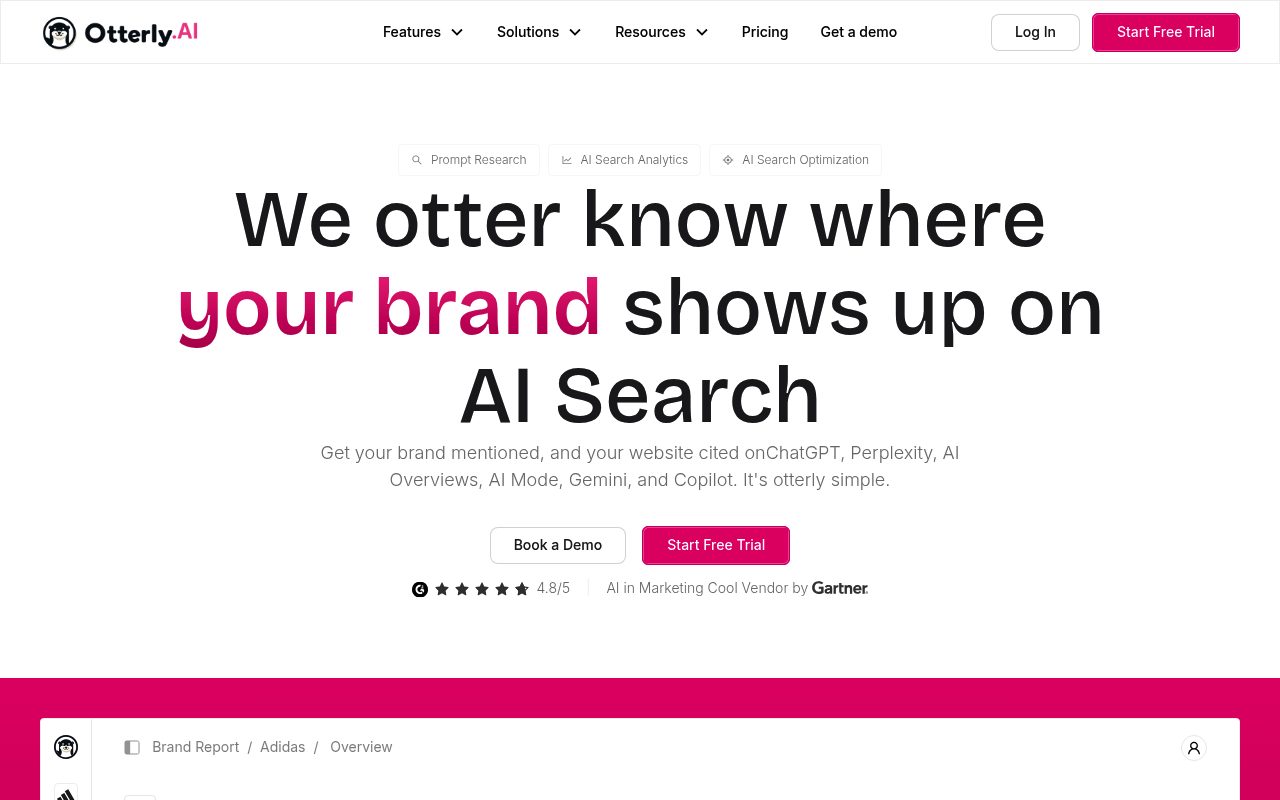
Screenshot: Otterly website, August 2026.
Otterly tracks brand mentions across ChatGPT and other AI answer engines, aimed at teams wanting a simple monitoring dashboard. It's a solid entry point for basic visibility checks. It does not extend into content generation or backlink outreach, so teams outgrow it once they need execution.
- Strength: straightforward mention tracking setup.
- Limitation: no content or backlink automation.
- Best fit: teams that only need monitoring, not action.
Profound: Best for Enterprise AI Answer Engine Analytics
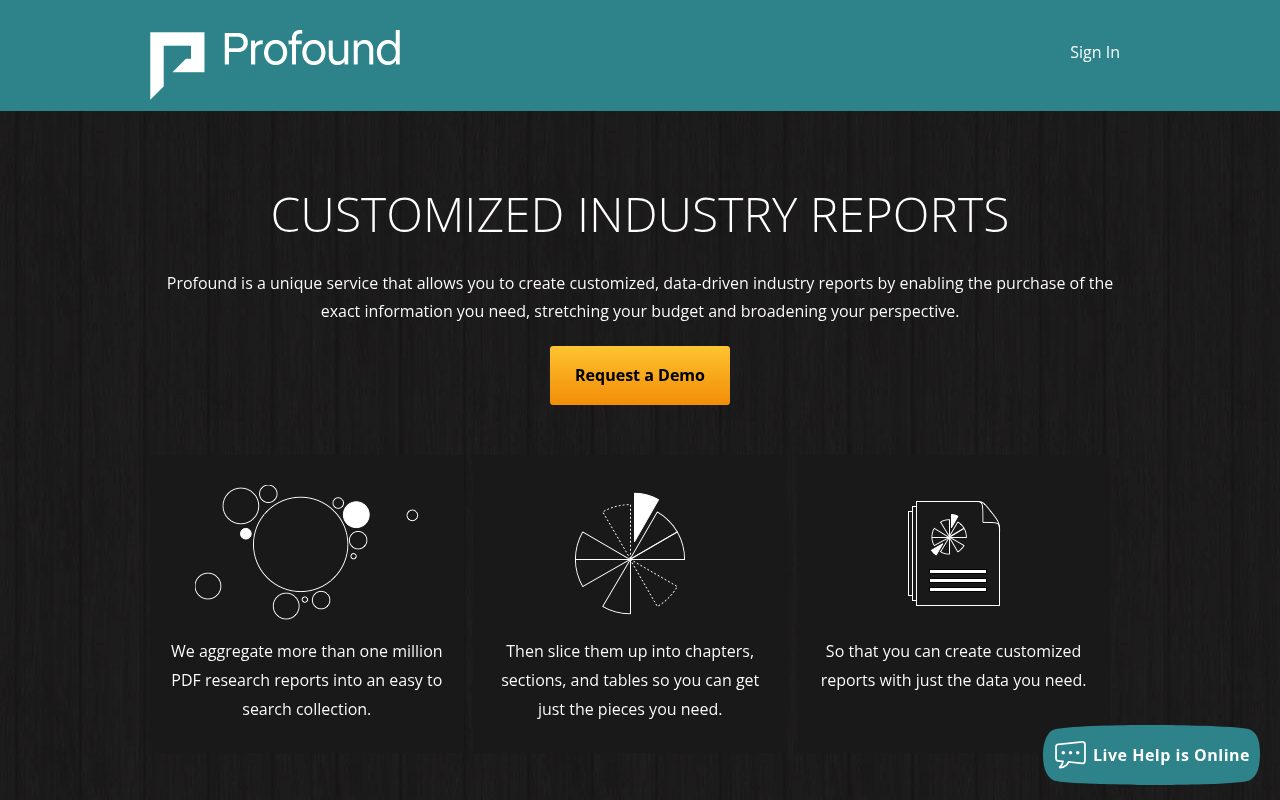
Screenshot: Profound website, August 2026.
Profound targets larger enterprises needing detailed analytics on how AI answer engines surface and cite brands, with deeper reporting than lightweight trackers. It's built for analysis depth rather than turning insights into published content or outreach, so it suits teams with separate execution resources.
- Strength: enterprise-grade reporting depth.
- Limitation: analytics-focused, not an execution engine.
- Best fit: larger orgs with existing content and backlink teams.
Peec AI: Best for Competitive AI Visibility Benchmarking
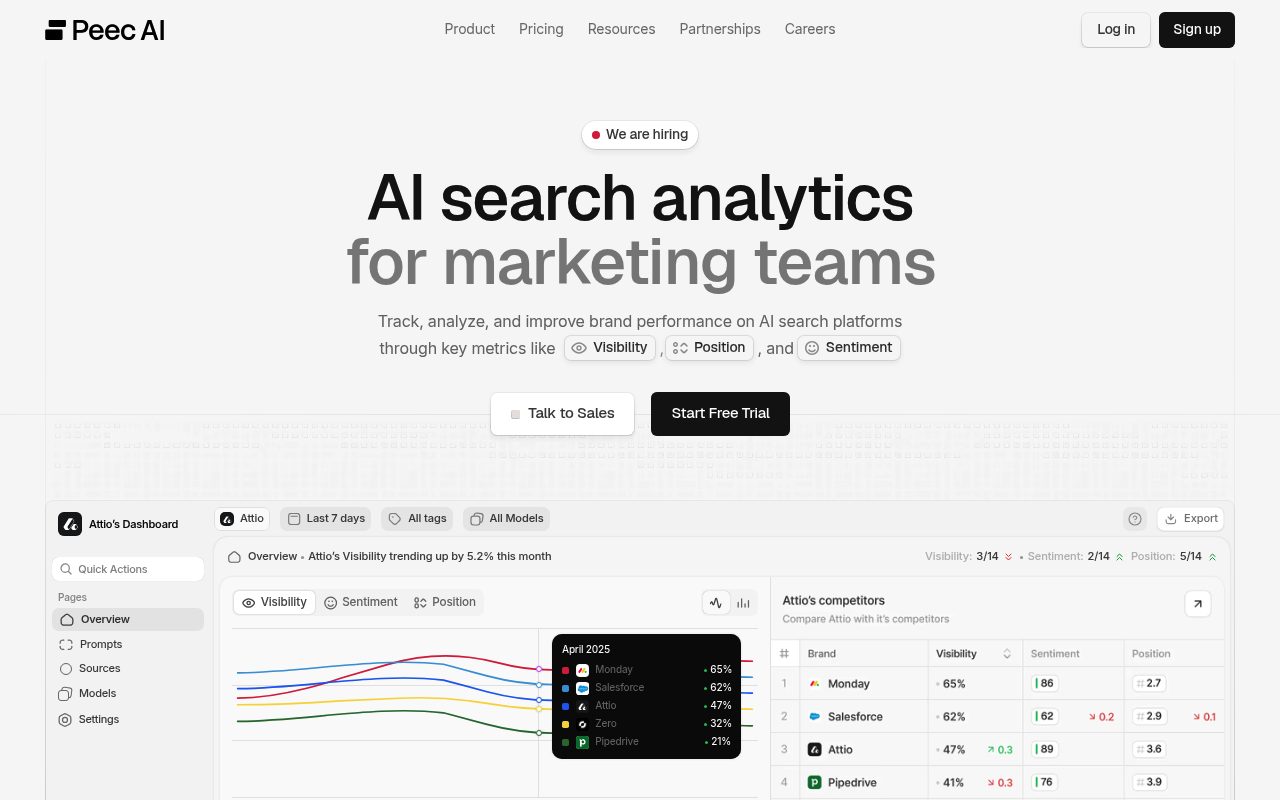
Screenshot: Peec AI website, August 2026.
Peec AI benchmarks brand visibility against competitors across AI search surfaces, giving marketers a comparative view rather than raw mention counts. It's useful for competitive positioning reports and leaves content creation and link building to other tools.
- Strength: competitor benchmarking focus.
- Limitation: no built-in content or outreach automation.
- Best fit: teams needing competitive reports, not full-funnel automation.
Scrunch AI: Best for AI Search Readiness Audits
Scrunch AI helps brands understand how AI-friendly their existing content and site structure are: an audit-first approach. It's useful for diagnosing readiness gaps and requires pairing with separate tools to act on findings through new content or links.
- Strength: readiness and audit-style diagnostics.
- Limitation: diagnostic, not generative. No auto-publishing.
- Best fit: teams wanting a readiness score before building a content plan.
AirOps, Rankscale AI, and Promptwatch: Best for Specific Niche Needs
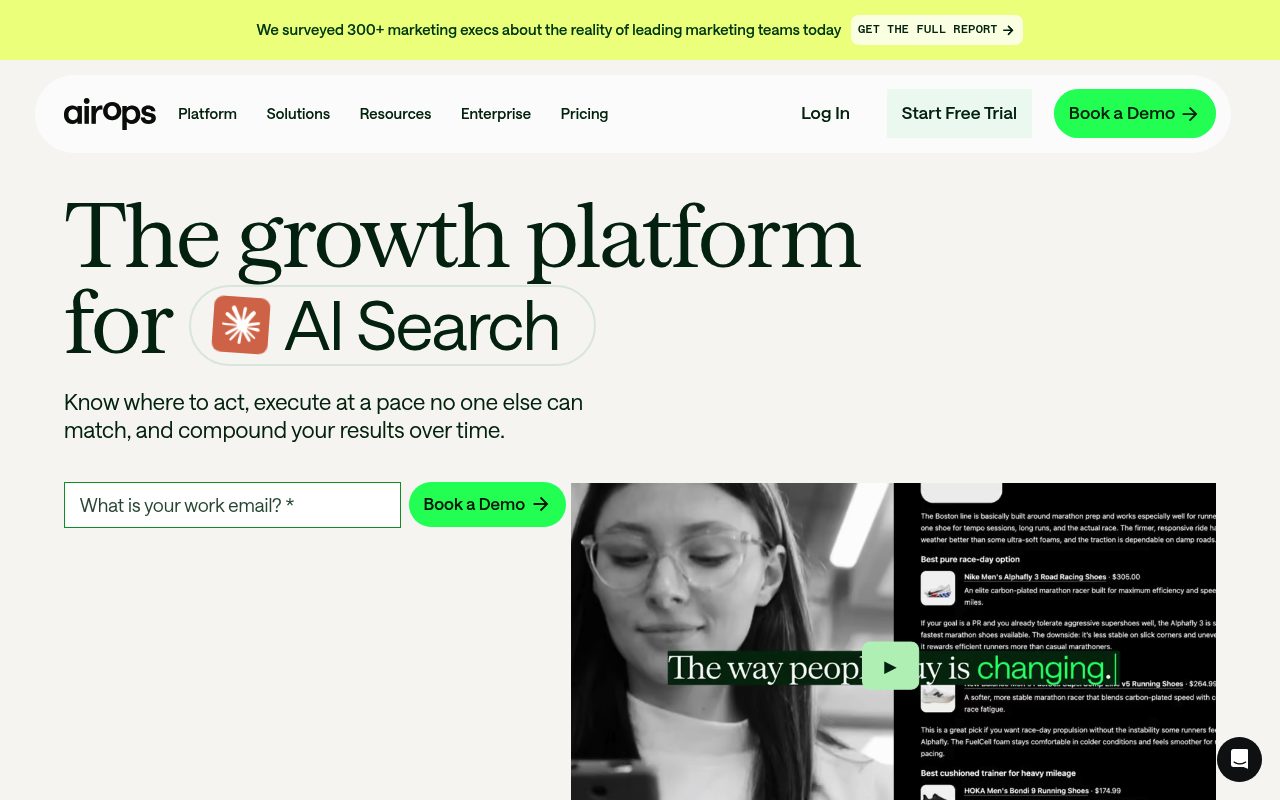
Screenshot: AirOps website, August 2026.
AirOps focuses on AI-assisted content workflow building, Rankscale AI on AI ranking and position tracking, and Promptwatch on prompt-level monitoring. Each solves a narrow slice of the automation stack rather than the full tracking-to-backlinks pipeline. Best for teams assembling their own stack piece by piece.
- AirOps: workflow builder for AI content pipelines; needs more setup and customization.
- Rankscale AI: focused on AI ranking and position data.
- Promptwatch: prompt-level monitoring for AI responses.
- Common limitation: none combine tracking, content, and backlink outreach in one system.
For teams evaluating this niche, our roundup of AI answer engine optimization tools covers where each fits.
Sightkick: Best for Combining Visibility Tracking, Content, and Backlinks in One Platform
Sightkick automates all three SEO layers: daily AI visibility tracking across 7+ surfaces, article research, writing and publishing, and backlink outreach on pages AI already cites, in one system with 2-minute setup and a 7-day free trial. Its limitation: teams wanting a pure analytics dashboard may find it does more than they need.
What it automates end-to-end
- Tracks mentions, sentiment, and rankings across ChatGPT, Gemini, Google AI Overviews, Google AI Mode, Claude, Perplexity, and Reddit.
- Runs prompts across 4 AI models daily for continuous competitive benchmarking.
- Articles engine auto-researches, writes, scores, and publishes with images, links, and schema on schedule.
- Backlinks engine finds AI-cited pages, verifies contacts, sends outreach and follow-ups, and confirms live links.
- Sightkick MCP offers 29 tools that integrate into Claude, ChatGPT, Cursor, OpenClaw, and Codex.
- A free brand visibility report is available before signup: visibility %, sentiment score, mention count, and average AI recommendation position.
Where it may be more than some teams need
The full-stack scope is a genuine tradeoff. A team that only wants a lightweight mention tracker, with content and outreach handled elsewhere, will pay for execution features it won't touch. Sightkick is built for teams that want tracking, content, and backlinks running as one pipeline, not for teams shopping for a single-purpose dashboard.
Can an AI SEO Platform Integrate with WordPress or Webflow?
Yes. Most AI content automation engines publish directly into CMS platforms like WordPress and Webflow on a schedule, removing manual copy-paste. The real question isn't whether integration exists, but whether it includes formatting, images, internal links, and schema automatically, or just drops raw text.
- Look for native CMS publishing, not just export or download of drafts.
- Confirm whether schema markup, image insertion, and internal linking are automated or manual add-ons.
- Scheduled publishing on a daily or weekly cadence matters more than one-off bulk exports for consistent gains.
What Are the Risks of Automating SEO with AI at Scale?
The main risks are content quality drift, duplicate or thin pages when scoring isn't rigorous, over-reliance on AI-cited sources that shift algorithmically, and outreach fatigue when pitches aren't personalized. Mitigate with platforms that score content before publishing, keep human review checkpoints, and use verified contacts.
- Quality drift: publishing volume without quality scoring can dilute site authority.
- Ranking volatility: AI visibility shifts as models update. Daily tracking, not monthly, reduces blind spots.
- Sender reputation: automated outreach without contact verification damages deliverability.
- Mitigation: choose platforms that score content before publishing and verify targets rather than sending blind pitches.
How Much Time Can an AI SEO Platform Save Per Month?
Teams using AI SEO tools cut keyword research time by roughly 80% and improve content optimization efficiency by about 30%, with 75% of SEOs using AI to eliminate manual, repetitive work. In practice, that reclaims days per month previously spent on research, drafting, and outreach follow-ups.
- 80% reduction in keyword research time across AI SEO tool users.
- 30% improvement in content optimization efficiency.
- 75% of SEOs now use AI to offload manual tasks and refocus on strategy.
- 67% report AI tools directly improve their search results, not just save time.
Stack the two efficiency gains and the picture sharpens: 80% off research plus 30% off optimization means the manual layer shrinks to a fraction, and the 75% who automate it redirect that time toward strategy.
Frequently asked questions
Is there an AI tool for SEO that handles everything automatically?
Some platforms automate tracking, content creation, and backlink outreach together, though most tools specialize in one layer. Full end-to-end automation from research to publish to outreach exists but is less common than single-purpose AI writing or tracking tools. Check which layers a platform actually covers before assuming full automation.
What is AI SEO called now?
It's commonly called AI SEO, AI search visibility, or generative engine optimization (GEO), all referring to optimizing for AI-generated answers on platforms like ChatGPT, Gemini, and Google AI Overviews, rather than traditional blue-link rankings.
What is the best AI automation platform for SEO?
There's no single best. It depends on which layer needs automating. Visibility-only trackers suit teams with existing content and outreach resources, while full-stack platforms combining tracking, content, and backlinks suit teams wanting one system. Compare based on which AI surfaces are tracked and how much execution, not just reporting, is included.
Can AI SEO automation replace a human SEO strategist?
No. AI automates execution tasks like research, drafting, and outreach, but 75% of SEOs report shifting toward strategic oversight rather than being replaced. Human judgment remains essential for brand voice, prioritization, and interpreting why AI visibility shifts occur.
How long does it take to set up an AI SEO automation platform?
Setup times vary. Some tools claim as little as a 2-minute setup with a free trial period, commonly around 7 days, to test tracking and automation features before committing to a paid plan.
Do AI SEO platforms work across multiple AI search engines at once?
The more capable platforms track visibility across multiple AI surfaces simultaneously, including ChatGPT, Gemini, Google AI Overviews, Google AI Mode, Claude, Perplexity, and Reddit, rather than monitoring one engine. This matters since brand visibility varies significantly between platforms.
Want to see where you stand before choosing a tool? Start a free Sightkick trial. 2-minute setup, plus a free brand visibility report showing your visibility %, sentiment, mentions, and average AI recommendation position.