Track AI Recommendations for My Brand: 8 Tools (2026)

Fabio Bergmann
You've watched a competitor get named in ChatGPT while your brand goes unmentioned, and you have no idea why or how often. Here's the answer: you track AI recommendations by running the same prompts across models daily and logging which brands get named, cited, or recommended over time.

Key takeaways
- Tracking AI mentions and tracking AI recommendations are not the same thing. A mention is being named; a citation is being linked as the source [19].
- Most tools re-run daily prompts across ChatGPT, Gemini, Perplexity, Claude, and Google AI Overviews/Mode, but pricing, prompt caps, and trial length vary widely.
- A single canonical grounding page gives AI a clear source to cite you from [17].
- Classifying citation sources as UGC, Editorial, Owned, or Competitor shows where AI recommendations originate, not just how many there are.
- Sightkick pairs daily 4-model tracking with an autopilot Articles and Backlinks engine, plus a free brand visibility report to start. (Sightkick is our product.)
Why Can't I Tell If AI Is Recommending My Brand?
You can't see AI recommendations because they happen inside private chat sessions with no referrer data, no analytics ping, and no notification. Unlike Google rankings, there's no dashboard by default. Dedicated tracking tools solve this by re-running prompts daily and logging which brands get named or cited across models.
- Classic rank trackers can't see inside ChatGPT, Claude, or Gemini conversations.
- AI answers change between sessions, so a single manual check isn't reliable.
- The fix: automated tools that run the same prompts on a schedule and log results over time. Profound runs structured prompts daily and OtterlyAI monitors tracked prompts daily across major engines.
AirOps calls this category AI search visibility, and groups the terminology into GEO tools, AEO, and LLM SEO [18]. The common thread: you measure whether models mention and cite your brand, not where you rank on a blue-link page. For setup steps, see our 2026 guide to monitoring brand in AI search results.
What's the Difference Between Tracking AI Mentions and AI Recommendations?
A mention is when AI names your brand in an answer. A citation is when it links to your page as the source. A recommendation is when AI suggests you as the option for a user's need. Most tools blur these together. Knowing which one you're measuring changes what you do next.
- Mention = named in text, no link required.
- Citation = linked as the source of the answer. AirOps notes a citation is when it links to your page as the source.
- Recommendation = positioned as the suggested choice, often tied to position and sentiment scoring. Peec AI tracks position and sentiment for this reason.
Sightkick tracks mentions, sentiment, and position together, so a brand can see where a mention stops short of a recommendation. AirOps says the gap is real: only about 28% of AI answers mention and cite the same brand, and only 30% of brands stay visible from one answer to the next.
How Do I Get Notified When AI Recommends My Brand?
Notification isn't built into ChatGPT or Gemini. You get it by running scheduled prompt checks daily and comparing results against a baseline, then alerting on new mentions, sentiment shifts, or competitor overtakes. Tools that run prompts across multiple models daily give the closest thing to a real-time alert system available today.
- Daily prompt re-runs create a comparable timeline instead of a one-off snapshot.
- Look for tools that flag sentiment and ranking changes, not just raw mention counts.
- Sightkick runs prompts across 4 AI models daily and records which brands get recommended, so changes surface automatically.
What Content Strategy Actually Increases AI Recommendations? The Grounding Page Angle
Grounding pages are the sharpest content tactic here. A grounding page is one canonical URL stating what your product is, who built it, what categories it serves, and how to cite it. It gives AI a clean ground-truth source instead of scraping fragmented pages.
Rankscale defines a grounding page as one official URL AI engines reach for ground-truth facts about a brand. Structured, unambiguous facts on one page reduce the chance AI pulls outdated or third-party info instead.
- A grounding page answers the exact questions models need before they cite a brand.
- This differs from classic SEO content, which optimizes for rankings, not for being quoted verbatim.
- Sightkick's Articles engine identifies this kind of content gap and publishes supporting pages automatically to a CMS on schedule.
How Do Review Sites and Third-Party Mentions Influence AI Recommendations?
Third-party coverage matters because tracking tools classify citation sources by type, and where a recommendation originates tells you more than a raw mention count. A brand with strong owned content but no third-party coverage can still lose recommendations to a competitor with more UGC and editorial mentions.
Sightkick classifies every tracked citation source as UGC, Editorial, Yours (owned), or Competitor. That's a structured view of where recommendations originate, not just that they happened. Heavy competitor UGC with none for your brand is an actionable finding, not a vague signal.
Which Tools Can Track AI Recommendations for Your Brand?
Several tools track brand visibility inside AI answers: Otterly, Profound, Peec AI, Scrunch AI, AirOps, Rankscale, and Sightkick. They differ mainly on model coverage, prompt caps, pricing tiers, and whether they extend into content or backlink action, not on the basic concept of daily prompt monitoring. (Sightkick is our product.)
- All run recurring prompts across multiple AI models and benchmark against competitors.
- Pricing ranges from $29/month (Otterly Lite) to $399/month (Profound Growth).
- Free trials vary; Otterly, Scrunch, and Sightkick each offer 7 days.
For a broader survey, see our roundup of the best AI search visibility tools for 2026.
AI Recommendation Tracking Tools Compared: Pricing, Models, and Trials
Side by side, entry pricing ranges from $29 to $250/month, model coverage from ChatGPT-only to seven platforms, and free trials from 7 days upward. The table lines up the named competitors plus Sightkick on the terms that affect which tool fits a given budget and stack.
| Tool | Entry price | Model coverage | Free trial |
|---|---|---|---|
| Otterly | $29/mo (Lite) | ChatGPT, AI Overviews, Perplexity, Copilot (Claude/Gemini/AI Mode add-on) | 7 days |
| Profound | $99/mo (Starter) | ChatGPT only (Starter); 3 engines (Growth) | — |
| Peec AI | Starter (3 models) | Major AI platforms, 3 models | — |
| Scrunch AI | $250/mo annual | ChatGPT, Claude, Gemini, Perplexity, Google AI, Meta | 7 days |
| Rankscale | $99/mo (Pro) | Multiple AI engines, credit-based | — |
| AirOps | — | ChatGPT, Perplexity, Gemini, AI Overviews | — |
| Sightkick | 7-day trial | ChatGPT, Gemini, AI Overviews, AI Mode, Claude, Perplexity, Reddit | 7 days |
Two numbers stand out. Otterly Lite at $29/month is 3.4× cheaper than Profound Starter at $99/month for a similar entry tier. Rankscale Growth at $385/month costs 3.9× more than Rankscale Pro at $99/month while lifting monthly credits from 1,200 to 5,500. Sightkick tracks 7 sources at once, the widest coverage listed here.
Otterly: Budget-Conscious Multi-Model Tracking
Screenshot: Otterly pricing page, September 2026.
Otterly's Lite plan starts at $29/month with 15 search prompts, daily tracking, and unlimited team members. It covers ChatGPT, Google AI Overviews, Perplexity, and Copilot by default, with Claude, Gemini, and Google AI Mode as add-ons. It's the cheapest entry point among the compared tools.
- A 7-day free trial with no credit card includes 50 prompts and 1,000 API/MCP calls to test before paying.
- Daily monitoring runs across ChatGPT, AI Overviews/AI Mode, Perplexity, Gemini, Copilot, and Claude.
- Fits teams that want low cost and don't need every model included by default.
Profound: Enterprise Citation and Sentiment Depth
Screenshot: Profound website, September 2026.
Profound's Growth plan runs $399/month for 3 answer engines and 100 tracked prompts, aimed at teams that need deep citation, sentiment, and competitive benchmarking data rather than the lowest price. Its Starter tier covers ChatGPT only, which is narrow next to tools tracking four models by default.
- Starter at $99/month tracks ChatGPT only with 50 prompts; Growth adds two more engines.
- Profound runs structured daily prompts and tracks citations, sentiment, ranking, and competitive presence.
- Its Summer 2026 Index draws on 1.9+ billion real conversations across 50+ industries, useful for industry-wide benchmarking.
Peec AI: AI Shopping and Product Recommendations
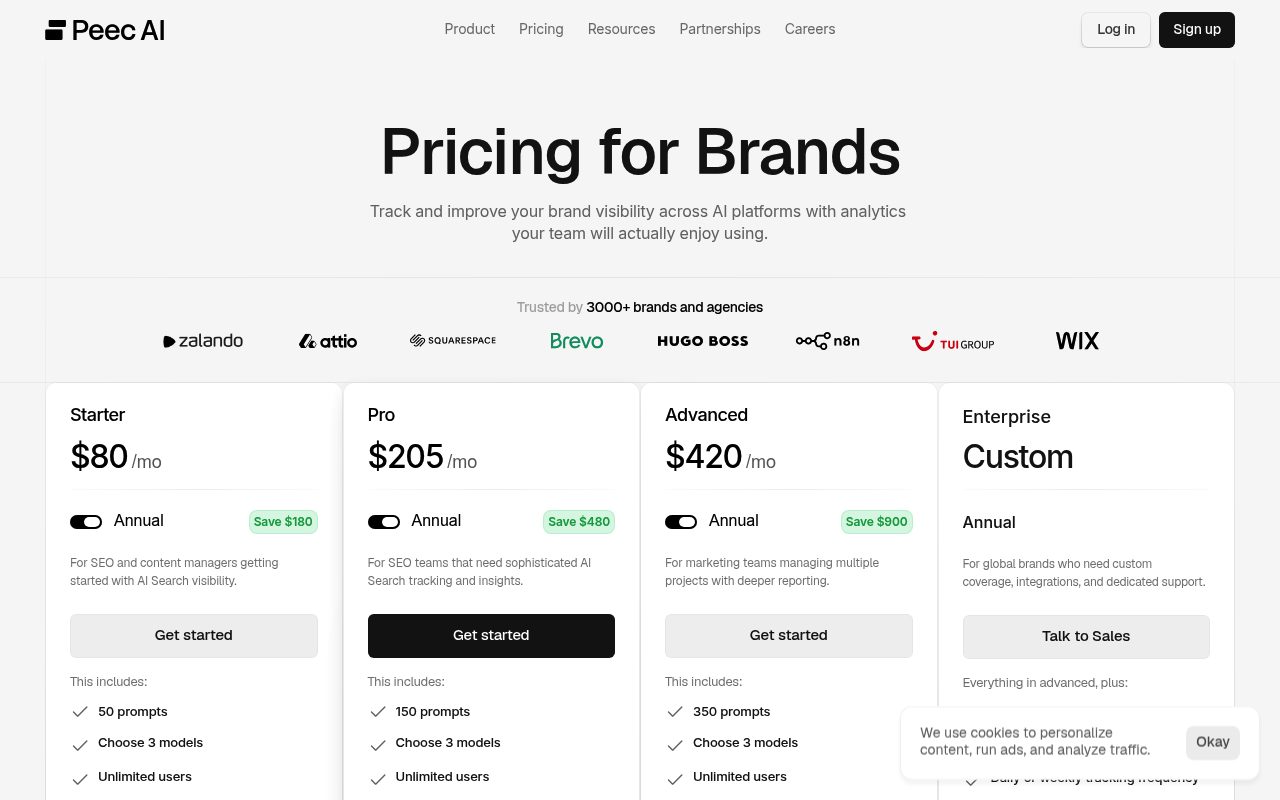
Screenshot: Peec AI pricing page, September 2026.
Peec AI fits product-led teams. It tracks visibility, win rate, position, and mentioned price specifically for AI shopping answers, metrics the general visibility trackers don't report at this level of detail.
Its Starter plan includes 50 prompts, 3 models, unlimited users, daily tracking, and 1 project. Peec AI's changelog defines visibility as the share of AI shopping answers where your product appears, win rate as the share where it lands first, position as where it ranks when it shows up, and mentioned price as the quoted engine price checked against your catalog price. Best for ecommerce teams competing on AI-driven purchase recommendations, less broad for general brand-mention tracking.
Scrunch AI, AirOps, and Rankscale: Where Each One Fits
Scrunch AI covers six platforms including Meta on a $250-300/month Starter plan. AirOps frames the category's terminology and separates mentions from citations. Rankscale runs on a credit system and documents the grounding-page tactic. Each fits a different priority: platform breadth, category clarity, or granular credit-based control.
- Scrunch AI: $250/month billed annually, 350 custom plus 1,000 industry prompts, 3 personas, 7-day trial, covering ChatGPT, Claude, Gemini, Perplexity, Google AI, and Meta.
- AirOps: defines the category and treats a brand mention and a citation as distinct measurable events.
- Rankscale: Pro at $99/month (1,200 credits, ~4,800 answers) versus Growth at $385/month (5,500 credits, ~22,000 answers), with each query typically costing 0.25 credits and scheduling from hourly to monthly.
Rankscale's grounding-page concept is a distinct content tactic worth adopting regardless of which tracker a team chooses. For more tooling, see our list of the best generative engine optimization tools.
Sightkick: Autopilot Tracking Plus Content and Backlink Action
Sightkick tracks brand mentions, sentiment, and position across ChatGPT, Gemini, Google AI Overviews, Google AI Mode, Claude, Perplexity, and Reddit daily. It then auto-publishes SEO articles and runs backlink outreach on pages AI already cites, closing the loop between tracking and action.
Disclosure: Sightkick is our product.
- Runs prompts across 4 AI models daily and records which brands get recommended, enabling continuous competitive benchmarking.
- The Articles engine researches, writes, scores, and publishes content with images, links, and schema to a CMS on a daily schedule with no manual input.
- The Backlinks engine finds pages AI already cites, verifies owner contact details, sends outreach and follow-ups, and confirms links go live.
- Sightkick MCP gives 29 tools that plug directly into Claude, ChatGPT, Cursor, OpenClaw, and Codex for agent-based workflows.
- 2-minute setup, 7-day free trial, plus a free brand visibility report showing visibility %, sentiment score, mention count, and average recommendation position.
- Limitation: as a newer entrant, Sightkick lacks the multi-year historical index data that Profound's report or Otterly's longer track record can offer.
Frequently asked questions
How do I get AI to recommend my company?
Build a clear grounding page stating what you do and who you serve, earn third-party UGC and editorial mentions, publish content that answers the exact prompts buyers ask AI, and monitor daily to see which tactics move sentiment and position over time.
What tools can I use to track the AI visibility of my brand?
Otterly, Profound, Peec AI, Scrunch AI, AirOps, Rankscale, and Sightkick all track brand visibility across AI models, differing on price, model coverage, and whether they extend into content or backlink action.
How do I know when an AI chatbot recommends my product to someone?
There's no native notification inside ChatGPT or Gemini for this. Tools that run scheduled prompts daily across models and log mentions, sentiment, and position give the closest equivalent to a recommendation alert, since they compare results against a baseline over time.
Is there a way to get notified when AI mentions my brand in a recommendation?
Yes, through tools that run recurring prompts and flag changes in mentions, sentiment, or ranking rather than a native platform alert. Sightkick, for example, runs prompts across 4 AI models daily and records recommendation changes automatically.
How does being cited in AI training data affect AI recommendations?
Focus on what a model can retrieve and cite: editorial content, UGC, and grounding pages. Strengthening citable, structured content is a more direct lever than trying to influence training data.
Which AI is best for product recommendations?
No single AI model dominates product recommendations; visibility varies by platform and category. Tools that track across ChatGPT, Gemini, Perplexity, Claude, and Google AI Overviews/Mode simultaneously reveal which specific model favors your brand, rather than assuming one model wins everywhere.
Want to see where you stand before picking a tool? Start with a free Sightkick brand visibility report to check your visibility, sentiment, mentions, and recommendation position across AI search.