 Join with Google
Free AI Tools for SEO Optimization in 2026: 9 Picks

Fabio Bergmann
Free AI tools for SEO optimization are software products — chatbots, content generators, and visibility trackers — that use AI to research keywords, draft copy, or monitor whether a brand gets recommended by ChatGPT, Gemini, Perplexity, and Google AI Overviews, typically offered as capped tiers or short trials rather than permanent unlimited access.
By the Sightkick team. Disclosure: Sightkick sells an AI visibility platform and appears in the list below.
Key takeaways
- Free AI SEO tools split into two jobs: visibility/citation monitoring (Otterly, Peec, Rankscale) and content drafting (ChatGPT, Gemini). No single free tool does both well.
- Most "free" AI SEO platforms are 7-day trials or capped starter plans, not permanent free tiers. Sightkick, Peec AI, Rankscale, and Promptwatch all gate full access behind a trial.
- Rankscale's Enterprise plan costs 7.9× its Pro plan ($780 vs $99), and Promptwatch's Business plan costs 2.4× its Essential plan ($579 vs $95). Scaling AI-SEO tools gets expensive fast.
- A free brand visibility report can show your visibility %, sentiment score, mention count, and average AI recommendation position before you commit to any paid plan.
- The most durable free workflow pairs a drafting AI (ChatGPT/Gemini) with a dedicated visibility tracker, because chat AI has no memory of your rankings across engines.
What Are Free AI Tools for SEO Optimization?
Free AI tools for SEO optimization fall into two categories: content and keyword tools that draft copy or optimize on-page structure, and visibility trackers that monitor whether AI engines recommend your brand. The distinction matters because most buyers pick by brand name when the real question is which category solves their bottleneck.
"Free" almost always means a trial, a capped starter plan, or a one-time report. Not forever-free unlimited usage. Otterly offers a trial with no payment details required. Peec AI gives agencies free 7-day pitch projects that sit outside the paid client quota, so prospecting does not consume paid capacity. Both are genuinely free-to-start. Both are time-boxed.
Can AI Actually Do SEO Optimization?
AI does SEO optimization with limits. It researches keywords, drafts on-page copy, and summarizes competitor content. It cannot independently verify how your brand ranks across live AI search engines or confirm that backlinks went live. Those jobs require dedicated tracking and outreach layered on top of generative output.
Generative models like ChatGPT and Gemini are strong at drafting and weak at measurement. They hold no persistent view of your citation history. Content workflows still move the needle structurally. AirOps says its content-refresh workflows inject structured data, FAQs, and unique insights to improve visibility in answer engines like AI Overviews and ChatGPT. True AI SEO closes the loop: draft, publish, track mentions and sentiment, then adjust. Chat tools alone stop at step one.
Which Free AI Is Best for SEO Optimization?
No single free AI is best for SEO. ChatGPT and Gemini free tiers are strongest for keyword research and drafting. Otterly's no-card trial and Peec AI's free pitch projects are better for testing AI visibility tracking before committing to a paid plan. The right pick depends on whether your bottleneck is content creation or brand measurement.
- Drafting and ideation: ChatGPT or Gemini free tiers.
- Visibility trials: Otterly (no payment details for the trial) and Peec AI (free 7-day pitch projects outside paid quota).
- Decision rule: match the tool to the bottleneck, not to the biggest brand name.
How Do Free-Tier Limits Actually Compare? (The Numbers No One Publishes)
Free and entry-tier AI SEO plans cap out fast. Otterly's Lite plan is $29/month for 15 prompts, Peec AI's Starter includes 50 prompts across 3 models, and Rankscale's Pro plan burns 1,200 credits at roughly 0.25 credits per engine per prompt. Daily multi-engine tracking exhausts a starter tier within days.
- Otterly Lite: $29/month, 15 search prompts, daily tracking, 4 engines (ChatGPT, AI Overviews, Perplexity, Copilot).
- Peec AI Starter: 50 prompts, 3 models, 1 project, daily tracking.
- Rankscale Pro: $99, 1,200 credits, 50 page audits, up to 4,800 AI-engine answers.
- Promptwatch Essential: $95/month, 50 prompts, 6,000 responses.
Why credit-based pricing scales faster than prompt counts
Rankscale's pricing runs on credits, where each AI-engine query costs about 0.25 credits per engine per prompt. That structure makes multi-engine daily tracking deplete a budget quickly, and it makes upgrades non-linear. Rankscale's Enterprise plan costs $780 against Pro's $99, which is 7.9× the price for roughly 10× the answer volume. Promptwatch's Business plan at $579 is 2.4× its Essential plan for 7× the prompts and responses. No ranking page quantifies these multiples, but they show plainly that starter tiers are demo-sized, not production-sized.
Free AI Tools Comparison: Visibility Tracking vs. Content Optimization
The table below separates free and trial-accessible AI SEO tools by primary job — visibility and citation monitoring, or content drafting and optimization — so teams can match the tool to the bottleneck instead of picking by recognition.
| Tool | Primary Job | Free Access Type | Engines / Models | Notable Limit |
|---|---|---|---|---|
| Otterly | Visibility tracking | Free trial, no card | 7 engines (ChatGPT, AI Overviews, AI Mode, Gemini, Perplexity, Copilot, Claude) | 15 prompts on Lite |
| Peec AI | Visibility tracking | 7-day free pitch projects | 3 models on Starter | 50 prompts |
| Rankscale | Visibility tracking | 7-day free trial | Credit-based, multi-engine | 1,200 credits/mo on Pro |
| Promptwatch | Visibility tracking | 7-day free trial | Includes Llama, DeepSeek, Grok | 50 prompts on Essential |
| AirOps | Content refresh | Custom pricing, no free tier | Injects schema/FAQs into content | No per-seat fees |
| Sightkick (our product) | Visibility + content + backlinks | 7-day trial + free report | 7 sources (ChatGPT, Gemini, AI Overviews, AI Mode, Claude, Perplexity, Reddit) | No permanent free tier |
| ChatGPT / Gemini (free web) | Content drafting | Always free, rate-limited | N/A | No citation tracking |
Disclosure: Sightkick is our product. For deeper breakdowns, see our guides to AI search visibility tools and AI SEO automation platforms.
Otterly: no-card trial for quick AI visibility checks
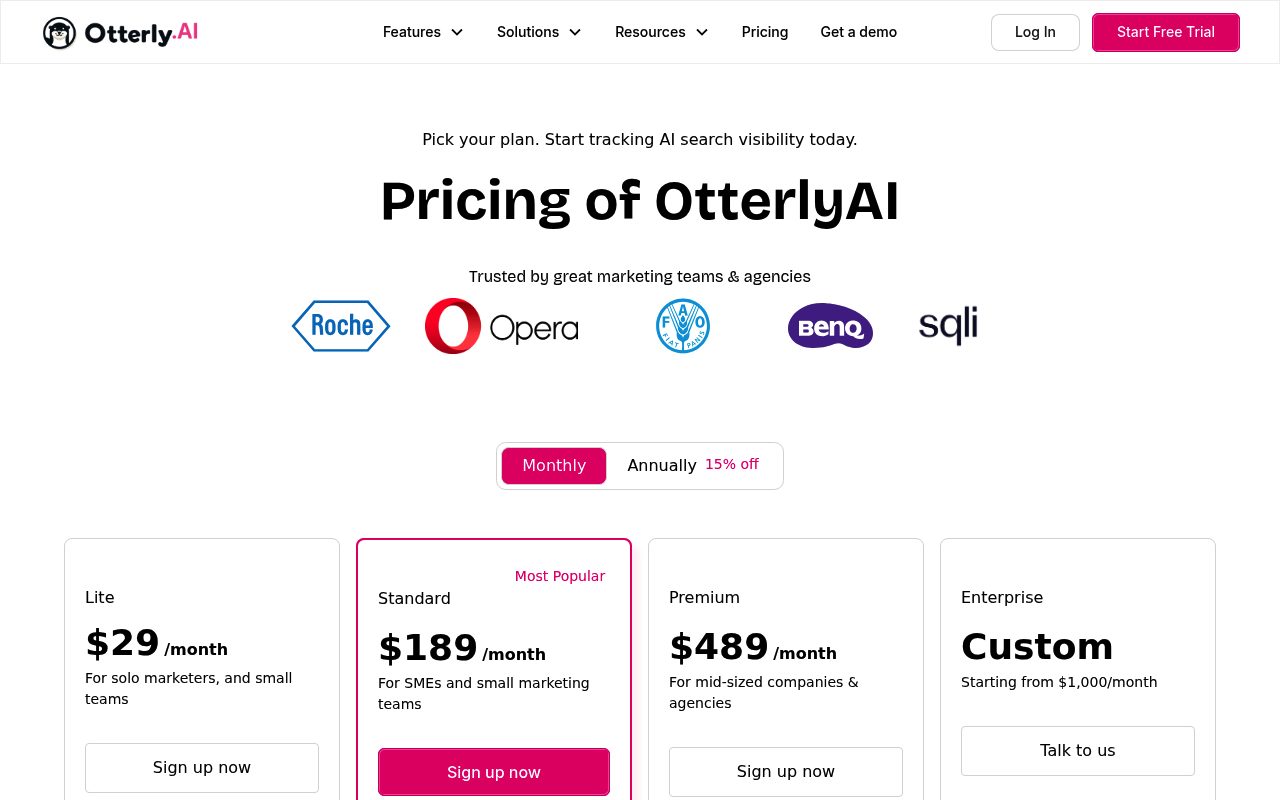
Screenshot: Otterly pricing page, September 2026.
Otterly suits a no-commitment first look at AI visibility. Its free trial requires no payment details, and its Lite plan tracks 4 engines with weekly mention and sentiment data. At 15 prompts, Lite fits spot-checking rather than comprehensive monitoring, but the zero-friction start makes it easy to evaluate.
Otterly's Lite plan is $29/month with daily tracking and unlimited team members. Across all tiers, Otterly tracks 7 major AI search engines: ChatGPT, Google AI Overviews, Google AI Mode, Gemini, Perplexity, Microsoft Copilot, and Claude. Every plan includes keyword research, prompt monitoring, weekly mentions, sentiment tracking, and link analysis. The main limitation: much of the mention and ranking data reports weekly, even though prompts run daily.
Peec AI: agencies testing visibility before pitching clients
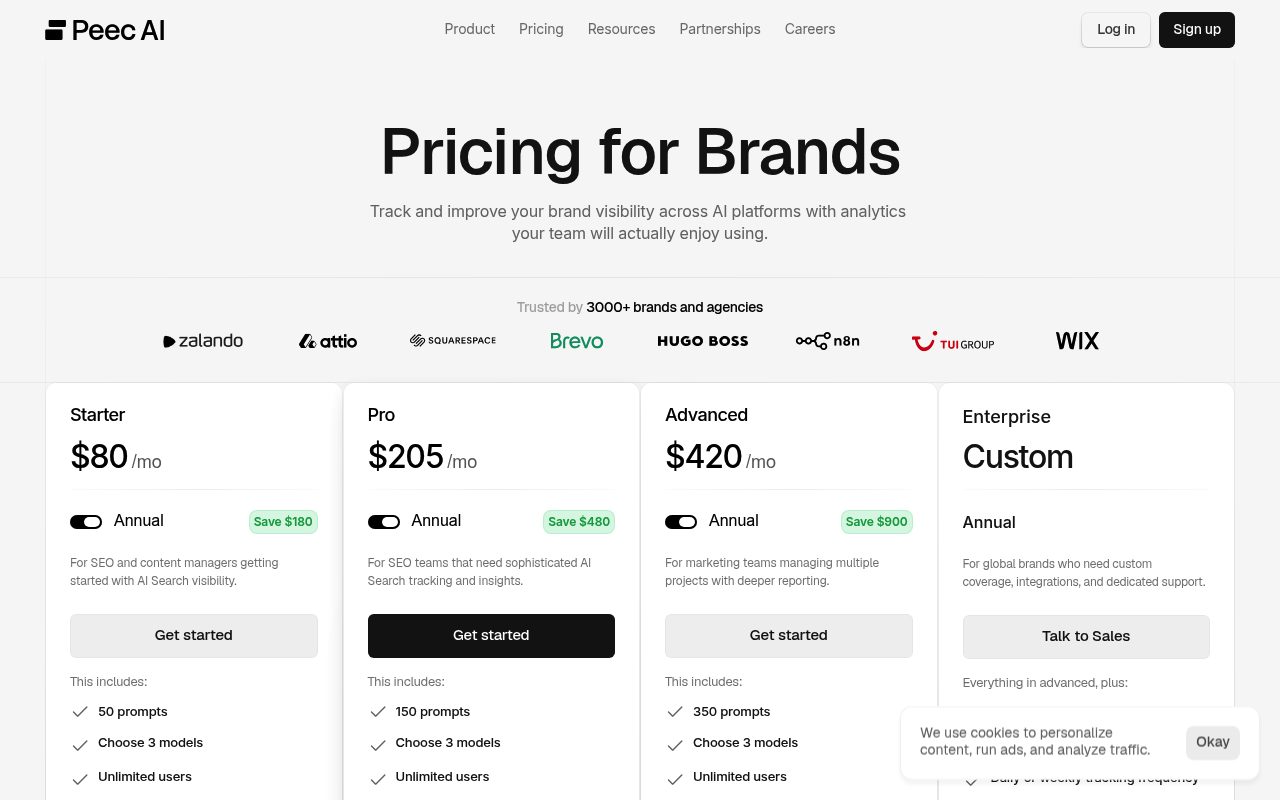
Screenshot: Peec AI pricing page, September 2026.
Peec AI fits agencies that want to prove AI visibility value to a prospect before signing them. Its free 7-day pitch projects sit outside the paid client quota entirely, so agencies run prospecting without consuming paid capacity. That is a rare genuinely free-to-use prospecting feature.
Peec AI's Starter plan includes 50 prompts, 3 models, unlimited users, daily tracking, and 1 project. Its agency offering adds unlimited client seats plus the free pitch projects, and those projects do not count against the paid quota. The limitation is time: pitch projects are boxed to 7 days, so they demonstrate value but do not replace ongoing monitoring.
Rankscale: credit-based multi-engine audits
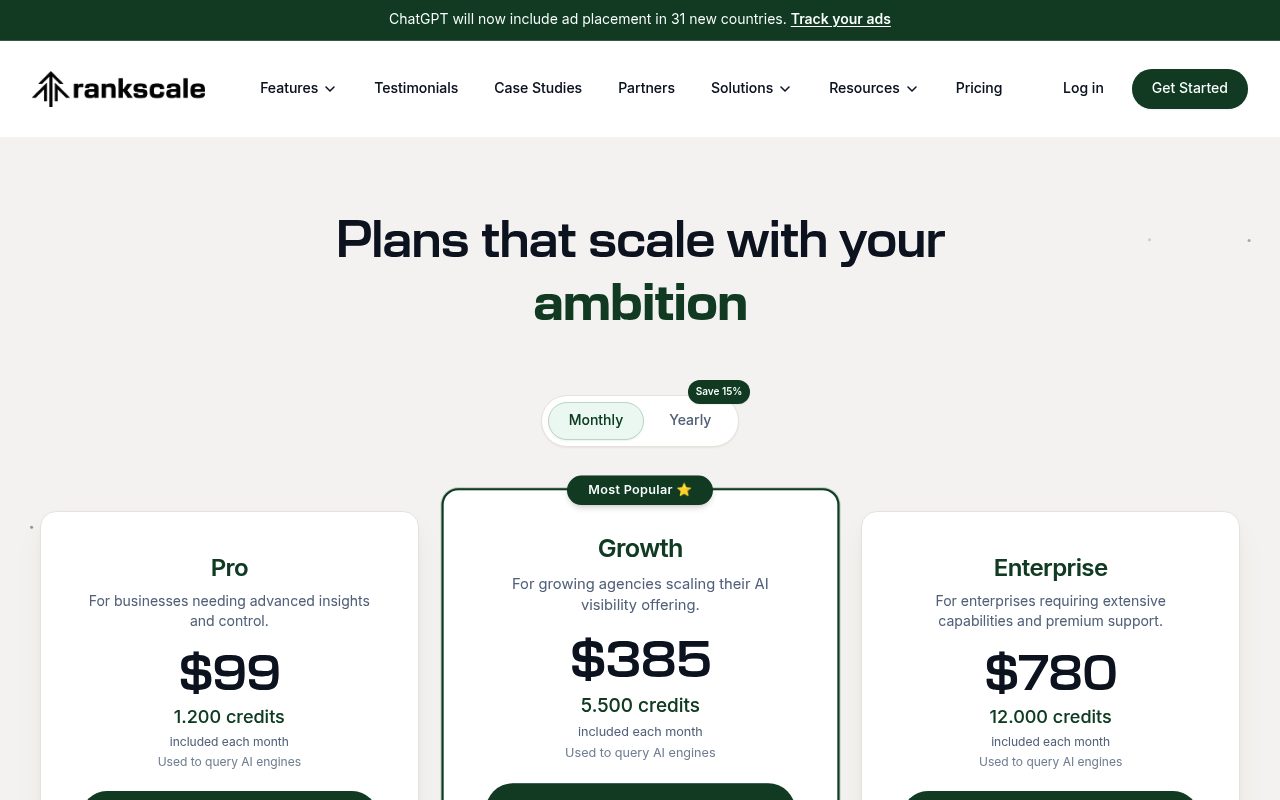
Screenshot: Rankscale pricing page, September 2026.
Rankscale fits teams that want page-level audits bundled with AI-engine answer tracking. Its 7-day free trial opens a credit system where each engine query costs about 0.25 credits, but scaling from Pro to Enterprise costs 7.9× more for roughly 10× the answer volume.
- Pro: $99, 1,200 credits, 50 page audits, up to 4,800 AI-engine answers, 7-day trial.
- Growth: $385, 5,500 credits, 200 page audits, up to 22,000 answers.
- Enterprise: $780, 12,000 credits, 200 page audits, up to 48,000 answers.
The page audit cap stays at 200 across Growth and Enterprise, so the top jump mainly buys more answer volume, not more audits. For teams committing to daily multi-engine tracking, credits deplete faster than the headline numbers suggest.
Promptwatch: broad model coverage including Llama and Grok
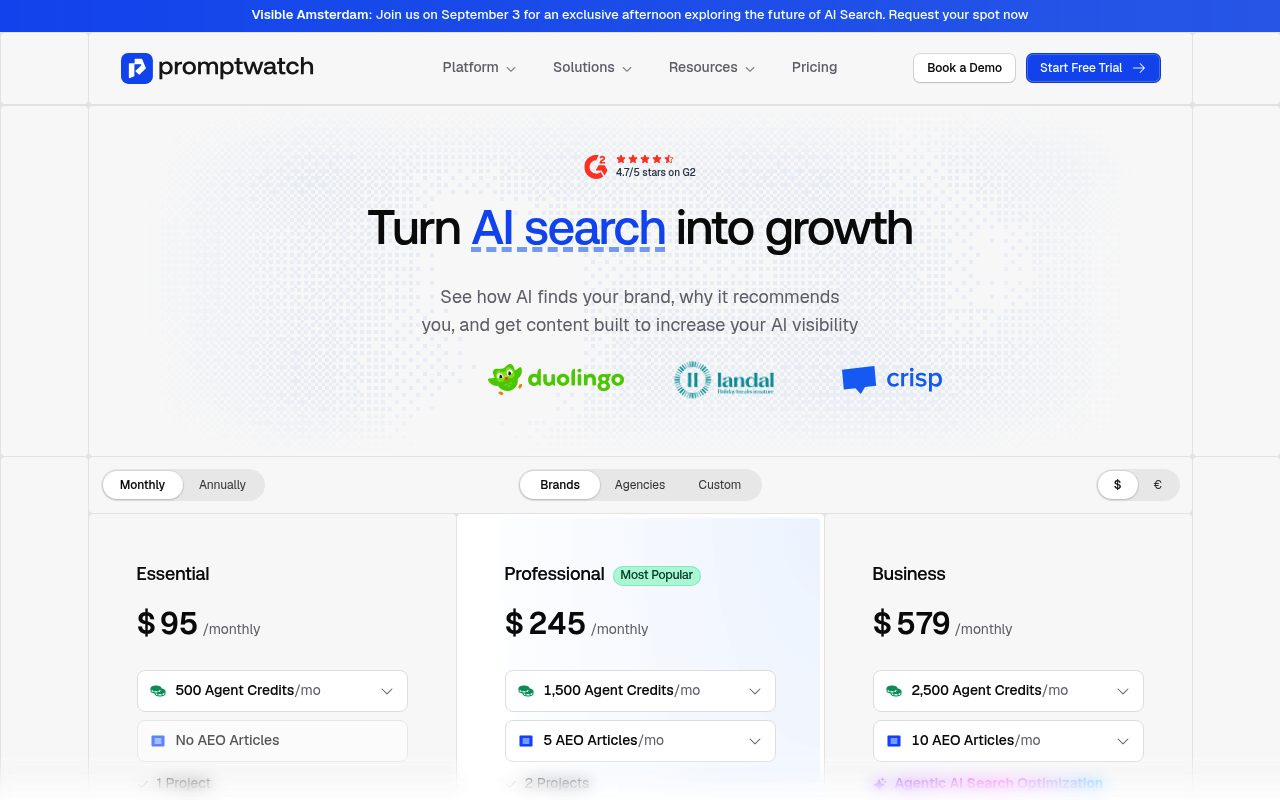
Screenshot: Promptwatch pricing page, September 2026.
Promptwatch fits teams tracking visibility beyond the mainstream engines. It supports models including Llama, DeepSeek, and Grok, and its 7-day free trial on the Essential plan bundles MCP and API access that competitors often reserve for higher tiers.
Promptwatch's Essential plan is $95/month for 1 project, 50 prompts, 6,000 responses, Agent Chat, and MCP and API access. It supports ChatGPT, Perplexity, AI Overviews, AI Mode, Claude, Gemini, Llama, DeepSeek, and Grok. Getting started can be as simple as entering a brand URL and picking 5 category prompts. The Business plan costs 2.4× Essential for 7× the prompts, a better per-prompt rate at scale. The limitation: 50 prompts covers only a slice of those engines if split evenly.
Sightkick: visibility tracking, content, and backlinks in one trial
Sightkick fits teams that want visibility monitoring, article publishing, and backlink outreach in one automated system rather than stitching separate free tools together. Its 7-day trial and free visibility report cover ChatGPT, Gemini, AI Overviews, AI Mode, Claude, Perplexity, and Reddit at once. Disclosure again: Sightkick is our product.
- Tracks brand visibility, sentiment, mentions, and position across ChatGPT, Gemini, Google AI Overviews, AI Mode, Claude, Perplexity, and Reddit simultaneously.
- Runs prompts across AI models daily to record which brands get recommended, enabling continuous competitor benchmarking.
- The Articles engine researches, writes, scores, adds images/links/schema, and publishes to a CMS daily without manual input.
- The Backlinks engine finds pages AI already cites, verifies owner contact details, sends outreach and follow-ups, and confirms links went live.
- Sightkick MCP exposes 29 tools inside AI agents like Claude, ChatGPT, Cursor, OpenClaw, and Codex.
- The free brand visibility report shows visibility %, sentiment score, mention count, and average AI recommendation position at entry.
- 7-day free trial, 2-minute setup. Citation sources are classified as UGC, Editorial, Yours, or Competitor.
The honest limitation: like every competitor here, Sightkick's full functionality sits behind the trial period. There is no permanent unlimited free tier.
How Do You Use ChatGPT or Gemini for Free SEO Tasks?
ChatGPT and Gemini free tiers generate keyword clusters, meta descriptions, and content outlines on demand. Neither retains memory of how your brand ranks across AI engines over time. That gap is why teams pair a drafting AI with a dedicated visibility tracker for measurement.
- Use for: keyword clustering, headline variations, meta description drafts, FAQ generation, and content briefs.
- Prompt structure matters: specify entity, intent, and format to get usable SEO drafts instead of generic copy.
- Injecting structured data, FAQs, and unique insights into drafts can improve visibility in answer engines like AI Overviews and ChatGPT.
Free-tier rate limits and the absence of persistent tracking mean these tools answer "what should I write" but not "am I being cited."
Where open-source and free on-page tools fit in
Open-source on-page tools — schema generators, free crawlers, sitemap validators — supplement structural fixes at zero cost. They handle markup and technical hygiene well, but they require manual setup and track nothing about AI citations. They complement a visibility tracker; they do not replace one. For a fuller list, see our roundup of generative engine optimization tools.
How Do the Limits of Free AI SEO Tools Compare to Paid Options?
Free and trial-tier AI SEO tools cap prompts, engines, and page audits tightly enough that daily multi-engine tracking exhausts them within days. Paid tiers remove those caps but jump in cost non-linearly, as seen in Rankscale's 7.9× Pro-to-Enterprise leap and Promptwatch's 2.4× Essential-to-Business leap.
- Caps: 15–50 prompts on entry tiers versus thousands on paid plans.
- Coverage: free tiers often narrow to 3–4 engines versus 7 or more on full plans.
- Pricing: cost multiples (7.9×, 2.4×) outpace resource multiples in some plans, so scaling needs budget planning, not just usage growth.
A practical free workflow: draft with ChatGPT or Gemini, test citation visibility on a free trial or entry-tier tracker, and pull a free visibility report to benchmark your starting position before choosing a paid plan. Run the trial deliberately. Test daily tracking across every engine you care about before the prompt cap runs out.
Frequently asked questions
Which free AI is best for SEO optimization in 2026?
It depends on the task. ChatGPT and Gemini free tiers work best for drafting keywords and content, while Otterly's no-card trial or Peec AI's free pitch projects work best for testing AI visibility monitoring. No single free tool covers both drafting and citation tracking well.
Can AI tools fully automate SEO optimization for free?
No. Free AI tools draft content and suggest keywords, but tracking whether a brand actually gets cited across ChatGPT, Gemini, Perplexity, and Google AI Overviews, plus securing backlinks, requires dedicated infrastructure that sits behind trials or paid plans, not permanent free tiers.
What's the difference between AI content tools and AI visibility tracking tools?
Content tools like ChatGPT and Gemini generate drafts, outlines, and keyword ideas. Visibility tracking tools like Otterly, Peec AI, Rankscale, and Sightkick monitor whether AI engines actually recommend a brand, tracking mentions, sentiment, and position. That is a distinct, measurement-focused job.
Are free AI SEO tools enough for a small business or startup?
Free trials and entry-tier plans (15–50 prompts) work for spot-checking visibility or testing a workflow, but daily tracking across multiple AI engines exhausts these caps quickly. Startups scaling beyond a quick test typically need a paid tier or an automated platform trial like Sightkick's.
How does Sightkick's free trial and visibility report work?
Sightkick offers a 2-minute setup and 7-day free trial, plus a free brand visibility report at entry showing visibility percentage, sentiment score, mention count, and average AI recommendation position. That gives a baseline before deciding whether to continue on a paid plan.
What are the biggest limitations of free AI SEO tools compared to paid platforms?
Free and entry tiers cap prompts (15–50), narrow engine coverage (3–4 versus 7 or more), and limit page audits or responses. Paid tiers remove these caps but scale non-linearly. Rankscale's Enterprise plan costs 7.9× its Pro plan, so budgeting for growth matters as much as picking a tool.
Want your starting position before you commit to anything? Start free with Sightkick. Pull a brand visibility report and run daily tracking across ChatGPT, Gemini, Perplexity, and Google in a 2-minute setup.