 Join with Google
8 Best AI Answer Engine Optimization Tools (2026)

Fabio Bergmann
An AI answer engine optimization tool is software that tracks how often a brand is mentioned, cited, or recommended by AI systems like ChatGPT, Gemini, Perplexity, and Google AI Overviews, then helps close visibility gaps through content and outreach.
Disclosure: this review is published by Sightkick, which makes one of the tools listed below. Pricing and feature claims are cited to each vendor's own documentation.
Key takeaways
- AEO tools track brand visibility across ChatGPT, Perplexity, Gemini, Google AI Overviews, and Claude. Pricing mechanics (prompt limits, credits, model counts) vary widely and are rarely compared side by side.
- OtterlyAI's top plan costs 16.9× its entry plan ($489 vs $29/month). Rankscale's Enterprise tier runs 7.9× its Pro tier ($780 vs $99). Scaling costs, not just features, drive tool selection.
- AEO builds on SEO rather than replacing it. The difference is structuring content so AI engines can extract, trust, and cite it as a direct answer.
- Citation sources split into four types: UGC, Editorial, Yours, and Competitor. That split reveals where AI models pull recommendations from.
- Crawler access controls matter as much as content quality. A blocked article gets zero citations.
What Is an AI Answer Engine Optimization Tool?
An AI answer engine optimization tool tracks, measures, and improves how often a brand gets mentioned, cited, or recommended by AI systems like ChatGPT, Gemini, Perplexity, and Google AI Overviews. It measures citations, not blue-link position, then helps close gaps through content and outreach.
AEO tools emerged because AI answers now replace clicks for many queries. AirOps defines Answer Engine Optimization as structuring content so AI engines can extract, trust, and cite it as the answer. The goal, per AirOps, is becoming the source an LLM quotes when it composes a response.
Core capabilities across the category: daily prompt tracking, sentiment and position scoring, content generation, and backlink outreach.
Which Is the Best AI Answer Engine Optimization Tool?
No single tool wins for every team. The right pick depends on prompt volume, number of AI models tracked, and whether you need content and backlink automation or just monitoring. Budget teams start around $29–99/month. Teams needing full-funnel automation need platforms built for that scope.
Match the tool to the workflow: pure tracking versus tracking plus content plus outreach. Check how many AI models each plan actually covers, not just the headline price. Small teams overpay when they buy credit tiers they won't use. Rankscale's Enterprise plan runs $780 against a $99 Pro entry.
Comparison Table: Pricing, Prompts, and AI Model Coverage
Entry plans across leading AEO tools range from $29 to $250/month, with prompt allowances from 15 to 500 and model coverage from 3 sources to simultaneous multi-platform tracking. The jump from entry to top-tier plans runs 7–17× the base price, so matching plan size to query volume matters more than brand name.
| Tool | Entry Price | Prompts Included | AI Models / Sources | Notable Add-on |
|---|---|---|---|---|
| OtterlyAI | $29/mo | 15 (up to 400) | 4 sources | API, MCP, Agent Analytics (Standard) |
| Peec AI | Prompt/model tiers | 50 (up to 350) | Choose-3 models | Looker Studio, 15% annual discount |
| Scrunch | $250/mo | 125 | 4 platforms | 5 site audits/month |
| Promptwatch | $95/mo | 50 (up to 150+) | Credit-based | AEO articles, shopping insights |
| Rankscale | $99 | Unlimited terms | Credit-based | Per-URL visibility checks |
| Sightkick | 7-day free trial | — | 7 sources, 4 models daily | Articles + backlinks automation |
Disclosure: Sightkick is our product. Sightkick tracks ChatGPT, Gemini, Google AI Overviews, AI Mode, Claude, Perplexity, and Reddit simultaneously, with a 7-day free trial and 2-minute setup.
Otterly: Straightforward Multi-Model Tracking
Screenshot: Otterly pricing page, August 2026.
Otterly is a citation-tracking tool for teams that want simple, affordable monitoring across ChatGPT, Google AI Overviews, Perplexity, and Microsoft Copilot. The Lite plan starts at $29/month with 15 prompts, daily tracking, and unlimited team seats. Entry is low-commitment: a 7-day trial, no card.
- Standard: $189/mo adds API access, MCP access, and Agent Analytics.
- Premium: $489/mo for 400 prompts, 16.9× the Lite plan cost.
- Free trial: 7 days, no card.
Limitation: Otterly is a monitoring layer only, with no built-in content or backlink automation.
Peec AI: Flexible Prompt-Based Pricing
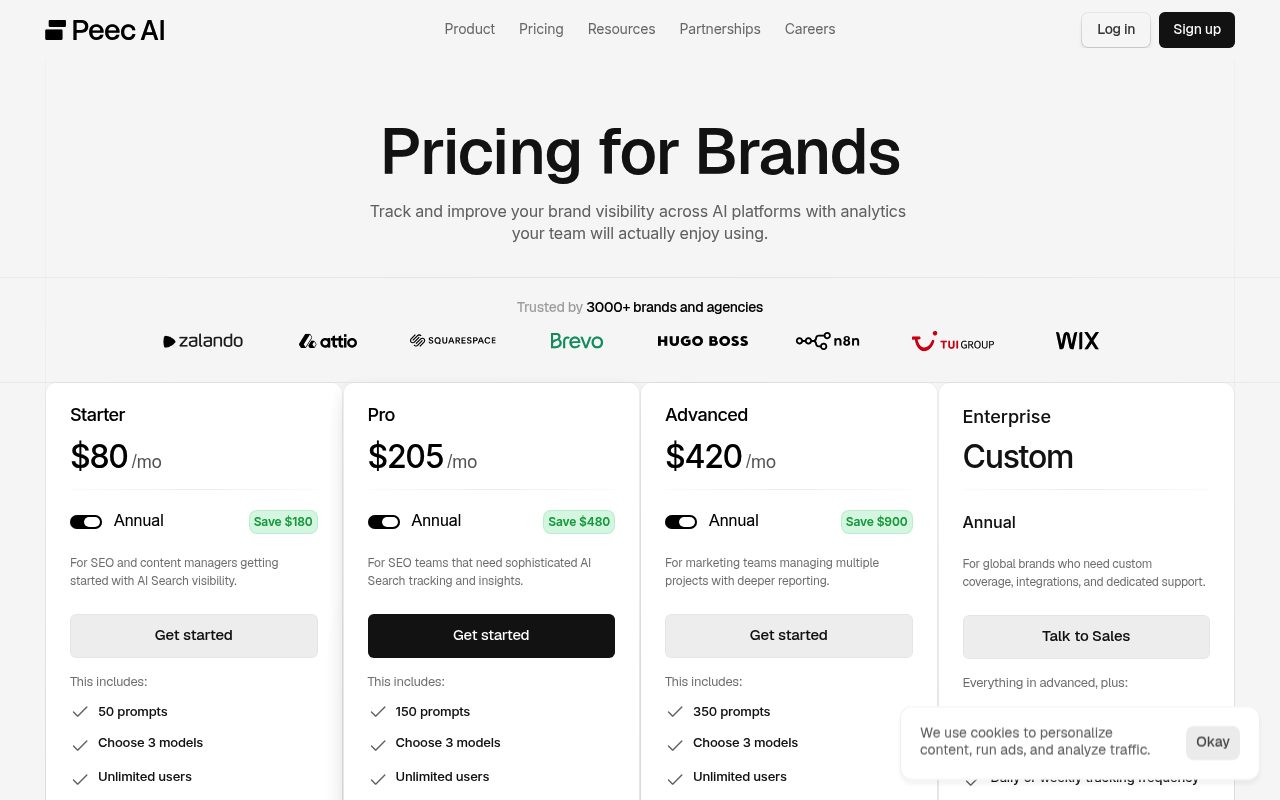
Screenshot: Peec AI pricing page, August 2026.
Peec AI prices plans by tracked prompts and models analyzed rather than flat tiers. Starter includes 50 prompts and choose-3 model coverage; Advanced scales to 350 prompts, 5 projects, and multi-country support. Annual billing saves 15%, which appeals to agencies managing multiple client accounts.
- Starter: 50 prompts, choose-3 models, 1 project, unlimited users.
- Pro: 150 prompts, 2 projects.
- Advanced: 350 prompts, 5 projects, Looker Studio integration.
Limitation: model choice is capped rather than all-inclusive.
Scrunch: Site Audits Alongside Tracking
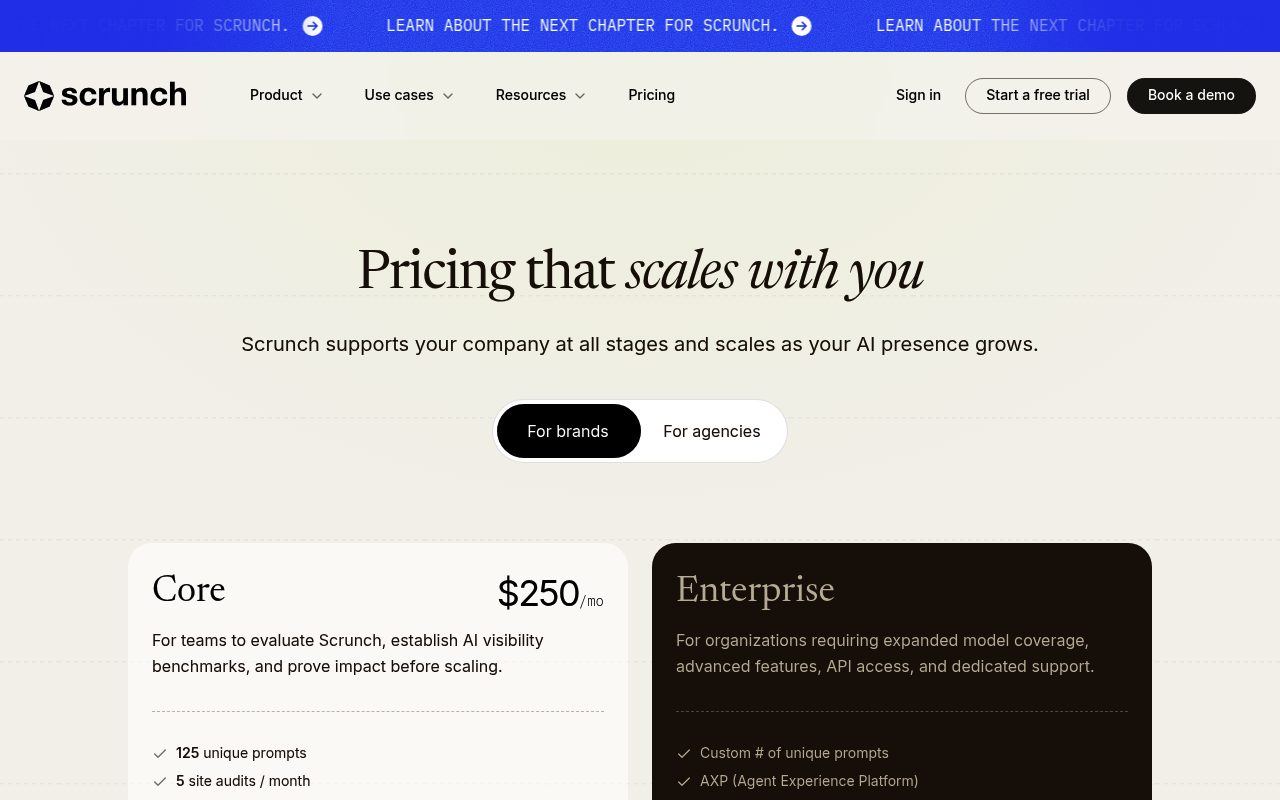
Screenshot: Scrunch pricing page, August 2026.
Scrunch pairs AI visibility tracking with built-in site audits, offering 125 prompts, 5 audits per month, and 4 AI platforms on its Core plan. At $250/month, Scrunch costs about 2.6× Otterly's entry plan, positioning it for teams that want technical audit data bundled with citation monitoring.
Core includes 1 brand workspace and 5 user licenses, plus a 7-day free trial. Limitation: the single brand workspace on the entry tier limits multi-brand agency use.
Promptwatch: Bundled AEO Content Production
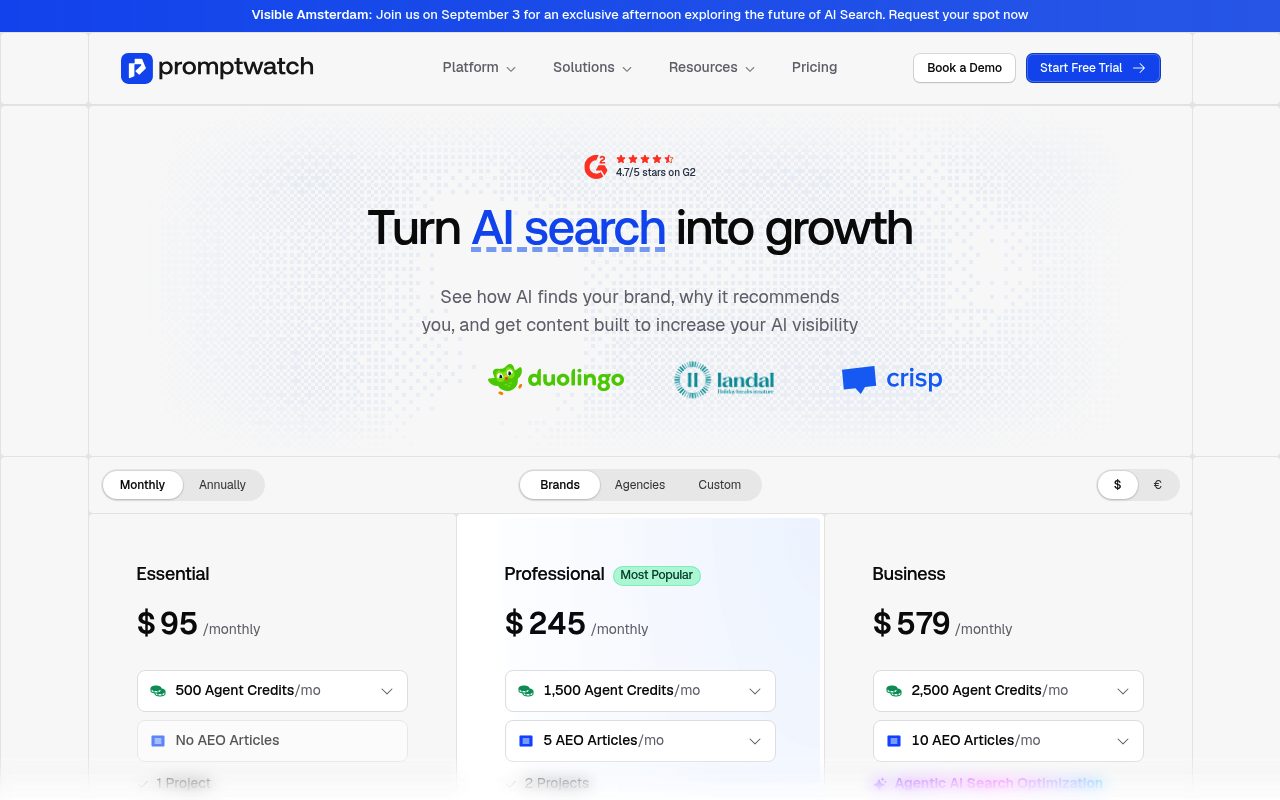
Screenshot: Promptwatch pricing page, August 2026.
Promptwatch bundles AI visibility tracking with AEO article generation. Its Professional and Business tiers include 5 and 10 AEO articles per month, alongside prompt tracking, MCP and API access, plus shopping insights and ads radar at the top tier.
- Essential: $95/mo, 500 Agent Credits, 50 prompts, MCP/API access.
- Professional: $245/mo, 5 AEO articles, 150 prompts, 18,000 responses.
- Business: $579/mo, 10 AEO articles, country/state/city tracking, shopping insights, ads radar.
Limitation: article volume is capped per tier rather than published continuously on a schedule.
Rankscale AI: Per-URL Visibility Checks
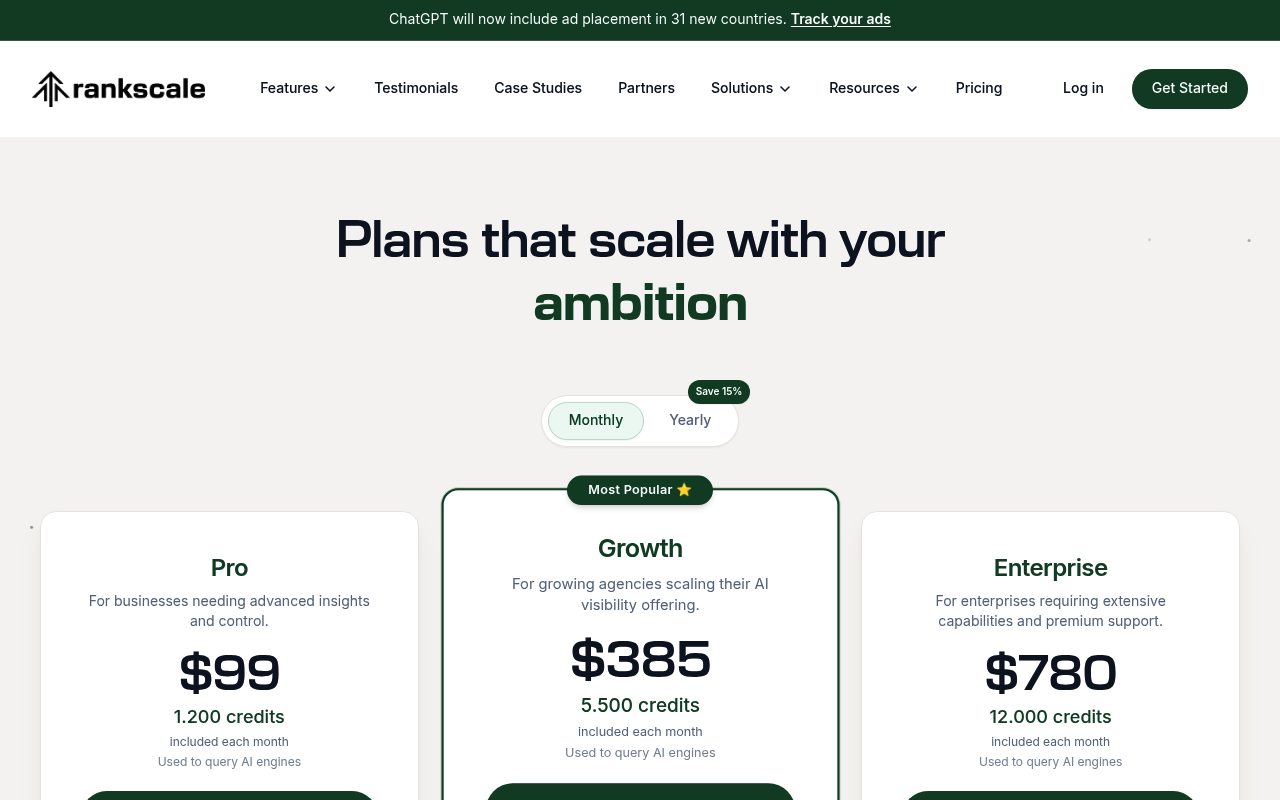
Screenshot: Rankscale AI pricing page, August 2026.
Rankscale differentiates with per-URL AI visibility checks: 50 checks on Pro, scaling to 200 on Growth and Enterprise, alongside credit-based usage and brand dashboards. Enterprise costs $780, about 7.9× the $99 Pro plan, a steep credit and dashboard jump rather than gradual pricing.
- Pro: $99, 1,200 credits, 50 URL checks, 10 dashboards, 7-day free trial.
- Growth: $385, 5,500 credits, 200 URL checks, REST API, white-label.
- Enterprise: $780, 12,000 credits, 100 dashboards, dedicated partner.
Limitation: the credit-based model makes costs harder to predict than flat prompt caps.
Sightkick: Autopilot Tracking, Content, and Backlinks in One Platform
Sightkick, our own product, combines three automated layers: daily 4-model prompt tracking across 7 AI and search surfaces, an Articles engine that writes and publishes SEO content on schedule, and a Backlinks engine that finds AI-cited pages and secures links. The aim is closing the loop from insight to action, not just reporting gaps.
- Tracks ChatGPT, Gemini, Google AI Overviews, AI Mode, Claude, Perplexity, and Reddit simultaneously.
- Runs prompts across 4 AI models daily to benchmark which brands get recommended.
- The Articles engine researches, scores, adds images, links, and schema, then publishes to a CMS without manual input.
- The Backlinks engine verifies contact details, sends outreach and follow-ups, and confirms links went live.
- 29 MCP tools integrate into Claude, ChatGPT, Cursor, OpenClaw, and Codex.
- Citation sources are classified as UGC, Editorial, Yours, and Competitor.
- 7-day free trial, 2-minute setup, and a free brand visibility report at entry.
Limitation: as an all-in-one automation platform, teams wanting only lightweight prompt tracking may find more surface area than they need. For a wider category view, see our roundup of the best generative engine optimization tools.
The Pricing Math No One Shows You: Entry vs. Scale Costs
Comparing entry to top-tier plans reveals how steeply AEO tools scale. OtterlyAI's Premium is 16.9× its Lite plan ($489 vs $29). Rankscale's Enterprise is 7.9× its Pro tier ($780 vs $99). Budget by growth trajectory, not just current prompt volume, and avoid expensive mid-year plan jumps.
- OtterlyAI: 16.9× multiplier from Lite to Premium.
- Rankscale: 7.9× multiplier from Pro to Enterprise.
- Scrunch's single-tier entry ($250) costs 2.6× Otterly's Lite, showing the flat-versus-tiered tradeoff.
Credit- and prompt-based models make future costs unpredictable without forecasting query growth. Model your 12-month prompt need before you commit.
How Does Answer Engine Optimization Actually Work?
Answer engine optimization works by structuring content so AI crawlers can extract, verify, and quote it directly. That means clear direct answers early in content, expanded schema markup, and open crawler access. Visibility also depends on citation sources: AI models pull from UGC, editorial coverage, owned pages, and competitor content.
AirOps recommends putting a direct answer and key term definition in the first 100 words, then using lists, comparison tables, and short scannable sections.
Schema and structured data that matter
Expand FAQPage, HowTo, and Article schema for machine readability. These types map directly to the question-answer format AI engines extract. Product and merchant-style structured data helps for commerce queries, though generic schema advice is often overstated relative to crawler access and content clarity.
Crawler access: the overlooked prerequisite
Don't block AI crawlers. OpenAI says that for content to appear in ChatGPT summaries and snippets, publishers should not block OAI-SearchBot. Any public website can appear in ChatGPT search, and publishers who allow the crawler can track referral traffic in Google Analytics. A technically perfect article that's blocked earns zero citations.
Citation types (UGC, Editorial, Yours, Competitor) show where recommendations originate, guiding whether to invest in content, PR, or outreach.
Is AEO Better Than SEO — Or Does It Replace Google Rankings?
AEO doesn't replace SEO. It builds on it. Traditional SEO governs whether Google can find and rank a page. AEO adds a layer focused on whether AI systems extract and cite that content as a direct answer. Google confirms snippets are auto-generated from page content matching query intent, which underlies both disciplines.
SEO focuses on rankings and clicks; AEO focuses on citations, mentions, and answer-share. Well-structured, snippet-optimized content is often the same content AI engines cite. Voice assistants and text-based AI both prioritize concise, quotable answers, though voice surfaces read a single top answer aloud while text AI can synthesize multiple sources.
Structured free courses are limited; most practical training comes from platform documentation and vendor guides. To baseline where you stand, our GEO audit guide walks through the diagnostics.
Frequently asked questions
What does an answer engine optimization tool actually measure?
It measures how often and how favorably a brand appears in AI-generated answers, tracking visibility percentage, sentiment score, mention count, and average recommendation position across models like ChatGPT, Gemini, Claude, and Perplexity, rather than traditional search rankings.
Is there a free course on answer engine optimization?
There's no widely recognized structured free course yet. Most practical AEO knowledge comes from vendor documentation, platform guides like OpenAI's publisher FAQ, and free tools such as brand visibility reports that show real metrics you can learn from directly.
Is AEO better than SEO for AI visibility?
AEO isn't better than SEO; it's complementary. SEO ensures content is findable and indexable. AEO ensures that same content is structured clearly enough for AI systems to extract, trust, and cite as a direct answer. Most tools and tactics support both at once.
How do I know if my content is being pulled into AI-generated answers?
Use a tracking tool that runs prompts against AI models daily and reports whether your brand or page is cited, along with citation type (UGC, editorial, owned, or competitor). Free brand visibility reports offer a quick baseline check without a paid subscription.
What structured data helps most with AEO?
FAQPage, HowTo, and Article schema are the most cited types, since they map directly to the question-answer format AI engines extract. Product and merchant-style schema also helps for commerce queries, though generic schema advice is often overstated relative to crawler access and content clarity.
Does answer engine optimization work differently for voice search versus text AI?
Both prioritize concise, quotable answers, but voice assistants typically read aloud a single top-ranked answer, while text-based AI like ChatGPT or Perplexity can synthesize and cite multiple sources in one response. That makes multi-source citation tracking more relevant for text AI optimization.
Want to see where you stand before picking a tool? Start your free Sightkick trial and pull a brand visibility report across ChatGPT, Gemini, Perplexity, and Google in about two minutes.