Generative Engine Optimization Companies: 2026 Picks

Fabio Bergmann
You rank #1 for your core term, but pipeline is flat and ChatGPT recommends a competitor when a buyer asks for options. Generative engine optimization companies exist to fix that gap: they track, diagnose, and correct how AI engines mention, rank, and cite your brand.

Key takeaways
- Entry-tier GEO pricing hides real limits: Otterly's $29/mo caps at 15 prompts, Profound's $99/mo tracks ChatGPT only, and Scrunch AI's $250/mo runs 8.6x Otterly's price [1][2][3].
- 54% of AI hallucinations about a brand trace back to that brand's own outdated web content, not competitor sabotage or model error [8].
- At a 58% click-through reduction from AI Overviews, a page that gets 10,000 organic clicks loses 5,800 of them (computed example).
- GEO agencies differ from SEO firms by optimizing for citation and retrieval — schema, question-format headers, entity clarity — beyond rankings.
- Sightkick tracks 7 AI surfaces (ChatGPT, Gemini, Google AI Overviews, Google AI Mode, Claude, Perplexity, Reddit) and classifies citations by source type (UGC, Editorial, Yours, Competitor), a structural view most trackers skip.
Why Are Brands Suddenly Invisible in ChatGPT and Google AI Overviews?
Brands lose traffic and pipeline because AI engines answer questions directly instead of linking out, and most companies can't see whether they're even mentioned. Generative engine optimization companies track, diagnose, and fix that blind spot across ChatGPT, Gemini, Perplexity, and AI Overviews before a competitor claims the recommendation slot.
- AI Overviews and chat answers reduce click-through even when a brand ranks #1 organically.
- Marketing teams often discover competitor mentions anecdotally, not systematically.
- The fix requires daily tracking, not a one-time audit.
The shift is structural. A user who once clicked three blue links now reads one synthesized answer. If your brand isn't inside that answer, the ranking beneath it earns nothing.
Is SEO Still Worth It in 2026, or Has AI Replaced It?
SEO isn't dead, but ranking alone no longer covers you. At a 58% click-through reduction from AI Overviews, a page earning 10,000 monthly organic clicks loses roughly 5,800 of them to zero-click answers (computed example). Visibility inside the answer now beats the ranking position beneath it.
Traditional rankings still feed the citations AI models pull from. Zero-click search doesn't destroy SEO value; it relocates where that value gets captured. Brands optimizing only for blue links cede ground to those optimizing for citation. For a broader tactical map, see our guide on AI visibility optimization.
How Do GEO Agencies Actually Differ From Traditional SEO Firms?
Traditional SEO firms optimize for crawlability and keyword rankings. GEO-focused companies optimize for how large language models chunk, retrieve, and cite content: restructuring headers into question format, tightening schema markup, and monitoring sentiment and position inside AI answers rather than SERP rank alone.
- GEO work structures content for retrieval, not just readability.
- Swapping static H2 keywords for question-format headers improves how LLMs label and retrieve content chunks.
- SEO firms measure rank; GEO firms measure recommendation frequency and sentiment.
Practical example: an H2 reading "Pricing" gives an LLM little retrieval signal. Rewrite it as "How much does the Pro plan cost?" and you label the chunk with the exact query a model matches against. Small structural change, large retrieval gain.
What's the Real Reason AI Gets Your Own Brand Facts Wrong?
Bad brand facts rarely come from a hostile competitor or model bias. A Profound study of over 158,000 AI inaccuracies found 54% of brands had at least one wrong AI claim sourced directly from their own outdated web content. The fix isn't reputation management; it's auditing and updating the pages models already cite.
- Outdated pricing pages, old team bios, and stale product specs are the common culprits.
- AI models don't distinguish "current" from "archived" content unless the page signals it.
- This reframes GEO work as content hygiene, not just outreach or link-building.
What Do Generative Engine Optimization Companies Actually Cost?
Entry pricing runs $29 to $250 per month, but the sticker price hides sharply different limits. Otterly's $29/mo Lite plan covers six AI platforms yet caps at 15 prompts, while Scrunch AI's $250/mo Core plan runs 8.6x that cost for four LLMs and 125 prompts.
| Company | Entry price | Platforms | Prompt limit | Notable |
|---|---|---|---|---|
| Otterly | $29/mo | 6 (incl. Copilot) | 15 prompts | Cheapest broad coverage |
| Promptwatch | $95/mo | Up to 11 | — | No per-platform add-ons |
| Profound | $99/mo | ChatGPT only | 100 Agent credits | 3.4x Otterly's price |
| Scrunch AI | $250/mo | 4 LLMs | 125 prompts | Hallucination detection |
| Peec AI | Credit-based | Variable | Prompts x models x duration | Scales with scope |
| AirOps | Free Solo | N/A (workflows) | 1,000 tasks/mo | $0.025 per extra task |
Profound's $99/mo Starter plan costs 3.4x Otterly's entry price despite tracking fewer AI engines. Peec AI's credit system multiplies prompts by models by duration, so cost scales fast with scope. Compare the limits, not the headline numbers — see our full breakdown of GEO tools for 2026.
Generative Engine Optimization Companies Compared
The platforms below split into three groups: visibility trackers (Otterly, Profound, Peec AI, Scrunch AI, Promptwatch), a content-automation workflow tool (AirOps), and Sightkick, which combines tracking, content publishing, and backlink outreach in one system. Disclosure: Sightkick is our product; the assessment below applies the same criteria to every tool.
Ordering reflects fit by use case, from budget testing through enterprise-grade monitoring. No single option wins for every team. The right pick depends on how many surfaces you track and whether you also need content and links automated.
Otterly: Budget-Conscious Multi-Platform Tracking
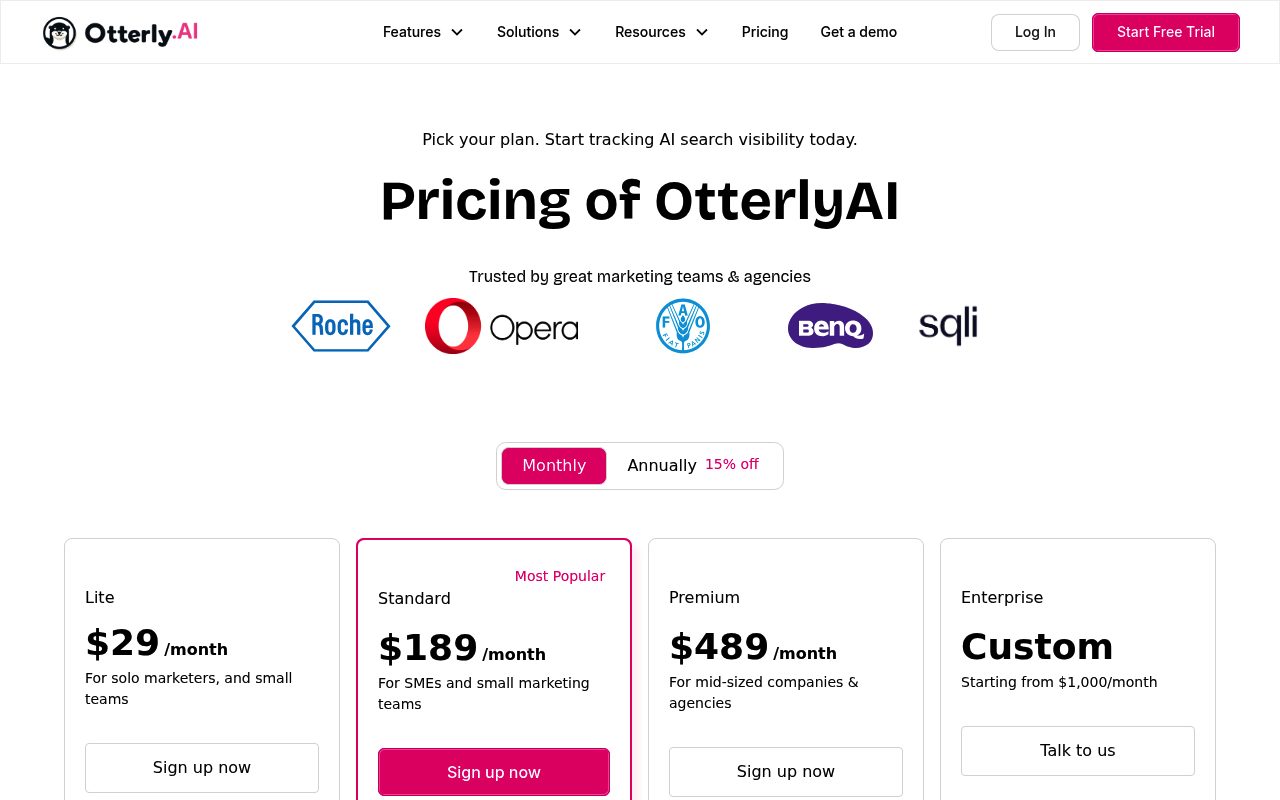
Screenshot: Otterly pricing page, September 2026.
Otterly's $29/mo Lite plan is the cheapest entry point covering six AI platforms: ChatGPT, AI Overviews, Gemini, Perplexity, Copilot, and Claude. The 15-prompt cap suits brands testing the waters, not full competitive benchmarking.
- Broadest platform coverage at the lowest starting price.
- The prompt limit forces upgrades quickly for teams tracking multiple products or competitors.
- A solid start for solo founders validating whether GEO monitoring matters for their niche.
Profound: Deep ChatGPT-Specific Analysis
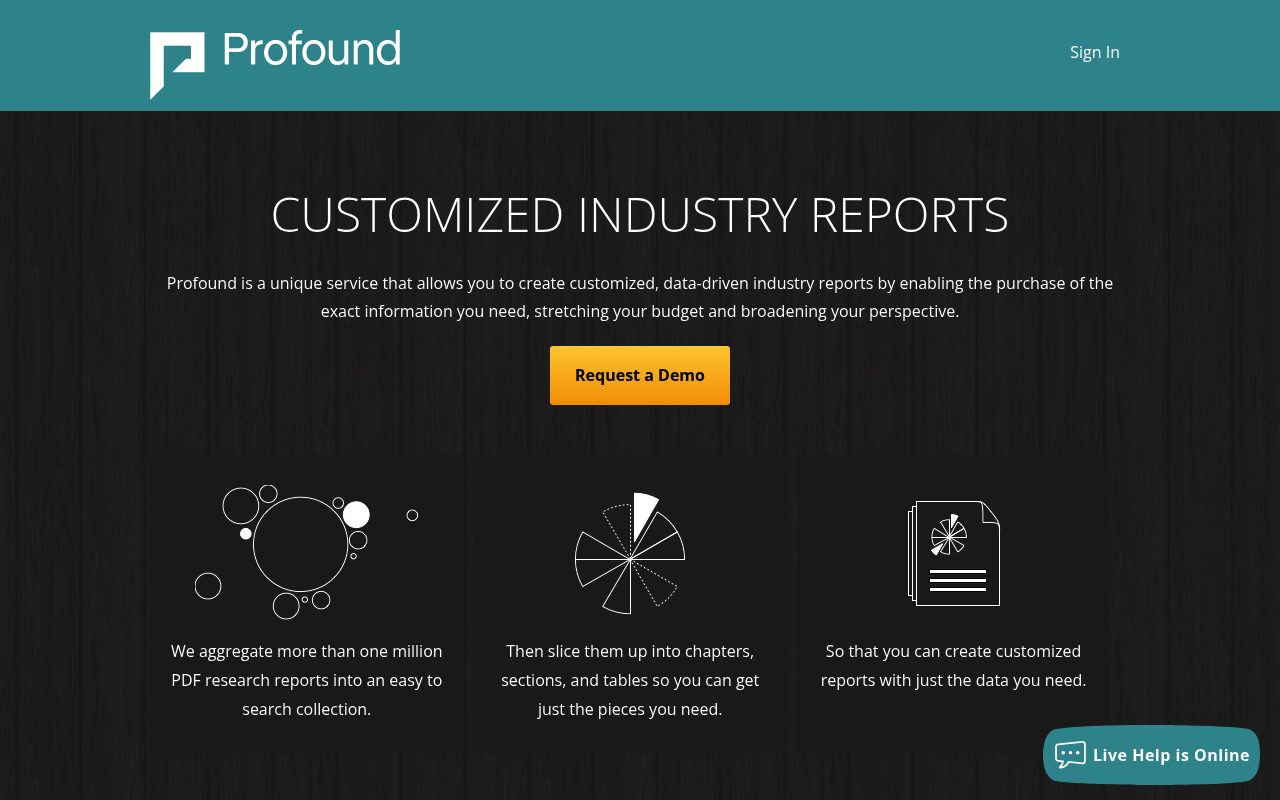
Screenshot: Profound website, September 2026.
Profound charges $99/mo, 3.4x Otterly's entry price, but restricts the Starter tier to ChatGPT only. That fits brands whose buyers concentrate there. Its research into hallucination sourcing is a genuine differentiator beyond pure tracking.
A study of over 158,000 AI inaccuracies by Profound found 54% of brands had at least one inaccurate AI claim sourced from citing the brand's own outdated web content.
Single-platform focus trades breadth for depth, and the price runs higher than several broader competitors. Worth it if your entire buyer journey lives inside ChatGPT.
Scrunch AI: Hallucination Detection
Scrunch AI's $250/mo Core plan is the most expensive entry tier here, roughly 8.6x Otterly's price, but it's the only one built around automated hallucination detection, flagging when AI models state incorrect prices, fake partnerships, or outdated facts about a brand.
- Tracks 4 LLMs with 125 unique prompts included.
- Hallucination flagging addresses the root problem, not just visibility counting.
- The premium price positions it for mid-market and enterprise budgets, not solo founders.
Peec AI: Flexible Prompt-Level Tracking
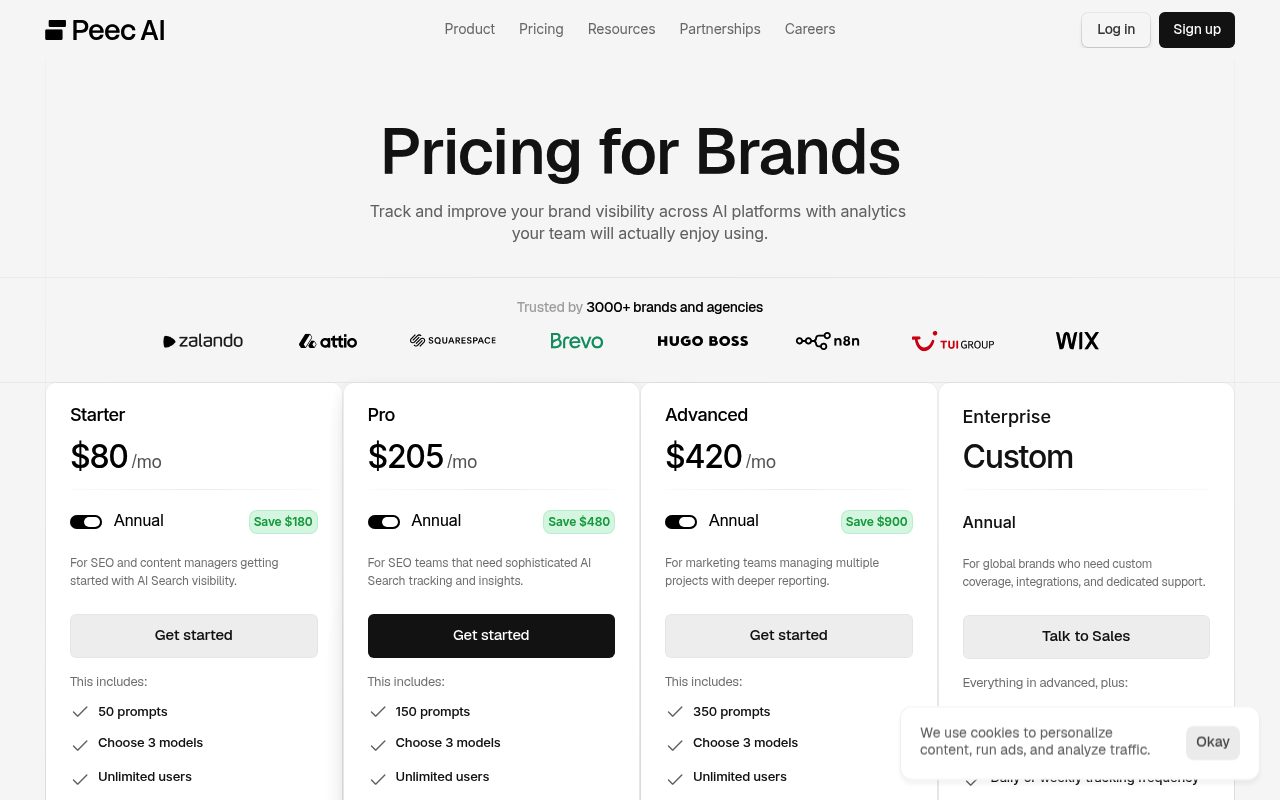
Screenshot: Peec AI pricing page, September 2026.
Peec AI uses a credit system that multiplies tracked prompts by AI models by tracking duration, giving teams granular control over scope but making costs harder to predict than flat-tier competitors.
- Useful for teams scaling tracking precisely to campaign needs.
- Requires more setup thought than flat-rate plans to avoid credit overruns.
- Best for teams comfortable modeling usage before committing.
AirOps: Content Workflow Automation, Not Tracking
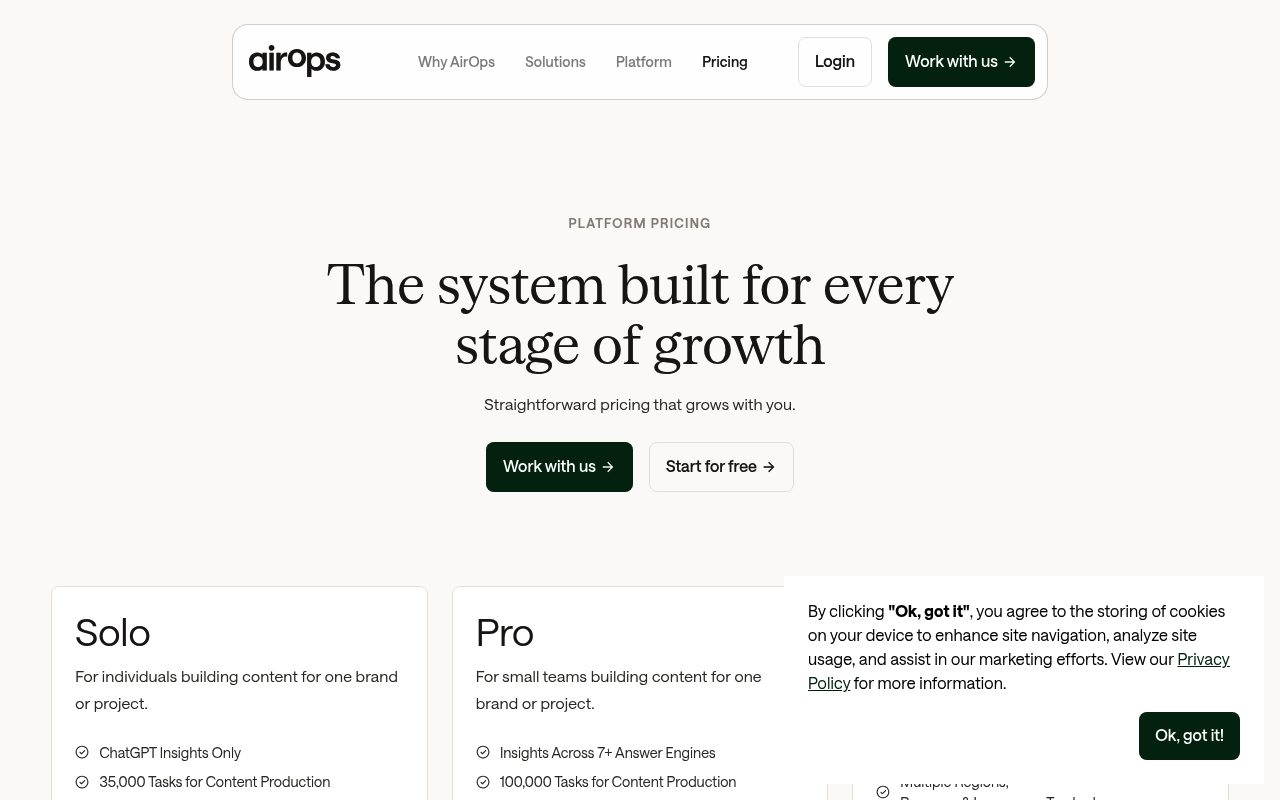
Screenshot: AirOps pricing page, September 2026.
AirOps isn't a visibility tracker. It's a workflow automation tool offering 1,000 free tasks per month before charging $0.025 per additional task, fitting teams that need programmatic content generation rather than AI mention monitoring.
- The free Solo tier is generous for small-scale content workflows.
- No native AI-platform mention tracking, so it pairs with a separate GEO tracker.
- Per-task pricing adds up for high-volume publishing operations.
Promptwatch: Value for Platform Breadth
Screenshot: Promptwatch blog page, September 2026.
Promptwatch bundles up to 11 AI platforms into a $95/mo starting price with no per-platform add-on fees, covering more surfaces than Profound's ChatGPT-only plan at a similar price. A strong pick for teams that want breadth without a la carte surprises.
- Widest platform coverage per dollar among flat-rate competitors.
- No add-on fees simplifies budgeting compared to credit-based tools.
- Per-platform analysis depth may be lighter than specialized single-platform tools.
Sightkick: Tracking, Content, and Backlinks in One Autopilot
Sightkick tracks brand visibility, sentiment, and position across ChatGPT, Gemini, AI Overviews, AI Mode, Claude, Perplexity, and Reddit at once, then automates article publishing and backlink outreach from the same data. That combined scope is something the pure trackers above don't attempt. Disclosure: Sightkick is our product.
- The Insights engine runs prompts across 4 AI models daily, tracking mentions and winnable keywords for competitive benchmarking.
- The Articles engine researches, writes, scores, and publishes SEO content with images, links, and schema on a daily schedule with no manual input.
- The Backlinks engine finds pages AI already cites, verifies owner contact details, sends outreach, and confirms links went live.
- Citation sources are classified as UGC, Editorial, Yours, or Competitor for structural clarity on where recommendations originate.
- Sightkick MCP exposes 29 tools directly inside Claude, ChatGPT, Cursor, OpenClaw, and Codex.
- A 7-day free trial with a claimed 2-minute setup.
- Limitation: as a newer entrant, Sightkick lacks the multi-year benchmark data some established trackers have published.
Which Generative Engine Optimization Companies Work With Enterprise Brands?
Enterprise buyers typically need multi-platform coverage, team seats, and audit-grade reporting, traits found in Scrunch AI's higher tiers and Profound's expanded plans beyond entry pricing. Platforms like Sightkick and Promptwatch scale from SMB to enterprise through tiered access to automation and tracking depth.
- Enterprise needs: SSO, higher prompt and model limits, dedicated support, and API access.
- Scrunch AI and Profound's higher tiers extend past their advertised entry pricing for this segment.
- Evaluate whether the platform reports source-type breakdowns (owned vs. competitor vs. editorial citations), which matters more at scale.
Frequently asked questions
Is SEO dead now that AI generates answers directly?
No. SEO isn't dead, but it's incomplete alone. AI Overviews can cut click-through by 58%, so a page ranking #1 organically may still lose most of its traffic. Content still needs to be crawlable and well-ranked, and it also needs structuring so AI models can cite it directly.
Which generative engine optimization company is best overall?
There's no single best option; it depends on scope. Otterly suits budget testing, Scrunch AI suits hallucination monitoring, Profound suits deep ChatGPT analysis, and platforms like Sightkick suit teams wanting tracking, content, and backlink outreach automated together rather than managed as separate tools.
What agencies specialize in optimizing content for AI-generated answers?
Specialists typically combine AI visibility tracking (monitoring mentions across ChatGPT, Gemini, Perplexity) with content restructuring for retrieval: schema markup, question-format headers, and entity clarity. Look for firms or platforms that show source-type breakdowns of where AI citations originate, not just raw mention counts.
How much should a business budget for GEO tools monthly?
Entry tiers range from $29 to $250 per month, but hidden limits matter more than sticker price. A $29/mo plan capped at 15 prompts may cost more per usable data point than a $95/mo plan covering 11 platforms with no add-on fees, so compare limits, not just price.
What results can a business realistically expect from hiring a GEO company?
Expect improved visibility tracking within weeks, but citation and ranking gains take longer since they depend on content updates and backlink acquisition. A meaningful early win is identifying and fixing outdated owned content, since 54% of brand hallucinations trace back to a brand's own stale pages.
Do generative engine optimization companies replace the need for a traditional SEO agency?
Not entirely. Most GEO platforms focus on tracking and content structuring for AI retrieval, while technical SEO fundamentals like site speed, crawlability, and backlink authority still matter because AI models often cite pages that already rank well organically.
Want to see where you stand before comparing tools? Start a free brand visibility report with Sightkick to check your visibility, sentiment, and AI recommendation position across ChatGPT, Gemini, and Google. Setup takes about 2 minutes.