 Join with Google
Optimizing Your Website for Generative AI Features on Google Search

Fabio Bergmann
You rank on page one for a core query, yet Google's AI Overviews cite three competitors and skip you. Optimizing your website for generative AI features on Google Search means clearing Google's eligibility gates (indexing, snippet eligibility, Search Console inclusion), writing pages that answer the related sub-queries Google's retrieval system fans out, and measuring the result in Search Console.
Why isn't my site showing up in AI Overviews?
AI Overviews can only consider pages that pass three eligibility gates. The page must be indexed and snippet-eligible. The site must be included for generative AI features in Search Console. The content must clear the same quality bar as regular ranking. Google lists no extra AI-only requirements beyond these.
Each gate is a yes/no check. Fail one and no content tweak helps:
| Requirement | Required? | What Google states |
|---|---|---|
| Indexed and snippet-eligible | Yes | Precondition for generative AI features |
| Search Console inclusion | Yes | Site must be included in Search generative AI features |
| Special schema.org markup | No | None needed for generative AI search |
| Other AI-only optimizations | No | No additional requirements for AI Overviews or AI Mode |
Sources: Google AI optimization guide, Google AI features documentation.
Audit robots meta directives first. A stray nosnippet or max-snippet:0 leaves a page ranking but outside the surface AI features draw from.
How does Google actually select content for AI Overviews?
Google selects AI Overview content through retrieval-augmented generation (RAG). Core Search ranking systems retrieve relevant, up-to-date pages from the index. Query fan-out then fires several related sub-queries in parallel to assemble a fuller answer. A page that ranks for those fan-out queries, not only the original query, gets pulled into the overview.
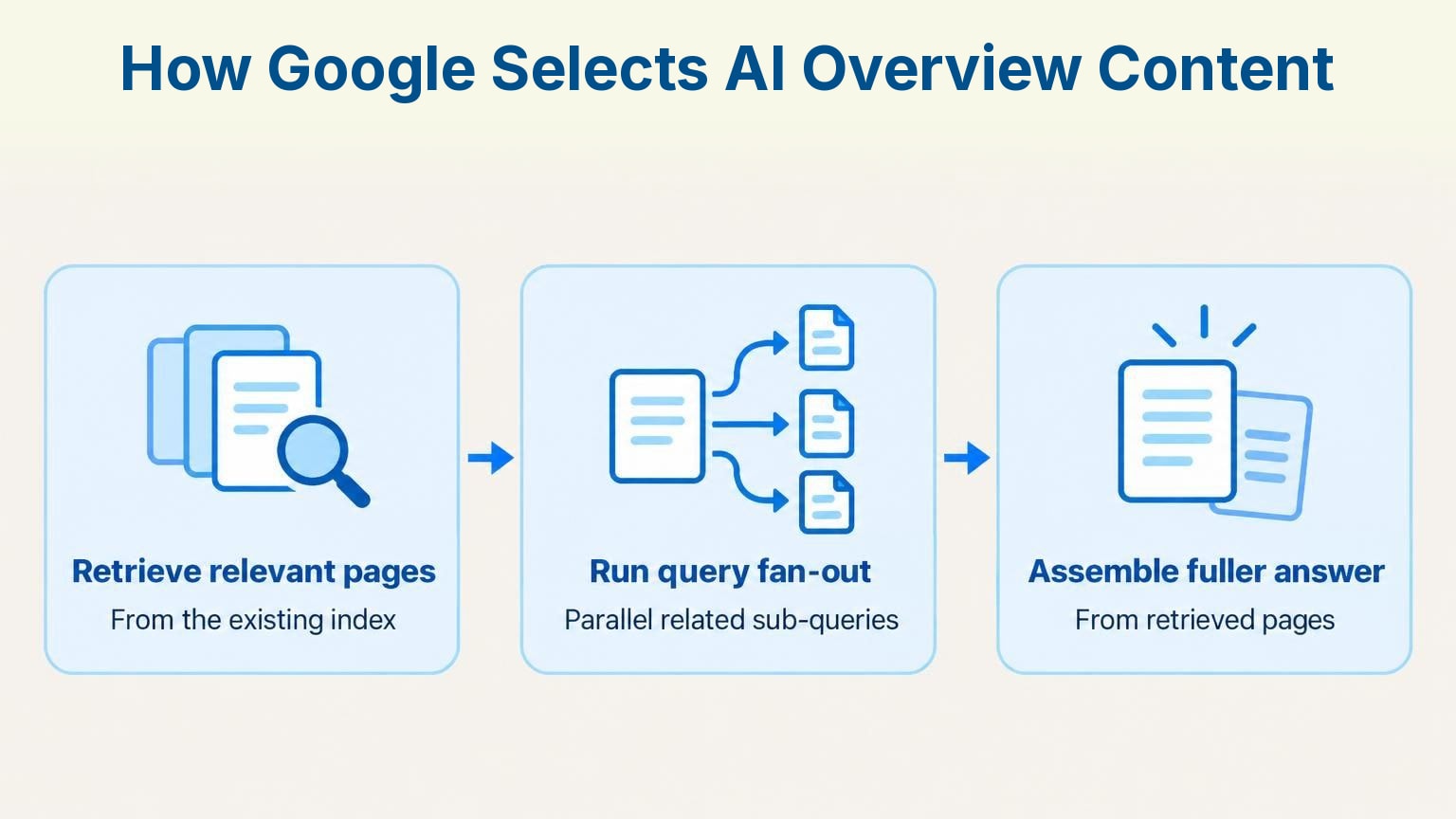
Process infographic: How Google Selects AI Overview Content – Retrieve relevant pages, Run query fan-out, Assemble fuller answer
RAG in plain terms
Google describes RAG, also called grounding, as relying on core Search ranking systems to fetch pages from its existing index. No separate AI database. The model writes from what ranking already retrieved. Invisible to classic ranking means invisible to AI Overviews.
Trigger logic sits in Google's Ads help center. AI Overviews appear when generative AI is especially helpful, such as understanding information from a range of sources. They fire mainly on "no one right answer" queries: complex questions, comparisons, multi-step problems.
Why query fan-out changes how you write
Query fan-out is Google's term for the concurrent related queries the model generates to fetch additional results. "Best CRM for a 10-person SaaS team" may fan out into pricing, integrations, onboarding time and alternatives. Your page competes across the whole cluster — and so do review sites, forums and competitor pages.
- Map the questions a buyer asks before and after the head query.
- Answer each one under its own heading, in the first sentence.
- Keep each answer self-contained so one passage can be retrieved without its neighbors.
The implication most guides skip: you can lose a fan-out sub-query to a third-party page that mentions your competitor. Owning your own pages covers only part of the cluster.
What actually counts as SEO fundamentals for AI visibility?
SEO fundamentals for AI visibility are the classic SEO checklist. Google lists crawl access, internal links, page experience, quality text and media, accurate structured data, and current Merchant Center and Business Profile data. Google confirms no AI-only schema or special optimization exists. The work is executing the existing list well.
Google's AI features documentation spells out the items:
- Crawl access: allowed in robots.txt and by any CDN or hosting layer. Bot-blocking at Cloudflare or a WAF counts.
- Internal links: content easy to find from elsewhere on the site.
- Structured data: must match the visible text on the page. Google uses it to understand content, and pages must follow its general guidelines to qualify for rich results.
- Commerce and local data: Merchant Center feeds and Google Business Profile kept current.
- Content: people-first writing that shows first-hand expertise and depth, per Google's helpful content guidance.
For a structured pass over these items, our GEO audit guide turns the checks into a repeatable workflow.
What is the 80/20 rule in SEO — and does it still apply with AI features?
The 80/20 rule in SEO is the Pareto heuristic: a small share of work, mainly crawlability, indexation and core page experience, drives most visibility gains. The rule holds with generative AI features. Google builds those features on the same index, so technical health plus genuinely helpful content stays the highest-leverage work.
Google says SEO best practices still apply because its AI features are rooted in core ranking and quality systems. Priority order:
- Retrievability. Clear the gates above.
- Content only you can write: product data, customer outcomes, first-hand testing.
- Volume last. A hundred thin pages lose to ten that cover the fan-out cluster with real expertise.
How do I measure AI Overview performance and traffic?
AI Overview performance is measured in the Generative AI performance report in Search Console. Google rolled the report out to all websites worldwide as of August 31, 2026. The report shows organic impressions over time, highest- and lowest-impression pages, and country and device splits. Pair it with Google Analytics for post-click behavior.
The report covers appearances in generative AI features across Search and Discover, and Google names it the measurement source for these surfaces. Workflow:
- Export the lowest-impression pages. These are your retrieval gaps.
- Cross-check top pages against country and device splits to see where AI visibility concentrates.
- In Google Analytics, segment sessions landing on those URLs. Compare engagement and conversions with the site average.
- Rewrite low performers to answer adjacent sub-questions. Re-check impressions.
How is Google's generative AI optimization different from traditional SEO — and where is it heading?
Google's generative AI optimization has no separate rulebook. Google states that it is still SEO, built on the same ranking systems. What changes is the surface. Preferred Sources now appear inside AI Overviews and AI Mode, a carousel surfaces timely articles, and ads enter AI Overviews in select markets.
Google frames recent updates as helping people find original content and trusted sources. Users see their Preferred Sources directly in AI Overviews and AI Mode. A new carousel highlights timely articles and diverse perspectives. Publishers who earn repeat readers gain a direct path into AI answers.
Paid side: ads in AI Overviews run in English on mobile and desktop in 12 countries — Australia, Canada, India, Indonesia, Kenya, Malaysia, New Zealand, Nigeria, Pakistan, Philippines, Singapore and the US. They trigger only on detected commercial intent, when the ad fits both query and overview. Google Ads offers no segmented reporting for these placements. Attribution stays blended.
How do I track AI visibility beyond Google's own reports?
Tracking AI visibility beyond Google requires a separate tool. Search Console reports only Google impressions, and Google Ads offers no segmented reporting for AI Overview ads. Neither shows which competitors get cited, which source types answers draw on, or how ChatGPT and Gemini respond. Third-party trackers, including our own, fill that gap.
Disclosure: Sightkick, used as the example below, is our product.
What a tracker should capture, and how Sightkick handles each:
- Daily prompt runs across engines. Sightkick runs every tracked prompt daily in 3 AI models (a 4th is an add-on) across ChatGPT, Gemini, Google AI Overviews and Google AI Mode.
- Competitor benchmarks. Records which brands get recommended, plus mentions, sentiment and position.
- Citation source type. Classifies cited sources as UGC, Editorial, Yours or Competitor.
Source type is the actionable signal. It ties back to fan-out: if AI cites your own pages, rewrite them for adjacent sub-questions. If it cites editorial or UGC pages, those pages are where you need a presence. Sightkick's Backlinks engine targets exactly those already-cited pages with outreach and confirms links went live; its Articles engine publishes content with schema to your CMS on a schedule.
No tracker replaces Search Console. Google's Generative AI performance report remains the source for Google impression data.
Frequently asked questions
What is generative AI in Google Search results?
Generative AI in Google Search refers to AI Overviews and AI Mode. Both synthesize answers from multiple retrieved pages using retrieval-augmented generation and query fan-out, instead of a single ranked list of links. They appear mainly for complex, "no one right answer" queries.
How can I optimize my website for Google Search overall, not just AI features?
Keep pages crawlable, internal links clear and page experience fast. Write people-first content with first-hand expertise. Google treats these fundamentals as the base for both classic ranking and AI feature eligibility.
Do I need special schema markup for AI Overviews?
No. Google states no special schema.org markup is required for generative AI search features. Standard structured data that follows existing guidelines covers both rich results and AI eligibility.