 Join with Google
7 Platforms for AI Visibility Metrics, Ranked (2026)

Fabio Bergmann
No single platform wins every AI visibility metric. Each vendor defines visibility and share of voice differently, and engine coverage, prompt allowance and refresh cadence vary by plan. Choose on engines covered, prompt allowance, refresh cadence, and how each tool defines share of voice.
Disclosure: this guide is published by Sightkick, which sells an AI visibility platform. It appears in the comparison table and has its own section, both labelled.
Which Platform Is Strongest for Tracking AI Visibility Metrics?
The strongest platform depends on the metric you report. Semrush leads with a single 0–100 score. Peec AI runs on four defined metrics. Rankscale names eight. Otterly publishes the lowest entry price. The same brand can look strong in one dashboard and weak in another.
| Platform | Headline metric approach |
|---|---|
| Semrush | 0–100 AI Visibility Score versus competitors |
| Peec AI | Visibility, Share of Voice, Position, Sentiment |
| Rankscale | Eight core metrics, incl. Detection Rate and Share of Citations |
| Otterly | Not published |
Sources: Semrush AI SEO metrics, Peec AI instructions, Rankscale core metrics.
Pick the metric model first. Then weigh three trade-offs:
- Coverage: which engines are tracked by default, which are add-ons.
- Price: what a usable prompt allowance costs.
- Reporting: whether visibility, share of voice, sentiment and citations are reported separately.
How We Chose These AI Visibility Platforms
These AI visibility platforms were shortlisted on five criteria: engines tracked, named dashboard metrics, lowest-tier prompt allowance, refresh frequency and published pricing. Every price and allowance comes from the vendor's own pricing or documentation pages. Where a vendor publishes no figure, the table says "Not published".
- Engines tracked. Base coverage versus paid add-ons, checked per plan.
- Named metrics. Visibility, share of voice, sentiment, citations, position and detection rate as separate numbers.
- Prompt allowance and cadence. Otterly Lite tracks 15 prompts. Semrush allows 25 to 200 by plan.
- Published price. Monthly USD list prices only.
- Free entry. Free trials, free reports and free monthly credits.
AI Visibility Platform Comparison Table
The AI visibility platform comparison table below splits seven tools on price first, because price separates them faster than features. Otterly is the only vendor here publishing a full four-tier ladder. Semrush, Rankscale and Promptwatch lead with free reports or credits instead. Shortlist on budget and engine coverage, then read the breakdowns. Prices current as of October 2026.
| Platform | Best for | Starting price | Free plan/trial | Key differentiator |
|---|---|---|---|---|
| Profound | Enterprise benchmarking | Not published | Not published | Not published |
| Otterly | Budget multi-engine tracking | $29/month (Lite, 15 prompts) | Not published | Standard tier adds API, MCP and Agent Analytics |
| Peec AI | Share of voice and sentiment | Not published | Not published | Four defined metrics; agency plans with unlimited client seats |
| Semrush | Teams already on Semrush | Not published | Free AI visibility report | 0–100 AI Visibility Score; 25–200 prompts by plan |
| Rankscale | Granular metric diagnosis | Credit-based | 10 prompt-research credits/month on at least one tier | Eight named core metrics incl. Detection Rate |
| Promptwatch | Technical crawler checks | Not published | Free AI visibility report | Robots.txt check for six AI crawler owners |
| Sightkick (Disclosure: our product) | Tracking plus automated content and outreach | $79/month | 3-day free trial; free visibility report | Citation sources split into UGC, Editorial, Owned, Competitor |
Sources: OtterlyAI pricing, Peec AI for agencies, Semrush AI Visibility, Semrush AI visibility checker, Rankscale pricing, Rankscale core metrics, Promptwatch AI visibility report, Sightkick.
Profound: best for enterprise-scale competitive benchmarking
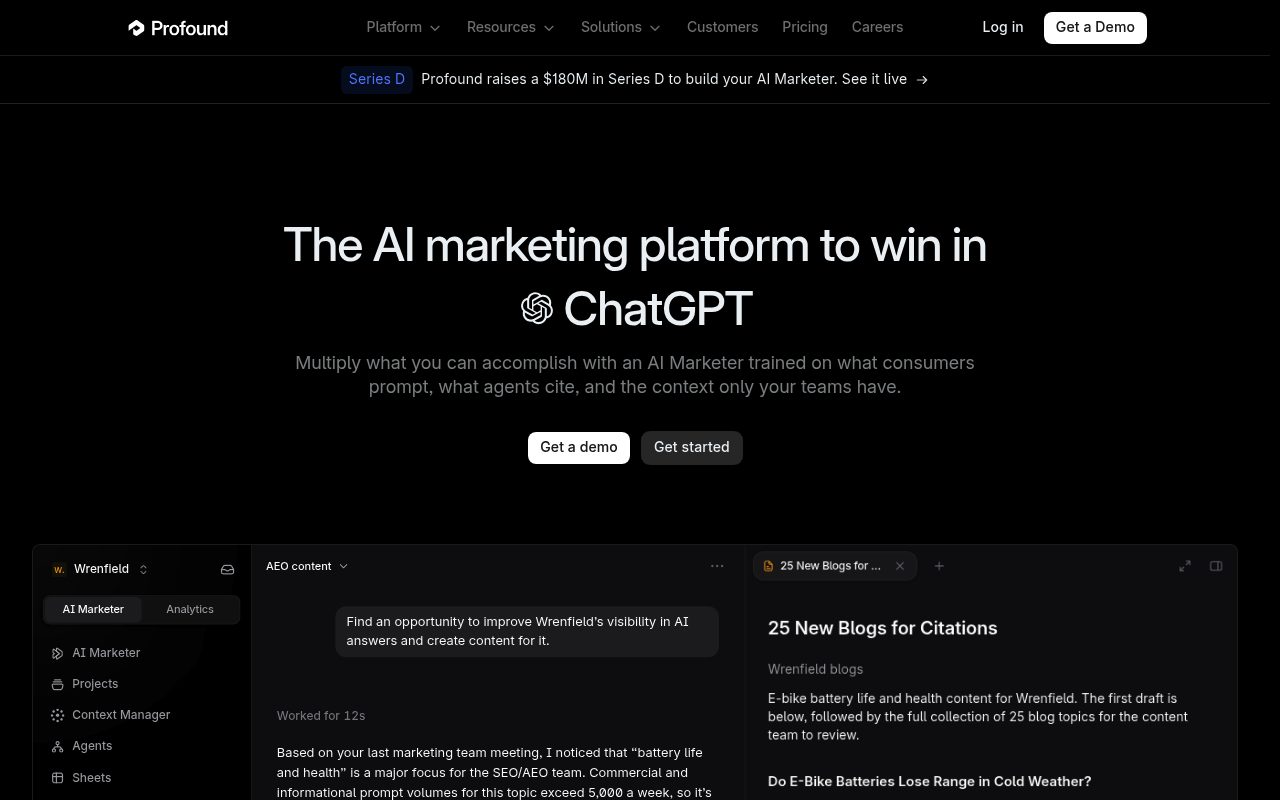
Screenshot: Profound homepage, October 2026.
Profound is listed here for enterprise benchmarking, but none of the sources used in this guide document its pricing, engine coverage, prompt allowance or metric definitions. Confirm all four directly before shortlisting.
- Pro: none verifiable from the published sources used here.
- Con: No published entry price or prompt allowance for side-by-side evaluation.
- Best for: teams willing to run a vendor call before comparing numbers.
Otterly: best for budget-conscious multi-engine tracking
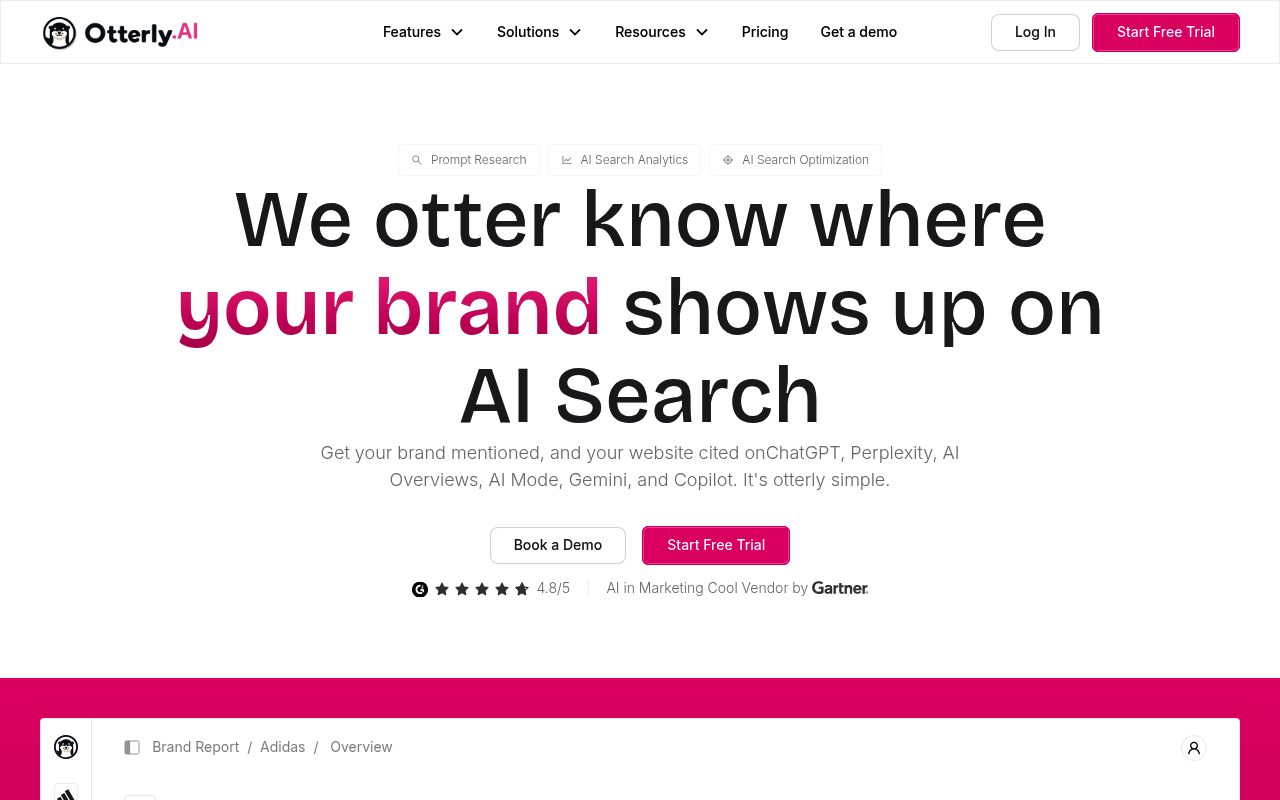
Screenshot: Otterly homepage, October 2026.
Otterly is the budget pick for small teams that need several engines tracked without enterprise pricing. Otterly's Lite plan costs $29/month for 15 prompts across ChatGPT, Google AI Overviews, Perplexity and Microsoft Copilot. Standard, at $189/month, costs 6.5× the $29 Lite price and raises the allowance to 100 prompts.
- Standard extras: API access, MCP access and Agent Analytics.
- Premium and Enterprise: $489/month and custom pricing.
- Add-ons: Google AI Mode, Gemini and Claude are optional extras, not base coverage.
- Con: API access starts at Standard. Wiring AI visibility into dashboards early means a $160/month step up.
Peec AI: best for sentiment and share-of-voice clarity
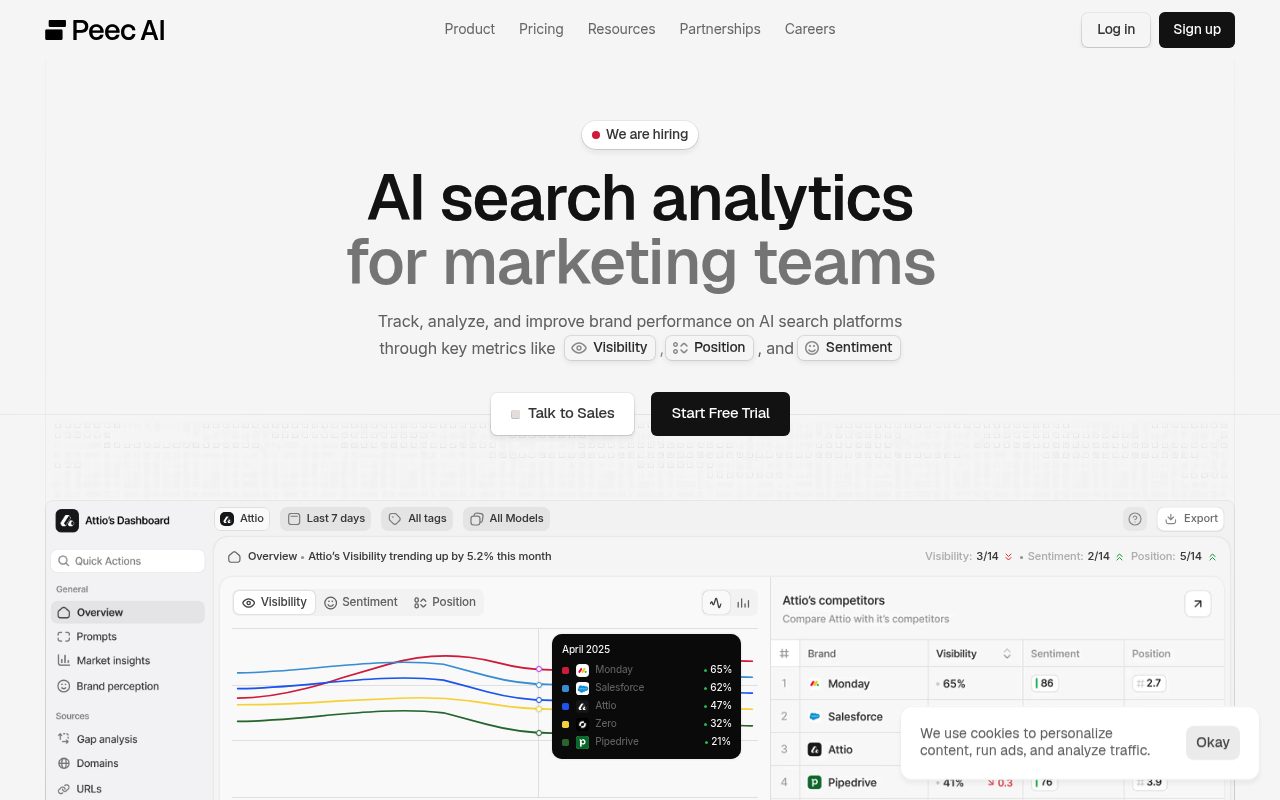
Screenshot: Peec AI homepage, October 2026.
Peec AI publishes plain definitions for every number on its dashboards, which run on four metrics: Visibility, Share of Voice, Position and Sentiment. Peec AI defines Visibility as the percentage of AI responses where a brand appears. That makes Peec AI's figures easy to explain to non-specialists.
- Base coverage: ChatGPT, Google AI Overviews, Google AI Mode, Gemini, Perplexity and Microsoft Copilot.
- Optional upgrades: OpenAI Search API, Claude Sonnet, Claude Haiku, DeepSeek API, Qwen API, Grok and Mistral.
- Agencies: unlimited client seats and dedicated 7-day pitch projects.
- Con: Claude and long-tail models cost extra. Base plan ≠ full supported list.
Semrush: best for teams already on Semrush
Semrush's AI Visibility Toolkit fits teams already paying for Semrush. The toolkit checks brand visibility across ChatGPT, Gemini, AI Mode and AI Overviews, tracks prompts daily and benchmarks against competitors. Semrush's free report adds total mentions, pages driving the most AI citations, and estimated audience reached through AI search.
- Headline metric: the AI Visibility Score runs 0–100, measuring how often a brand appears versus competitors.
- Prompt allowance: 25 on the toolkit plan, 50 on Semrush One Starter, up to 200 on Advanced.
- Reporting: share of voice, sentiment behind every citation and source-page analysis, refreshed weekly in one section.
- Con: mixed cadence. Prompts run daily; that section refreshes weekly.
Rankscale: best for granular metric diagnosis
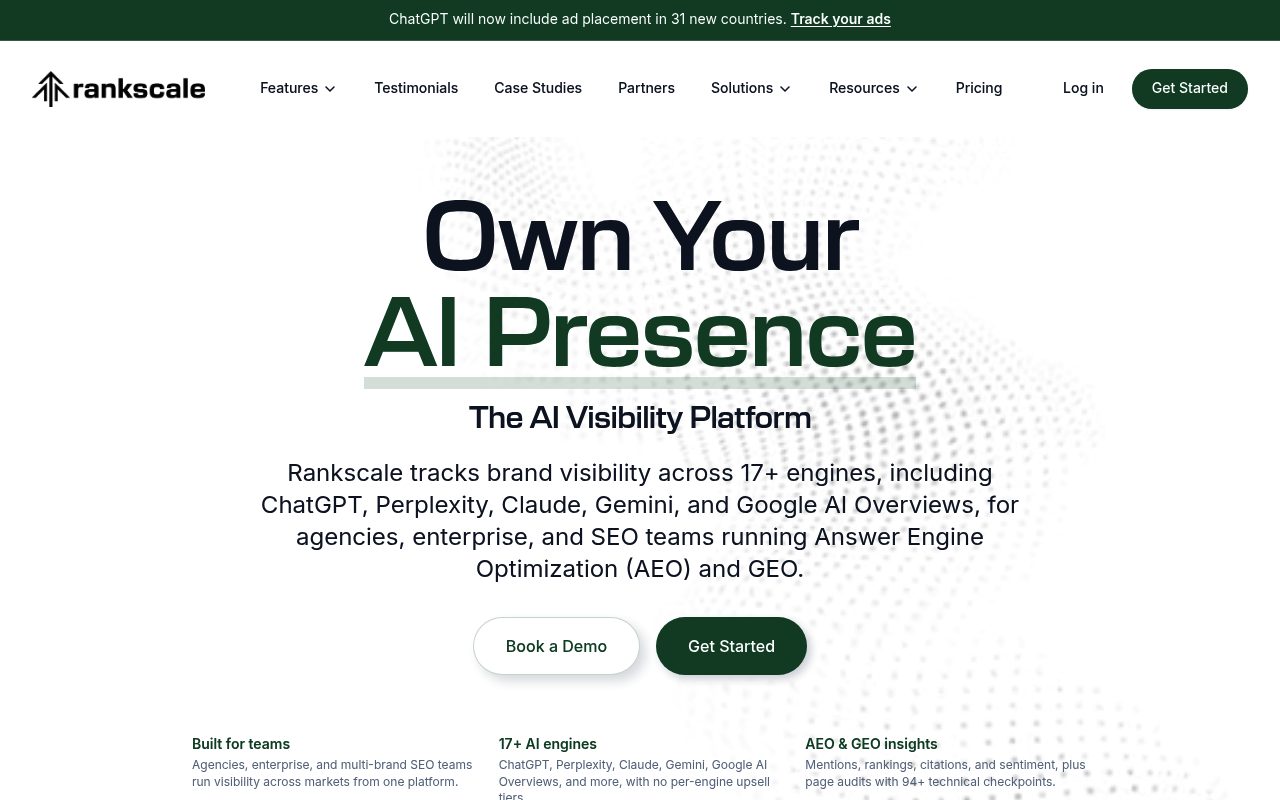
Screenshot: Rankscale homepage, October 2026.
Rankscale suits teams that need to diagnose why visibility moved, not only whether it moved. Rankscale treats AI visibility as several numbers and reports eight core metrics, including Detection Rate and Share of Citations. Rankscale's pricing is credit-based, with 10 prompt-research credits free each month on at least one tier.
- Pro: the widest named metric set in this comparison.
- Pro: free monthly research credits for testing prompts before committing.
- Con: credit-based pricing is harder to compare against flat monthly plans.
Promptwatch: best for technical crawler checks
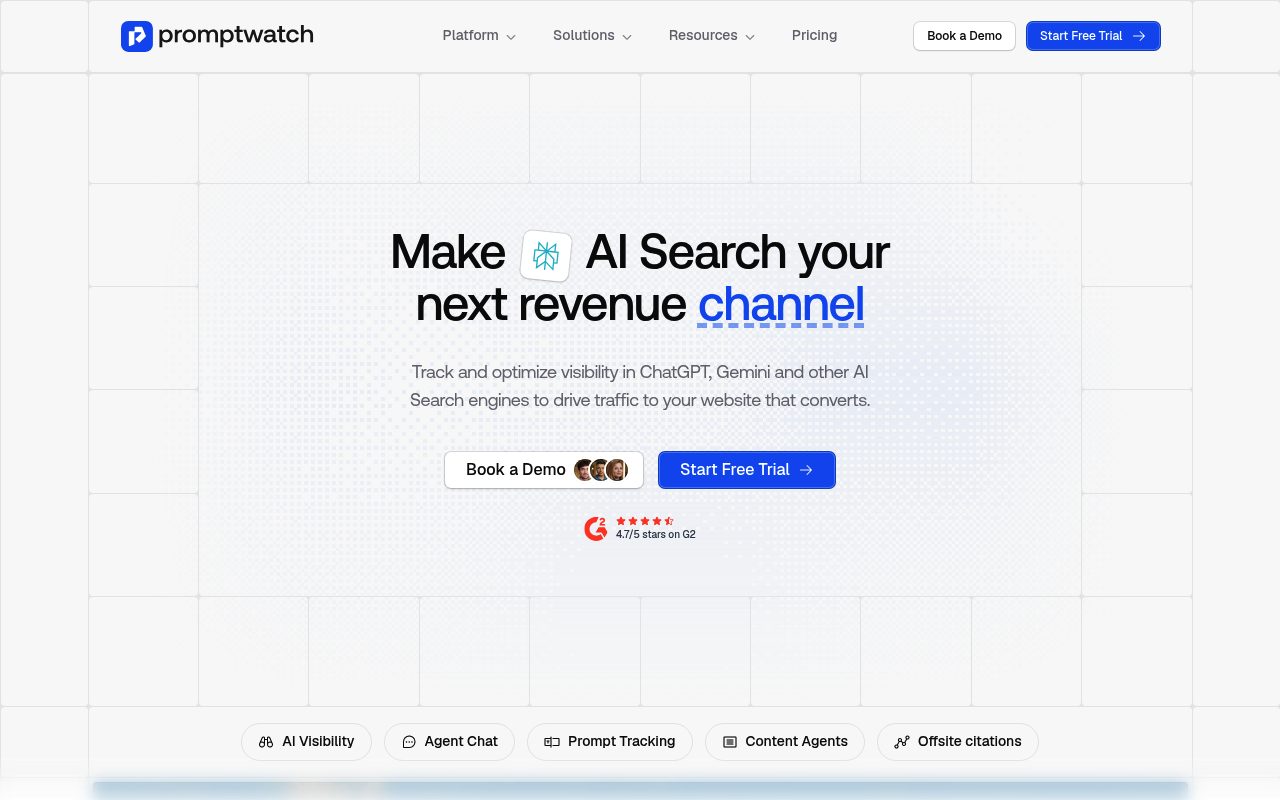
Screenshot: Promptwatch homepage, October 2026.
Promptwatch suits teams that suspect a technical block before a content gap. Promptwatch's free AI visibility report scans ChatGPT, Google Gemini and Perplexity, and checks whether crawlers from six AI companies (OpenAI, Anthropic, Perplexity, Google, Meta, ByteDance) are allowed in robots.txt. Blocked crawler, no visibility.
- Pro: free diagnosis that separates crawl problems from content problems.
- Con: paid pricing not published. The free scan covers three engines.
Sightkick: best for tracking plus automated content and outreach (Disclosure: our product)
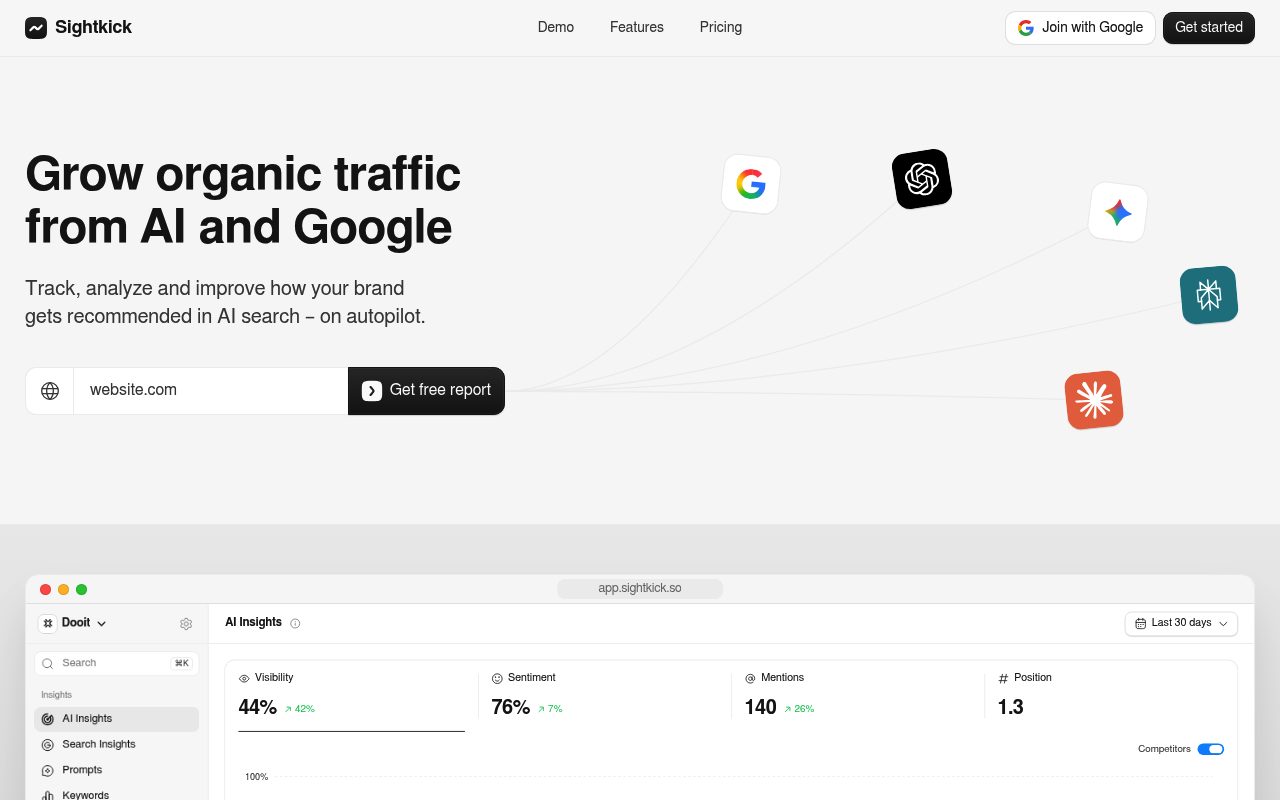
Screenshot: Sightkick homepage, October 2026.
Sightkick suits teams that want tracking and the fix in one platform. Sightkick tracks visibility, sentiment, mentions and position across ChatGPT, Gemini, Google AI Overviews and Google AI Mode. Every tracked prompt runs daily in 3 AI models. A 4th is an add-on. One plan costs $79/month, with a 3-day free trial and 2-minute setup.
- Sources: cited sources classified as UGC, Editorial, Yours (owned) or Competitor.
- Articles engine: researches, writes, scores, adds images, links and schema, and publishes to your CMS daily.
- Backlinks engine: finds pages AI already cites, verifies owner contacts, sends pitches and follow-ups, confirms links went live.
- MCP: 56 tools for Claude, ChatGPT, Cursor, VS Code and OpenClaw.
- Con: base runs 3 models. The 4th costs extra.
Compare Profound vs Peec AI vs Semrush for Share of Voice Tracking
Share of voice from Profound, Peec AI and Semrush can't be compared one-to-one, because each figure uses a different denominator. Peec AI divides your mentions by all tracked brands' mentions. Semrush scores 0–100 against competitors. Profound's share-of-voice definition isn't documented in the sources used here. Check denominators before sharing a slide.
- Semrush: a 0–100 score relative to competitors. Daily prompts, weekly share-of-voice section.
- Peec AI: share of voice is your mentions as a percentage of all tracked brands' mentions. Add a competitor and your share drops, even when raw mentions stay flat.
- Profound: calculation method not published in our sources. Ask for the denominator before comparing.
Match the definition to the question. "How often do we appear?" → visibility rate. "How much of the conversation do we own?" → competitor-relative share.
How Is AI Visibility Actually Measured?
AI visibility is measured as a set of separate metrics, not one number. Rankscale lists eight core metrics: Visibility Score, Position, Sentiment, Mentions, Citations, Detection Rate, Share of Voice and Share of Citations. A brand can rank high on mentions but low on position, so single-score dashboards hide real gaps.
- Visibility Score: an aggregate 0–100 score on a prompt variation or prompt group, in Rankscale's definition.
- Share of Voice: your mention share versus competitors on a prompt group.
- Mentions vs Citations: a mention names your brand. A citation links your page as a source.
- Position and Sentiment: where you appear relative to rivals, and the tone around the mention.
Rankscale's weekly tracker example shows how far these numbers drift apart. A 34% Visibility Score sits alongside 18% Share of Voice, 142 weekly mentions and 38 weekly citations. The brand appears often but owns under a fifth of the competitive conversation.
Source type is the layer most dashboards skip. Sightkick classifies cited sources as UGC, Editorial, Yours (owned) or Competitor, which shows where recommendations originate, not only how many exist. That split decides the fix: owned content, editorial outreach or community presence. The GEO audit guide turns these metrics into an audit.
How to Track Brand Mentions Inside ChatGPT and Gemini Answers
Tracking brand mentions inside ChatGPT and Gemini answers starts with one check: whether both engines sit in base coverage or one is a paid add-on. Otterly's Lite plan covers ChatGPT but not Gemini. Peec AI lists ChatGPT and Gemini in base coverage alongside Google AI Overviews and AI Mode.
- Read the engine list per plan. Pricing pages bury the line between base engines and add-ons.
- Confirm the cadence. Otterly states it monitors daily across ChatGPT, Google AI Overviews / AI Mode, Perplexity, Gemini, Copilot and Claude, add-on engines included.
- Rule out access problems first. Run a robots.txt crawler check like Promptwatch's. If GPTBot is blocked, low ChatGPT visibility is a crawl issue, not a content issue.
- Prioritize cadence over engine count. In our view, four engines tracked daily catch competitive shifts faster than seven refreshed weekly.
Engine-by-engine setup: LLM visibility checker guide.
A Benchmark Framework for Competitor Share of Voice
A competitor share-of-voice benchmark needs a fixed prompt set, constant engines and cadence, and a share calculation per competitor. The method below copies straight into your own reporting. Segmenting citations by source type then shows where rivals win placement and which gaps are winnable.
- Fix the prompt list. Use real buyer questions ("best AI visibility tool for agencies"), not your brand name. Branded prompts inflate share.
- Hold engines and cadence constant. Same three or four engines, daily, for at least 30 days. Single runs vary too much.
- Calculate share per competitor. Share = answers naming the brand ÷ total completed answers. Shares won't sum to 100%.
- Classify citation sources. Tag each cited URL as Owned, Editorial, UGC or Competitor. If a rival wins through UGC threads while you rely on owned pages, editorial placements are the gap.
- Report the spread, not just your number. A narrow gap is a race. A wide, persistent gap is structural.
Output to a weekly sheet, five columns: prompt group, engine, brand, share, top source type. One view of who owns each buyer question.
Frequently asked questions
These AI visibility tracking FAQs cover three questions buyers raise after shortlisting: whether a one-time report is enough, how Google's AI surfaces differ from ChatGPT, and whether vendors publish ROI case studies. Each answer relies only on vendor-published facts.
Is a one-time AI visibility report enough, or does it need ongoing tracking?
A one-time report is a baseline snapshot. AI answers shift as models update and competitors publish, so ongoing tracking catches movement. Daily prompt runs, such as Semrush's prompt tracking, surface shifts faster than weekly refreshes. That matters most for brands actively working to improve position.
Do AI visibility platforms track Google AI Overviews and AI Mode the same way as ChatGPT?
No. Most vendors list Google AI Overviews and AI Mode as separate surfaces from ChatGPT and Gemini, and some sell one of them as an add-on. Peec AI, for example, lists AI Overviews and AI Mode as two distinct engines. Check each vendor's engine list per plan.
Are there case studies showing ROI from AI visibility tracking tools?
None of the vendor pages cited here publish ROI case studies with figures. Ask vendors for client results directly, and measure your own baseline before and after so the return is yours to prove.
Vendor metrics show how each tool counts visibility. A 30-day benchmark on your own buyer prompts shows where you can win.
For a baseline before choosing any tool, get a free brand visibility report from Sightkick (our product). It shows visibility, sentiment, mentions and position against competitors across AI search.