 Join with Google
8 Best AI Search Visibility Tools for 2026 (Ranked)

Fabio Bergmann
· Updated
An AI search visibility tool is software that tracks whether a brand is mentioned, cited, and recommended inside AI answer engines like ChatGPT, Perplexity, Gemini, and Google AI Overviews, measuring mention rate, sentiment, and competitive position instead of keyword rankings.
Disclosure: this guide is published by Sightkick, which sells an AI visibility platform included in the list below.
Key takeaways
- AI search visibility means being mentioned and cited inside AI answers (ChatGPT, Perplexity, AI Overviews), not ranking blue links.
- Only 28% of AI answers mention and cite the same brand, and just 30% of brands stay visible across consecutive answers, per AirOps.
- Pricing scales fastest at the top: OtterlyAI's Standard plan is 6.52× its Lite tier, and Scrunch's Pro plan is 3.33× its Starter tier.
- The stronger tools pair monitoring with action (content publishing, backlink outreach), not just dashboards.
- A free brand visibility report baselines your visibility %, sentiment, mentions, and position before you buy.
What Is an AI Search Visibility Tool?
An AI search visibility tool tracks whether and how a brand is mentioned, cited, and recommended inside AI answer engines like ChatGPT, Gemini, Google AI Overviews, Claude, and Perplexity. It measures mention rate, sentiment, citation sources, and competitive position instead of keyword rank positions.
AirOps defines AI search visibility as how present your brand is across AI answers: how often you're mentioned, how often you're cited, and your share of voice versus competitors. These tools differ from rank trackers because AI answers are generated fresh, not pulled from a fixed list of URLs.
- Tracks brand mentions, sentiment, and position across multiple AI models at once.
- Runs automated prompts daily and reports share of voice against named competitors.
- Reports per-engine and per-prompt, which AirOps recommends measuring with mention rate, citation rate, share of voice, and sentiment.
How Do AI Search Engines Decide Which Brands to Mention?
AI engines weigh content authority, structured citations, third-party editorial mentions, UGC sentiment from Reddit and forums, and how often a source is already cited elsewhere. The compounding effect matters most: pages an engine already cites tend to get cited again.
Citation sources break into four types: UGC, Editorial, Yours (owned pages), and Competitor. Sightkick classifies tracked citations by these types, showing where recommendations actually come from. That structure exposes a practical lever most dashboards ignore.
This is why backlink and outreach strategy now feeds AI visibility, not only classic SEO. A link from a page AI already trusts raises the odds your brand shows up in the next answer.
AI Search Visibility vs. Traditional SEO Rankings: What's Actually Different?
Traditional SEO tracks a keyword's rank position for a URL on a results page. AI search visibility tracks whether a brand is mentioned or cited inside a generated answer, which varies by prompt phrasing, model, and session. That makes it a probabilistic, per-prompt measurement rather than a fixed rank.
- SEO measures a fixed SERP position for a keyword; AI visibility measures mention or citation probability per prompt, per model.
- A page can rank #1 in Google and still never appear in an AI Overview or ChatGPT answer.
- Operationally, you track page-level citations across engines daily, not with a monthly rank check.
For a deeper operational breakdown, see our 2026 guide to AI search visibility.
The Hidden Mention-vs-Citation Gap Nobody Talks About
Being mentioned in an AI answer is not the same as being cited as a source. This gap is the single most under-measured metric in vendor roundups, and the AirOps numbers show why it matters. As AirOps puts it:
Only about 28% of AI answers mention and cite the same brand, and only 30% of brands stay visible from one answer to the next.
The 28% overlap means most brand mentions aren't backed by a clickable source. The 30% persistence figure means a brand visible today may vanish tomorrow, so visibility has to be tracked continuously, not audited once.
Ask any tool two questions before buying: do you separate mention rate from citation rate, and do you track day-over-day persistence? Most roundup pages skip this distinction.
How to Check Your Website's AI Visibility (and What Metrics Matter)
To check AI visibility, run category-relevant prompts across ChatGPT, Perplexity, Gemini, and Google AI Overviews, then log whether your brand is mentioned, whether it's cited, its sentiment, and its average recommendation position. These are the four metrics a free visibility report typically surfaces.
- Visibility percentage: share of tracked prompts where the brand appears.
- Sentiment score: the tone of the mention, not just its presence.
- Mention count and average position: how often and how high you're recommended across models.
Sightkick's free brand visibility report generates this baseline (visibility percentage, sentiment score, mention count, average AI recommendation position) before you commit to any paid plan.
Comparison Table: AI Search Visibility Tools at a Glance
Pricing and coverage vary sharply. Entry plans run $29 to $300/month, and top tiers cost several times the entry tier. OtterlyAI's Standard plan is 6.52× its Lite plan, Rankscale's Growth is 3.89× its Pro, and Scrunch's Pro is 3.33× its Starter. The table compares prompt or answer limits, tracked models, and starting price.
| Tool | Price range /mo | Prompts / answers | Top-to-entry ratio | Notable coverage |
|---|---|---|---|---|
| OtterlyAI | $29–$489 | 15–400 prompts | 6.52× (Standard vs. Lite) | ChatGPT, AIO, Perplexity, Copilot; Claude/Gemini/AI Mode add-ons |
| Peec AI | By prompt/model count | 50–350 prompts, 3 models | — | Multi-country + Looker Studio on Advanced |
| Scrunch AI | $250–$1,000+ | 350–1,200 custom prompts | 3.33× (Pro vs. Starter) | ChatGPT, Perplexity, Claude, Meta AI, Gemini, AIO |
| Rankscale | $99–$385 | 1,200–5,500 credits (≈4,800–22,000 answers) | 3.89× (Growth vs. Pro) | 7-day free trial |
| Promptwatch | $95–$245 | 500–1,500 Agent Credits | 2.58× (Pro vs. Essential) | AEO articles on Professional tier |
| Sightkick | 7-day free trial | 4 models, daily | — | 7 sources incl. Reddit + content & backlink automation |
Otterly: Budget-Conscious Teams Starting With Core AI Engines
Screenshot: Otterly pricing page, August 2026.
Otterly is a straightforward tracker with three tiers covering ChatGPT, Google AI Overviews, Perplexity, and Copilot by default, plus Claude, Gemini, and AI Mode as paid add-ons. Its Standard plan costs 6.52× its Lite plan, a steep jump for teams scaling prompt volume.
- Lite: $29/mo, 15 prompts; Standard: $189/mo, 100 prompts; Premium: $489/mo, 400 prompts.
- All three plans include daily tracking and unlimited team members, per Otterly's help center.
- Annual billing saves 15% off monthly pricing.
- Claude, Gemini, and AI Mode require add-on fees, which raise the real cost.
Peec AI: Teams Scaling Prompt Volume Gradually
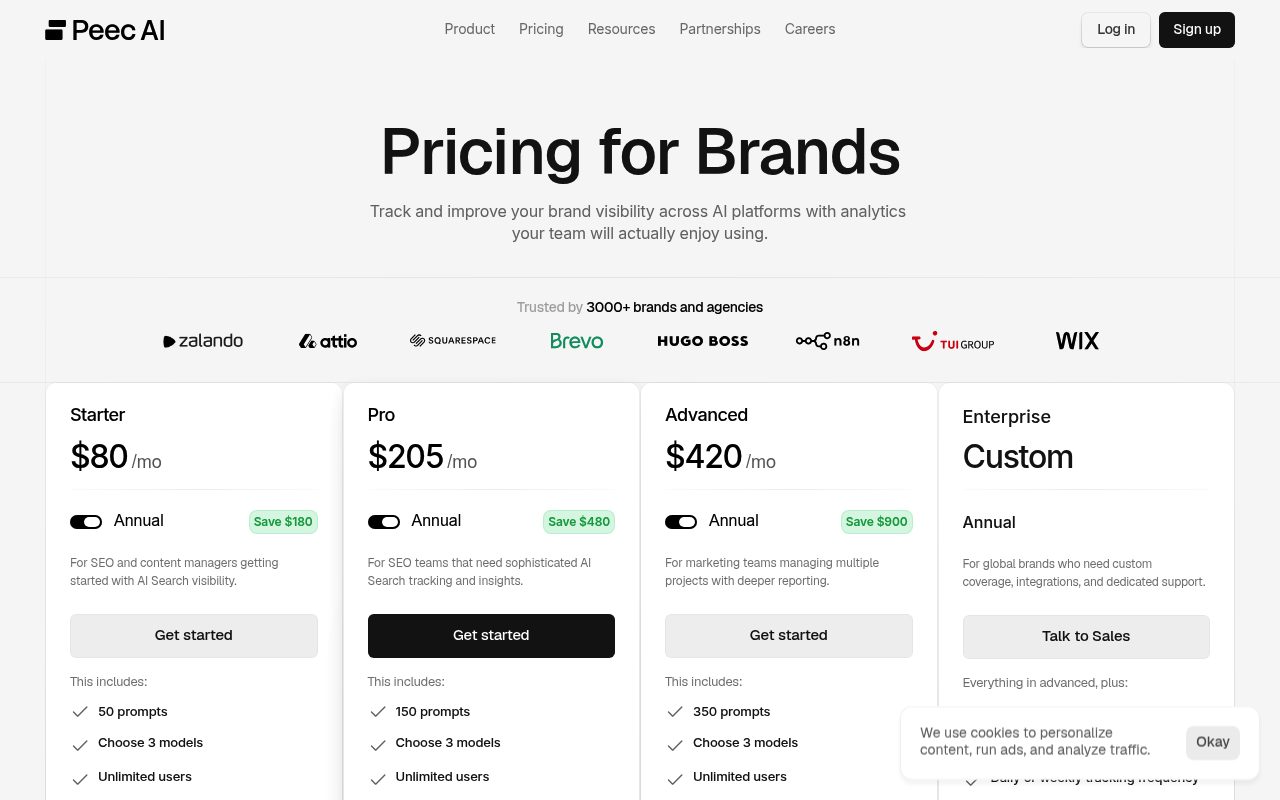
Screenshot: Peec AI pricing page, August 2026.
Peec AI prices by tracked prompts and models, starting at 50 prompts across 3 models on Starter and scaling to 350 prompts with multi-country support and Looker Studio integration on Advanced. All tiers include unlimited users and daily tracking, with per-prompt discounts at higher volumes.
- Starter: 50 prompts, 3 models, 1 project.
- Pro: 150 prompts, 3 models, 2 projects.
- Advanced: 350 prompts, 3 models, 5 projects, multi-country plus Looker Studio.
Peec AI prices on tracked prompts and models analyzed, and higher tiers get discounts on price per prompt plus dedicated support. That structure suits teams adding prompt volume over time rather than buying flat feature tiers.
Sightkick: Combines Visibility Tracking With Content and Backlink Automation
Sightkick tracks brand mentions, sentiment, and position across ChatGPT, Gemini, Google AI Overviews, Google AI Mode, Claude, Perplexity, and Reddit at once, then acts on the gaps by auto-publishing articles and running backlink outreach.
- Runs prompts across 4 AI models daily to benchmark which brands get recommended.
- The Articles engine researches, writes, scores, adds images/links/schema, and publishes to a CMS on schedule with no manual input.
- The Backlinks engine finds pages AI already cites, verifies owner contact details, sends outreach and follow-ups, and confirms links go live.
- Sightkick MCP exposes 29 tools inside Claude, ChatGPT, Cursor, OpenClaw, and Codex.
- 7-day free trial, roughly 2-minute setup, plus a free brand visibility report at entry.
Limitation: as a newer, broader platform, Sightkick publishes a free-trial entry rather than a public per-tier price sheet. Buyers who want a bare-bones tracker with fixed published tiers may prefer single-purpose tools.
Scrunch AI: Enterprises Needing Page Audits and Personas
Scrunch AI targets larger teams with plans from $250 to $1,000+/month, bundling custom and industry prompts with persona segmentation and page audits across ChatGPT, Perplexity, Claude, Meta AI, Gemini, and Google AI Overviews. Its Pro plan costs 3.33× its Starter plan.
- Starter: $300/mo, 350 custom + up to 1,000 industry prompts, 3 personas, 5 page audits.
- Growth: $500/mo, 700 custom prompts, 5 personas, 10 page audits.
- Pro: $1,000/mo, 1,200 custom prompts, 7 personas, 20 page audits.
Scrunch's FAQ also lists a separate Core tier at $250 per month covering four platforms (ChatGPT, Perplexity, Google AI Overviews, Microsoft Copilot), so coverage varies by which pricing page you land on.
Rankscale AI: Credit-Based Flexibility With a Free Trial
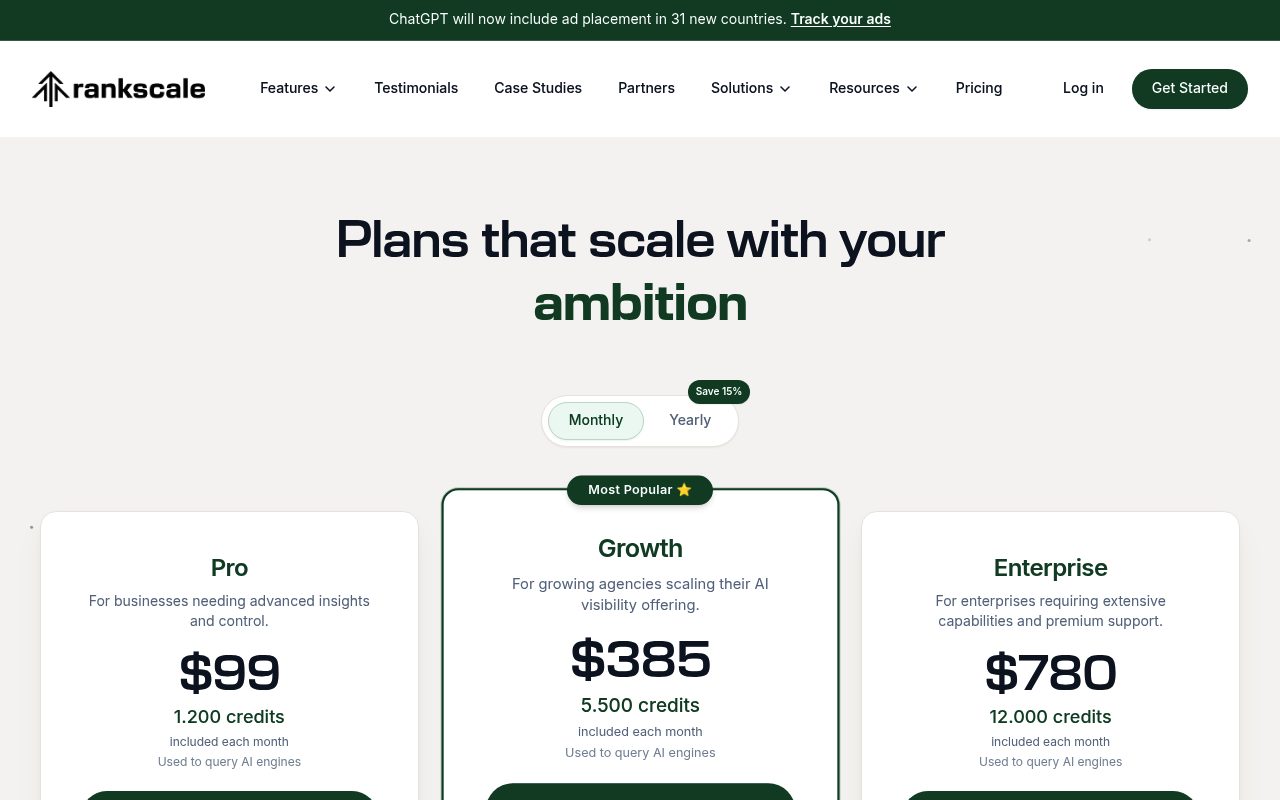
Screenshot: Rankscale AI pricing page, August 2026.
Rankscale uses a credit system rather than flat prompt counts. Pro costs $99/month for 1,200 credits (up to 4,800 tracked answers), while Growth costs $385/month for 5,500 credits (up to 22,000 answers). Each engine query typically consumes about 0.25 credits, and a 7-day free trial is included.
- Pro: $99/mo, 1,200 credits, up to 4,800 tracked answers, 7-day free trial.
- Growth: $385/mo, 5,500 credits, up to 22,000 tracked answers.
- Growth costs 3.89× Pro, a steep step for teams needing more answer volume.
Rankscale says each AI engine query uses a fraction of a credit, usually 0.25, so tight prompt design stretches a plan further. For more credit-model comparisons, see our roundup of the best generative engine optimization tools.
Promptwatch: Teams Wanting Built-In AEO Article Production
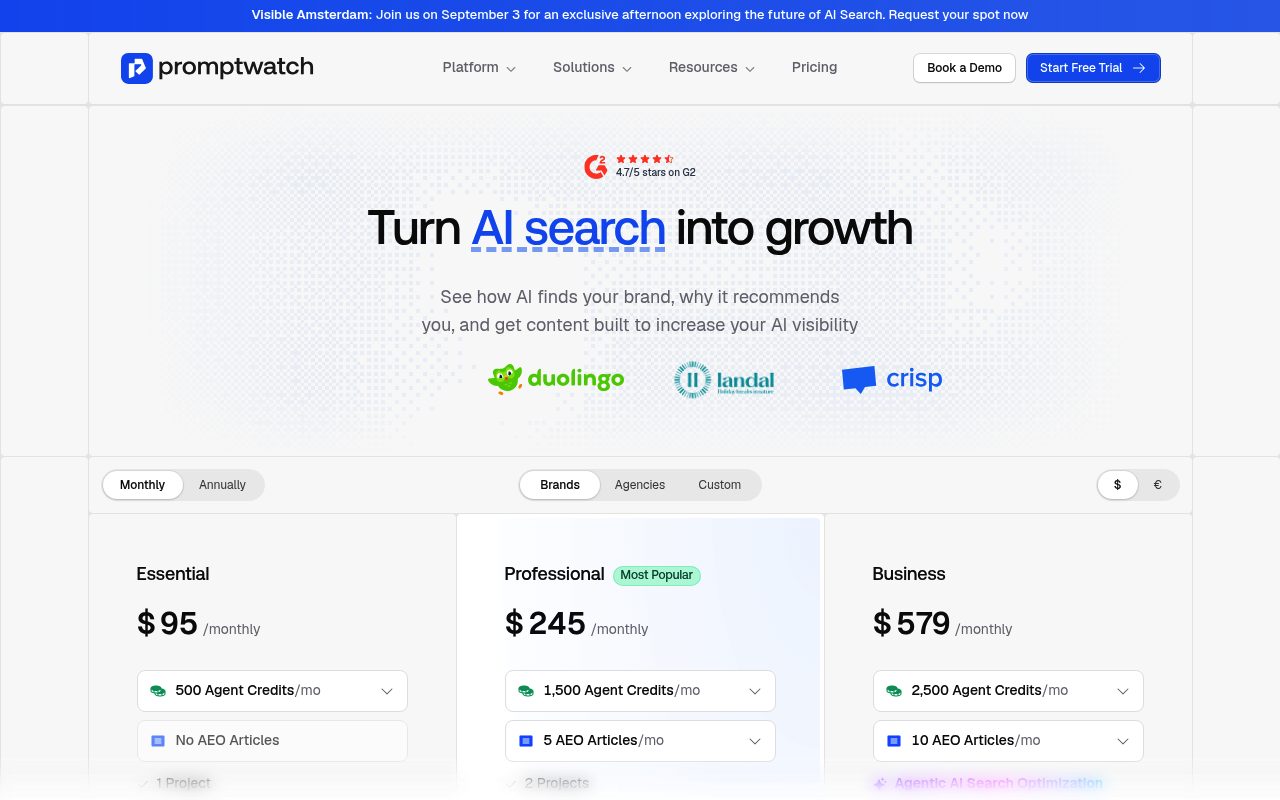
Screenshot: Promptwatch pricing page, August 2026.
Promptwatch bundles visibility tracking with content output. Essential ($95/month) covers 500 Agent Credits and 50 prompts across 4 models, while Professional ($245/month) adds 5 AEO articles per month, a knowledge base, and Agent Analytics alongside MCP/API access.
- Essential: $95/mo, 500 Agent Credits, 1 project, 50 prompts, 6,000 responses.
- Professional: $245/mo, 1,500 Agent Credits, 5 AEO articles/mo, 2 projects, 150 prompts, 18,000 responses.
- Both tiers include MCP/API access, useful for teams building AI agent workflows.
The AEO article inclusion makes Promptwatch one of the few trackers pairing monitoring with content production, close to what we cover in our list of AI SEO automation platforms.
Frequently asked questions
What is the best AI search visibility tool?
No single tool wins for everyone. Otterly and Rankscale suit budget-conscious teams wanting core tracking; Scrunch fits enterprises needing page audits; Promptwatch and Sightkick suit teams wanting tracking paired with content or backlink automation rather than analytics alone.
How do I see my AI visibility across platforms?
Use a visibility tool that runs your brand and competitor prompts daily across ChatGPT, Gemini, Perplexity, Google AI Overviews, and Claude, then reports mention rate, sentiment, and citation sources. Many platforms, including Sightkick, offer a free report showing visibility percentage, sentiment, mentions, and average position.
What are AI Visibility Services?
AI visibility services are platforms or agencies that monitor and improve how often a brand is mentioned and cited in AI-generated answers. They typically combine prompt-based tracking across multiple models with optimization actions like content publishing, schema markup, or backlink outreach.
Which platforms let you benchmark AI visibility against competitors?
Otterly, Peec AI, Scrunch AI, Rankscale, Promptwatch, and Sightkick all support competitive benchmarking by running the same prompts for your brand and named competitors, then comparing mention frequency, sentiment, and share of voice across AI models at once.
What metrics matter most for measuring AI search visibility?
The core metrics are mention rate, citation rate (only about 28% of AI answers mention and cite the same brand), sentiment, share of voice versus competitors, and average recommendation position, tracked per engine and per prompt rather than as one aggregate score.
How can I improve my brand's presence in AI-generated search results?
Publish content that answers the specific prompts your buyers ask, earn citations on pages AI already references, and monitor sentiment continuously since visibility fluctuates. Combining tracking with automated content publishing and backlink outreach closes gaps faster than manual SEO alone.
Want a baseline before you pick a tool? Get a free Sightkick brand visibility report to see your current visibility percentage, sentiment, mentions, and average AI position against competitors.