 Join with Google
8 Best LLM Tracking Tools for AI Search Visibility (2026)

Fabio Bergmann
Your demo requests mention ChatGPT, yet your rank tracker can't show what ChatGPT actually said about you. LLM tracking tools target that gap. The six tools compared here (Otterly, Peec AI, Rankscale AI, Promptwatch, AI Peekaboo, and Sightkick) run prompts across AI models on a schedule, then log whether your brand gets named, in what position, and with what sentiment.
Disclosure: Sightkick publishes this comparison and is one of the six tools listed.
Why tracking brand mentions in AI answers is harder than it looks
Classic rank trackers can't see what ChatGPT, Gemini, or Perplexity say about your brand. AI answers are generated per query, not indexed and cached. LLM tracking tools run repeated prompts across models and log whether, how, and with what sentiment your brand gets named. That is a different monitoring problem from traditional SEO.
A Google SERP is roughly stable for everyone searching the same keyword. A ChatGPT answer is not. The same prompt can name your brand on Monday, drop it on Tuesday, and rank a competitor first on Wednesday. One audit captures one draw from a moving distribution. Visibility becomes a sampling problem: the same prompts, across several models, repeated over time.
Vendors sample differently. Otterly monitors daily across major AI search engines. AI Peekaboo asks tracked prompts live against each model with real-time web search on, so answers reflect current retrieval, not frozen training data.
The term "LLM tracking" covers two different jobs. Brand-visibility trackers monitor what public AI answers say about your company. LLM observability tools trace your own production AI app: latency, token spend, evals, failed tool calls. A marketing team buying the second gets dashboards for a chatbot it doesn't run. Every tool below does the first job.
How we chose these LLM tracking tools
These six LLM tracking tools made the list for direct relevance to AI search visibility: tracking brand mentions, sentiment, or share of voice across ChatGPT, Gemini, Claude, Perplexity, or Google AI Overviews and AI Mode. Pricing, model coverage, integrations, and trial terms were checked against each vendor's own pricing or product pages as of October 2026.
- Scope: the tool must track brand presence inside AI-generated answers. Keyword rank tracking alone did not qualify.
- Pricing: plan prices, credits, prompt caps, and model access come from vendor pages. Where a vendor doesn't publish a number, the table says so.
- Integrations: Slack, Search Console, Data Studio, and MCP claims were checked against vendor documentation.
- Excluded: tools built only for LLM app observability or prompt debugging.
For a wider field that includes enterprise suites, see our ranking of AI search visibility tools.
LLM tracking tools compared: pricing, models, and free trials at a glance
Published entry pricing for these six LLM tracking tools runs from a free workspace to $199 a month. Prompt caps, credits, and model access vary sharply by plan, and model coverage and integrations separate the tools more than headline price does. The table compares all six on entry pricing, trial terms, limits, and integrations as of October 2026.
Takeaway: cheap entry often means fewer models. Broad coverage and workflow integrations cost more.
| Tool | Entry price | Free trial / tier | Entry limits | Model coverage | Published integrations |
|---|---|---|---|---|---|
| Otterly | $29/month | 7-day trial; 14-day trial with 50 free prompts | Not published | Major AI search engines | Not published |
| Peec AI | Not published | Not published | 50 prompts, 1 project, unlimited users | 3 models (Starter) | Not published |
| Rankscale AI | $99/month (Pro) | Not published | 1,200 credits; up to 4,800 answers | ChatGPT, Gemini, Perplexity, Claude, DeepSeek, Mistral, Grok, Copilot, more | MCP (Claude, ChatGPT, Cursor) |
| Promptwatch | $199/month (Kick-off) | Not published | 1,000 Agent Credits/month | Not published | Slack, Google Search Console, Data Studio |
| AI Peekaboo | Free workspace | Free tier | 1 brand, 25 prompts, 3 competitors | Not published | Not published |
| Sightkick (our product) | Not published | 7-day trial | Not published | 4 AI models sampled daily; ChatGPT, Gemini, AI Overviews, AI Mode, Claude, Perplexity, Reddit tracked | MCP (29 tools) |
Sources: Otterly pricing, Otterly trial, Peec AI pricing, Rankscale pricing, Rankscale MCP, Promptwatch pricing, AI Peekaboo free account, Sightkick product documentation.
On integrations, the split is clear. Promptwatch is the only vendor here listing Slack and analytics connectors. Rankscale and Sightkick publish MCP connections. Teams that live in Slack or Data Studio should weigh those columns before price.
Which LLM tracking tool actually gets cited most by AI models?
In Sightkick tracking data, Profound and Otterly were the two brands AI answers named most for this category. Across 6,988 AI answers about LLM tracking tools from 2026-09-02 to 2026-10-02, Profound was named in 37.4% and Otterly in 35.2%. That is recommendation share. It does not measure product quality or customer satisfaction.
| Brand | Share of answers |
|---|---|
| Profound | 37.4% |
| Otterly | 35.2% |
Source: Sightkick AI-visibility tracking, 2026-09-02 to 2026-10-02, 6,988 answers.
Method: share is the percentage of 6,988 AI answers about LLM tracking tools in which the brand was named. One answer can name several brands, so shares don't sum to 100%.
The two leaders sit 2.2 points apart. A buyer asking an AI model for a shortlist will likely see both names. Profound has no section below because this comparison sticks to vendors whose published pricing and product pages we checked. Our guide to tracking AI recommendations for your brand covers running the same measurement on your own category.
Otterly: best for fast setup and budget-friendly entry pricing
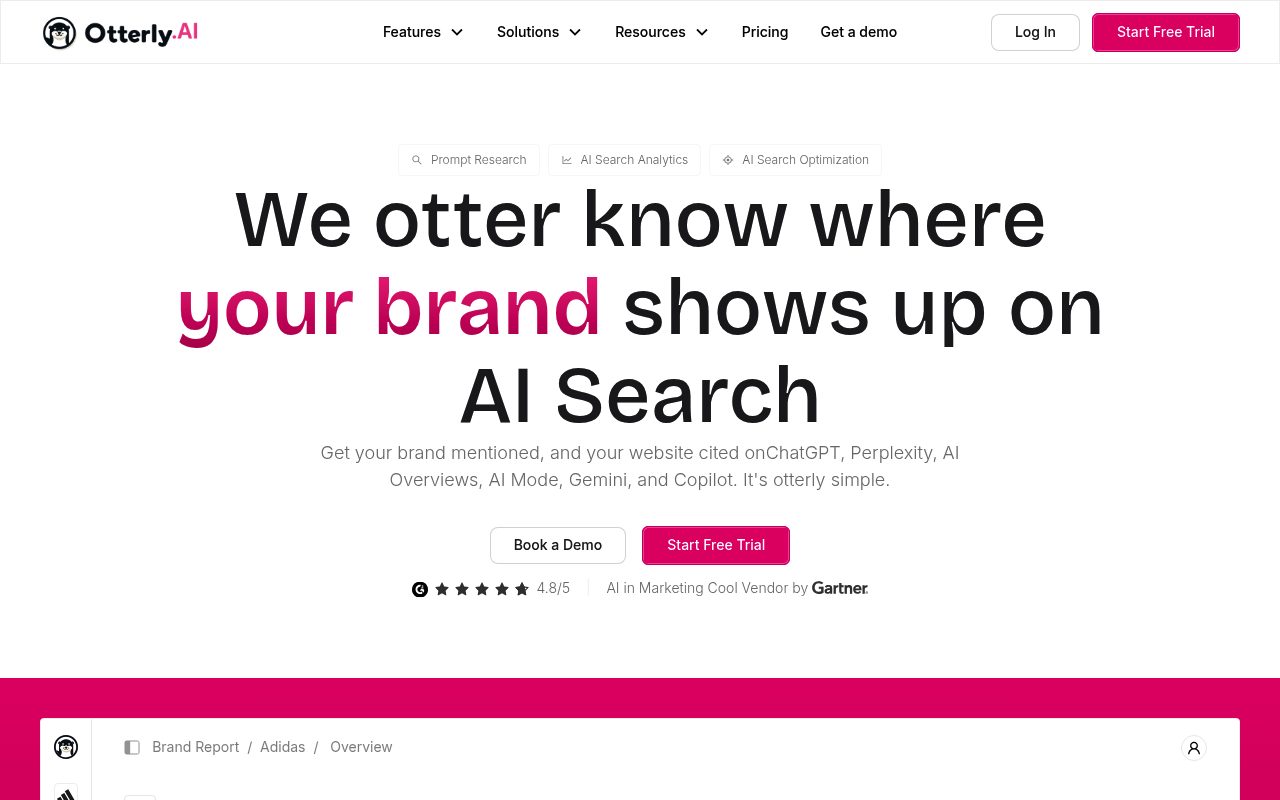
Screenshot: Otterly homepage, October 2026.
At $29/month, Otterly is the lowest-cost paid entry in this comparison. It monitors visibility daily across major AI search engines, and a 14-day trial with 50 free prompts lowers the barrier further. The trade-off: some engines sit behind paid add-ons rather than coming bundled at entry.
Add-ons for Google AI Mode, Gemini, and Claude are available on all plans. True monthly cost depends on which engines your buyers actually use. A B2B SaaS team whose prospects research in Claude or Gemini should price those add-ons on day one.
- Pros: low starting price, daily tracking, two trial paths
- Cons: broader engine coverage costs extra
- Fit: smaller teams testing AI visibility before committing to a bigger platform
Peec AI: best for share-of-voice and sentiment detail at entry tier
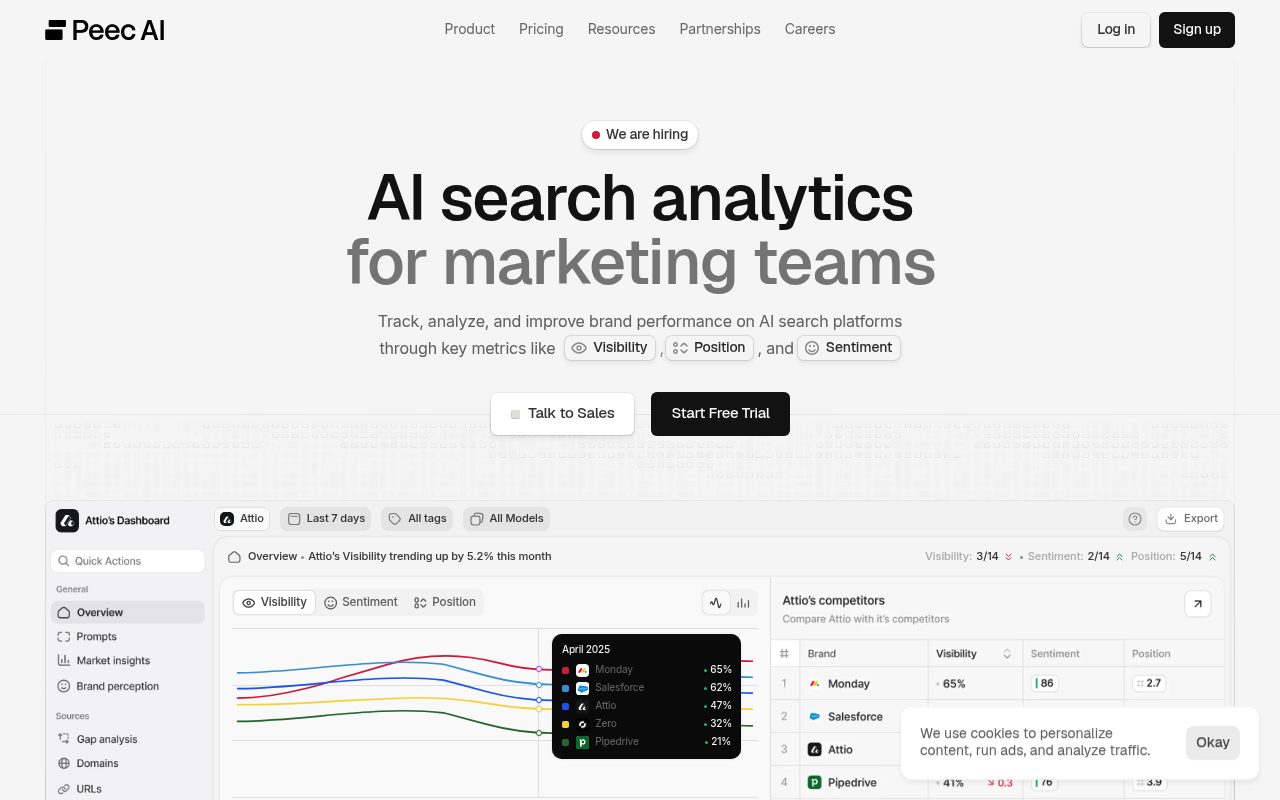
Screenshot: Peec AI homepage, October 2026.
Peec AI's verdict comes down to metric clarity. Its Starter plan includes 50 prompts across 3 models, unlimited users, and daily tracking. Its metric definitions are precise enough to report upward without translation. Marketers who need competitor-benchmarked share-of-voice numbers get them without building custom reports.
Peec AI tracks visibility, position, sentiment, and share of voice across major AI platforms. Visibility is the percentage of AI responses that mention your brand. Share of voice is your brand's mentions as a percentage of all mentions, competitors included. One answers "are we present?" The other answers "are we winning the conversation?"
The constraint is scope. Starter covers one project and three models, which gets tight for agencies juggling clients or brands tracking several markets.
Rankscale AI: best for broad model coverage and MCP/agent workflows
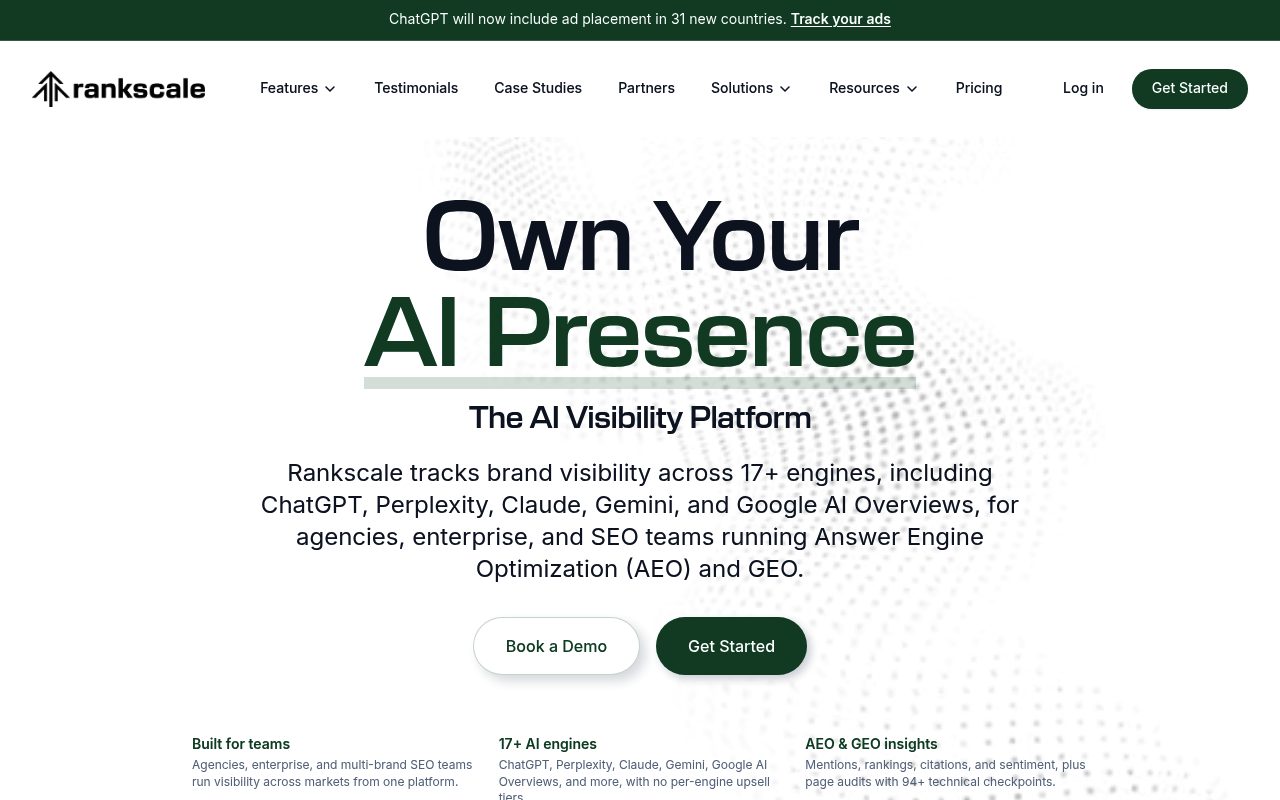
Screenshot: Rankscale AI homepage, October 2026.
Rankscale AI publishes coverage across 17+ engines, including ChatGPT, Gemini, Claude, Perplexity, and Google AI Overviews; its pricing page adds DeepSeek, Mistral, Grok, and Copilot. An MCP connection lets teams query visibility data from inside Claude, ChatGPT, or Cursor. Pricing runs from $99 to $385 a month by credit volume.
Credits map to answer volume. Pro costs $99/month for 1,200 credits and tracks up to 4,800 AI-engine answers. Growth costs $385/month for 5,500 credits and up to 22,000 answers. Enterprise reaches 48,000. Credit pricing rewards tight prompt sets and punishes sprawl: many engines times hundreds of prompts burns credits fast.
The MCP angle matters for technical teams. Asking about brand visibility in plain language from an AI assistant removes a dashboard login from the daily loop.
Promptwatch: best for Slack and Search Console integration
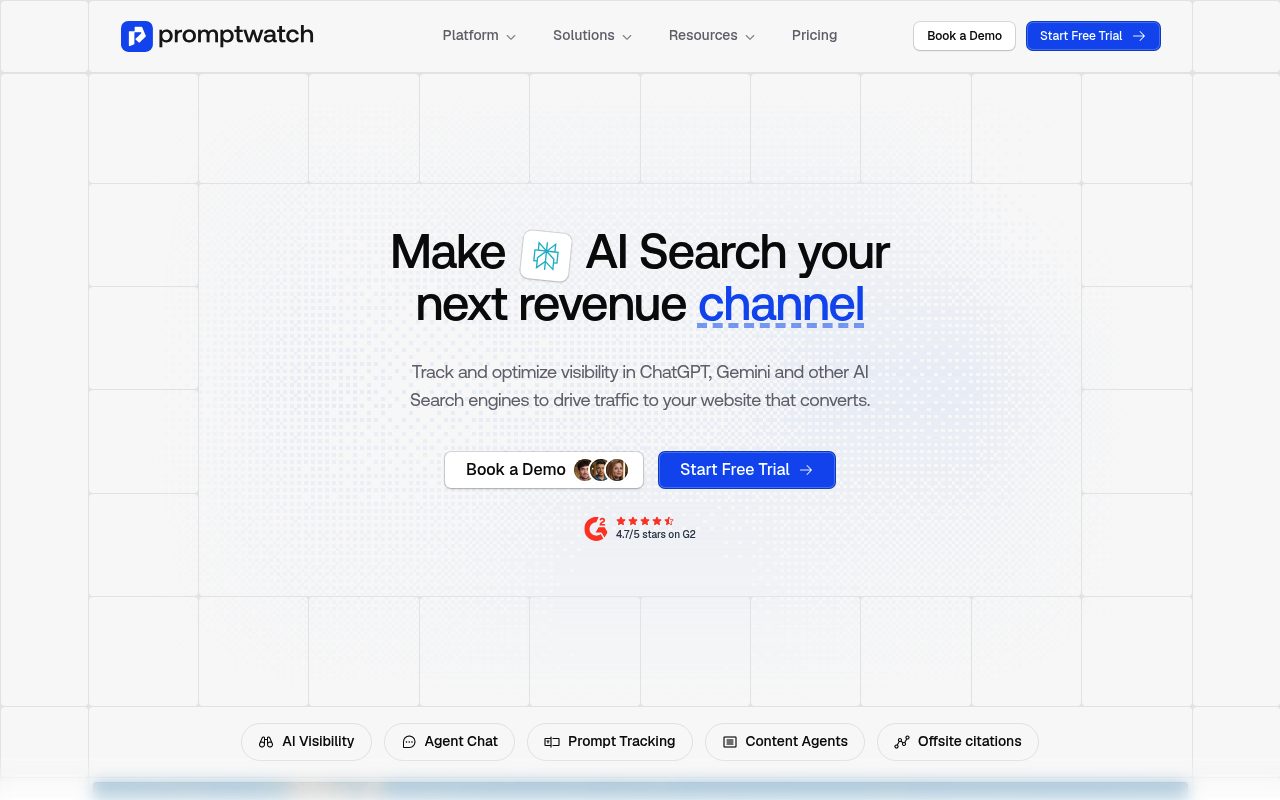
Screenshot: Promptwatch homepage, October 2026.
Promptwatch fits teams that already report from Search Console and want AI visibility alerts in Slack. Slack, Google Search Console, and Data Studio Integration all appear on its integrations list. Plans start at $199/month for 1,000 Agent Credits and scale toward agencies and larger teams, making it a workflow purchase more than a budget one.
Tiers step up in clear increments:
- Kick-off: $199/month, 1,000 Agent Credits
- Growth: $399/month, 2,500 Agent Credits
- Scale: $799/month, 6,500 Agent Credits
Promptwatch has the highest published entry price here. You pay for workflow fit. If your team won't open a new dashboard, alerts in Slack and data in Data Studio are what get the numbers acted on.
AI Peekaboo: best for a no-cost first look at AI visibility
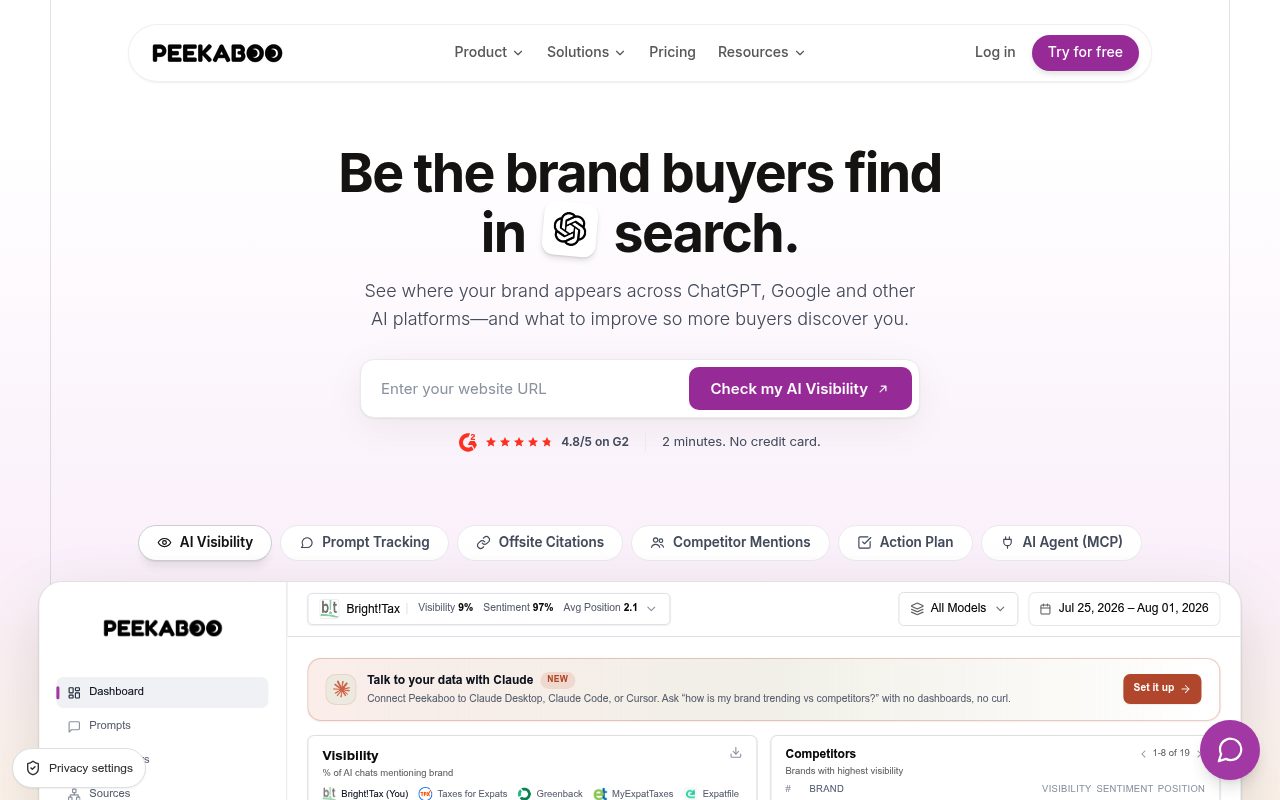
Screenshot: AI Peekaboo homepage, October 2026.
AI Peekaboo's free workspace is narrow: 1 brand, 25 prompts, 3 competitors, and 3 Ask AI messages. For a solo founder or marketer wanting a first, no-commitment read on AI visibility, that scope is enough. Prompts run live against each model with real-time web search on, so answers aren't cached.
Twenty-five prompts won't cover a multi-market brand or an agency roster. They will show whether your brand appears at all on your top buying-intent questions. Use AI Peekaboo to explore, then move to a paid tool once you know which prompts and competitors matter. Our roundup of free AI visibility checkers covers other no-cost options.
Sightkick: best for pairing AI visibility tracking with automated content and backlinks
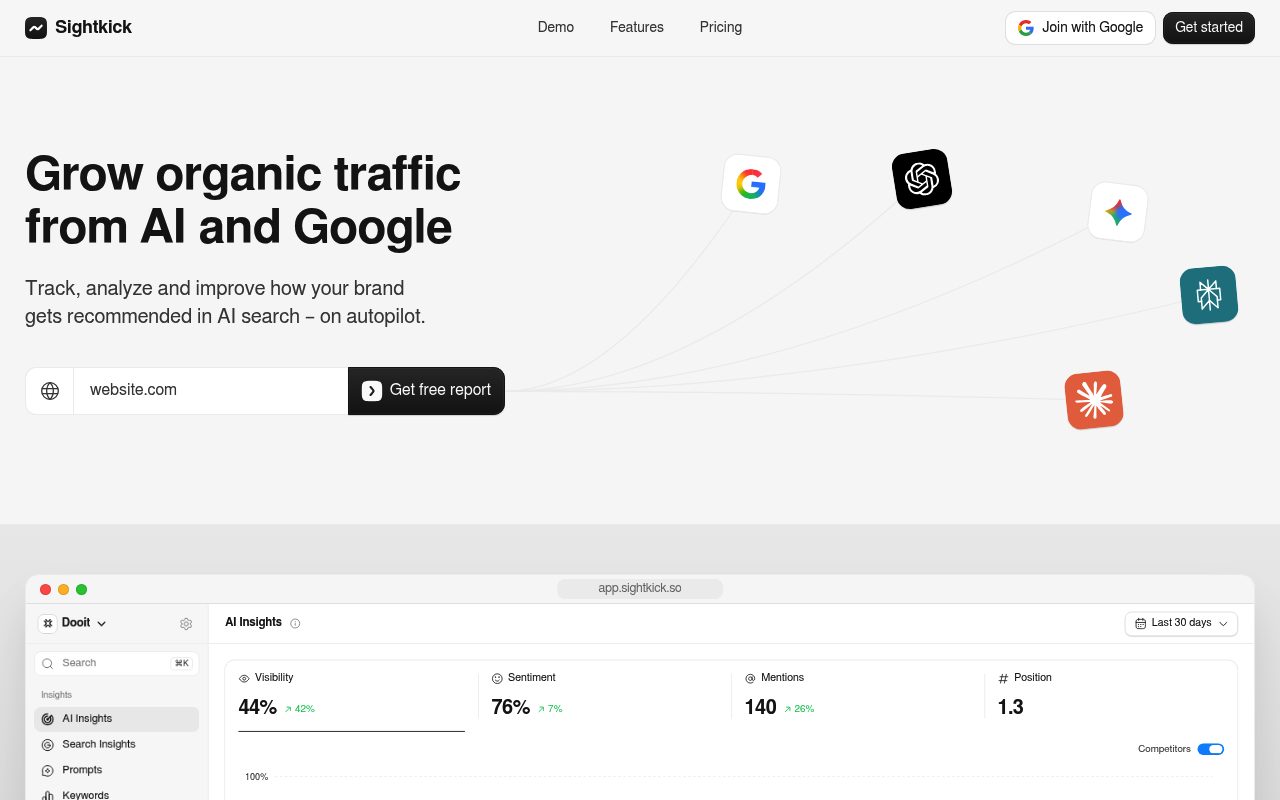
Screenshot: Sightkick homepage, October 2026.
Sightkick (our product) suits teams that want tracking to trigger action. Sightkick tracks visibility, sentiment, mentions, and position across ChatGPT, Gemini, Google AI Overviews, Google AI Mode, Claude, Perplexity, and Reddit. That data feeds an Articles engine that publishes content and a Backlinks engine that runs outreach to pages AI already cites.
- Tracking: prompts run across 4 AI models daily, recording which brands get recommended.
- Sources: cited pages are classified as UGC, Editorial, Yours (owned), or Competitor.
- Articles: researches, writes, scores, adds images, links, and schema, then publishes to your CMS daily.
- Backlinks: finds AI-cited pages, verifies owner contacts, sends pitches and follow-ups, confirms links went live.
- MCP: 29 tools inside Claude, ChatGPT, Cursor, OpenClaw, and Codex.
- Trial: 7 days; setup claimed at 2 minutes.
The limitation: Sightkick samples 4 AI models daily, while Rankscale publishes broader engine coverage. Teams that need DeepSeek, Mistral, or Grok answers specifically should weigh that. Plan details are on the pricing page.
Frequently asked questions
LLM tracking tool questions usually come down to two things: which tools plug into Slack or analytics stacks, and how share of voice is calculated. The answers below draw only on the vendor pages cited above, so check each vendor's current plan before buying.
Which LLM tracking tool integrates with Slack or analytics platforms?
Promptwatch lists Slack, Google Search Console, and Data Studio Integration, making it the clearest fit for alerts inside existing messaging and analytics workflows. For agent-based workflows, Rankscale AI and Sightkick both offer MCP connections to Claude, ChatGPT, and Cursor.
How is share of voice measured in LLM answers?
Share of voice is your brand's mentions as a percentage of all brand mentions in AI responses, competitors included, sampled across repeated prompts over time. Peec AI uses this definition and pairs it with a simpler presence metric, covered in the Peec AI section above.
Pick your 10 highest-intent buyer prompts and run them through one of the six tools in the comparison table for a week. You'll see whether your brand appears and which competitor AI names instead.