 Join with Google
Which LLM Optimization Service Is Best? 7 Tools (2026)

Fabio Bergmann
The best LLM optimization service for AI products depends on the job. Otterly and AI Peekaboo fit tight budgets. Peec AI fits brands that want sentiment and share-of-voice tracking. Scrunch AI fits teams preparing for AI agents. Promptwatch fits agencies with many clients. Rankscale AI fits variable query volume. Most of these tools monitor. Scrunch AI and Rankscale AI add page audits.
What's the best LLM optimization service for AI products?
No single LLM optimization service wins every category. The right pick depends on which of three jobs you need done: brand monitoring, optimization action, or agency-scale delivery. Entry pricing runs from $29/month to $300/month, enterprise tiers start from $1,000/month, and engine coverage differs by vendor.
Name the job, and the buying problem splits cleanly:
- Monitoring. You want to know whether ChatGPT, Gemini, Perplexity or Google AI Overviews name your product, and in what position. Otterly, AI Peekaboo, Peec AI and Rankscale AI live here.
- Optimization action. You want gaps closed through page fixes and content. Scrunch AI and Rankscale AI include page audits. None of the six list content publishing or outreach on the pages reviewed.
- Agency delivery. You report AI visibility across many client brands. Promptwatch and Peec AI's agency tiers are priced for this.
The budget span is wide. Otterly's Lite plan starts at $29/month, and its Enterprise tier starts from $1,000/month. Agency plans cluster between $199 and $799/month.
How we chose and compared these LLM optimization services
These LLM optimization services were judged on four criteria, using only each vendor's published pages: AI engines tracked, entry and top-tier pricing, free-trial access, and whether the tool goes past monitoring into audits, content or outreach. Sales-call quotes and third-party estimates were excluded. Where a vendor publishes nothing, the table says so.
- Engine coverage. Each vendor's stated engine list.
- Pricing at entry and at scale. Official monthly list prices, plus annual discounts where published.
- Trial friction. Free trial or free report, and whether either requires a credit card.
- Monitoring versus action. Tools that only report, flagged against tools that audit pages, publish content or support outreach.
LLM optimization services compared
Six LLM optimization services were compared. Starting prices run from $29/month (Otterly Lite) to $300/month (Scrunch Starter, month-to-month), and enterprise tiers pass $1,000/month. Free trials or free reports are common, though Peec AI and Promptwatch don't publish one. At similar list prices, prompt volume and post-tracking features differ sharply.
| Name | Best for | Starting price | Free plan/trial | Key differentiator |
|---|---|---|---|---|
| Otterly | Budget multi-engine tracking | $29/month (Lite) | Free trial, no credit card | 15 prompts, 4 engines, unlimited team members on Lite |
| Peec AI | Sentiment and share of voice | $95/month (Starter) | Not published | Daily visibility metric per engine; ~15% annual discount |
| Scrunch AI | AI agent ecosystems | $300/month ($250/month annually) | 7-day trial, no credit card | 350 custom + 1,000 industry prompts, 3 personas |
| Rankscale AI | Usage-based monitoring | $99/month (Pro) | 7-day trial | 1,200 credits, up to 4,800 AI-engine answers |
| Promptwatch | Multi-client agencies | $199/month (Kick-off) | Not published | Unlimited prompts and projects, city-level tracking |
| AI Peekaboo | Lowest-cost entry | $30/month | Free report, no credit card | Citation sources per answer, Looker Studio reporting |
Sources: Otterly pricing, Peec AI plans, Peec AI visibility, Scrunch pricing, Rankscale pricing, Promptwatch agency pricing, AI Peekaboo pricing.
Disclosure: this comparison is published by Sightkick, which sells an AI visibility platform. Sightkick is excluded from the table and the sections below. The recommendation-share data later in this article comes from Sightkick's own tracking.
Otterly: best for budget-friendly multi-engine tracking
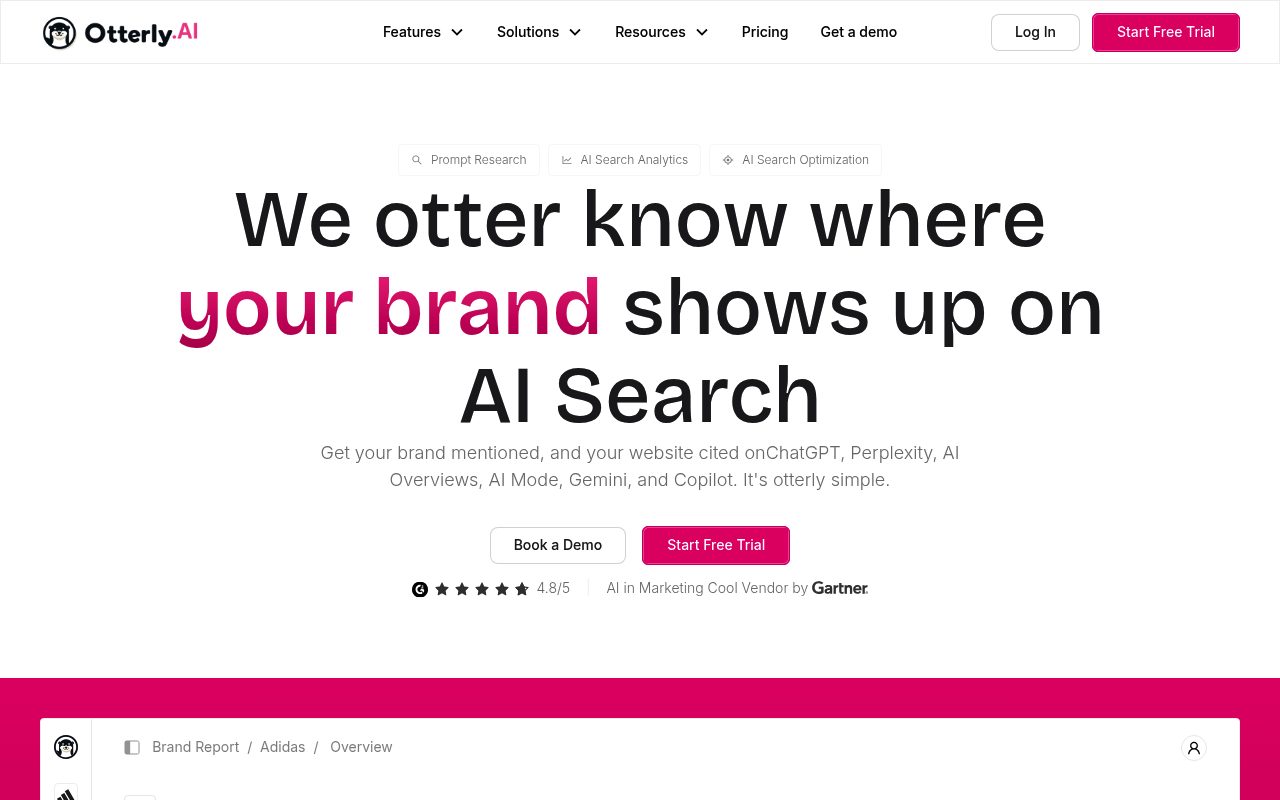
Screenshot: Otterly homepage, October 2026.
Otterly's Lite plan delivers 15 prompts, 4 engines and daily tracking for $29/month, the lowest entry price in this comparison. Lite suits a first check on whether AI search engines mention your brand at all. The full platform tracks 7 AI search engines, including Microsoft Copilot and Claude, and Otterly says 40,000+ marketing professionals use it.
- Pros: low entry price, a trial with no credit card, unlimited team members even on Lite.
- Cons: 15 prompts won't cover a multi-product SaaS catalog. The top tier is a big step: Enterprise starts from $1,000/month with SSO, customizable prompt tracking and a quarterly GEO health check.
- Best fit: startups and solo marketers validating AI visibility before committing budget.
Peec AI: best for sentiment and share-of-voice tracking
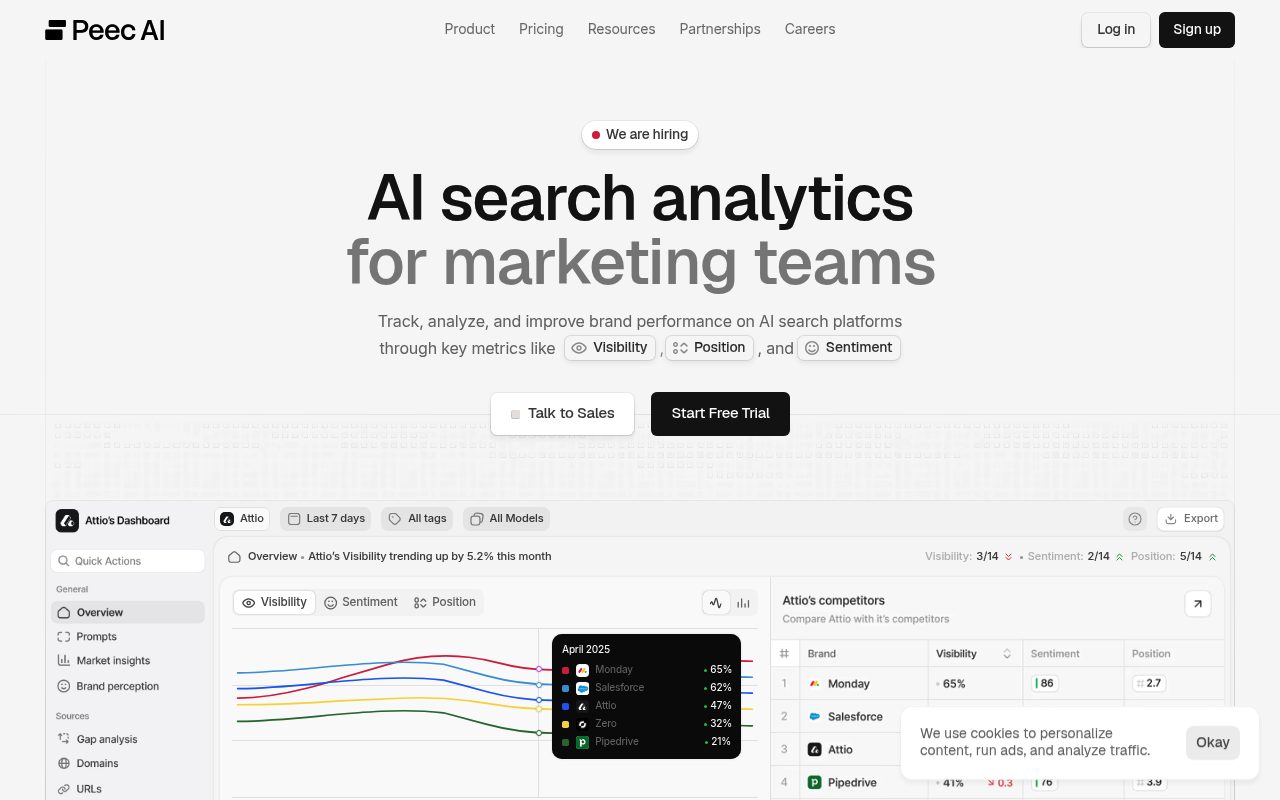
Screenshot: Peec AI homepage, October 2026.
Peec AI earns its higher price on measurement depth. The platform tracks visibility, position, sentiment and share of voice across major AI platforms, and its visibility metric updates daily per engine. Brand plans start at $95/month, and annual billing cuts roughly 15% off every tier.
Brands and agencies get separate ladders. Brand plans run Starter $95, Pro $245, Advanced $495 and Enterprise custom. Agency plans run Essential $245, Growth $495, Scale $795 and Comprehensive custom.
- Pros: sentiment from the base tier, a clean brand-versus-agency split, daily data per engine.
- Cons: an entry price more than triple Otterly's or AI Peekaboo's.
- Best fit: mid-market brands and agencies that report sentiment trends to stakeholders.
Head-to-head: Peec AI vs Scrunch AI.
Scrunch AI: best for agent-ecosystem optimization
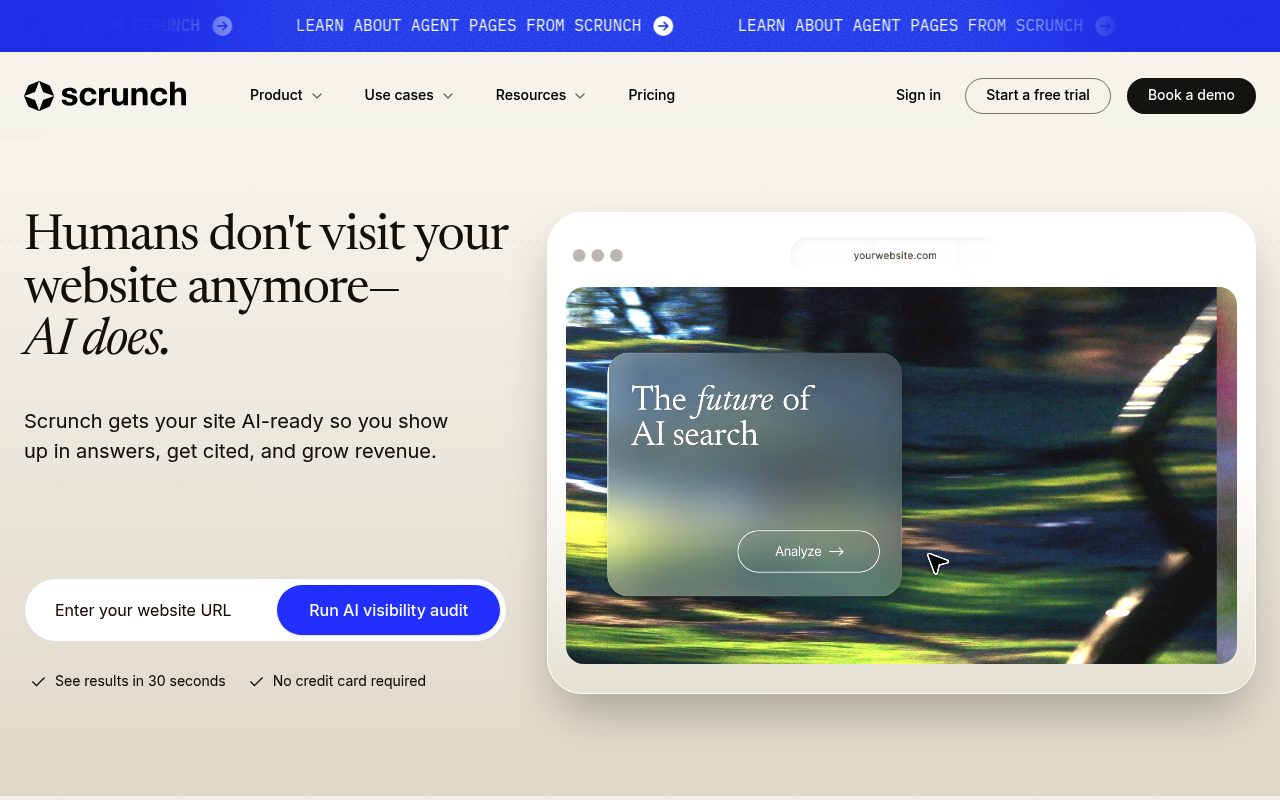
Screenshot: Scrunch AI homepage, October 2026.
Scrunch AI fits teams whose buyers use AI assistants and agents to shortlist vendors. The company says it is built for AI search and agent ecosystems, not just web SERPs, and supports ChatGPT, Claude, Gemini, Perplexity, Google AI Mode and Overviews, and Meta. Coverage runs wide; the entry price runs highest.
The Starter plan costs $300/month month-to-month or $250/month billed annually. It includes 350 custom prompts, 1,000 industry prompts, 3 personas, 5 page audits and 3 user licenses. A 7-day trial requires no credit card.
- Pros: persona-based prompts, page audits on the entry tier, a no-card trial.
- Cons: the highest entry price of the group. Only 5 page audits on Starter.
- Best fit: companies preparing content for AI agents as well as chat answers.
Rankscale AI: best for credit-based flexible monitoring
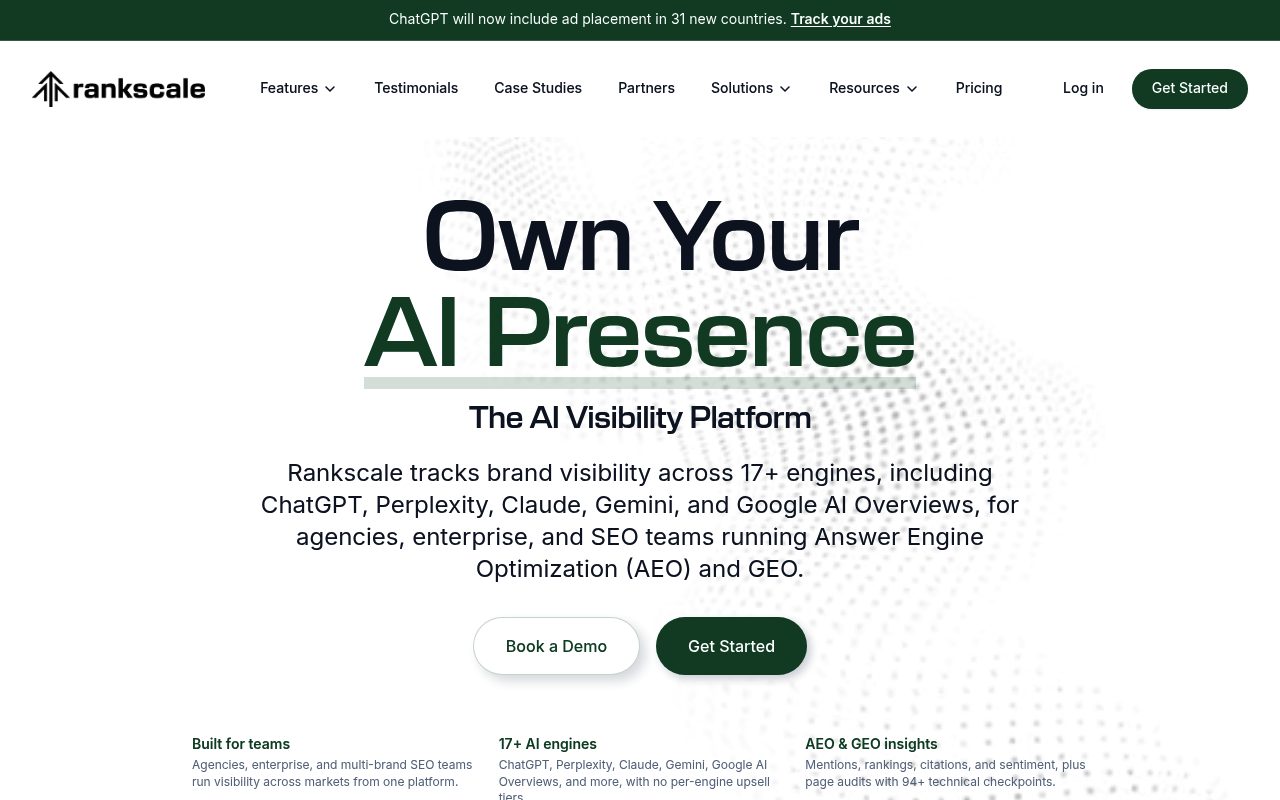
Screenshot: Rankscale AI homepage, October 2026.
Rankscale AI swaps fixed prompt caps for credits. The Pro plan costs $99/month for 1,200 credits, which covers up to 4,800 AI-engine answers. Pro also includes 10 brand dashboards, 50 page audits and a 7-day free trial, so spend tracks actual query volume rather than a preset prompt ceiling.
The math is simple once you know the rate. Rankscale says each AI-engine query typically uses 0.25 credits, so 1,200 credits equals 4,800 answers. Across 4 engines daily for a 30-day month, that is 40 prompts tracked per day.
- Pros: spend follows usage. 10 dashboards suit small portfolios.
- Cons: monthly cost is harder to forecast than a flat prompt plan.
- Best fit: teams with seasonal or unpredictable query volume.
Promptwatch: best for agencies managing multiple clients
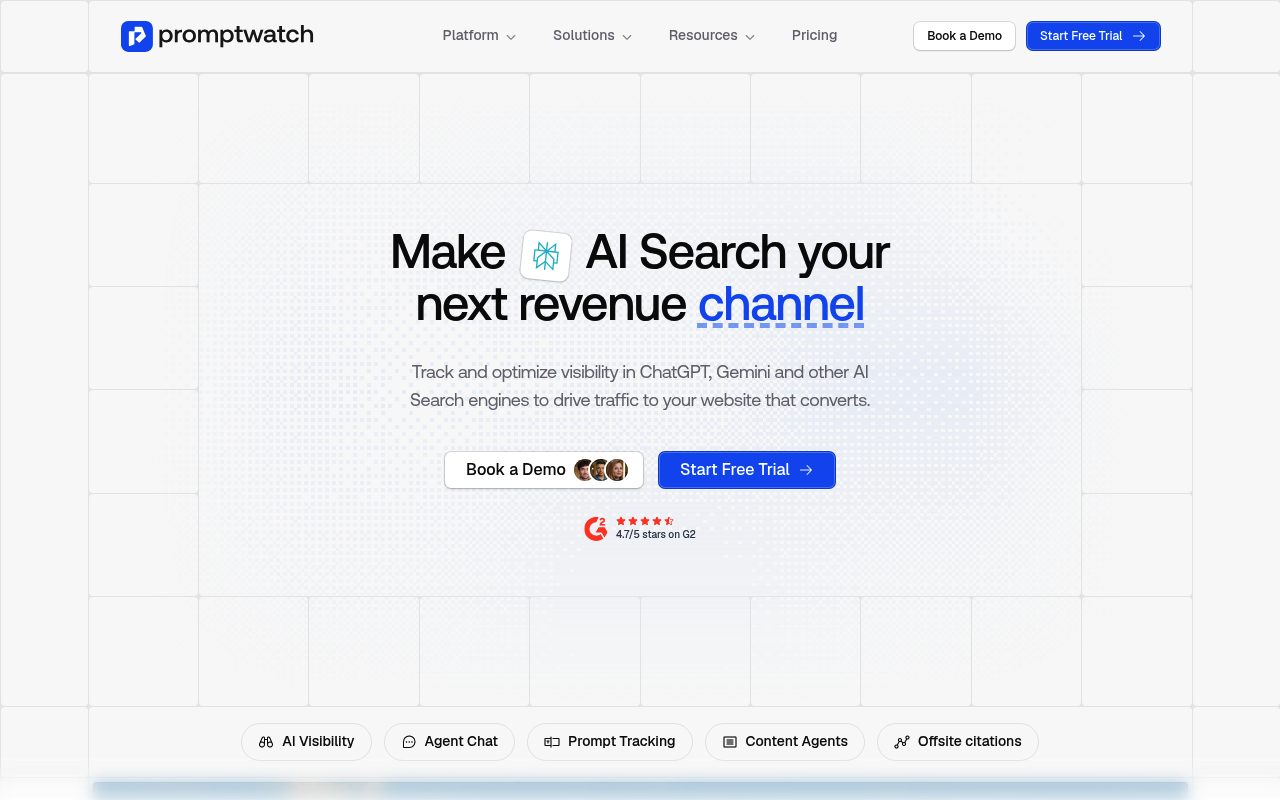
Screenshot: Promptwatch homepage, October 2026.
Promptwatch's limitation for in-house teams is its strength for agencies: the pricing assumes many clients. Agency plans run from Kick-off at $199/month to Growth at $399 and Scale at $799. Every tier includes unlimited prompts and unlimited projects, so client count doesn't trigger an upgrade.
Promptwatch says its agency plans track all models, with country-, state- and city-level tracking plus MCP and API access. The Scale tier allows up to 65,000 responses.
- Pros: no prompt ceiling, local-market granularity, API access for custom reporting.
- Cons: a single brand pays for capacity it won't use.
- Best fit: agencies reporting AI visibility across many client accounts.
AI Peekaboo: best for lowest-cost entry monitoring
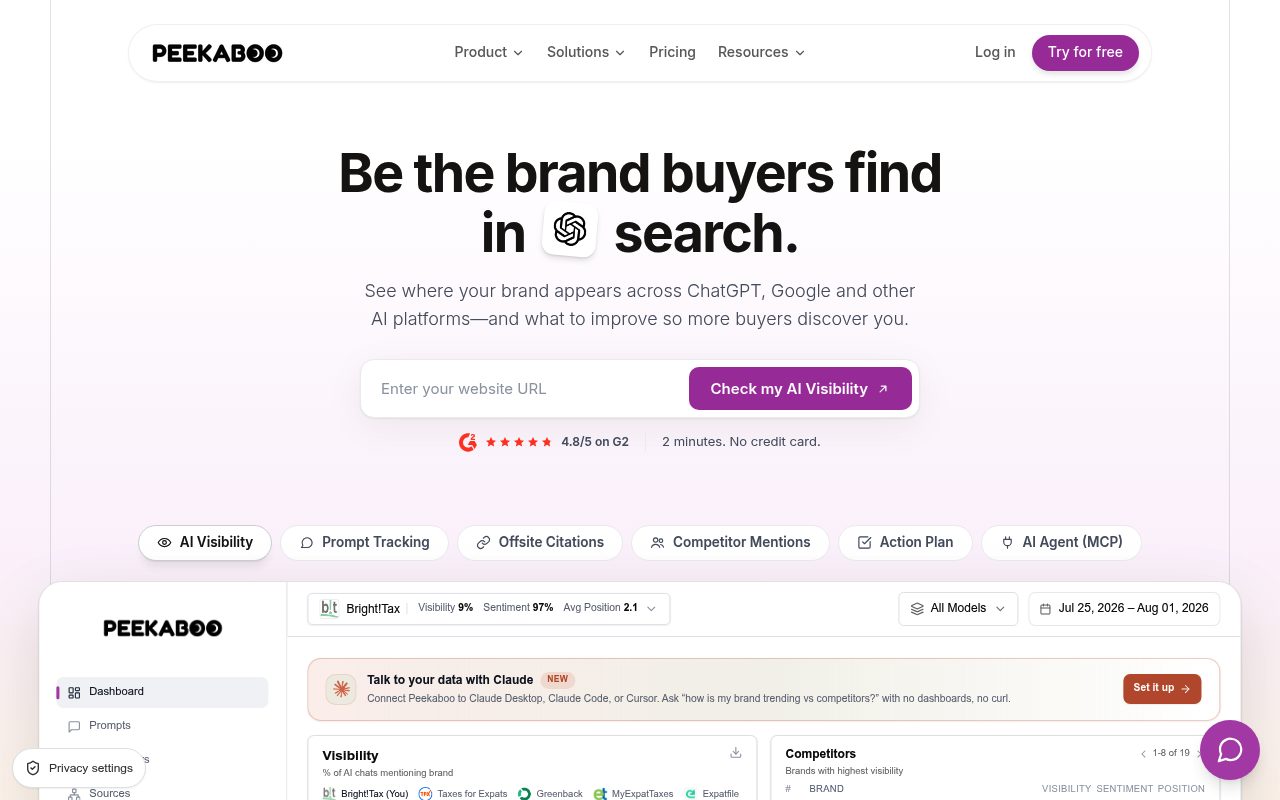
Screenshot: AI Peekaboo homepage, October 2026.
AI Peekaboo packs a long feature list at the floor of the market. Every plan starts at $30/month and includes competitor share of voice, sentiment and framing analysis, citation sources per answer, Looker Studio reporting, workspace seats and prompt suggestions. A free report needs no credit card; ongoing monitoring is a separate, paid product.
- Pros: per-answer citation sources and Looker Studio output at a $30 entry point.
- Cons: the smallest recommendation share in the tracking data below, 0.3% of answers.
- Best fit: very early teams that want basic visibility signals cheaply.
Who actually gets recommended? AI visibility share by platform
Across 6,988 AI answers between September 2 and October 2, 2026, Profound was named in 37.4% of answers and Otterly in 35.2%. AI Peekaboo was named in 0.3%. AI engines don't distribute recommendations in proportion to price or feature depth. Two vendors dominate the shortlist.
Share is the percentage of 6,988 completed, unbranded AI answers (ChatGPT, Gemini, AI Mode, AI Overviews) in which a brand was named. One answer can name several brands, so shares don't sum to 100%.
| Brand | Share of answers |
|---|---|
| Profound | 37.4% |
| Otterly | 35.2% |
| Peec AI | 23.3% |
| Scrunch AI | 15.4% |
| Rankscale AI | 9.2% |
| Promptwatch | 5.3% |
| AirOps | 1.5% |
| AI Peekaboo | 0.3% |
Source: Sightkick AI-visibility tracking, 2026-09-02 to 2026-10-02, 6,988 answers across ChatGPT, Gemini, AI Mode, AI Overviews.
Set shares beside list prices. Otterly starts at $29/month and was named in 35.2% of answers. Scrunch AI starts at $300/month month-to-month and was named in 15.4%. Price doesn't predict presence in AI answers. A vendor's own visibility in those answers is one signal of how well it reads the channel.
GEO vs. LLM optimization vs. LLMOps: what's actually being bought?
"LLM optimization" also shows up in model-serving guidance. GEO and AI-search visibility tools, like the six above, track whether AI answers name your brand. Google Cloud uses the term for inference: its guidance recommends quantization, tensor parallelism and memory optimization to improve LLM inference performance and cost-efficiency. That work targets infrastructure, not brand recommendations.
- GEO / AI-search visibility. Earning mentions and citations in AI-generated answers. Tools: prompt trackers, page audits, content and citation work.
- LLMOps. Infrastructure work for teams running their own models. Google Cloud's GKE optimization guide treats it as a deployment and cost problem.
No separate GEO algorithm exists to game. Google's AI optimization guide says SEO best practices remain foundational for generative AI search and notes llms.txt files are not needed for Google Search. Search Central's follow-up guidance asks for valuable, unique, non-commodity content with a clear technical structure.
Frequently asked questions
LLM optimization service buyers usually ask about cost, in-house versus agency delivery, and ROI. Short answers: entry plans run $29 to $300/month, Promptwatch and Peec AI publish separate agency tiers, and ROI is measured by comparing visibility share on a fixed prompt set over time. Details below.
How much does an LLM optimization service typically cost?
Entry pricing runs from $29/month (Otterly Lite) to $300/month (Scrunch Starter, month-to-month). Agency and enterprise tiers reach $495 to $1,000+/month. Cost scales with prompt volume, tracked engines, and agency reporting or API access.
Should I hire an agency or build an in-house LLM optimization workflow?
Published pricing separates the two setups. Promptwatch's agency plans include unlimited prompts and unlimited projects from $199/month, and Peec AI's agency ladder starts at $245/month. For a single brand, Otterly Lite offers daily tracking and unlimited team members at $29/month, and AI Peekaboo starts at $30/month with workspace seats.
How do I measure ROI from an LLM optimization service?
Track AI-referred traffic, citation share across tracked engines and sentiment direction over time. None of the vendors above publish standardized ROI benchmarks, so compare visibility share before and after on the same prompt set.