Peec AI vs Scrunch AI (2026): Which Wins for AI Search?

Fabio Bergmann
Peec AI vs Scrunch AI is a comparison of two AI search visibility platforms: Peec AI tracks brand mentions using credit-based plans and UI scraping, while Scrunch AI uses prompt-based tiers and an API-first architecture. Neither writes content nor builds backlinks.

Key takeaways
- Peec AI uses a credit-based system (10,000–65,000 credits across agency plans); Scrunch AI uses prompt-based tiers starting at $250/month for 125 prompts.
- Scrunch's Core plan costs 8.6% more than Otterly's Lite plan but delivers 8.3× the prompt volume. Per-prompt value beats sticker price as the comparison metric.
- Peec AI's UI-scraping approach and shopping-recommendation tracking is a technical differentiator Scrunch's public materials don't describe.
- Scrunch's API-first architecture and agency prospecting environments suit teams wanting programmatic integration over dashboard-only monitoring.
- Neither tool automates content creation or backlink outreach. That gap is what platforms like Sightkick (our product) are built to close.
What's the real problem when choosing between Peec AI and Scrunch AI?
Choosing between Peec AI and Scrunch AI is a choice between two AI-visibility trackers with different pricing logic (credits vs. prompts) and different technical foundations (UI scraping vs. API-first). The harder problem: neither platform writes content or builds backlinks to fix the visibility gaps it finds. Teams still need a separate execution layer.
Both tools monitor brand mentions and citations across AI answer engines. Peec AI runs separate pricing tracks for brands and agencies, while Scrunch AI anchors its brand offering to a $250/month Core plan. The pricing structures differ enough to change total cost at scale, and monitoring without a content or backlink response leaves surfaced gaps unaddressed.
Is Peec AI legit, and what is it used for?
Peec AI is a legitimate AI search visibility platform used to track brand mentions and citations across AI engines. It uses UI scraping that mimics real user interactions rather than API calls alone. Brands and agencies use it for competitor benchmarking, shopping-recommendation tracking, and white-label client reporting instead of traditional keyword-rank tracking.
Peec AI's docs say the platform uses advanced UI scraping to interact with AI models exactly as real users do. Its shopping feature tracks individual products inside AI-generated shopping recommendations: whether a product is recommended, its win rate and position, the price the AI cites versus the actual catalog price, and which competing products appear alongside it. Agencies get customizable tracking by client and white-label reporting.
How much does Peec AI cost for agencies?
Peec AI's agency pricing has three tiers: Essential (10,000 credits) for agencies winning first AI-search clients, Growth (25,000 credits) for boutique agencies managing 3–10 clients, and Scale (65,000 credits) for larger books of business. A recent pricing update increased tracking capacity at the same or lower price across plans.
- Essential: 10,000 credits, entry-level tier for teams starting with AI Search.
- Growth: 25,000 credits, built for boutique agencies managing 3–10 clients.
- Scale: 65,000 credits for larger agency operations.
Every plan includes unlimited client seats, and each client is an isolated project with its own prompts, competitors, and channels. Peec AI's pricing update post says every plan now comes with significantly more tracking capacity at the same price or less.
How much does Scrunch AI cost per month?
Scrunch AI's Core plan for brands costs $250/month and includes 125 unique prompts, 5 site audits, 1 brand workspace, and 5 user licenses, covering 4 AI platforms. Agency pricing starts at $500/month for Agency Core, with a custom-priced Enterprise tier covering 9 platforms and a 7-day free trial on Core.
- Core (brand): $250/month, 125 prompts, plus 5 audits, 1 workspace, and 5 licenses.
- Agency Core: starts at $500/month; Agency Enterprise is custom priced.
- Platform coverage: Core supports 4 AI platforms (ChatGPT, Perplexity, Google AI Overviews, Microsoft Copilot); Enterprise expands to 9 platforms including Claude, Gemini, and Grok.
Scrunch's pricing FAQ says users get a 7-day free trial of the Core plan.
What does the credit-versus-prompt pricing model actually mean for your budget?
Peec AI charges by credits that scale with monitoring depth; Scrunch AI and Otterly charge by fixed prompt counts per tier. Scrunch's Core plan costs 8.6% more than Otterly's Lite plan but includes 8.3× the prompts. Prompt volume, not sticker price, determines real value per dollar at the entry tier.
The derived comparison: Scrunch's 125-prompt Core plan carries 8.3× the prompt allotment of OtterlyAI's Lite plan, which lists 15 search prompts for $29/month, while costing just $5 more per month, or 8.6% higher. Peec AI's credit model instead lets agencies convert plan size (10,000 to 65,000 credits) directly into expected monitoring volume across clients. Prompt and credit caps are the real constraint on coverage. They decide how many brand-competitor comparisons you can run each month.
Peec AI: UI-accurate tracking and shopping visibility
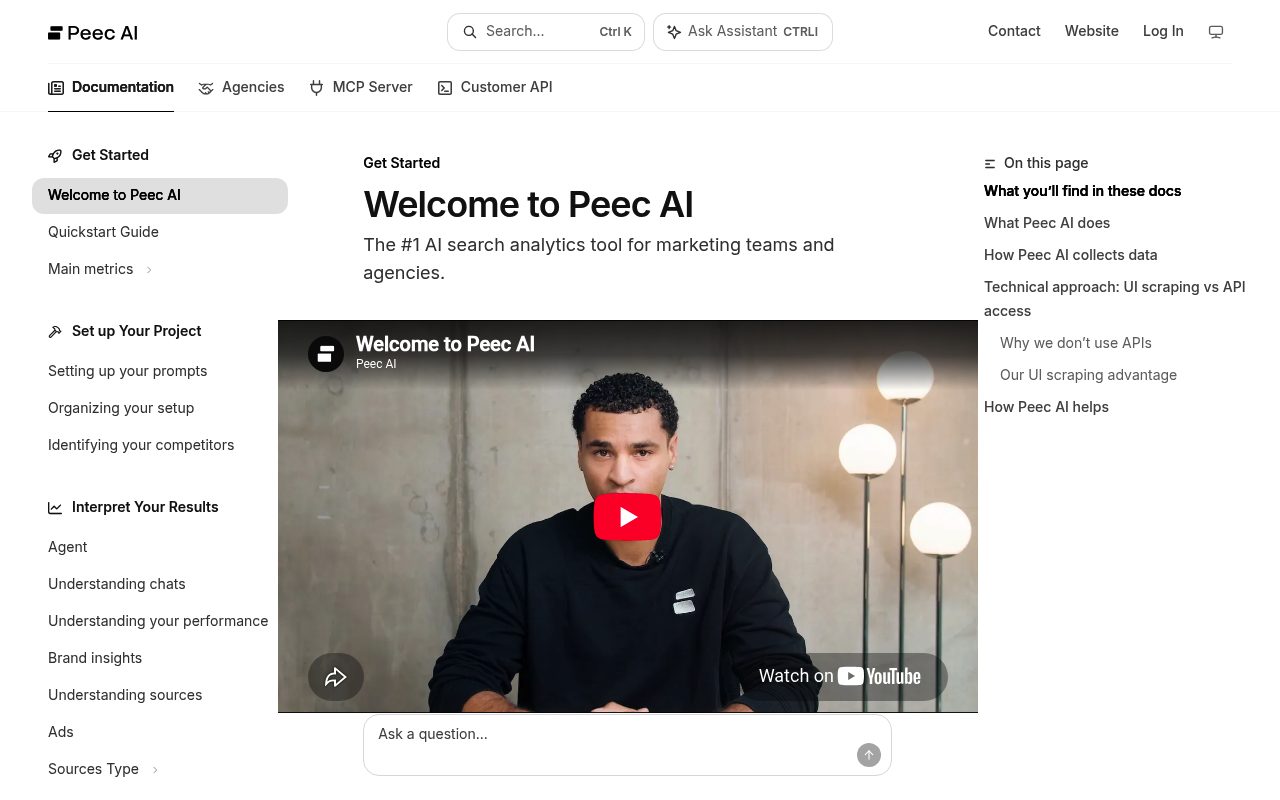
Screenshot: Peec AI intro to peec ai page, September 2026.
Peec AI differentiates through UI scraping that replicates real user AI interactions and a shopping module showing product win rate, position, and price discrepancies inside AI recommendations. This makes it well-suited for brands selling through AI shopping assistants and agencies needing isolated, white-label client reporting at a fixed credit budget.
The UI scraping method may capture visibility signals API-only tools miss, and the shopping tracking is a distinct capability for e-commerce and retail brands. Peec AI's agency workflow page says it tracks every mention and citation so teams can bring numbers to the conversation instead of guesses, with unlimited client seats on every plan.
Limitation: credit-based caps mean heavy monitoring across many prompts and competitors can burn through allowances faster than expected.
Scrunch AI: API-first, multi-client workflows
Scrunch AI is built around an API-first architecture aimed at teams wanting to integrate visibility data programmatically rather than only via dashboard. It supports multi-client workspaces, offers agency prospecting environments for demos and pitches, and pays referral commissions.
Scrunch's agencies page says the platform is API-first, supports multi-client workspaces, and offers prospecting environments for demos and pitches. Agencies can earn up to 20% commission on referred customers. Scrunch's about page positions it as a Sitecore company trusted by 500-plus brands and agencies.
Limitation: entry pricing of $250/month is higher than lighter-weight trackers, and Core platform coverage is capped at 4 AI engines.
How do Peec AI and Scrunch AI compare at a glance?
Peec AI and Scrunch AI both track AI-generated brand mentions but differ in pricing logic, platform coverage, and technical approach. Peec uses credits and UI scraping; Scrunch uses prompts and API-first delivery. The table below lines up plans, coverage, and agency features side by side.
| Dimension | Peec AI | Scrunch AI |
|---|---|---|
| Pricing model | Credit-based | Prompt-based |
| Entry (brand) | Varies by credits | $250/mo Core, 125 prompts |
| Agency entry | Essential: 10,000 credits | Agency Core: $500/mo |
| Top agency tier | Scale: 65,000 credits | Agency Enterprise: custom |
| Platform coverage | AI channels via UI scraping | 4 (Core) to 9 (Enterprise) |
| Agency seats | Unlimited per plan | 5 licenses on Core |
| Free trial | Not specified | 7-day on Core |
| Standout feature | Shopping-recommendation tracking | API-first delivery |
Match plan size to monitoring needs before committing. For a wider field, our roundup of AI search visibility tools covers additional options.
Which tool gives a more complete view of AI search visibility?
Neither tool gives a fully complete view alone. Peec AI covers more visibility surface via UI scraping and shopping-recommendation tracking; Scrunch AI covers more AI engines at its Enterprise tier (9 platforms) than Core's 4. Completeness depends on whether you prioritize UI-accurate depth (Peec) or broad engine breadth at higher budgets (Scrunch).
Both bring citation-level numbers to the table. Peec AI's workflow page frames it plainly:
It tracks every mention and citation across AI channels so teams can bring numbers to the conversation instead of guesses.
But both stop at reporting. Sightkick (our product) tracks visibility, sentiment, mentions, and position across ChatGPT, Gemini, Google AI Overviews, Google AI Mode, Claude, Perplexity, and Reddit. That's seven surfaces, wider than Core's 4 or Peec's scraped channels, and it classifies every citation source by type (UGC, Editorial, Yours, Competitor), a structured view neither competitor's materials describe.
Which tool is more effective for agency SEO workflows?
Agency effectiveness depends on structure. Peec AI gives unlimited client seats with isolated per-client projects at a fixed credit budget; Scrunch AI ships 5 licenses on Core with API access and pitch-support environments. Agencies running many small clients may prefer Peec's seat model; agencies needing custom integrations may prefer Scrunch's API-first setup.
- Peec AI: unlimited seats, isolated projects per client, white-label reporting.
- Scrunch AI: multi-client workspaces, API-first delivery, prospecting environments, and referral commissions up to 20%.
Neither tool automates content production or outreach. Agencies still need separate execution tooling for the gaps their reports surface. Our guide to tracking AI recommendations breaks down that execution layer.
What can neither tool do — and how does automated content and backlink coverage close that gap?
Peec AI and Scrunch AI both surface where and how brands appear in AI answers, but neither writes the articles nor secures the backlinks needed to improve those citations. Sightkick pairs the same daily, multi-model tracking with an Articles engine and a Backlinks engine that act on findings automatically.
Disclosure: Sightkick is our product. Sightkick runs prompts across 4 AI models daily for continuous competitive benchmarking, a similar cadence to Peec and Scrunch tracking, and adds an execution layer they don't:
- An Articles engine researches, writes, scores, adds images, links, and schema, then publishes SEO content to a CMS on a daily schedule without manual input.
- A Backlinks engine finds pages AI already cites, verifies owner contact details, sends outreach pitches and follow-ups, and confirms links went live.
- Citation sources are classified by type: UGC, Editorial, Yours, and Competitor, for structured tracking.
- Sightkick MCP exposes 29 tools directly inside AI agents including Claude, ChatGPT, Cursor, OpenClaw, and Codex.
Limitation: as a newer entrant, Sightkick has less third-party review history than established trackers like Peec or Scrunch.
What do users say about Peec AI and Scrunch AI for content teams?
Content teams generally value Peec AI for granular, per-client isolation and shopping-specific tracking, while Scrunch AI users highlight its API-first flexibility and broader platform coverage at higher tiers. Both are noted for citation-level detail, though pricing tiers can feel restrictive once teams scale prompt or credit volume.
Peec AI feedback centers on white-label agency reporting and UI-accurate scraping. Scrunch AI feedback centers on integration flexibility and its Sitecore-backed enterprise trust. Both tools' entry tiers can undercount prompts or credits for teams tracking many competitors. That's the recurring friction point at scale.
Frequently asked questions
Is Peec AI legit for tracking brand visibility in AI search?
Yes. Peec AI is a legitimate platform used by brands and agencies to track mentions and citations across AI engines. It uses UI scraping to replicate real user interactions with AI models rather than relying only on API responses, which gives it a distinct technical approach among visibility trackers.
What is Peec AI used for specifically?
Peec AI is used to monitor brand mentions, citations, and product recommendations across AI search engines, including a shopping-specific feature that tracks product win rate, position, and price accuracy in AI-generated shopping answers. Agencies also use it for isolated, white-label client reporting.
How does Peec AI differ from Scrunch AI in terms of features?
Peec AI centers on UI scraping and shopping-recommendation tracking with a credit-based pricing model and unlimited agency seats. Scrunch AI centers on API-first delivery and prompt-based pricing tiers covering up to 9 AI platforms on its Enterprise plan, with prospecting environments for agency pitches.
What does Peec AI do that Scrunch AI cannot, and vice versa?
Peec AI offers shopping-recommendation tracking (price, win rate, position) and UI-accurate scraping that Scrunch's materials don't describe. Scrunch AI offers API-first programmatic access and prospecting environments for agency pitches, which Peec's public docs don't detail.
Which tool is better for monitoring AI search presence, Peec or Scrunch?
It depends on structure. Peec AI's credit model and unlimited seats suit agencies managing many small clients cheaply; Scrunch AI's API-first design and 9-platform Enterprise coverage suit teams needing deeper integration and broader engine coverage at higher budgets.
Do Peec AI or Scrunch AI help fix visibility gaps, not just find them?
Neither tool automates content creation or backlink outreach. Both are monitoring and reporting platforms. Teams that want tracking plus automated article publishing and backlink acquisition typically pair these tools with a separate execution layer like Sightkick's Articles and Backlinks engines.
Want to see where you stand before choosing a tracker? Start free with Sightkick. It sets up in 2 minutes and runs your visibility, sentiment, and position tracking across AI models on autopilot.