7 Best GEO Tools for AI Search Visibility in 2026

Fabio Bergmann
The six best GEO tools in 2026 are Otterly, Peec AI, Rankscale AI, Promptwatch, AI Peekaboo, and Sightkick. GEO here means generative engine optimization: software that tracks how often ChatGPT, Perplexity, Gemini, and Google AI Overviews cite or recommend a brand. If you need geolocation and mapping software, look at GIS tools instead. This guide doesn't cover them.
Each of the six tools balances price against engine coverage differently. Entry plans start from €20 a month, and coverage ranges from 4 tracked models to 17+ engines.
By Fabio Bergmann, Founder of Sightkick
What Is a GEO Tool, and Why Does It Matter Now?
A GEO tool is software that audits and optimizes how often a brand gets cited or recommended inside AI-generated answers from ChatGPT, Perplexity, Gemini, and Google AI Overviews. A GEO tool does not track blue-link rankings. GEO stands for generative engine optimization. Geolocation and mapping software is a separate category.
Rankscale defines GEO tools as software used to audit and optimize content for discovery in AI search engines. The acronym collides with GIS tooling such as radius maps, geocoders, and spatial layers. GIS answers where something is. A GEO tool answers whether an AI model names your brand when a buyer asks for a recommendation.
Promptwatch breaks AI search visibility into five dimensions:
- Citation frequency: how often the brand appears.
- Citation quality: which sources carry the mention.
- Platform coverage: which engines mention the brand.
- Query coverage: which prompts trigger a mention.
- Brand representation accuracy: whether the AI describes the product correctly.
You can't fix what you can't see. A tool that reports one dimension leaves the other four blind.
How We Chose These GEO Tools
We chose these GEO tools on five checks:
- Native AI-engine coverage.
- Published pricing and free-tier limits.
- Citation tracking as a named feature, separate from a visibility score.
- Agency and team support.
- Tracking of which vendors AI answers actually recommend.
Engine coverage comes from vendor product pages. Prices come from published rate cards only, with no sales-call quotes. We verified free access per vendor. Otterly, for example, offers a no-card free trial. For the final check, we used Sightkick's daily prompt runs, which record which brands AI answers recommend, so the ranking doesn't rest on vendor self-reporting alone. For a wider field, see our generative engine optimization tools roundup.
GEO Tools Compared: Pricing, Free Tiers, and Engine Coverage
Entry prices for GEO tools run from roughly €20 to $95 a month. Agency and business tiers reach $495 to $579 a month. Engine coverage starts at 4 tracked models and climbs from there. The table below lists pricing, free access, and coverage for all six tools in this guide, as of September 2026.
The takeaway: Rankscale AI has both the lowest entry price and the widest coverage. Otterly is the only vendor here that states its trial requires no card.
| Tool | Entry plan | Entry limits | Free access | AI engines tracked | Higher tier |
|---|---|---|---|---|---|
| Otterly | $29/mo (Lite) | 15 prompts | Free trial, no card | 7 major engines | $189/mo Standard, 100 prompts |
| Peec AI | $95/mo (Starter) | 50 prompts, 6,000 responses | Not published | 6 | $495/mo agency Growth, 25,000 credits |
| Rankscale AI | From €20 | Not published | 7-day free trial | 17+ | $99 Pro, 1,200 credits |
| Promptwatch | $95/mo (Essential) | 50 prompts, 6,000 responses | Not published | 4 tracked models (Essential) | $579/mo Business, 350 prompts |
| AI Peekaboo | Not published | Not published | Free visibility checker and free report | 5 | Not published |
| Sightkick | Not published | Not published | 7-day free trial and free visibility report | 7 surfaces tracked, including Reddit; prompts run on 4 models daily | Not published |
Sources: Otterly pricing, Otterly features, Peec AI pricing, Peec AI instructions, Rankscale facts, Rankscale pricing, Rankscale, Promptwatch pricing, AI Peekaboo pricing, AI Peekaboo checker, Sightkick.
Otterly: Best for Budget-Friendly Multi-Engine Tracking
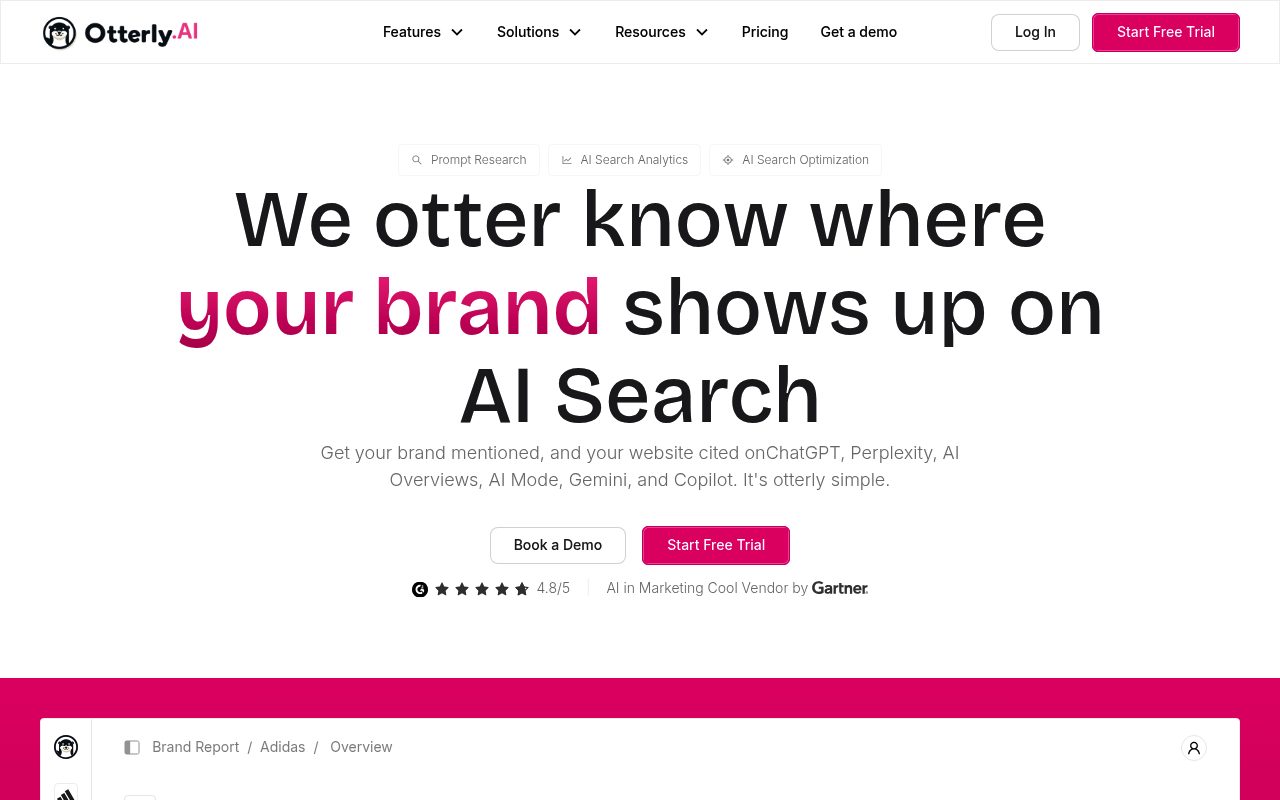
Screenshot: Otterly homepage, September 2026.
Otterly is the budget pick for teams that want multi-engine tracking without putting a credit card on file. Its Lite plan costs $29 a month for 15 prompts across ChatGPT, Google AI Overviews, Perplexity, and Microsoft Copilot. The Standard plan costs $189 a month and adds API access, MCP access, and Agent Analytics.
Otterly says it tracks 7 major AI search engines across 65+ countries and languages. Its analytics page lists brand-mention tracking in ChatGPT, Perplexity, Google AI Overviews, and AI Mode. Standard raises the limit to 100 prompts.
- Pros: low entry price, no-card trial, broad country and language coverage, API and MCP access on Standard.
- Cons: 15 prompts is thin for tracking many keyword variants. The jump from Lite to $189 is steep.
Peec AI: Best for Agencies Managing Multiple Client Brands
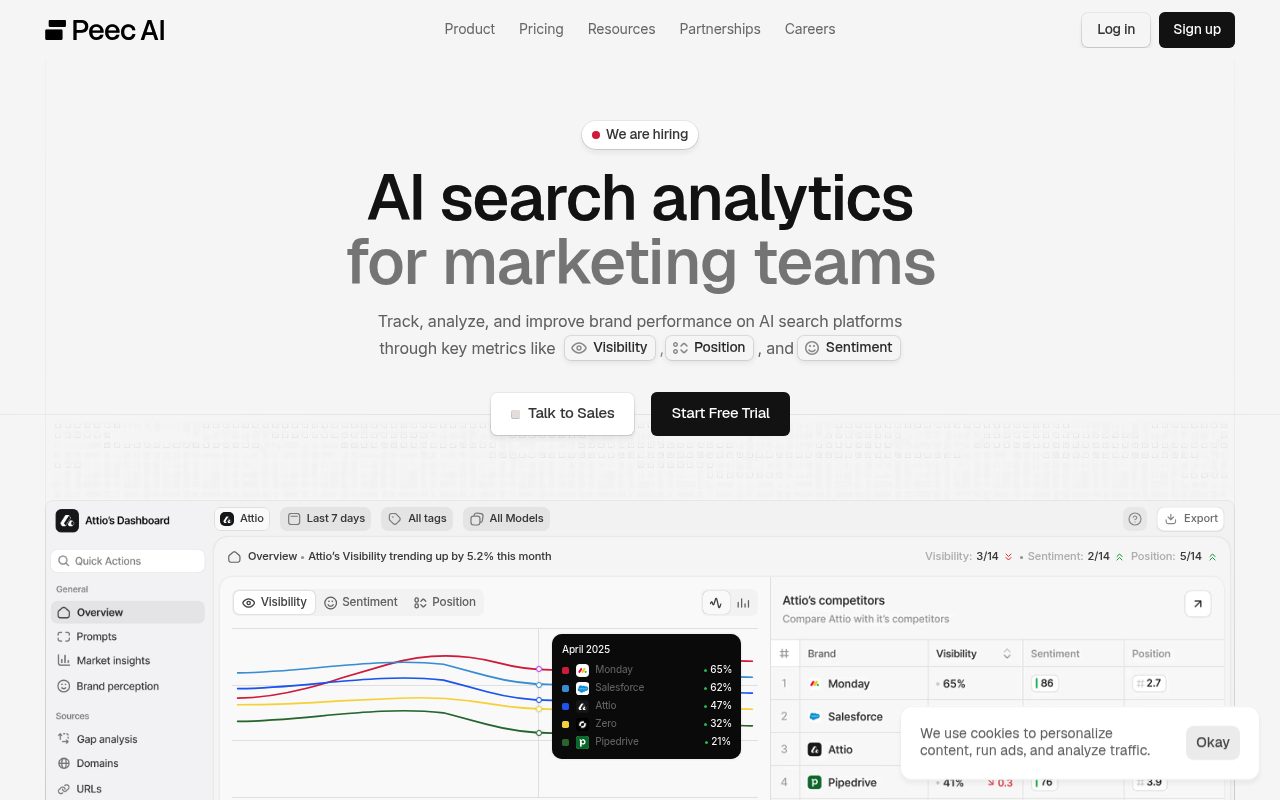
Screenshot: Peec AI homepage, September 2026.
Peec AI removes per-seat math for an agency juggling a dozen client brands. Every agency plan includes unlimited client seats and daily tracking. The Growth agency plan costs $495 a month for 25,000 credits, which works out to about 277 prompts. Brand plans start at $95 a month for 50 prompts and 6,000 responses.
Peec AI says all tiers cover ChatGPT, Google AI Overviews, Google AI Mode, Microsoft Copilot, Perplexity, and Gemini by default. The agency page confirms unlimited client seats. Brands that outgrow Starter can move to Pro, which costs $245 a month for 150 prompts and 18,000 responses.
- Pros: unlimited client seats, daily tracking, clear upgrade steps.
- Cons: no published free trial or free tier. The $495/month agency tier is a real commitment before ROI is proven.
Rankscale AI: Best for Broadest Engine Coverage
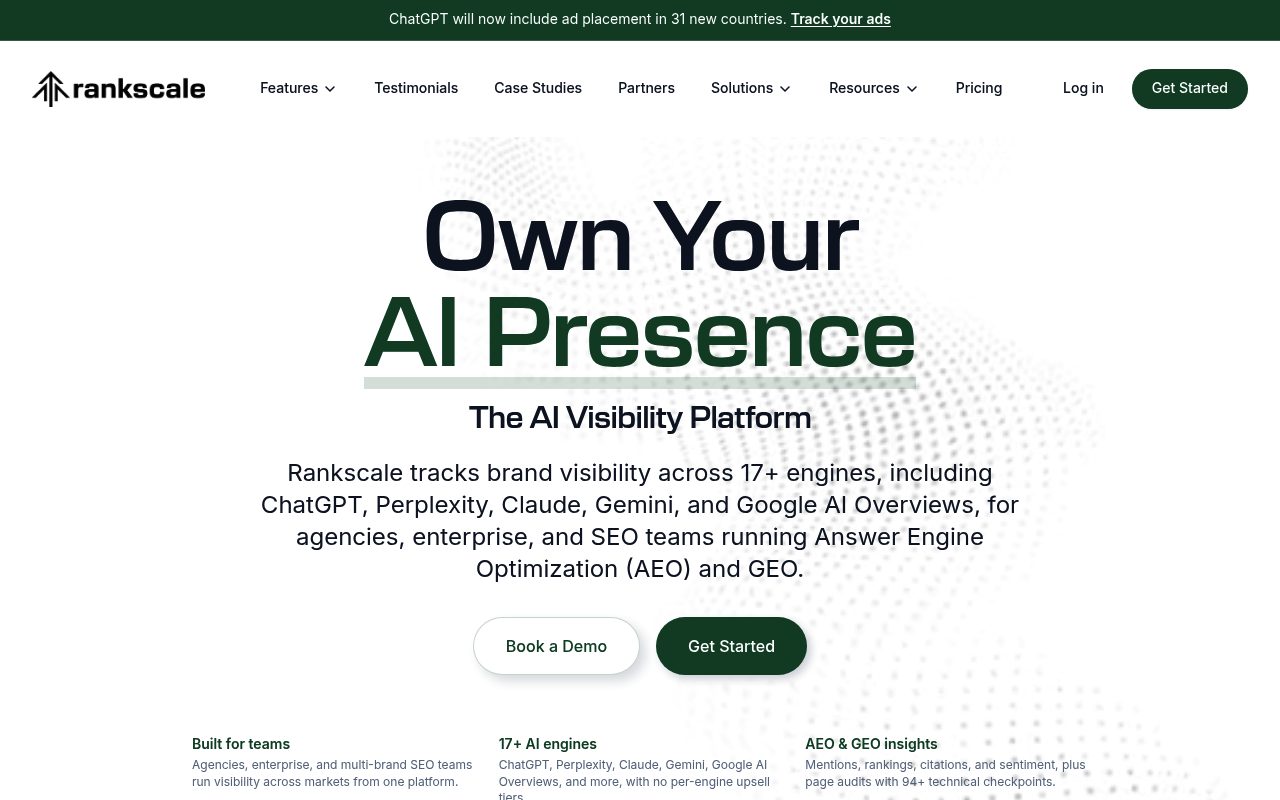
Screenshot: Rankscale AI homepage, September 2026.
Rankscale AI has the widest engine footprint in this guide. It tracks 17+ engines, including ChatGPT, Perplexity, Claude, Gemini, and Google AI Overviews. Plans start from €20, and the Pro tier costs $99 for 1,200 credits with a 7-day free trial. Brands selling across many AI surfaces get the most from it.
Rankscale's citation tracking shows which domains and URLs get cited in AI answers. That tells a team which third-party pages to target. The Pro plan's 1,200 credits cover up to 4,800 AI-engine answers a month, depending on engine selection.
Credits are the trade-off. Your answer count depends on your engine mix, so budgeting is harder than with a flat prompt count.
Promptwatch: Best for Location-Level Visibility Reporting
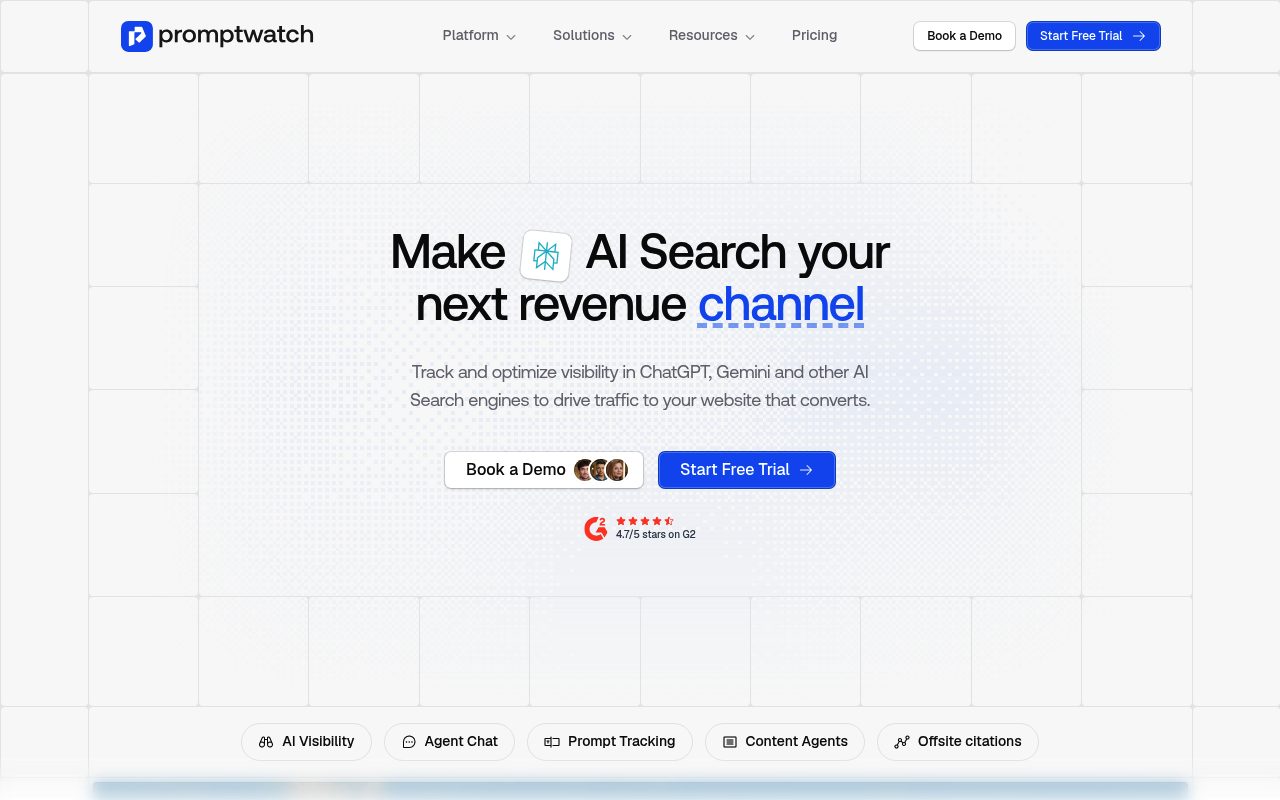
Screenshot: Promptwatch homepage, September 2026.
Promptwatch stands out for city-level tracking. Its Business plan costs $579 a month and adds state and city-level reporting, Shopping Insights, and Ads Radar. The Essential plan costs $95 a month for 50 prompts and 4 tracked models. Business costs 6.1× as much as Essential.
Promptwatch includes MCP and API access even on the $95/month Essential plan. Essential also includes 6,000 responses, 1 project, and country-level tracking. Business raises the limits to 350 prompts, 42,000 responses, and 5 projects.
That price gap is the steepest tier jump among these tools. Multi-location brands will justify it. Most single-market SaaS teams will stay on Essential.
AI Peekaboo: Best for a Quick, Free First Look
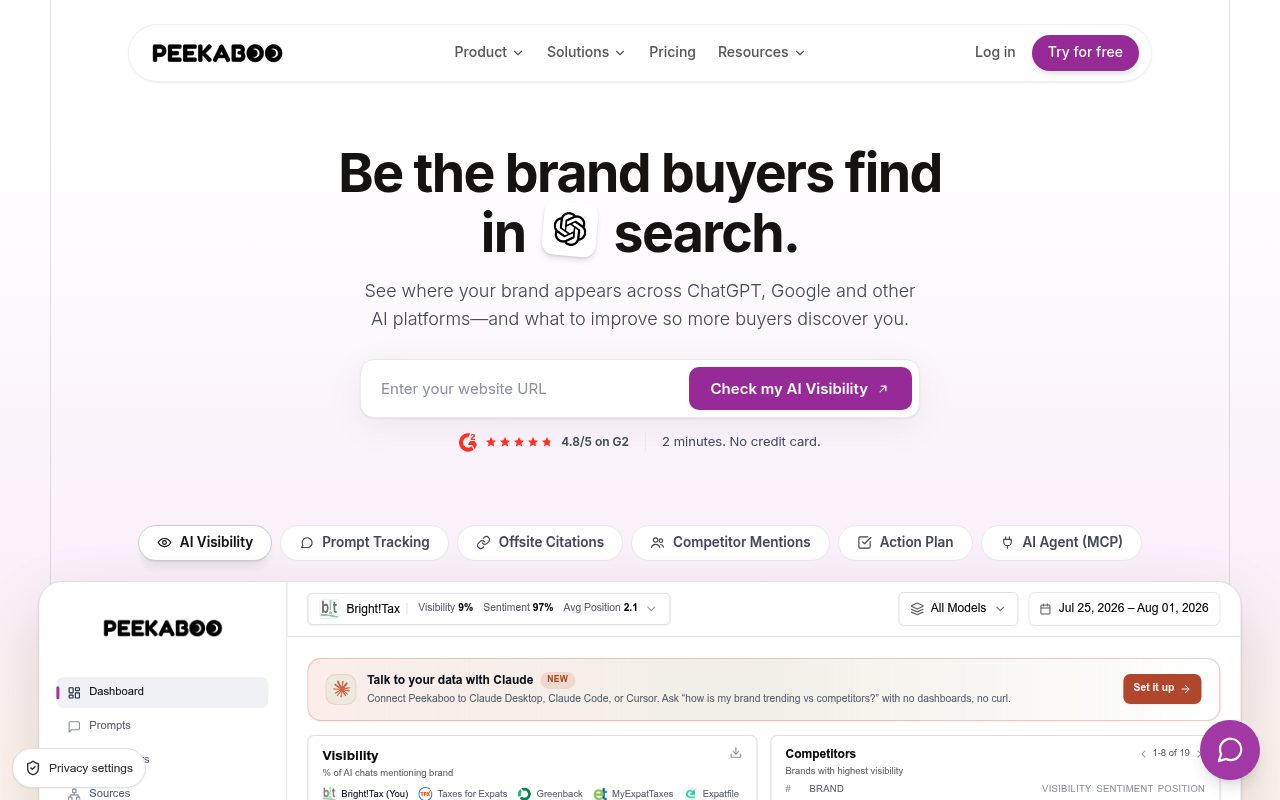
Screenshot: AI Peekaboo homepage, September 2026.
AI Peekaboo covers fewer models than most rivals, but it costs nothing to start. Its free product visibility checker runs a 7-point check on the signals AI assistants use to recommend products, including price, benefits, schema markup, and trust signals. The full product tracks visibility over time across 5 AI models.
The 7-point check returns fixable items, such as missing schema or weak trust signals, rather than a bare score. AI Peekaboo also offers a free AI Visibility Report. The limit: 5 models is narrower coverage than most tools here. For other no-cost options, see our free AI visibility checker guide.
Sightkick: Best for Turning Visibility Data Into Automated Action
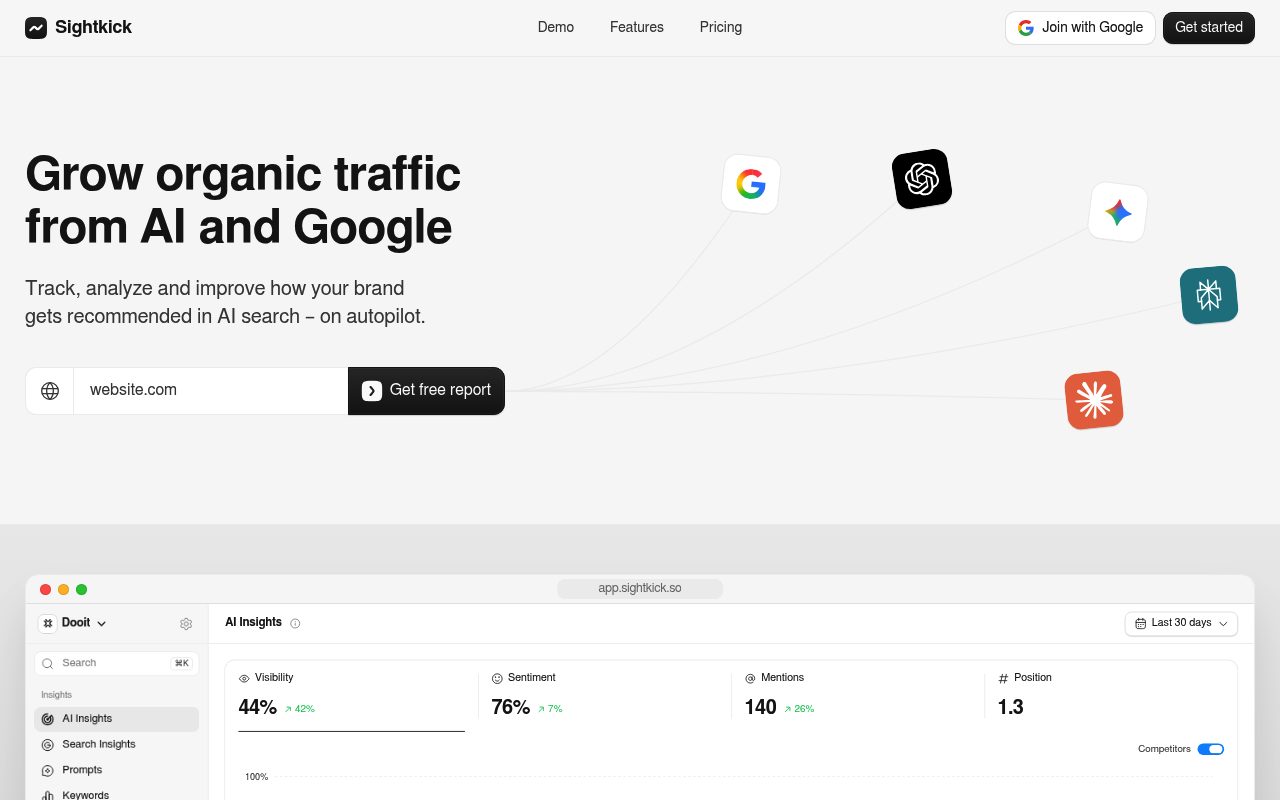
Screenshot: Sightkick homepage, September 2026.
Sightkick pairs daily visibility tracking with automated fixes. It tracks brand visibility, sentiment, mentions, and position across ChatGPT, Gemini, Google AI Overviews, Google AI Mode, Claude, Perplexity, and Reddit. It then publishes articles and runs backlink outreach to pages AI already cites. Setup once, runs forever.
Disclosure: Sightkick is our product.
- Get a baseline. Pull the free brand visibility report to see your visibility percentage, sentiment score, mention count, and average AI recommendation position against competitors.
- Start tracking. Setup takes 2 minutes. Sightkick then runs prompts across 4 AI models daily and records which brands are recommended.
- Read citation sources. Tracked sources are classified as UGC, Editorial, Yours (owned), or Competitor, which shows where recommendations originate.
- Close content gaps. The Articles engine researches, writes, and scores articles, adds images, links, and schema, and publishes to your CMS daily.
- Earn citations. The Backlinks engine finds pages AI already cites, verifies owner contact details, sends pitches and follow-ups, and confirms placements went live. Sightkick MCP exposes 29 tools to Claude, ChatGPT, Cursor, OpenClaw, and Codex.
Limitation: daily prompt runs cover 4 AI models, fewer than Rankscale AI. Teams that want only a lightweight prompt tracker may find Otterly simpler. Plans are on the Sightkick pricing page. The trial runs 7 days.
How Do GEO Tools Actually Differ From Traditional SEO Software — and How Is Citation Frequency Measured?
Traditional SEO software tracks keyword rankings and backlinks on the classic results page. GEO tools measure how often, and how favorably, AI-generated answers cite a brand. Citation frequency is the share of a fixed set of test prompts, run repeatedly across engines, in which the brand's name or domain appears.
- SEO software output: SERP position, backlink count, keyword rank.
- GEO tool output: mention count, sentiment, average recommendation position, citation source type, platform coverage.
To measure citation frequency comparably across vendors:
- Fix an unbranded prompt set that matches real buyer questions, such as "best GEO tools for agencies."
- Run it on a schedule, daily if possible, across multiple models.
- Count completed answers that name the brand. Discard errors and refusals.
- Divide by total completed answers. Report per engine and over time.
One answer can name several brands, so shares overlap. The next section explains how to read the result. Source typing adds a layer SEO reporting lacks. Classifying citations as UGC, Editorial, Owned, or Competitor explains why a brand is missing from answers, not just whether it ranks. For the audit side, see our GEO audit tool guide.
AI Recommendation Share for GEO Tools
AI recommendation share is the percentage of completed, unbranded AI answers that name a given tool. Sightkick runs prompts across 4 AI models daily and records which brands are recommended, which turns share into a continuous competitive benchmark rather than a one-off snapshot.
Method: count completed, unbranded answers that name the brand, divide by total completed answers, and report per engine and over time. Shares do not sum to 100%.
Share measures visibility to AI models, not feature quality. A tool with wide engine coverage can still be named rarely, and a widely named tool can be a poor fit. Treat share as a market-presence signal, then judge fit on pricing and coverage.
Frequently asked questions
GEO tool buyers usually ask four things: which features matter, whether free options exist, what plans cost, and how GEO differs from geography tools. The short answers: multi-engine and citation-level tracking matter most. AI Peekaboo, Otterly, Rankscale AI, and Sightkick offer free entry points. Entry plans run about €20 to $95 a month.
What features should a good GEO tool have?
A good GEO tool covers Promptwatch's five visibility dimensions: citation frequency, citation quality, platform coverage, query coverage, and brand representation accuracy. It should also track citations at the domain and URL level, as Rankscale AI does, and classify sources by type, as Sightkick does with UGC, Editorial, Owned, and Competitor.
What are the five tools of geography?
That question refers to geography education tools such as maps, globes, GPS, GIS, and remote sensing. It is a separate topic from GEO tools for AI search visibility, which this guide covers.
Are there free GEO tools available for tracking AI search visibility?
Yes. AI Peekaboo offers a free product visibility checker and a free AI Visibility Report. Otterly offers a no-card free trial. Rankscale AI and Sightkick each offer 7-day free trials, and it also offers a free brand visibility report.
How much do GEO tools typically cost?
Entry plans run about €20 to $95 a month. Mid-tier plans cost $189 to $245 a month. Agency and business tiers run $495 to $579 a month.
Next step: run 10 unbranded buyer prompts across ChatGPT, Gemini, and Perplexity. Count the answers that name your brand, and use that number as the baseline for judging any of the six tools above.
To skip the manual count, start a free Sightkick trial. Visibility, sentiment, and competitor position get tracked daily.