Best GEO Agency in 2026: 7 Top Picks Compared

Fabio Bergmann
No single GEO agency or tool fits every SaaS brand. Choose on AI platform coverage, prompt volume, and price. Published entry prices run from €20 at Rankscale to $250 per month at Scrunch. Test on a free tier or trial before signing any retainer.
By Fabio Bergmann, Founder of Sightkick
What Is the Best GEO Agency Right Now?
The best GEO agency depends on AI platform coverage, prompt volume, and budget. No vendor below publishes the widest coverage, the most prompts, and the lowest price in one plan. Compare all three before brand recognition.
How often AI engines name a vendor does not measure fit for your SaaS stack, prompt volume, or budget. Judge vendors on what their published plans actually track.
Many GEO agencies deliver their work on top of software platforms like these. Pick the platform first and the agency second. For service-led shops, see our list of generative engine optimization companies.
- High visibility does not guarantee ROI.
- SaaS buyers need coverage of ChatGPT, Gemini, Claude, and Perplexity. Check it before price.
- The sections below cover pricing, coverage, and fit for each option.
How We Chose These GEO Agencies and Tools
Seven GEO vendors went through four filters. The first was AI platform coverage across ChatGPT, Perplexity, Gemini, Claude, Google AI Overviews, and AI Mode. The others were current published pricing, prompt or credit volume at the entry tier, and free trial or free tier availability. Each filter uses the vendor's own pages.
- Pricing: vendor pricing pages and help centers, as of September 2026.
- Free access: GEO ROI is hard to judge without running your own prompts, so we checked for test-first options.
- Coverage gaps: models sold as add-ons raise the real cost. Each one is flagged.
- Disclosure: our product is included and marked at its first mention.
Best GEO Agency and Tool Comparison for 2026
Published entry prices for leading GEO tools run from €20 at Rankscale to $250 per month at Scrunch Core. Peec AI's Advanced brand plan lists $495 per month. Cost rises with prompt volume, model coverage, and per-brand versus per-agency billing. Four of the seven vendors publish a free tier or trial.
Entry price and full model coverage rarely come in the same plan. Compare what the entry tier actually tracks. Disclosure: Sightkick is our product.
| Tool | Starting price | Entry volume | Free option | AI platforms (published) | Key differentiator |
|---|---|---|---|---|---|
| Profound | Not published | Not published | Not published | Not published | Not published |
| Otterly | $29/month | 15 prompts (Lite) | Free tier | 4 core, 3 add-ons | Low-cost entry |
| Peec AI | $95/month (Starter) | Not published | Not published | Not published | Separate agency credit track |
| Scrunch AI | $250/month (Core) | 125 prompts | 7-day trial | Core: 4; Enterprise: 9 | Widest published coverage |
| Rankscale AI | From €20 | Credit-based | Not published | Not published | MCP access, credit rollover |
| AI Peekaboo | $29/month minimum | 25 prompts (free workspace) | Free workspace | 5 | White-label Looker Studio reports |
| Sightkick | Not published | Prompts across 4 AI models daily | 7-day trial | 7, incl. Reddit | Tracking plus automated articles and backlinks |
Sources: Scrunch pricing, Scrunch FAQ, OtterlyAI pricing help, OtterlyAI plans, OtterlyAI pricing, Peec AI, Rankscale, AI Peekaboo FAQ, AI Peekaboo; Sightkick product data.
For a wider field, see our roundup of the best generative engine optimization tools.
Profound: Best for Enterprise AI Answer Benchmarking
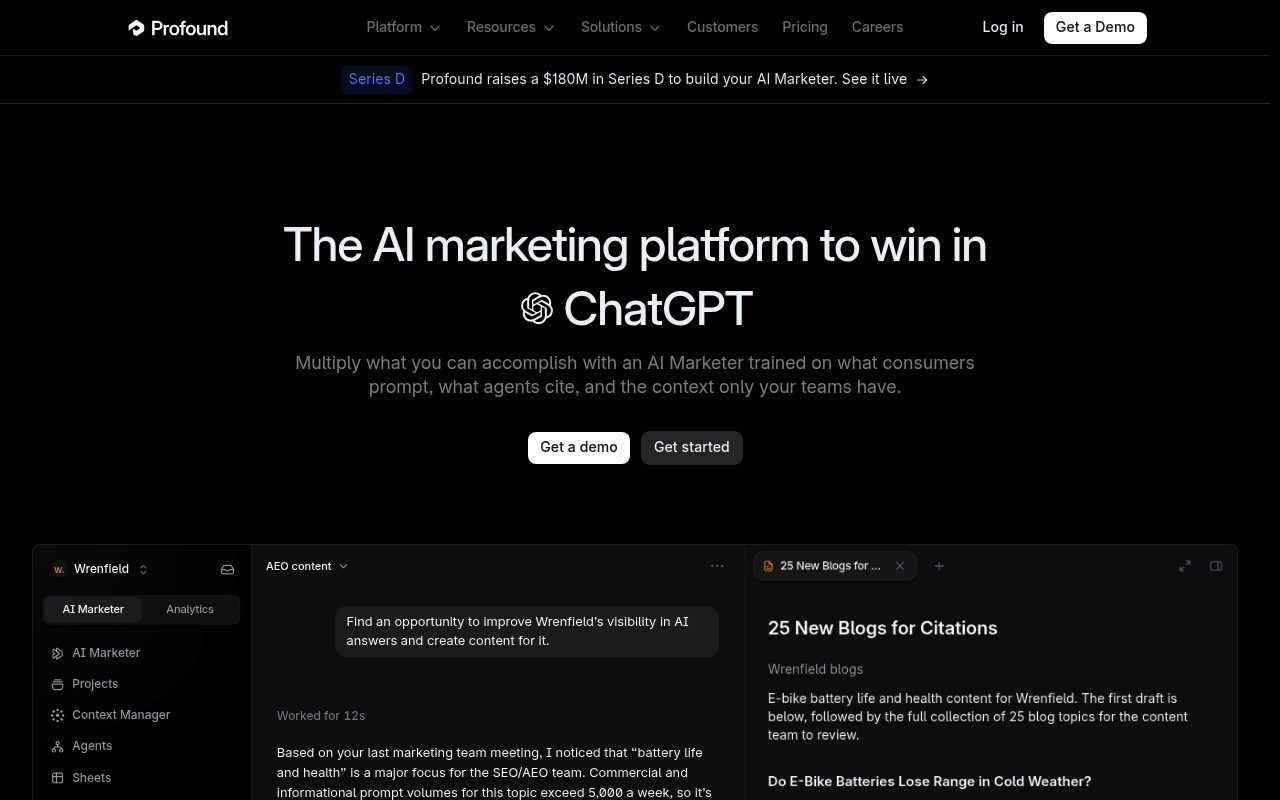
Screenshot: Profound homepage, September 2026.
Profound publishes no pricing, prompt limits, free option, or platform list on the public pages we compared. Buyers cannot benchmark Profound against Scrunch, Peec AI, or Rankscale before a sales call. Treat it as an enterprise option.
- Best for: enterprise teams that can run a sales cycle.
- Pro: none verifiable from public pages. Scope it through a demo.
- Con: nothing to compare on price. Get model coverage and prompt limits in writing before you sign.
Otterly: Best for Budget-Conscious Teams Starting Out
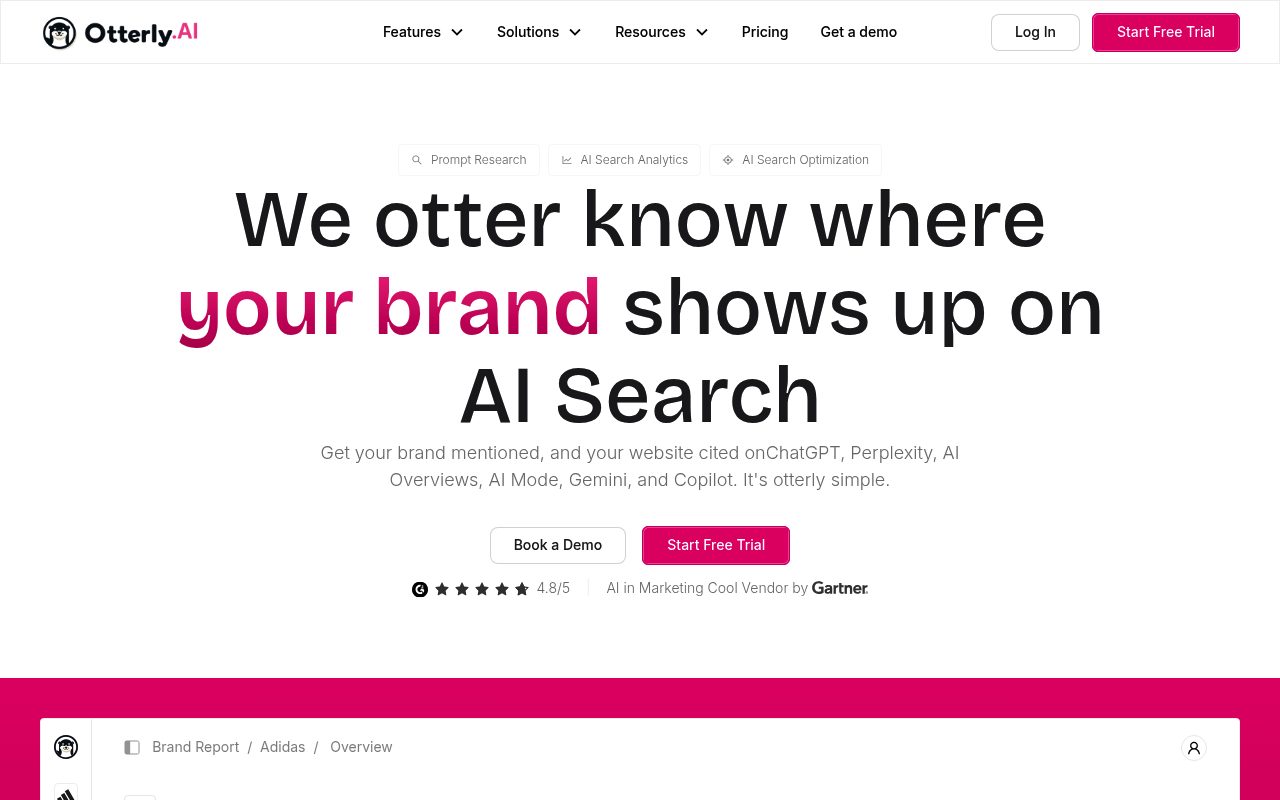
Screenshot: Otterly homepage, September 2026.
Otterly is the practical entry point for a small SaaS team running its first GEO test. Pricing starts at $29 per month, and a free tier comes first. Prompt volume scales from 15 on Lite to 100 on Standard and 400 on Premium, with custom enterprise plans above.
Core coverage spans Google AI Overviews, ChatGPT, Perplexity, and Microsoft Copilot. Google AI Mode, Gemini, and Claude are add-ons.
- Best for: startups that want low-cost AI visibility tracking.
- Pro: free tier plus a $29 start keeps risk low.
- Con: Claude or Gemini adds cost. Total the add-ons before comparing sticker prices.
Peec AI: Best for Agencies Managing Multiple Client Brands
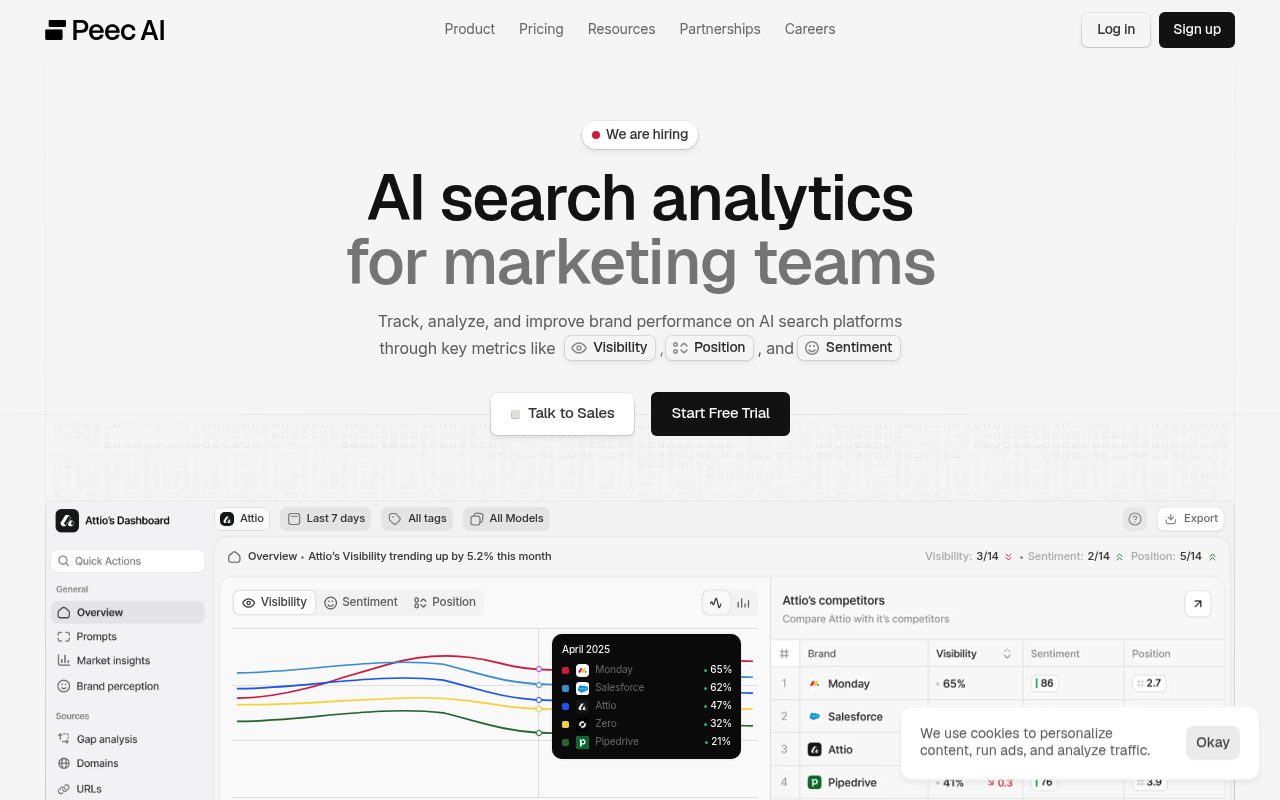
Screenshot: Peec AI homepage, September 2026.
Peec AI runs two pricing tracks. The brand track costs $95 per month for Starter, $245 for Pro, and $495 for Advanced, plus a custom Enterprise option. The agency track bills annually in credits. The split lets agencies run several client accounts in one system instead of paying for separate per-brand seats.
Agency tiers: Essential at 10,000 credits a year, Growth at 25,000, Scale at 65,000, and a custom Comprehensive tier, per Peec AI's agency page. Annual billing saves about 15% on every tier.
- Best for: agencies that want one credit pool across clients.
- Pro: seat-based or credit-based billing, your choice.
- Con: two tracks make Peec AI harder to compare with single-track tools like Scrunch.
Scrunch AI: Best for Broad AI Platform Coverage
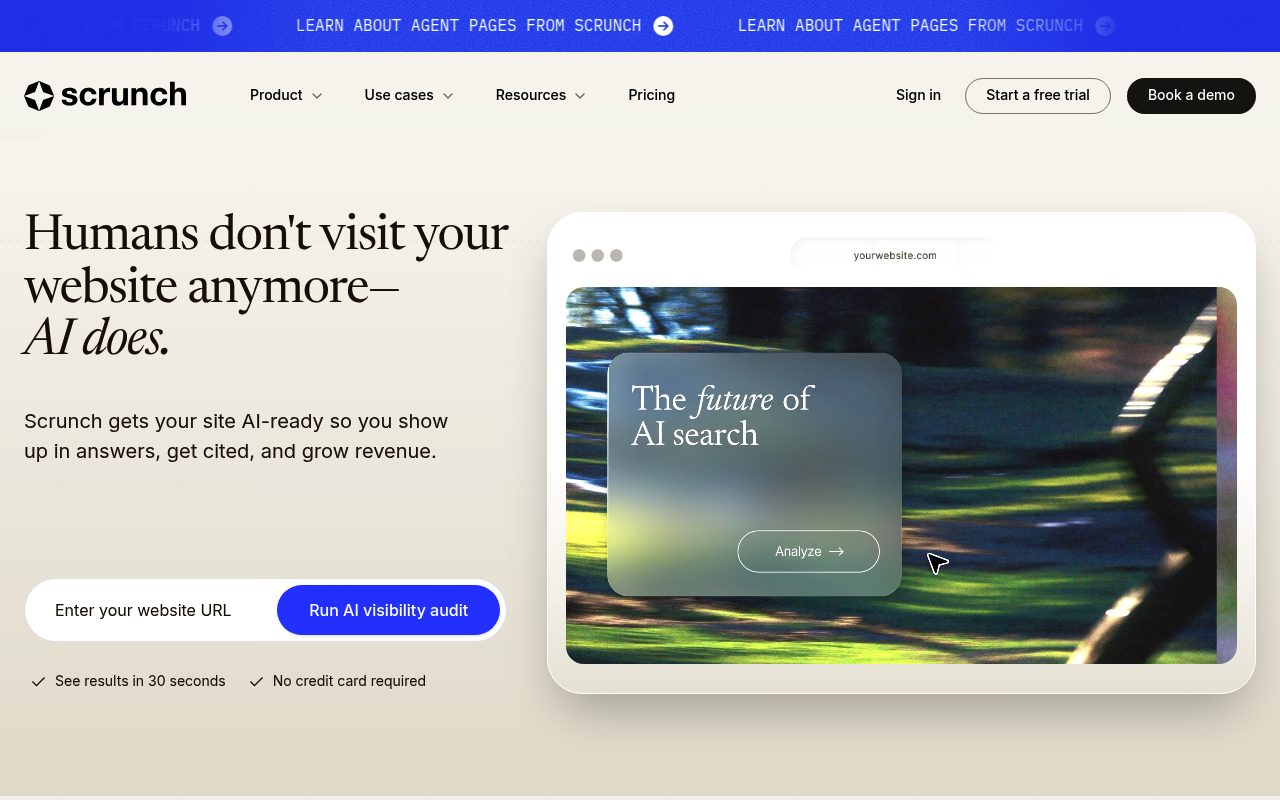
Screenshot: Scrunch AI homepage, September 2026.
Scrunch has the highest published entry price here: $250 per month for Core. That buys 125 prompts, five site audits a month, five user licenses, and four platforms: ChatGPT, Perplexity, Google AI Overviews, and Copilot. Core comes with a 7-day free trial. Enterprise expands coverage to nine AI platforms.
The Enterprise plan adds Claude, Gemini, Meta AI, Google AI Mode, and Grok, plus API access, SSO via SAML and OIDC, and a dedicated account team.
- Best for: mid-market and enterprise teams that need the widest published coverage.
- Pro: nine named platforms on Enterprise, the longest list here.
- Con: Core omits Claude and Gemini, and $250 sits well above Otterly, Rankscale, and AI Peekaboo.
Rankscale AI: Best for AI-Agent Integrated Workflows
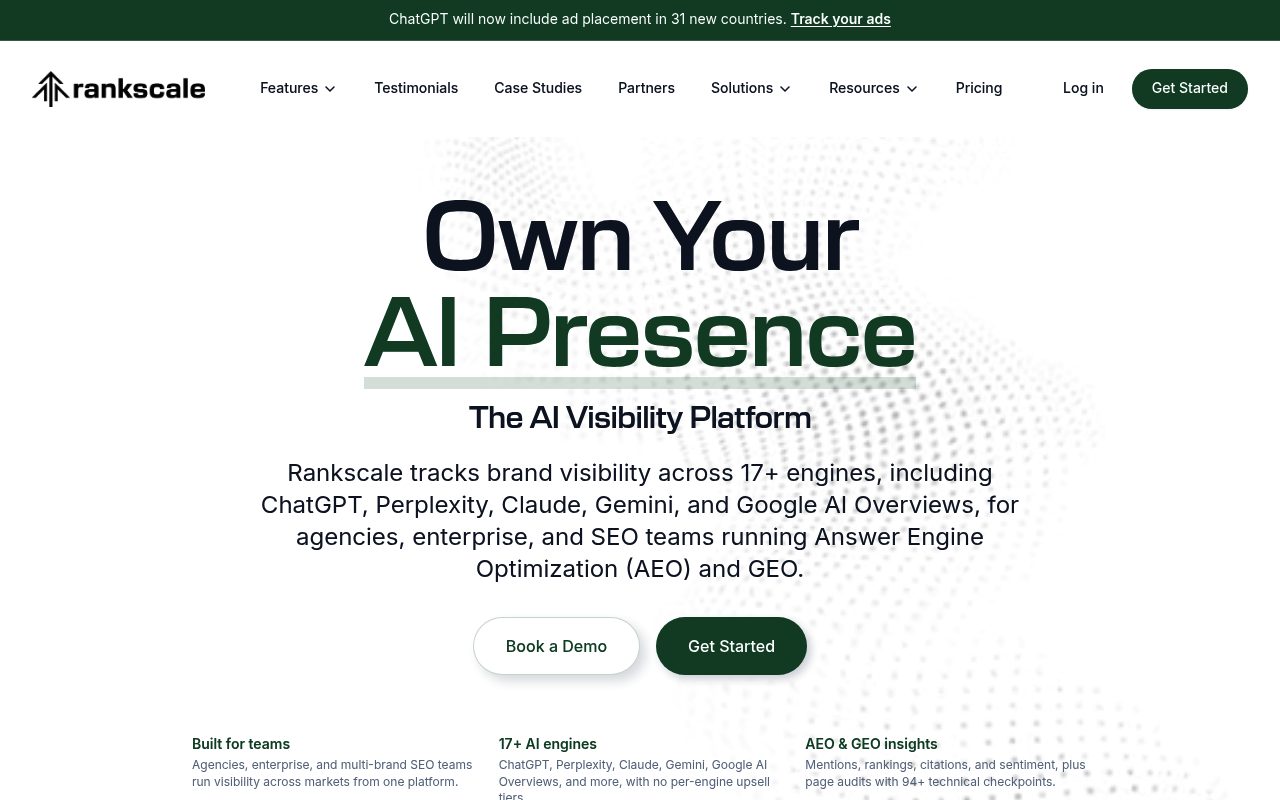
Screenshot: Rankscale AI homepage, September 2026.
Rankscale AI has the lowest published entry point in this group: from €20. It runs on credits, and each AI-engine query uses a fraction of a credit. Unused credits roll over on paid plans. MCP connections let teams query Rankscale data in plain language from Claude, ChatGPT, or Cursor.
- Best for: product and engineering teams already working inside AI agents.
- Pro: lowest starting price plus rollover. Light months are not wasted spend.
- Con: query volume must be estimated upfront. Flat prompt counts like Otterly's budget more easily.
AI Peekaboo: Best for Agencies Needing White-Label Reporting
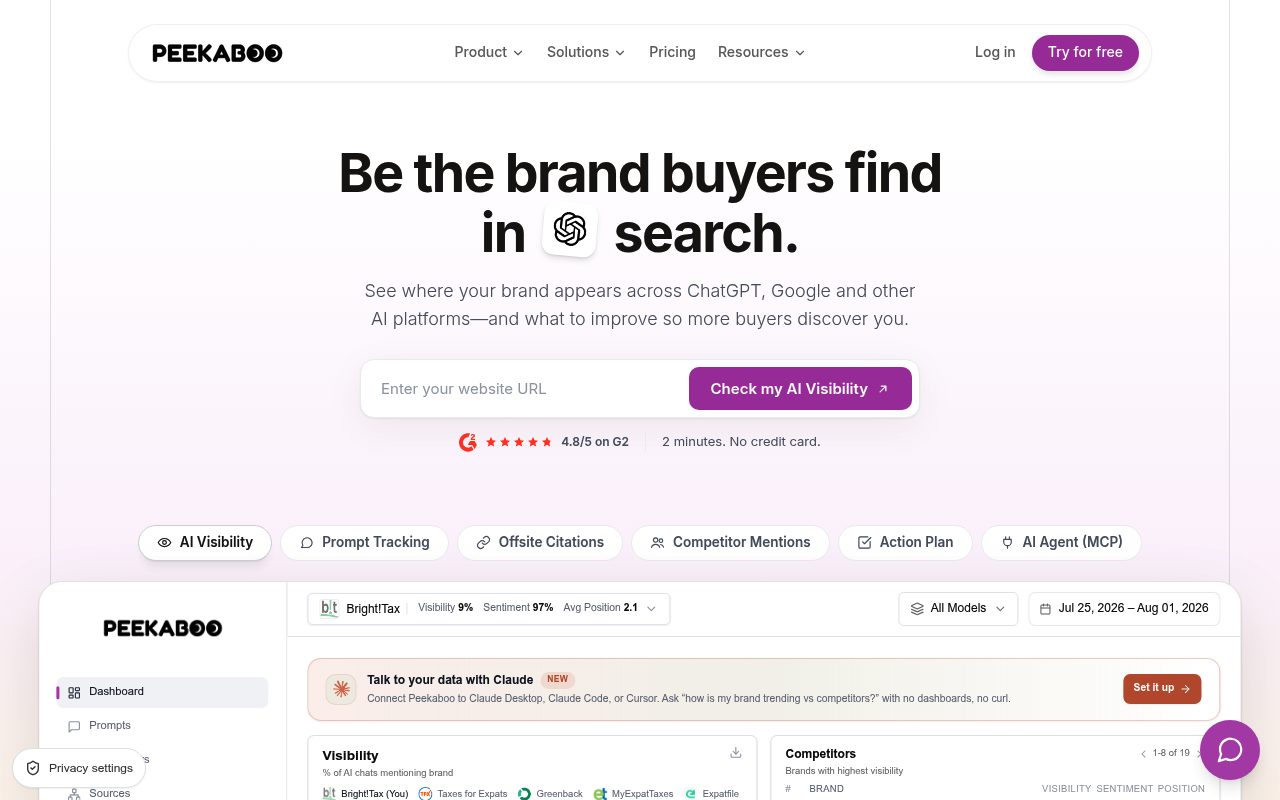
Screenshot: AI Peekaboo homepage, September 2026.
AI Peekaboo fits an agency sending monthly visibility reports under its own brand. It offers white-label, client-themed Looker Studio reporting. Pricing is usage-based: $16.67 per 1,000 configured checks per month, with a $29 minimum. A free workspace covers 1 brand, 25 prompts, and 3 competitors.
Coverage spans ChatGPT, Gemini, Perplexity, Google AI Overviews, and Google AI Mode. The help center documents the per-check rate and free workspace limits.
- Best for: agencies that want client-branded reports without building them.
- Pro: usage pricing plus a free workspace for testing.
- Con: the published model list leaves out Claude and Copilot.
Sightkick: Best for Automated Tracking, Content, and Outreach
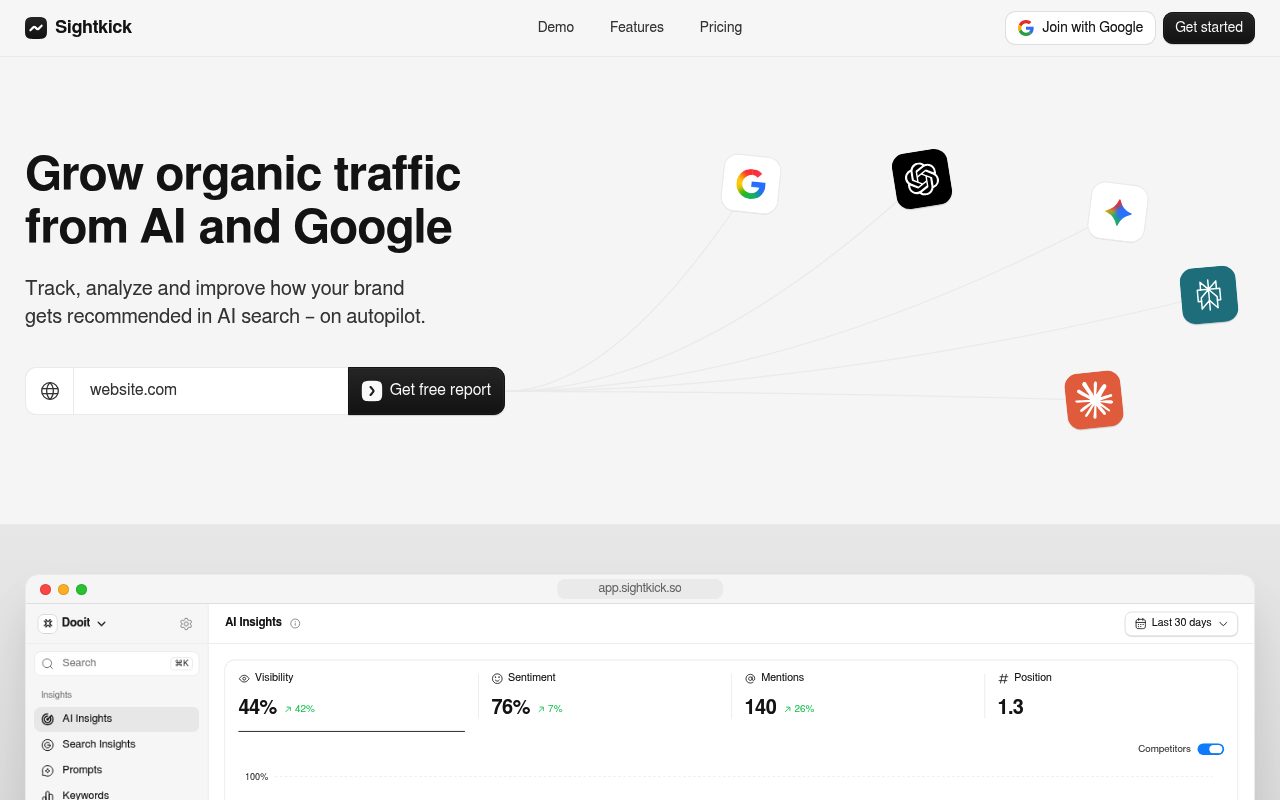
Screenshot: Sightkick homepage, September 2026.
Sightkick tracks visibility, sentiment, mentions, and position across ChatGPT, Gemini, Google AI Overviews, Google AI Mode, Claude, Perplexity, and Reddit at once. It runs prompts across 4 AI models daily and records which brands get recommended. Cited sources are classified as UGC, Editorial, Yours, or Competitor.
Tracking feeds two execution engines. Articles researches, writes, scores, adds images, links, and schema, then publishes to your CMS daily. Backlinks finds pages AI already cites, verifies owner contacts, sends pitches and follow-ups, and confirms links went live. 29 MCP tools connect to Claude, ChatGPT, Cursor, OpenClaw, and Codex. Setup takes 2 minutes. A 7-day free trial and a free brand visibility report come first.
- Best for: SaaS teams that want monitoring, content, and outreach in one system.
- Pro: Claude, Gemini, and Reddit included, plus automated execution beyond tracking.
- Con: pricing is not published in this comparison. Use the trial to check fit.
Is SEO Dead Now That GEO Exists?
SEO is not dead. Google Search Central states that SEO best practices remain relevant and foundational for success with Google's generative AI features. GEO extends SEO. AI models can only cite content they can crawl, parse, and trust, so structured data and authority signals still decide eligibility.
- AI Overviews and AI Mode draw on indexed, well-structured web content.
- GEO layers citation tactics on SEO: answer-first passages, schema, authoritative sourcing.
- Treat GEO as SEO-plus. The fundamentals feed both channels.
To check your footing, see our GEO audit guide.
In-House GEO Team vs. Hiring an Agency: What Actually Works?
The in-house versus agency GEO decision comes down to control versus reach. An in-house team moves fast on brand-specific prompts and keeps data internal. An agency brings cross-client benchmarks and existing outreach relationships. Before choosing, check what current tools already let you monitor, audit, and white-label without outside help.
- In-house works when someone owns daily prompt monitoring across four or more AI models.
- Agencies earn their fee through outreach relationships and cross-client pattern recognition.
- White-label tooling such as AI Peekaboo's client-themed reports keeps small agencies lean.
- Hybrid is often cheapest: automated monitoring in-house, outside help only for outreach.
Running the in-house side of the hybrid model in Sightkick:
- Baseline first. Pull the free brand visibility report: visibility percentage, sentiment score, mention count, and average AI recommendation position against competitors. Setup takes 2 minutes.
- Automate monitoring. The Insights engine runs prompts across 4 AI models daily and records which brands get recommended across ChatGPT, Gemini, Google AI Overviews, AI Mode, Claude, Perplexity, and Reddit.
- Read the source mix. Cited sources are classified as UGC, Editorial, Yours (owned), or Competitor. See whether AI recommendations come from your pages or rivals'.
- Close content gaps. The Articles engine researches, writes, scores, adds images, links, and schema, then publishes to your CMS daily.
- Replace the outreach retainer. The Backlinks engine finds pages AI already cites, verifies owner contacts, sends pitches and follow-ups, and confirms each link went live. Agent users get 29 MCP tools in Claude, ChatGPT, Cursor, OpenClaw, or Codex.
Step-by-step setup: monitoring your brand in AI search results.
How GEO Connects to Global Media-Agency Scale
WPP Media manages $64 billion of client advertising investment, ranking it the world's number 1 media group per COMvergence. Publicis Media led COMvergence's 2025 Total and Net New Business rankings with $10 billion in new client billings. That scale sets the context for GEO tooling.
- Standalone GEO tools price in tens to hundreds of dollars per month. Holding-group media buying runs in billions.
- Holding-group agencies fit brands buying media at scale.
- The specialist tools above fit SaaS teams that want direct control of AI citations.
Frequently asked questions
GEO buyers ask three recurring questions: how to measure an agency, how GEO differs from SEO, and how pricing works. The short answers are weekly mention tracking, AI-answer citations on top of SEO fundamentals, and subscriptions tied to prompt or credit volume rather than flat project fees.
How do I measure a GEO agency's performance after hiring one?
Track mention frequency, sentiment, and average recommendation position weekly across ChatGPT, Gemini, Claude, Perplexity, Google AI Overviews, and AI Mode. Don't stop at the contract-signing baseline. Classify citation sources as owned, editorial, UGC, or competitor to see whether gains come from real authority or incidental mentions.
What's the real difference between a GEO agency and a traditional SEO agency?
A traditional SEO agency optimizes mainly for Google's organic rankings. A GEO agency also targets how often your brand is cited inside AI-generated answers across multiple models. Google's guidance confirms SEO fundamentals still matter, so the strongest providers add GEO to existing SEO work.
Do GEO agencies charge retainers or one-time project fees?
Most GEO tools price as monthly or annual subscriptions tied to prompt or credit volume. Published entry prices start from €20 at Rankscale, and Peec AI's Advanced brand plan lists $495 per month. See the comparison table for entry tiers.
Next step: run your top 10 buyer prompts through one free tier or trial from the comparison table. Compare your mention share against competitors before committing to any retainer.
To get that baseline without manual prompt runs, start a free 7-day Sightkick trial.