AI Search Monitoring Tools 2026: 7 Platforms Compared

Fabio Bergmann
AI search monitoring tools track whether ChatGPT, Gemini, Claude, and Perplexity mention, cite, or recommend your brand inside generated answers, measuring presence, sentiment, and citation sources instead of blue-link rankings.

Key takeaways
- AI search monitoring tracks brand presence inside generated answers (ChatGPT, Gemini, Perplexity, Claude), not blue-link rankings. Different discipline than SEO rank tracking.
- Pricing scales steeply. Rankscale's Enterprise costs 8.3× its Pro tier; OtterlyAI's Standard costs 6.5× its Lite plan. Prompt volume matters more than headline price.
- Most tools stop at reporting. The gap is connecting query fan-out and citation drift to content and outreach workflows.
- Citation sources split into UGC, Editorial, Owned, and Competitor types. Which type drives your mentions determines whether you need content, backlinks, or reputation work.
- Only about 28% of AI answers both mention and cite the same brand, and only 30% of brands stay visible from one answer to the next.
Disclosure: Sightkick is our product and appears in the comparisons below.
What Are AI Search Monitoring Tools?
AI search monitoring tools track whether and how a brand is mentioned, cited, or recommended inside AI-generated answers from ChatGPT, Gemini, Claude, Perplexity, and Google AI Overviews. They measure presence, sentiment, and citation sources inside conversational responses, the layer where buying decisions increasingly start.
The core metrics are mention count, sentiment, citation share, and average recommendation position. OtterlyAI's analytics track brand mentions, citations, sentiment, and share of voice across seven AI engines. AirOps frames the discipline as how often ChatGPT, Perplexity, Gemini, and Google AI Overviews mention and cite a brand versus competitors.
But mention and citation don't move together. AirOps found only about 28% of AI answers both mention and cite the same brand, so tracking one without the other misses most of the picture.
SaaS teams, agencies, and product-led growth teams use these tools to defend or grow AI-driven discovery. The queries where a prospect asks an AI which tool to buy instead of scrolling a results page.
How Do AI Search Monitoring Tools Differ From Traditional Rank Trackers?
Traditional rank trackers measure where a URL sits in a list of blue links for a keyword. AI search monitoring tools measure whether a brand is named, cited, or recommended inside a synthesized answer: a presence signal plus sentiment, since most conversational responses have no fixed "position 1-10" structure.
Rank trackers assume stable SERP slots. AI answers vary by session, model, and phrasing, so a brand can appear in one run and vanish in the next. AI tools also add sentiment and citation-source classification that rank trackers never needed.
The clearest divergence is query fan-out. Rankscale's Query Fanout feature exposes the internal searches an engine runs before answering, including coverage, probed domains, and wins and losses in a sortable table. Rank trackers have no equivalent. There is no hidden search layer behind a static blue link.
How Do You Track Brand Mentions Across ChatGPT, Perplexity, and Gemini?
Tracking brand mentions across ChatGPT, Perplexity, and Gemini means running the same prompt set on a recurring schedule against each model, then logging whether your brand appears, how it's framed, and which source got cited. Most platforms automate this daily. Manual spot-checking misses the drift between runs.
Daily automated runs catch model updates that shift who gets recommended. OtterlyAI monitors six engines on a daily basis, and Rankscale tracks eight including DeepSeek, Mistral, and Grok. Sightkick runs prompts across 4 AI models daily and records which brands are recommended.
Citation-source classification explains why a brand was or wasn't cited. Sightkick classifies tracked citation sources as UGC, Editorial, Yours (owned), or Competitor, so you know whether the fix is content, backlinks, or reputation work. See our 2026 setup guide for a deeper walkthrough.
How Do You Measure Share of Voice in Generative AI Responses?
Share of voice in generative AI is the percentage of relevant answers that name your brand versus competitors, measured across a fixed prompt set run repeatedly over time. It needs enough prompt volume and query diversity to be meaningful. A handful of one-off ChatGPT checks won't reveal a trend.
OtterlyAI defines share of voice as the share of answers naming your brand versus rivals. But that share is volatile. AirOps found only about 28% of AI answers both mention and cite the same brand, and only 30% of brands stay visible from one answer to the next.
Only 30% of brands stay visible from one answer to the next. — AirOps
That volatility is the whole argument for daily tracking. OtterlyAI's Looker Studio connector exposes brand share of voice and citation share fields, so AI visibility folds into existing dashboards instead of living in a separate silo.
What's the Real Gap Between Watching AI Answers and Acting on Them?
The gap between watching and acting is workflow. Most tools report mentions and sentiment, then stop, leaving teams staring at dashboards without a next move. The fix ties query fan-out and citation drift to concrete changes: publishing content on the exact gaps AI surfaces, and pursuing backlinks on pages AI already cites.
Query fan-out exposes the internal searches an engine runs before answering, including probed domains and wins and losses. Most monitoring stops before using that data to drive content briefs. Rankscale's Query Fanout output is a good example of the raw material. The question is what you do with it.
Citation drift, a brand losing a citation it previously held, is a trigger event, not just a metric. With 70% of brands falling out of visibility between one answer and the next, drift isn't an edge case. It's the default. It should auto-trigger a content or outreach task. Sightkick's Articles engine turns identified content gaps into published, schema-tagged articles on a daily schedule, and its Backlinks engine finds pages AI already cites, verifies owner contacts, sends outreach and follow-ups, and confirms links went live. That closes the loop instead of flagging it.
How Do Data Collection Methods Affect Accuracy?
Data collection method changes what you measure. AI monitoring tools capture answers either by scraping the live consumer UI (what a real user sees) or by calling the underlying API (which can return different, sometimes less curated, results). This affects whether reported visibility matches what your customers experience in the ChatGPT or Gemini app.
API-based collection is faster and cheaper to scale but may miss UI-only features like inline citations or follow-up suggestions. UI-scraped data mirrors real user experience more closely but is harder to run at high prompt volume. AirOps' Prompt Discovery goes a step further, pulling from third-party panel data from millions of real ChatGPT, Perplexity, and Google AI users to seed prompts from actual query behavior.
Before trusting any cross-tool comparison, ask the vendor which method they use. Two tools reporting different visibility scores for the same brand may simply be sampling two surfaces of the same model.
AI Search Monitoring Tools Compared: Pricing and Coverage
Pricing and engine coverage vary widely. Entry plans start near $29-99/month for a few hundred prompts, while enterprise tiers reach $780+/month for tens of thousands of AI-engine answers. Coverage differs too. Some tools track 4 engines, others 7-8, and only some include Reddit, query fan-out, or MCP integrations.
The steepness of the pricing curve is the buying signal, not the entry price. Rankscale's Enterprise plan at $780/month costs 8.3× its $99/month Pro plan. OtterlyAI's Standard plan at $189/month costs 6.5× its $29/month Lite plan, gating API and MCP access behind the higher tier.
Prompt volume is what you're really paying for. Rankscale's Growth plan runs $385/month for 5,500 credits, with each query typically using 0.25 credits and unused credits rolling over. That works out to up to 22,000 AI-engine answers on Growth versus 4,800 on Pro. Match tier to prompt count and required engines before comparing headline numbers.
Comparison Table: 7 AI Search Monitoring Tools at a Glance
This table compares seven AI search monitoring platforms on entry pricing, AI engines tracked, and standout capability, so teams can shortlist by budget and required coverage before a deeper trial. Entry price ranges from free (Sightkick's report, Promptwatch's scan) to a $50 day pass (Profound).
Disclosure: Sightkick is our product.
| Tool | Entry Price | Engines Tracked | Standout Feature |
|---|---|---|---|
| Sightkick | Free report / 7-day trial | ChatGPT, Gemini, Google AI Overviews & Mode, Claude, Perplexity, Reddit | Automated articles + backlinks engine |
| OtterlyAI | $29/mo | ChatGPT, Google AI Overviews, Perplexity, Copilot (+add-ons) | Looker Studio connector |
| Rankscale | $99/mo | ChatGPT, Gemini, Perplexity, Claude, DeepSeek, Mistral, Grok, Copilot | Query fan-out analysis |
| Promptwatch | Free scan / paid tiers | ChatGPT, Perplexity, Google AI Overviews/Mode, Claude, Gemini, Llama, DeepSeek | Crawler logs, Shopping Insights |
| AirOps | Contact sales | ChatGPT, Gemini, Perplexity, Google AI Mode/Overviews | Prompt Discovery from panel data |
| Profound | $50/day pass | Multi-engine (full catalog access) | Flexible day-pass pricing |
| Scrunch AI | Contact sales | Multi-engine | Enterprise GEO focus |
For a broader ranked list, see our roundup of the 8 best AI search visibility tools for 2026.
Sightkick: Turning AI Visibility Into Published Content and Backlinks
Sightkick combines daily 4-model brand tracking with an automated Articles engine and a Backlinks engine that finds AI-cited pages, verifies contacts, and confirms links went live. It offers a 7-day free trial and a free visibility report, and claims a 2-minute setup. The design goal is closing the monitoring-to-action loop other tools leave open.
Sightkick tracks ChatGPT, Gemini, Google AI Overviews, Google AI Mode, Claude, Perplexity, and Reddit simultaneously, and classifies citation sources as UGC, Editorial, Owned, or Competitor for structured gap analysis. Sightkick MCP exposes 29 tools directly into Claude, ChatGPT, Cursor, OpenClaw, and Codex.
Limitation: as a newer, all-in-one automation layer, teams wanting deep manual prompt customization or a long-established enterprise track record may want to pair Sightkick with a specialist tool during evaluation.
OtterlyAI: Budget-Conscious Teams Starting With Share of Voice
OtterlyAI's Lite plan starts at $29/month for 15 prompts and daily tracking across ChatGPT, Google AI Overviews, Perplexity, and Microsoft Copilot, with unlimited team members and Claude, Gemini, and Google AI Mode as paid add-ons. Its Looker Studio connector folds AI visibility into existing reporting stacks.
The Standard plan at $189/month unlocks 100 prompts plus API access, MCP access, and Agent Analytics. The Premium plan at $489/month scales to 400 prompts for larger competitive sets.
OtterlyAI defines share of voice as the share of answers naming your brand versus rivals, and monitors six engines on a daily interval. A clean entry point for teams new to the discipline.
Rankscale: Query Fan-Out and Engine Breadth
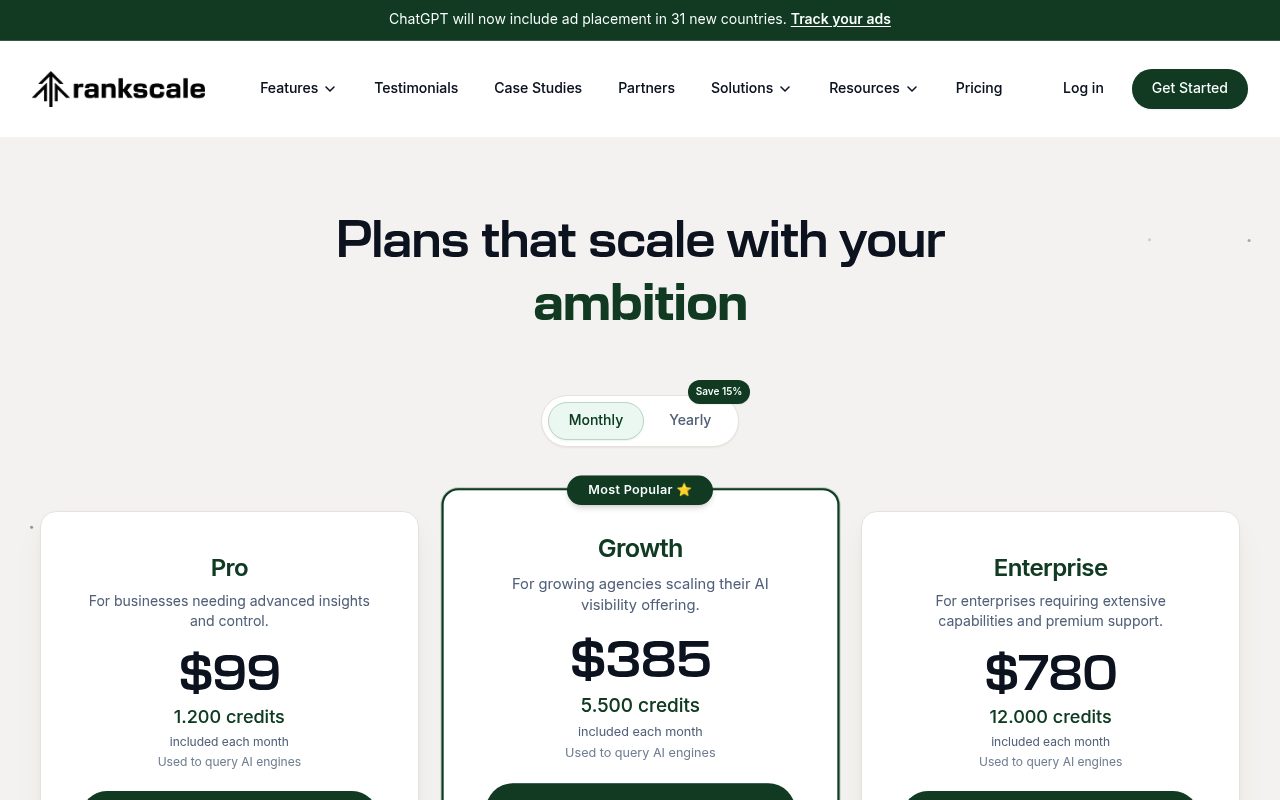
Screenshot: Rankscale pricing page, September 2026.
Rankscale tracks eight AI engines including DeepSeek, Mistral, and Grok, and its Query Fanout feature shows the internal searches an engine ran before answering. A level of operational detail most competitors don't expose. Plans start at $99/month for 1,200 credits and scale to $780/month for enterprise volume.
Each AI-engine query typically uses 0.25 credits, and unused credits roll over to the next billing cycle. Useful for uneven monthly usage. The Growth plan at $385/month offers 50 brand dashboards and 200 page audits, aimed at agencies managing multiple clients.
Query fan-out output includes coverage, appendix phrases, probed domains, and wins and losses in a sortable all-queries table. Raw material for content briefs, not just a score.
Promptwatch: Free Entry-Level Visibility Scans
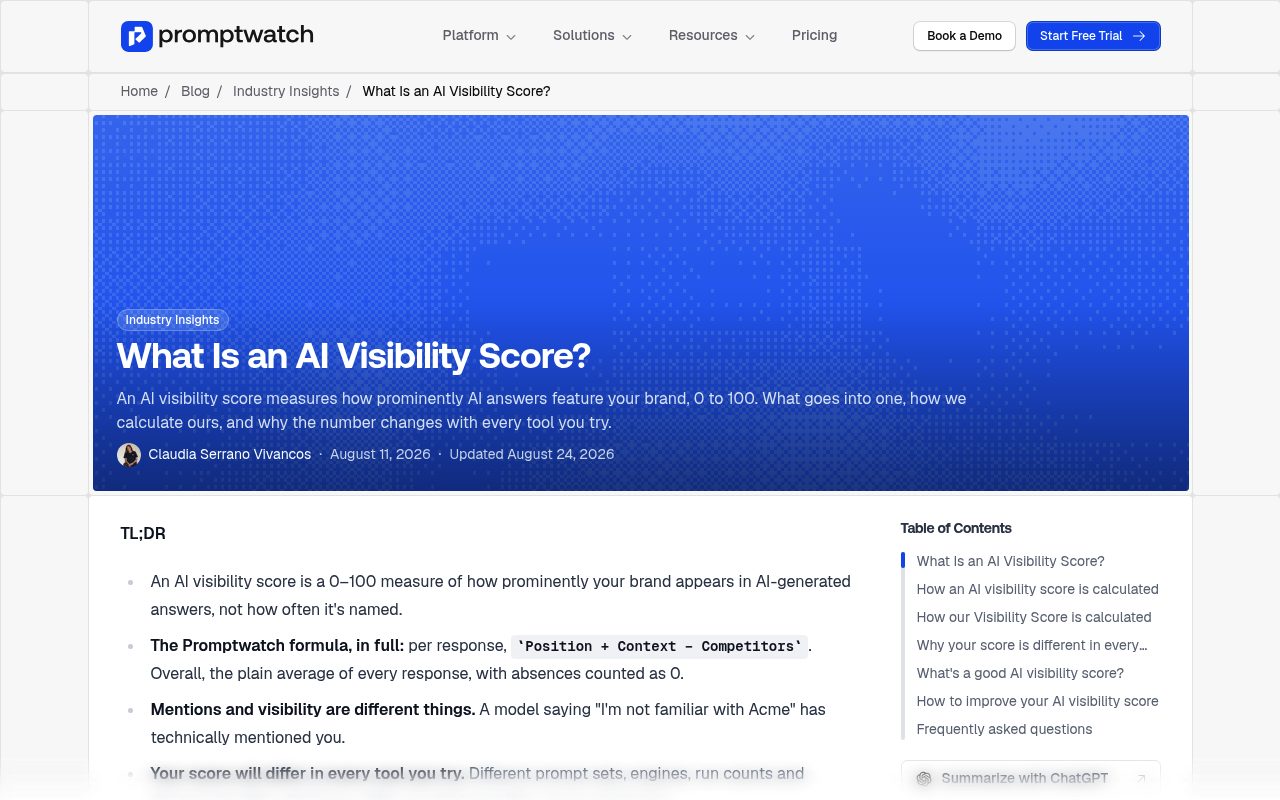
Screenshot: Promptwatch blog page, September 2026.
Promptwatch offers a free AI visibility report that scans robots.txt, checks whether AI crawlers can read a site, and scores visibility, mentions, position, and citations. A low-friction way to baseline before committing to a paid plan. Paid tiers add conversion tracking, crawler logs, and geographic breakdowns.
The Promptwatch AI visibility score is a 0-100 score calculated as Position + Context − Competitors. Its free report also extracts what AI thinks a site does and returns whether AI crawlers can actually read the site.
Promptwatch tracks eight engines including Meta Llama and DeepSeek, and its Shopping Insights and Ads Radar features target e-commerce and paid-visibility use cases.
AirOps, Profound, and Scrunch AI: Enterprise and Content-Team Workflows
Screenshot: AirOps report page, September 2026.
AirOps leans into content-team workflows with Prompt Discovery built from real user panel data; Profound offers flexible day-pass to quarterly pricing for individuals; Scrunch AI targets enterprise GEO programs. Each suits teams needing broader research or flexible commitment over daily operational tooling.
AirOps' Prompt Discovery pulls from third-party panel data from millions of real ChatGPT, Perplexity, and Google AI users, and the company analyzed over 5.5 million LLM responses for its community-flywheel report, showing UGC's outsized role in citations. Its tracking spans ChatGPT, Gemini, Perplexity, Google AI Mode, and AI Overviews.
Profound's individual pricing includes a $50 day pass, a $99 monthly plan, and a $249 quarterly plan, each with full catalog access and a single-user license. A fit for one-off audits or solo analysts who don't need a team seat.
How Do You Set Up Automated AI Search Monitoring?
Setting up automated monitoring means defining a prompt set covering commercial, informational, and competitor-comparison queries, connecting it to a tool that runs those prompts daily across target AI models, and routing alerts for citation gains or losses to the team that owns content or outreach. Most modern platforms configure in minutes, not weeks.
Segment prompts by buyer intent, persona, and region for SaaS and agency use cases, not just generic brand-name queries. A prompt like "best CRM for early-stage startups in Germany" surfaces different competitors than a bare brand check.
Sightkick claims a 2-minute setup and 7-day free trial, with a free visibility report at entry showing visibility percentage, sentiment score, mention count, and average AI recommendation position. Route citation-loss alerts to whoever can act: content team for gaps, outreach team for lost backlinks.
Frequently asked questions
What are the top AI search monitoring tools right now?
Options include Sightkick, OtterlyAI, Rankscale, Promptwatch, AirOps, Profound, and Scrunch AI, each varying by engine coverage, pricing model, and whether they extend into content or backlink automation. The right pick depends on whether you need pure monitoring or a tool that also acts on the data.
What are the big 3 AI engines to monitor?
Most brands prioritize ChatGPT, Google (AI Overviews and AI Mode), and Perplexity, since these see the highest consumer query volume for commercial and research intent. Gemini and Claude are close behind and increasingly tracked alongside them by most monitoring platforms.
How do you track AI visibility for a brand?
Track AI visibility by running a consistent set of prompts against multiple AI models daily, logging mention presence, sentiment, and citation source each time, then comparing trends against named competitors. Tools like Sightkick, OtterlyAI, and Rankscale automate this instead of requiring manual prompt checks.
Can tools alert you when your brand disappears from AI answers?
Yes. Platforms that run daily prompt tracking can detect when a previously-cited brand drops out of an answer, a signal often called citation drift. With only 30% of brands staying visible from one answer to the next, that drop-off is common, not rare. The useful version of this alert ties directly into a workflow, such as flagging a content update or backlink outreach task, rather than just logging the drop.
How is AI search monitoring different from traditional SEO rank tracking?
Traditional rank tracking measures a URL's position in a list of blue links for a keyword; AI search monitoring measures whether a brand is mentioned, cited, or recommended inside a generated conversational answer. The underlying signals (sentiment, citation source, share of voice) don't exist in classic rank tracking.
How much do AI search monitoring tools typically cost?
Entry plans range from free reports to roughly $29-99 per month for a few hundred prompts, while enterprise tiers with tens of thousands of tracked answers run $385-780+ per month. Sightkick offers a free brand visibility report and 7-day trial before any payment is required.
Want to see where you stand across ChatGPT, Gemini, Claude, and Perplexity? Start free with Sightkick. The visibility report shows your mentions, sentiment, and average recommendation position.