AI Visibility SEO Strategy 2026: 8 Steps That Work

Fabio Bergmann
An AI visibility SEO strategy is the deliberate practice of tracking, structuring, and publishing content so a brand gets cited or recommended inside ChatGPT, Gemini, Google AI Overviews, Claude, and Perplexity answers, built on top of core SEO rather than instead of it.
Disclosure: This guide is published by Sightkick, which sells an AI visibility platform listed among the tools below.

Key takeaways
- AI visibility is an added layer on crawlability, indexing, and grounding, not a replacement for core SEO fundamentals [1][2][4].
- The BCG 10-20-70 rule reframes AI ROI: 10% is algorithms, 20% is tech/data, 70% is people and process [6].
- OtterlyAI's Lite plan is 0.30× the cost of Promptwatch's entry plan; Rankscale Pro is 0.42× Promptwatch Professional. Tier choice matters more than brand name.
- Google now ships dedicated Search Console reports for generative AI performance, making AI visibility measurable with first-party data [5].
- A minimum viable startup stack runs on a 7-day trial, a 15-50 prompt set, and one automated content or backlink loop.
What Is an AI Visibility SEO Strategy?
An AI visibility SEO strategy is the deliberate practice of monitoring, structuring, and publishing content so brands get cited inside ChatGPT, Gemini, Google AI Overviews, Claude, and Perplexity answers. It sits on top of traditional SEO fundamentals like crawlability and indexing, not as a replacement for them.
Google is explicit about the mechanics. Its generative AI search features rely on publicly accessible, crawlable content, and foundational SEO best practices remain the basis for visibility. Pages must be indexed and eligible for a snippet in Google Search to qualify for generative AI features at all.
Two mechanisms drive citation. RAG, also called grounding, retrieves live pages from Google Search and generates a response from them, so indexing eligibility is a prerequisite. Query fan-out generates a set of concurrent, related queries around one user question, expanding the surface a brand can be cited on. AI visibility is measurable. It sits downstream of crawl, index, and content-quality signals.
What Is the 10/20/70 Rule for AI, and Why Does It Matter for Visibility?
BCG's 10-20-70 rule states AI value creation splits into 10% algorithms, 20% technology and data, and 70% people and process. Applied to visibility, most failures trace back to workflow and team adoption gaps, not missing tools or model access.
The framework allocates just 10% to algorithms, 20% to technology and data, and 70% to people and processes. Buying a tracking tool sits in the 20%. Without changing content workflows, briefing, and publishing cadence, that 20% caps your results.
Brands that succeed reallocate effort toward the human 70%: better briefs, a fixed publishing schedule, a repeatable outreach process. Use this rule as a gut-check before comparing tools. Process readiness comes first.
What Is the 80/20 Rule in SEO — and How Does It Apply to AI Search?
The 80/20 rule in SEO holds that roughly 20% of pages, keywords, or fixes drive 80% of visibility. In AI search it concentrates further, since query fan-out and RAG retrieval pull a small set of well-structured, entity-clear pages into most generated answers.
Because AI features only draw from indexed, snippet-eligible pages, fixing indexing issues on a core page set outweighs broad content expansion. Query fan-out multiplies the value of a few authoritative pages, since one page can answer several related sub-queries in a single session.
The practical move: audit and fix the 20% of pages already ranking or getting cited before writing anything net-new. Prioritize before you produce.
What Does a Complete AI Visibility SEO Strategy Look Like, Step by Step?
A complete strategy runs five stages on repeat: track brand mentions across AI models, audit indexing and content gaps, publish structured content on schedule, earn citations via backlink outreach, then measure and iterate. Each stage feeds the next in a continuous loop rather than a one-time project.
Track
Run prompts daily across ChatGPT, Gemini, Claude, Perplexity, Google AI Overviews, Google AI Mode, and Reddit to record who's recommended and why. Daily runs catch shifts that monthly snapshots miss.
Audit
Confirm pages are indexed and snippet-eligible. That's the baseline for AI feature inclusion. An unindexed page cannot be grounded or cited, no matter how good the content.
Publish
Close content gaps with researched, schema-tagged articles on a fixed schedule rather than ad hoc drops. Consistency compounds. Sporadic publishing does not.
Earn Citations
Find pages AI already cites, verify site-owner contacts, then pitch and follow up for backlinks. Citation follows retrieval, so target the pages retrieval already trusts.
Measure & Iterate
Feed fresh reporting back into the next cycle. Google launched dedicated Search Console generative AI performance reports on June 3, 2026, giving first-party Search and Discover data to cross-check third-party tools. Automation handles tracking, publishing, and outreach, but editorial judgment on tone and positioning stays human.
How Do You Build Topical Authority for AI Search Engines?
Topical authority for AI search comes from covering a topic's full query fan-out, the cluster of related sub-questions a model generates around a core query, with clearly structured, entity-labeled pages that are indexed and crawlable. Retrieval systems then pull from your domain across multiple related prompts.
- Map the fan-out. List the sub-queries a model would generate around your core topic and cover each with a distinct, linked page. Google describes query fan-out as a set of concurrent, related queries the model creates.
- Use consistent entity naming. Repeat brand, product, and category terms so grounding systems match your content to the right query.
- Keep pages indexed and snippet-eligible. Authority signals are irrelevant if a page isn't in the eligible retrieval pool.
- Favor depth over sprawl. A tightly interlinked cluster outperforms scattered pages that never reference each other.
How Should Content Teams Adapt Their Workflow for AI-First Search?
Content teams should shift from calendar-driven publishing to gap-driven publishing: prioritize briefs by where competitors are cited and you aren't, ship schema-tagged pages continuously rather than in batches, and run backlink outreach as an ongoing engine rather than a quarterly campaign.
Replace static editorial calendars with gap analysis, publishing on tracked mention and citation gaps instead of keyword volume alone. Build schema, images, and internal links into the default article template, since grounding systems favor well-structured, crawlable pages.
Run backlink outreach continuously. Identifying pages AI already cites and pursuing links there beats generic link building. Shorten the feedback loop: use daily or weekly tracking data to redirect next week's briefs. For a deeper operating model, see our 2026 guide to AI SEO optimization.
Which KPIs Matter Most for Tracking an AI Visibility SEO Strategy?
The core KPIs are visibility percentage (share of tracked prompts where a brand appears), sentiment score, mention count, average recommendation position, and citation source type, split into UGC, Editorial, Yours, and Competitor. That last split shows where mentions originate, not only whether they happened.
Track visibility %, sentiment, mention count, and average position weekly, not just at launch. Citation source typing shows whether visibility depends on owned content, editorial coverage, forums, or competitors, a distinction most trackers skip.
Google's generative AI performance reports add a first-party data source for Search and Discover visibility, useful for cross-checking third-party numbers. Cadence matters: daily prompt runs catch swings that weekly or monthly snapshots miss.
How Do You Get Your Brand Cited in ChatGPT and Perplexity Answers?
Getting cited requires being present on pages these models already retrieve from. Brands should find which existing pages AI cites for their category, then either get featured there via outreach or replicate that page's structure and depth on owned domains, since citation follows retrieval, not just ranking.
- Identify which third-party and owned pages currently get cited for your target prompts before writing anything new.
- Pitch owners of frequently-cited pages for inclusion or backlinks. RAG retrieves relevant pages before generating, so citation-source pages carry outsized influence.
- Ensure any target page is indexed and snippet-eligible in Google Search, a baseline requirement across AI features.
- Close the loop with verified outreach: confirmed contact details, tracked follow-ups, and confirmed live links, the step most manual link-building skips.
How Can Startups Run an AI Visibility SEO Strategy on a Limited Budget?
Budget-conscious teams should start with a minimum viable prompt set of 15-50 prompts, use a free trial to validate signal before committing spend, and lean on one automated content or outreach loop instead of buying separate tools. Most entry plans across the category sit between $20 and $95 per month.
- OtterlyAI's Lite plan starts at $29 per month with 15 prompts across ChatGPT, Google AI Overviews, Perplexity, and Copilot, tracked daily.
- Rankscale's Essentials plan starts at $20 per month, the lowest entry point in this comparison.
- Free trials remove first-month risk: OtterlyAI offers 7 days with 50 prompts and no card required, and Scrunch offers a 7-day agency trial.
- Sightkick also offers a 7-day free trial with a claimed 2-minute setup and a free brand visibility report showing visibility %, sentiment, mentions, and average position at entry.
Minimum viable stack: one tracking tool at the entry tier plus one automated content or backlink engine, reviewed monthly, beats juggling multiple full-price platforms. Our free AI visibility checker roundup covers the limits of the no-cost options.
AI Visibility Tools Compared: Pricing, Prompts, and Coverage
Entry pricing across AI visibility trackers ranges from $20 to $95 per month, but the real difference is what's included: prompt counts, engine coverage, audit depth, and whether content or backlink production is bundled in. Those details change which plan is the better deal.
| Tool | Entry price | Prompts / pages | Engine coverage | Standout feature |
|---|---|---|---|---|
| OtterlyAI (Lite) | $29/mo | 15 prompts | ChatGPT, AI Overviews, Perplexity, Copilot | Daily tracking, unlimited seats |
| Rankscale (Essentials → Pro) | $20/mo → $99/mo | Unlimited terms (Pro: 50 audits) | 17+ AI engines | 94+ technical checkpoints |
| AirOps (Solo → Pro) | Custom / tiered | 100 → 250 | ChatGPT (Solo), multi-engine (Pro) | Bundled content tasks |
| Promptwatch (Essential → Business) | $95/mo → $579/mo | 50 → 350 | Multi-engine | Done-for-you AEO articles |
| Scrunch AI | Custom | Enterprise/agency scale | Multi-engine | Multi-client agency management |
| Sightkick | 7-day free trial | Daily prompts, 4 models | 7 sources incl. Reddit | Automated articles + backlinks |
The pricing math rewards attention to tiers. OtterlyAI's $29 Lite plan costs 0.30× Promptwatch's $95 Essential plan. Rankscale's $99 Pro plan costs 0.42× Promptwatch's $245 Professional plan. AirOps' Pro plan tracks 2.5× more prompts and pages than its Solo plan, moving from 100 to 250.
Otterly: best for lean startups needing a low entry price
Screenshot: Otterly pricing page, September 2026.
Otterly suits teams that want daily multi-engine tracking without enterprise pricing. It starts at $29/month for 15 prompts across ChatGPT, Google AI Overviews, Perplexity, and Copilot, with a 7-day free trial including 50 prompts and no credit card required. The Lite tier lists no native Claude or Gemini tracking.
- Lite plan: $29/month, 15 search prompts, unlimited team members, daily tracking.
- Coverage: ChatGPT, Google AI Overviews, Perplexity, Microsoft Copilot.
- Free trial: 7 days, 50 prompts, no card required.
- Limitation: no native Claude or Gemini tracking listed in the Lite tier.
Rankscale: best for technical audit depth
Screenshot: Rankscale pricing page, September 2026.
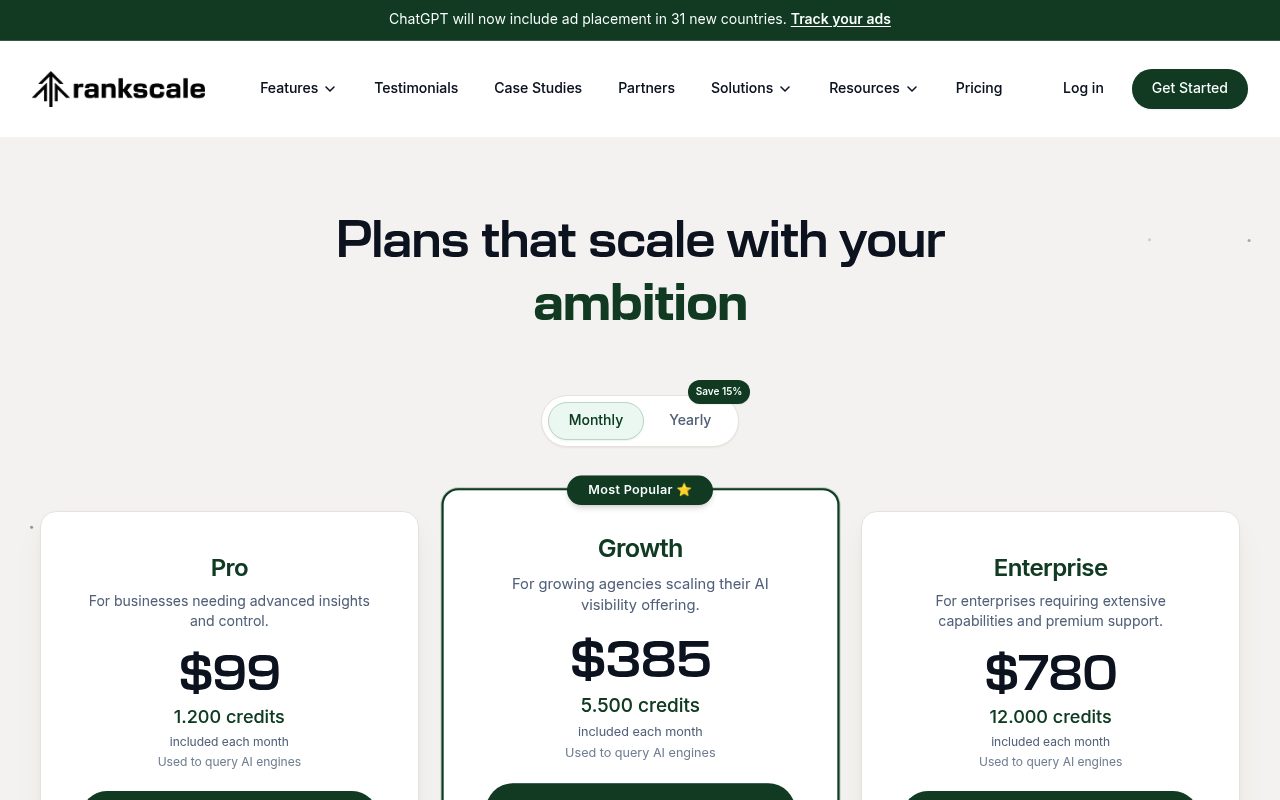
Rankscale stands out for audit granularity, offering 94+ technical checkpoints across 17+ AI engines. Plans run from $20/month for Essentials up to $99/month for Pro's 1,200 credits and 50 page audits, a fit for teams that want technical diagnostics alongside tracking.
- Essentials plan starts at $20/month, the lowest entry price compared here.
- Pro plan: $99/month, 1,200 credits, 50 page audits, unlimited search terms, 17+ AI engines.
- 94+ technical checkpoints for structural and authority signal auditing.
- Limitation: per-plan credit limits mean budgeting for higher tiers as tracking scales.
AirOps: best for bundling content production with tracking
Screenshot: AirOps ai search visibility page, September 2026.
AirOps combines visibility tracking with content task allocation. The Solo plan carries 100 tracked prompts/pages and 20,000 content tasks, scaling to a Pro plan with 250 prompts/pages and 75,000 tasks, plus custom enterprise pricing with no per-seat fees and a typical four-week rollout.
- Solo plan: 100 tracked prompts/pages, ChatGPT-only insights, monthly reports, 20,000 content tasks.
- Pro plan: 250 tracked prompts/pages (2.5× Solo), multi-engine insights, weekly reports, 75,000 tasks, unlimited seats.
- Enterprise: custom pricing, no per-seat fees, most teams live in four weeks.
- Limitation: the Solo tier's ChatGPT-only insight scope may undercount multi-engine competitive shifts.
Promptwatch: best for teams wanting bundled AEO articles
Screenshot: Promptwatch pricing page, September 2026.
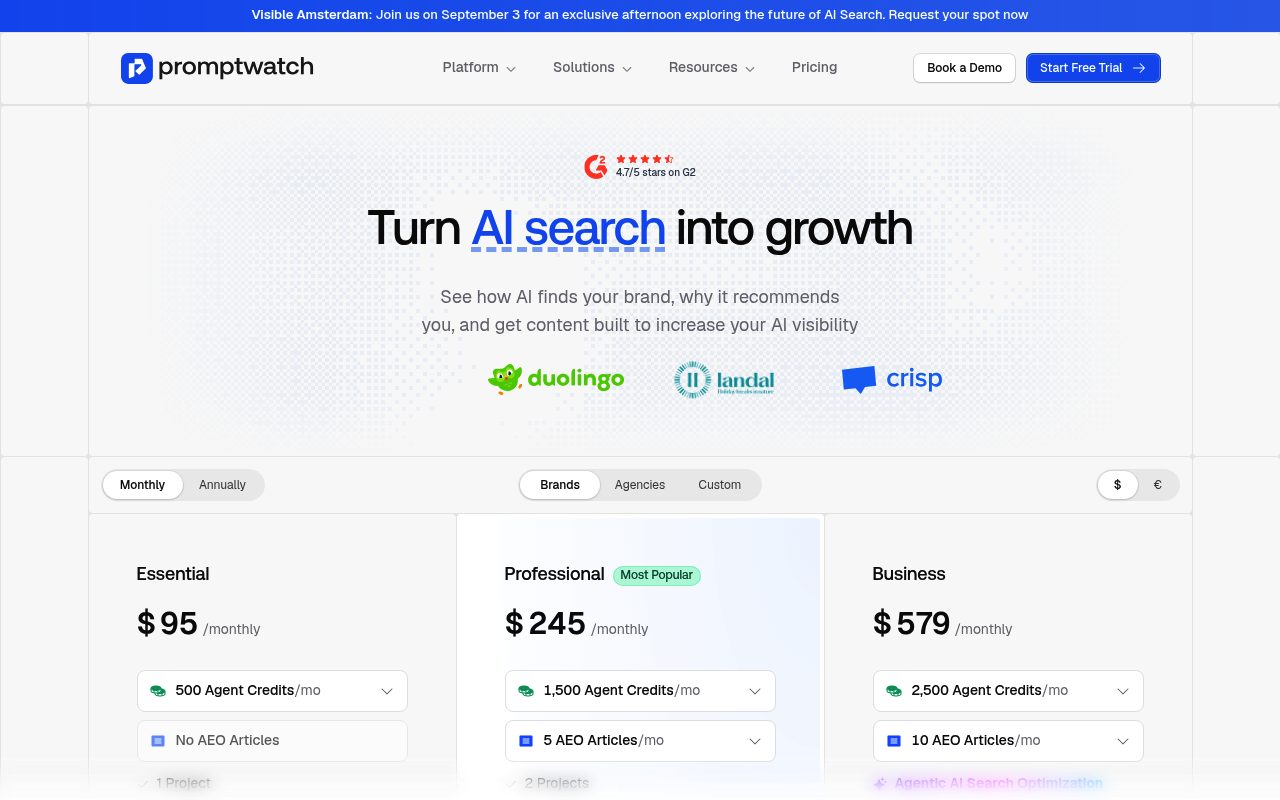
Promptwatch bundles prompt tracking with done-for-you AEO articles. Pricing starts at $95/month for Essential (500 credits, 50 prompts, MCP/API access) up to $579/month for Business (2,500 credits, 350 prompts, 10 AEO articles/month). Onboarding is simple: enter a URL and pick five category prompts.
- Essential: $95/month, 500 Agent Credits, 50 prompts, 6,000 responses, MCP and API access.
- Professional: $245/month, 1,500 credits, 150 prompts, 18,000 responses, 5 AEO articles/month.
- Business: $579/month, 2,500 credits, 350 prompts, 42,000 responses, 10 AEO articles/month.
- Onboarding: enter brand URL, select five prompts to start.
- Limitation: entry price is higher than Otterly or Rankscale's lowest tiers for a comparable prompt count.
Scrunch AI: best for enterprise and agency scale
Scrunch is built for scale. Fortune 500 enterprises use it to analyze 6 million-plus citations and 1.5 million-plus prompts weekly, and its agency tier supports multi-client management, role-based permissions, and a 7-day free trial with data collection often within a day. It fits agencies and large teams more than solo founders.
- Enterprise scale: 6M+ citations and 1.5M+ prompts analyzed weekly.
- Agency features: multi-client management, role-based permissions, data collection within a day, 7-day free trial.
- Best suited to agencies tracking multiple client brands rather than single-brand startups.
- Limitation: pricing isn't published for smaller single-brand use cases, making cost comparison harder.
Sightkick: best for pairing tracking with automated content and backlinks
Sightkick tracks brand mentions, sentiment, and position across ChatGPT, Gemini, Google AI Overviews, Google AI Mode, Claude, Perplexity, and Reddit daily, then feeds that data into an Articles engine that writes and publishes content and a Backlinks engine that pitches and confirms live links. It fits teams that want the full loop automated. Sightkick is our product.
- Tracks 7 sources simultaneously, including Reddit, broader than most compared tools.
- Runs daily prompts across 4 AI models with continuous competitive benchmarking of who gets recommended.
- The Articles engine researches, scores, adds images/links/schema, and publishes to a CMS on schedule without manual input.
- The Backlinks engine finds AI-cited pages, verifies owner contacts, sends outreach and follow-ups, and confirms links went live.
- Sightkick MCP provides 29 tools that integrate into Claude, ChatGPT, Cursor, OpenClaw, and Codex for agent-based workflows.
- 7-day free trial, 2-minute claimed setup, and a free brand visibility report (visibility %, sentiment, mentions, average position) at entry.
- Limitation: as a newer platform, Sightkick doesn't yet publish the multi-million citation volume benchmarks Scrunch reports for enterprise scale.
For a wider field, our ranked list of the 8 best AI search visibility tools for 2026 covers additional options and trade-offs.
Frequently asked questions
Does AI visibility replace traditional SEO?
No. Google states its generative AI search features depend on publicly crawlable, indexed content and standard SEO fundamentals, so AI visibility is an added layer of monitoring and content structure built on top of existing SEO work, not a separate discipline.
Can AI do SEO optimization on its own?
AI can automate large parts of SEO: researching gaps, drafting schema-tagged articles, and running outreach. But indexing eligibility, crawlability, and query fan-out are governed by Google's systems, so automation still needs to target those specific technical requirements to matter.
How often should brand mentions across AI models be tracked?
Daily tracking is the practical standard, since AI recommendations shift as models retrieve fresh, indexed pages through RAG/grounding. Weekly or monthly snapshots miss short-term swings in citation and sentiment.
What's the minimum prompt set a startup needs to start tracking AI visibility?
A workable starting point is 15-50 prompts covering core category questions, matching entry-tier plans like OtterlyAI's 15-prompt Lite plan or its 50-prompt free trial, enough to spot major visibility gaps before scaling.
What are citation source types and why do they matter?
Citation sources are typically classified as UGC, Editorial, Yours (owned), and Competitor. This breakdown shows whether a brand's AI visibility depends on its own content, earned coverage, forums, or competitors, context missing from a raw mention count alone.
Are free trials enough to evaluate an AI visibility tool?
A 7-day trial with a meaningful prompt allotment, such as OtterlyAI's 50-prompt trial or Scrunch's 7-day agency trial, is generally enough to validate whether a tool surfaces useful competitive data before committing to a paid tier.
Want to see where you stand before committing to any tool? Start a free Sightkick brand visibility report to check your visibility %, sentiment, mentions, and average AI recommendation position across ChatGPT, Gemini, Perplexity, and Google.