 Join with Google
What Is Brand Visibility? Definition for AI Search

Fabio Bergmann
Your software ranks in Google, but an AI answer recommends a competitor. Brand visibility in AI search measures whether your brand appears inside generated answers, how prominently it appears, and which sources support it. Track mentions, citations, and recommendation position separately from organic rankings to find that gap.
By Fabio Bergmann, Founder of Sightkick
Key takeaways
AI brand visibility measures presence inside generated answers, not organic position alone. Track mentions, citations, and recommendations separately. Compare results across a consistent prompt set. Use the sources behind competing recommendations to identify content gaps and outreach targets. Keep exposure metrics separate from recognition, pipeline, and revenue.
- AI answer presence and organic rankings measure different surfaces.
- A mention, a citation, and a recommendation are different outcomes.
- Visibility measures external exposure. Awareness concerns recognition or recall.
- Combine Google Search Console, AI prompt tracking, and competitive share of voice.
- Inspect cited sources before commissioning content or outreach.
What is brand visibility in AI search?
Brand visibility in AI search is the degree to which a brand is mentioned, cited, and surfaced inside generated answers across ChatGPT, Google AI Overviews, AI Mode, and Gemini. Semrush’s definition puts measurement inside the answer itself. A search-result position alone does not measure that presence.

The broader definition also matters. HubSpot defines brand visibility as the frequency and prominence of exposure to a target audience across relevant channels. AI answers are one surface within that wider view.
Separate the outcomes. A mention names your company. A citation links to a supporting source. A recommendation presents your product as an option. Record whether each citation points to your website or a third-party page.
Google says its AI experiences retrieve current content from the existing search index. The underlying systems remain connected to traditional Search:
“Our new generative AI features are rooted in the same core ranking and quality systems as traditional Search.”
Why does the gap between ranking and being cited in AI answers matter?
The ranking-to-citation gap needs separate measurement: only 3% of relevant AI Overviews cite the median enterprise B2B brand, according to Search Engine Land’s reporting on Walker Sands’ H1 2026 benchmark. The study covered 828 enterprise companies and more than 45 million queries. Organic rank alone cannot report citation coverage.
Branded queries need attention too. Ahrefs found AI Overviews on 83% of branded queries, using 232.8 million U.S. desktop Google result crawls from July through September 2026. Ahrefs warns this could reduce website clicks while giving Wikipedia, YouTube, and LinkedIn more influence over brand presentation.
These studies use different populations. Do not subtract their percentages or treat them as a shared conversion funnel. Check separately whether an AI Overview appears, whether your brand appears, and which source supports its description.
How is brand visibility different from brand awareness?
Brand visibility is external presence where buyers pay attention. Brand awareness is the buyer’s ability to recognize or recall a brand. HubSpot distinguishes the two on that basis. A familiar SaaS brand can still be absent from an AI answer about its product category. Familiarity does not establish answer coverage.
Keep the reporting separate. Use answer mentions and citation coverage for visibility. Google Search Central says Search Console can filter branded versus non-branded queries, with branded traffic indicating strong brand recognition. Treat that traffic as a recognition signal, not a direct measurement of buyer memory.
How is brand visibility different from brand recognition?
Brand recognition answers “Can the buyer identify this company?” Brand visibility answers “Where does the company appear?” Qualtrics defines recognition through unprompted naming and identification from the company name, logo, colors, advertisements, and other identity cues. Recognition concerns identification; an AI visibility audit records observable exposure.
Qualtrics also says recognition and awareness influence each other. Strong recognition can support awareness. Keep the operational distinction clear: an identifiable logo cannot substitute for checking whether ChatGPT names the product in a relevant recommendation.
What factors determine a brand's visibility in AI search?
AI brand visibility has no universal weighting formula in the evidence here. Google identifies shared Search ranking and quality systems; reporting on AI discovery points toward brand authority and third-party sources. Audit retrieval, answer relevance, and corroboration separately. Do not assign unsupported weights to backlinks, formatting, or community mentions.
Search Engine Land’s summary of Fractl research reports declining trust in AI search, more cross-platform validation, and a stronger relationship between AI visibility and brand authority than traditional SEO metrics.
- Owned evidence: check whether cited pages explain the product, intended customer, and limitations accurately.
- Independent evidence: inspect editorial coverage, comparisons, and community discussions appearing in tracked answers.
- Competitive evidence: record which sources support competing recommendations for the same prompt.
Wikipedia, YouTube, and LinkedIn are audit targets identified by Ahrefs. Their presence does not establish a universal source preference across AI platforms.
How can a company increase its brand visibility?
A company should start with missed recommendations, then improve the evidence available for those buyer questions. Build a prompt set from product-category, comparison, and use-case questions. Inspect answers and cited pages before commissioning content or outreach. Use a documented visibility gap as the working unit, not an isolated keyword.

- Capture the gap. Save the prompt, platform, answer, recommended competitors, and supporting URLs.
- Fix the owned answer. Publish or update a page addressing the buyer’s question. State product capabilities and limits plainly.
- Inspect third-party descriptions. Review cited comparisons and discussions for inaccurate or missing product information. Request factual corrections where appropriate.
- Prioritize relevant outreach. Approach publishers whose pages appear in tracked answers. Offer evidence that improves the page.
- Rerun the prompt set. Compare mentions, citations, and recommendation position against the baseline.
Third-party corroboration responds to Ahrefs’ findings about external sources and Fractl’s findings about cross-platform validation. Neither establishes that more mentions guarantee AI recommendations. For implementation detail, use the AI visibility strategy workflow.
What strategies and channels improve brand visibility online and offline?
Brand visibility needs a channel plan beyond the company website. Google reports that people using AI search visit 12 buying-process touchpoints, nearly 3X more than people in non-AI journeys. Give each channel a measurable job: answer a question, provide independent evidence, or reveal demand. Keep channel metrics separate.
Online channels
Use SEO analysis to identify uncovered questions. Sprout Social says share-of-voice analysis can expose missing keywords and organic traffic opportunities. Its social listening guidance tracks brand or product mentions across networks, providing context on conversations, sentiment, and perception.
Define separate outputs: an owned answer page for a product question, an editorial outreach target for independent coverage, and a social listening query for customer language. Do not count social mention growth as AI citation growth.
Offline channels
Treat events, partnerships, and press activity as distribution opportunities to evaluate, not automatic AI ranking signals. Before a webinar or conference appearance, specify a useful public artifact: a transcript, partner case study, or technical explanation. Then check whether that artifact appears in tracked citations.
Google describes the new Search journey as expanding rather than shrinking. Keep product facts consistent across event material, partner pages, and owned documentation.
How is brand visibility measured and tracked?
Brand visibility measurement combines Google Search Console for Google performance, Merchant Center for shopping-intent discovery, and prompt tracking for cross-platform answers. Calculate competitive share of voice using a declared denominator. Keep the prompt set, market, platform, and reporting period consistent. Separate answer coverage from your share of tracked-brand mentions.
- Establish Google performance. Google launched generative AI performance reports on June 3, 2026, in Search Console. Use these alongside branded and non-branded query segments.
- Add commerce-specific discovery. Merchant Center’s AI performance insights cover conversational shopping-intent queries on AI Mode and AI Overviews. Its share-of-voice reporting benchmarks visibility across Search and Gemini against similar brands.
- Maintain a fixed prompt panel. Run the same buyer questions across selected platforms. Record mentions, source URLs, sentiment, recommendation position, and date.
- Declare the denominator. Sprout Social defines share of voice as brand metrics divided by total market metrics. For an operational AI version, divide your brand’s mentions by all tracked-brand mentions in the same answer set. Label this definition explicitly.
- Separate coverage from competitive share. Calculate prompt coverage as answers mentioning your brand divided by answers checked. An answer can mention several brands. Coverage and share of voice answer different questions.
Benchmark scope matters. Semrush’s 2026 AI Visibility Index uses 126 million real U.S. search prompts. Its expanded database contains 261 million global prompts, including 126 million U.S. prompts and 58.4 million ChatGPT prompts. A company-specific panel measures selected questions, not that entire market.
Export a reporting view with prompt, platform, date, brand, citation URL, and source type. Compare changes against the same baseline. The AI visibility report walkthrough provides a related workflow.
What are the benefits of increased brand visibility for sales and growth?
Greater brand visibility can support customer loyalty, conversion rates, and sustainable growth, according to Mailchimp. AI answer presence places the product within the buyer’s research material. Revenue impact needs separate measurement: a citation records exposure, while a qualified signup, opportunity, or sale records a commercial outcome.
Google says 3 in 4 people report that its AI features help them make faster, more confident decisions. That concerns decision-making, not a guaranteed conversion lift for cited brands. Track visibility alongside qualified pipeline and customer-reported discovery sources. Correlation is not attribution.
Sightkick: tracking and building AI brand visibility on autopilot
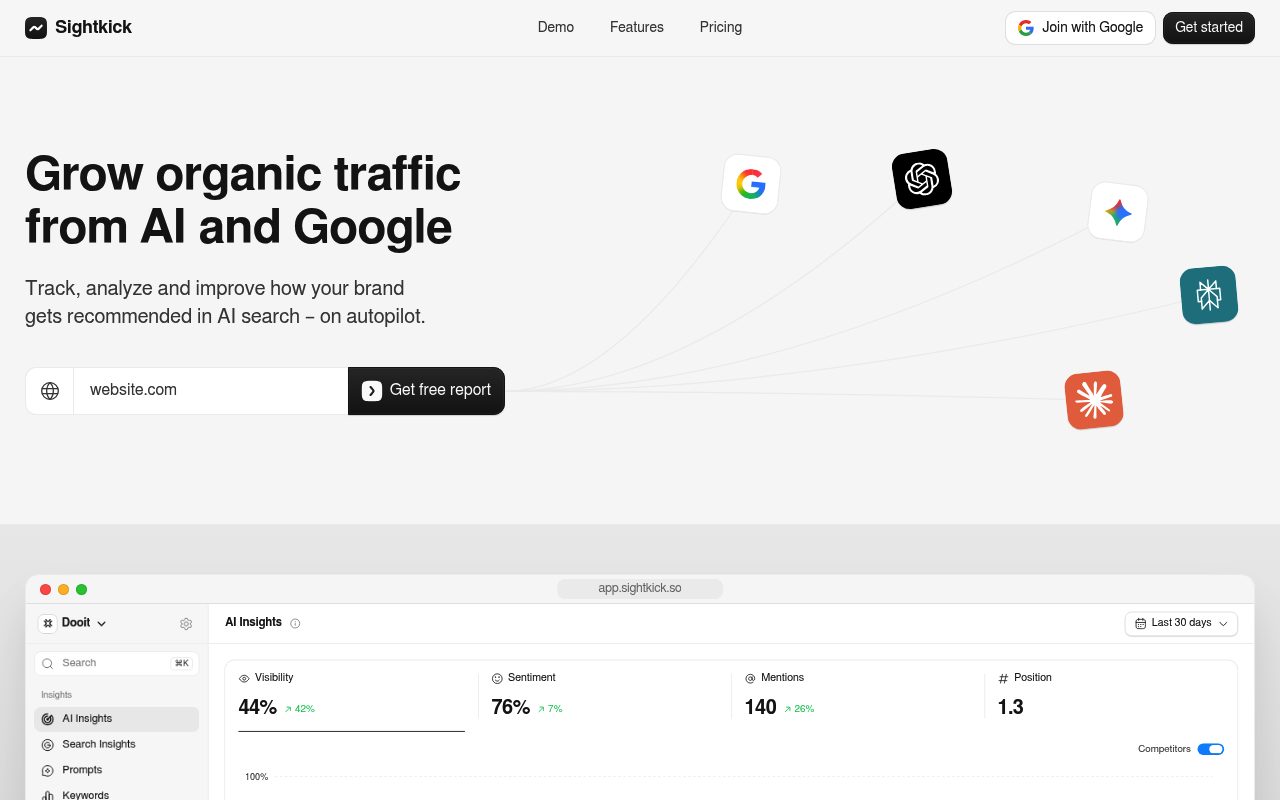
Screenshot: Sightkick homepage, October 2026.
Sightkick connects daily AI visibility tracking with article publishing and backlink outreach. The platform tracks visibility, sentiment, mentions, and position across ChatGPT, Gemini, Google AI Overviews, and Google AI Mode. Teams can monitor recommendations, inspect citation sources, and automate publishing and outreach from the same platform.
Disclosure: Sightkick is our product.
- Establish the baseline. Sightkick’s free report shows visibility percentage, sentiment score, mention count, and average AI recommendation position relative to competitors.
- Track continuously. Sightkick runs every tracked prompt daily in three AI models and records recommended brands for competitive benchmarking. A fourth model is an add-on. Citation sources are classified as UGC, Editorial, Yours, or Competitor.
- Automate publishing. The Articles engine researches, writes, scores, adds images, links, and schema, then publishes to a CMS daily without manual input.
- Automate cited-page outreach. The Backlinks engine finds pages already cited by AI, verifies owners’ contact details, sends pitches and follow-ups, and confirms when backlinks go live.
Sightkick lists a two-minute setup and a three-day free trial. One plan costs $79 per month; consult the pricing page for plan selection.
Frequently asked questions
Brand visibility questions require clear measurement boundaries. Business value, SEO performance, social conversations, and AI recommendations are related topics, not interchangeable metrics. Use the distinctions below to choose what to track. Define the category and prompt set before naming leaders, comparing channels, or attributing commercial results.
Why is brand visibility important for a business?
Brand visibility puts a business where target buyers pay attention. Mailchimp says improving visibility can support customer loyalty, higher conversion rates, and sustainable growth. Measure those outcomes separately from exposure.
What role does SEO play in improving brand visibility?
SEO remains relevant because Google says its generative AI features use the same core ranking and quality systems as traditional Search and retrieve content from its existing index. Use SEO analysis to find missing buyer questions. Measure AI answer inclusion separately from organic rankings.
What are examples of brands with high visibility in AI search?
Identify high-visibility brands within a defined category and prompt set. Run the same questions across platforms, then compare coverage and share of voice. Wikipedia, YouTube, and LinkedIn are source examples in Ahrefs’ research, not a leaderboard of recommended software brands.
Does social media activity directly improve AI search visibility?
The evidence here does not establish a direct causal lift. Use social listening to discover buyer questions and inspect community sources appearing in AI answers. Measure AI citations separately from social engagement.
Can a brand have strong SEO rankings but poor AI visibility?
Yes. Organic position and inclusion inside a generated answer are separate observations. Record the organic result, whether an AI answer appears, whether it names your brand, and which sources it cites. A ranking does not guarantee a recommendation.
Prompt tracking measures a selected sample. Content and outreach cannot guarantee citations. Use the workflow to identify which buyer questions recommend competitors and which sources support those recommendations.
Try Sightkick free for three days to start tracking that baseline.