 Join with Google
AEO for AI Search: What Actually Gets You Cited

Fabio Bergmann
Zero additional technical requirements apply to supporting links in Google’s AI Overviews and AI Mode beyond indexing and snippet eligibility. AEO for AI search means making your content useful as evidence in generated answers, then measuring whether platforms cite your pages or recommend your brand. SEO remains the foundation.
By Fabio Bergmann, Founder of Sightkick
Key takeaways
AEO adds citation and recommendation tracking to an SEO foundation. Keep eligibility, content evidence, and measurement separate. A page can qualify for search without earning an AI citation. A cited page can supply evidence without generating a brand recommendation. Neither outcome proves a visit or conversion.
- Google requires indexing and snippet eligibility, not a separate AI optimization protocol.
- Google AI Mode’s research capabilities can issue hundreds of searches for a cited report. That is not a fixed search count.
- Google’s May 2026 guidance addresses AEO/GEO misconceptions and keeps SEO fundamentals central.
- Track citations separately from brand recommendations. Classify sources as owned, editorial, user-generated content, or competitor pages.
- The platform documentation describes retrieval mechanics and quality guidance, not a complete citation-ranking formula.
What is AEO (Answer Engine Optimization) and how does it differ from traditional SEO?
AEO is the practice of making content useful for AI-generated answers and measuring its inclusion in those answers. Traditional SEO emphasizes search visibility and visits; AEO adds citations and brand recommendations as outcomes. Google says SEO best practices remain relevant, including helpful, reliable, people-first content.
For a SaaS company, distinguish two targets: a product page ranking for a category query, and an AI answer recommending that product for a specific buyer requirement. Record both. A citation to your documentation and a recommendation of your product are different events.
Google emphasizes unique, non-commodity content that visitors find helpful and satisfying. Invest in evidence: documented integrations, reproducible procedures, and explicit product constraints. Another generic category definition adds little to that inventory.
How do ChatGPT, Google AI Mode, and Perplexity decide which sources to cite?
ChatGPT, Google AI Mode, and Perplexity disclose different retrieval mechanics, but their documentation does not supply a complete citation-selection formula. OpenAI describes multifactor search ranking. Google describes searches across subtopics. Perplexity describes synthesis across source types. These explain how evidence is gathered, not how to guarantee selection.
ChatGPT search
OpenAI says ChatGPT search answers questions with current information and provides citations readers can open. It sometimes works with other search providers and ranks results using multiple factors intended to surface relevant, reliable information. That is not a disclosed formula for final citation placement.
OpenAI also warns that results and citations can be incomplete, outdated, or incorrect. During an audit, open the cited page and check whether it supports the answer’s claim. A displayed citation alone is insufficient verification.
Google AI Mode
Google AI Mode uses query fan-out: breaking a question into subtopics and issuing queries simultaneously. Google describes capabilities that can issue hundreds of searches and produce a fully cited report in minutes. That is a capability, not a fixed search count for every answer.
Google describes AI Mode as connecting users to high-quality web information, with helpful links for evaluating sources and exploring different perspectives. Audit those links as evidence sources, not just as brand placements.
Perplexity Pro Search
Perplexity Pro Search answers complex questions by synthesizing a diverse, high-quality source set. Depending on the selected focus, searches can draw from articles, academic papers, forums, videos, and more. Its attribution policy is explicit:
Every answer includes direct links to the original sources
Record the selected focus alongside the prompt. Source availability can differ with that choice.
What are the key ranking factors or signals for getting cited by AI search engines?
Google’s confirmed technical baseline is indexing plus eligibility to appear in Search with a snippet. Google states there are no additional technical requirements for supporting links in AI Overviews or AI Mode. Eligibility is a prerequisite, not a citation guarantee. Do not generalize this rule to every platform.
- Technical eligibility: Google’s supporting-link requirements stop at indexing and snippet eligibility.
- Content guidance: Google connects AI-search success with original, useful content rather than interchangeable summaries.
- Quality guidance: Google says its core ranking systems reward good page experience. Search Quality raters evaluate effort, originality, talent or skill, and accuracy.
- Critical distinction: Google says rater data is not used directly in ranking algorithms.
Treat proposed rules such as a required answer length or mandatory FAQ section as testable editorial choices, not documented citation factors. Meeting a publishing checklist does not establish why a platform selected a source.
How does AEO relate to or overlap with GEO (Generative Engine Optimization)?
AEO and GEO can share one operational goal: making a business visible in generated answers. A useful working distinction is answer construction versus broader generative visibility, but that is a planning convention. Google’s May 2026 guidance addresses AEO/GEO misconceptions and reinforces SEO fundamentals rather than establishing separate technical disciplines.
Google’s new optimization guide covers appearance in generative AI features, challenges common AEO/GEO misconceptions, and keeps SEO best practices foundational. Use one backlog for indexing, content evidence, citation coverage, and recommendation gaps. Separate labels do not identify which page needs work.
What content formatting and structure improves visibility in AI-generated answers?
Content structure should make a specific answer and its evidence easy to identify. Question-led sections, explicit conditions, and labeled comparisons are editorial choices, not confirmed citation boosts. Google documents fan-out across subtopics and data sources, which makes coverage of buyer subquestions a sensible planning method.
Google says both AI Overviews and AI Mode may use query fan-out to develop a response. Build sections around distinct requirements rather than repeating the same category definition under different headings.
Perplexity recommends five elements for effective prompts: instruction, context, input, keywords, and output format. That is prompting guidance, not publisher ranking guidance. Use it to build realistic test queries, such as: “Compare onboarding software for a SaaS team requiring an approval workflow; return requirements and trade-offs.”
- Make each section answer one buyer subquestion, such as whether an approval step exists.
- State the answer first. Follow with the procedure, conditions, and evidence.
- Label examples. Separate supported behavior from planned functionality.
Formatting cannot replace unique information. A precise workflow explanation contributes more than adding question marks to generic headings.
How can businesses measure or track their AI search visibility?
AI visibility measurement needs separate records for the prompt, platform, answer, recommended brands, and cited URLs. Do not collapse Google AI Mode and AI Overviews into one result: Google says their models and techniques differ, so responses and supporting links vary. Keep traffic and conversion measurement separate from answer visibility.
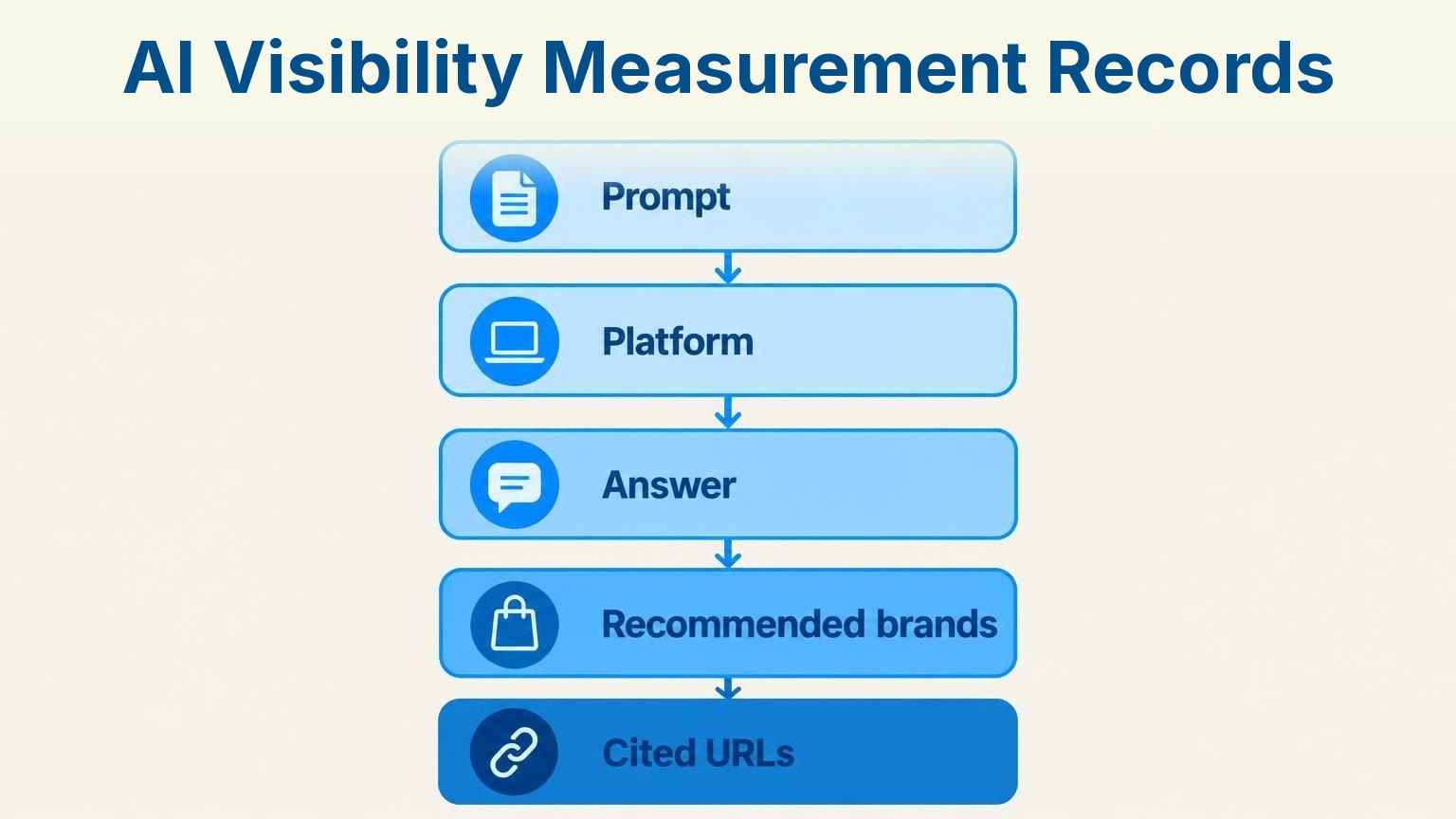
Infographic: AI Visibility Measurement Records – Prompt, Platform, Answer, Recommended brands, Cited URLs
Google documents those model and technique differences. Log each surface separately, even when the prompt is identical.
- Fix the test conditions: save exact prompt wording, platform, available mode or focus setting, and run date.
- Separate outcomes: log brand mentions, recommendations, position, and cited URLs in different fields.
- Classify sources: use owned, editorial, UGC, and competitor categories. These are audit labels, not platform ranking categories.
- Define the denominator: calculate mention rate as runs mentioning the brand divided by all tracked runs. Keep the prompt set stable when comparing periods.
Use the source classification to route work. An owned citation without a recommendation calls for checking what the page actually establishes. An editorial or UGC citation supporting a competitor calls for reviewing that source’s evidence. Different gaps. Different tasks. Neither automatically calls for another article.
Compare recorded visibility with identifiable referral visits and conversions in your analytics. Do not count a citation as a visit or attribute every conversion change to AEO.
What role do schema markup and structured data play in AEO?
Schema markup helps Google interpret page meaning; it is not a documented shortcut to AI citation. Google defines structured data as a standardized format providing explicit clues about content. Structured data can also help pages appear in richer Search features. Neither function promises inclusion in generated answers.
Google states the purpose in its structured data documentation:
You can help us by providing explicit clues about the meaning of a page to Google by including structured data on the page.
Implement markup that accurately describes the visible page. Check that product details and other marked-up facts agree with the text users read. Understanding page meaning and enabling richer features are narrower claims than increasing AI citation frequency.
How important are E-E-A-T signals for AI search visibility?
E-E-A-T is useful as a quality-review framework, not a disclosed AI citation score. Google’s guidance describes rater evaluation of effort, originality, skill, and accuracy. Google also says rater assessments do not directly determine rankings. Keep evidence of content quality separate from claims about algorithmic weights or citation guarantees.

Google’s quality guidance supports reviewing concrete evidence: who maintains integration instructions, whether screenshots match the workflow, and whether comparison claims have support. These are editorial checks, not another eligibility gate beyond Google’s indexing and snippet requirements for supporting links.
What content formats perform best in AI answer engines?
No format winner can be established from these platform descriptions. FAQs, how-tos, and comparisons are useful when they match the buyer’s task, but their citation advantage is not demonstrated here. Google describes subtopic searches; Perplexity describes multiple source types. Neither establishes that an FAQ outranks a procedure or comparison.
- Use a how-to for execution: document prerequisites, actions, and the expected result.
- Use a comparison for selection: compare products on the same requirements and disclose unknowns.
- Use an FAQ for bounded questions: answer a restriction, compatibility issue, or purchase condition.
- Use original documentation for evidence: publish the configuration details behind a product claim.
Perplexity’s documented use of multiple source types shows that its evidence gathering is not restricted to one publishing format. Choose the format that demonstrates the answer. Test citation outcomes rather than declaring a universal winner.
Sightkick: tracking and acting on AI visibility in one workflow
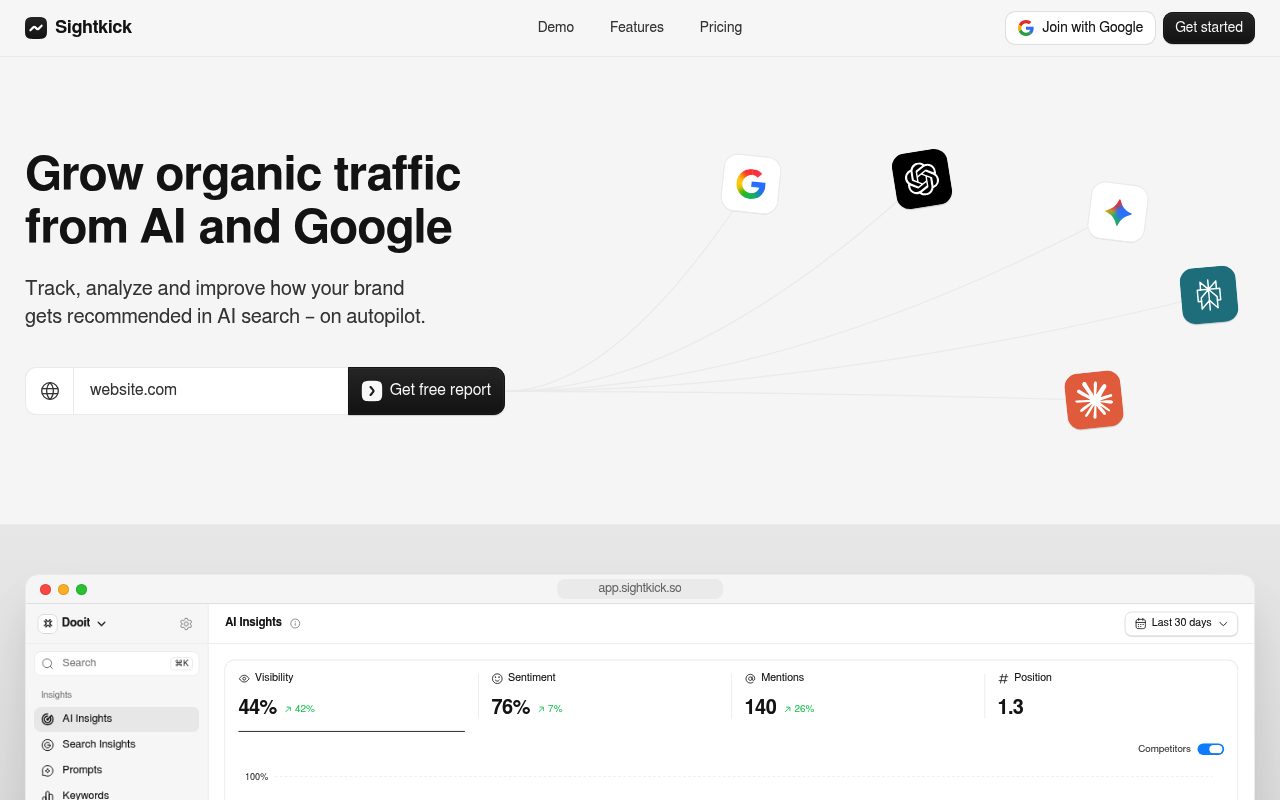
Screenshot: Sightkick homepage, October 2026.
Sightkick combines AI visibility tracking with automated article publishing and backlink outreach. The platform tracks brand visibility, sentiment, mentions, and recommendation position across ChatGPT, Gemini, Google AI Overviews, and Google AI Mode. Its workflow connects daily competitive benchmarking with content production and outreach to pages already cited by AI.
Disclosure: Sightkick is our product.
- Establish the baseline. Sightkick’s free Brand Visibility Report shows visibility percentage, sentiment score, mention count, and average AI recommendation position relative to competitors.
- Track recurring prompts. Sightkick runs every tracked prompt daily in three AI models; a fourth is an add-on. It records recommended brands and classifies citation sources as UGC, Editorial, Yours, or Competitor.
- Publish supporting content. Sightkick’s Articles engine researches, writes, and scores articles, adds images, links, and schema, then publishes to a CMS on a daily schedule without manual input.
- Run citation-source outreach. Sightkick’s Backlinks engine finds pages already cited by AI, verifies page-owner contact details, sends pitches and follow-ups, and confirms when backlinks go live.
Keep the action ledger separate from the outcome ledger. An article published is not a citation earned. A backlink confirmed is not a recommendation gained. Compare subsequent tracked answers against the same prompt set to see what changed, without treating sequence as proof of cause.
Sightkick states a two-minute setup and offers a three-day free trial. A plan costs $79 per month. Check model coverage when choosing a plan: the fourth tracked model is an add-on.
Frequently asked questions
AEO implementation requires separate checks for eligibility, citations, recommendations, and business outcomes. Google describes AI features as surfacing relevant links for discovery and further exploration, not as guaranteeing visits or sales. Use these distinctions to evaluate claims about replacing SEO, securing citations, or measuring commercial impact.
Does AI search visibility replace the need for traditional SEO?
No. Google’s May 2026 guidance keeps SEO best practices foundational to generative AI visibility. Maintain search eligibility and useful content, then add measurement for citations and recommendations.
Can a page rank well in Google but still never get cited by AI Mode or AI Overviews?
Yes. Search eligibility does not guarantee a supporting link. Google says AI Overviews appear only when its systems judge them additive to classic Search. AI Mode and AI Overviews also use different models and techniques, so citation results can differ.
Is there a way to guarantee a page gets cited by ChatGPT or Perplexity?
The documented mechanics provide no guarantee. OpenAI warns that search results and citations can be incomplete or incorrect. Perplexity describes source gathering that depends on the selected focus. Improve the evidence and check repeated results. Do not promise fixed placement.
How does AEO impact website traffic and conversions compared to traditional organic search?
The supplied platform guidance establishes no comparative traffic or conversion lift. Google says its AI features surface relevant links to help users find information and discover content. Measure identifiable referrals and conversions separately from citations; do not treat answer visibility as a visit or a sale.
What are common mistakes or pitfalls to avoid when implementing an AEO strategy?
Avoid treating eligibility as guaranteed placement, schema as a citation shortcut, or prompting advice as a ranking rule. Do not merge AI Mode with AI Overviews, change the prompt set mid-comparison, or combine citations and recommendations into one metric. Open cited sources before accepting an answer as accurate.
A tracked prompt set cannot represent every buyer question. Use it to identify which tested questions omit your brand and which sources support competing recommendations. Then choose the next task from that evidence.
Try Sightkick free to establish a daily visibility baseline.