 Join with Google
What Does AEO Mean? Answer Engine Optimization Guide

Fabio Bergmann
AEO means Answer Engine Optimization in SEO: improving content and measuring whether answer engines cite your pages or recommend your brand. AEO adds an answer-level visibility goal to search optimization. Track citations and recommendations separately from rankings, visits, and revenue. A brand mention is exposure, not proof of a sale.
Key takeaways
AEO adds an answer-level scorecard to SEO. Track whether a page receives a citation, whether a brand gets recommended, and whether identifiable referrals produce business results. Keep those outcomes separate. Use a consistent prompt set so changes in visibility reflect comparable checks rather than changes in what you asked.
- A citation and a product recommendation are different outcomes.
- Keep organic SEO and source verification in the workflow.
- Inspect each platform’s actual answer and linked pages.
- Define the visibility denominator before reporting a percentage.
- Measure attributable profit separately from unlinked exposure.
What does AEO mean?
AEO stands for Answer Engine Optimization in the SEO and AI search context. Its practical target is visibility inside an answer: a page cited as evidence, a product recommended by name, or a brand included in a comparison. Measure these separately because they represent different kinds of exposure.
For a SaaS team, distinguish “the answer links to our documentation” from “the answer recommends our software.” Record both. A citation to an educational article does not establish that the system selected your product for the buyer’s use case.
What is Answer Engine Optimization (AEO) as a practice?
Answer Engine Optimization turns a customer question into content that answers it directly and supports its claims with evidence. The workflow includes checking the resulting answers, not just publishing pages. Google says to evaluate AEO and GEO advice against official Search guidance. Treat that as the baseline when assessing tactics.
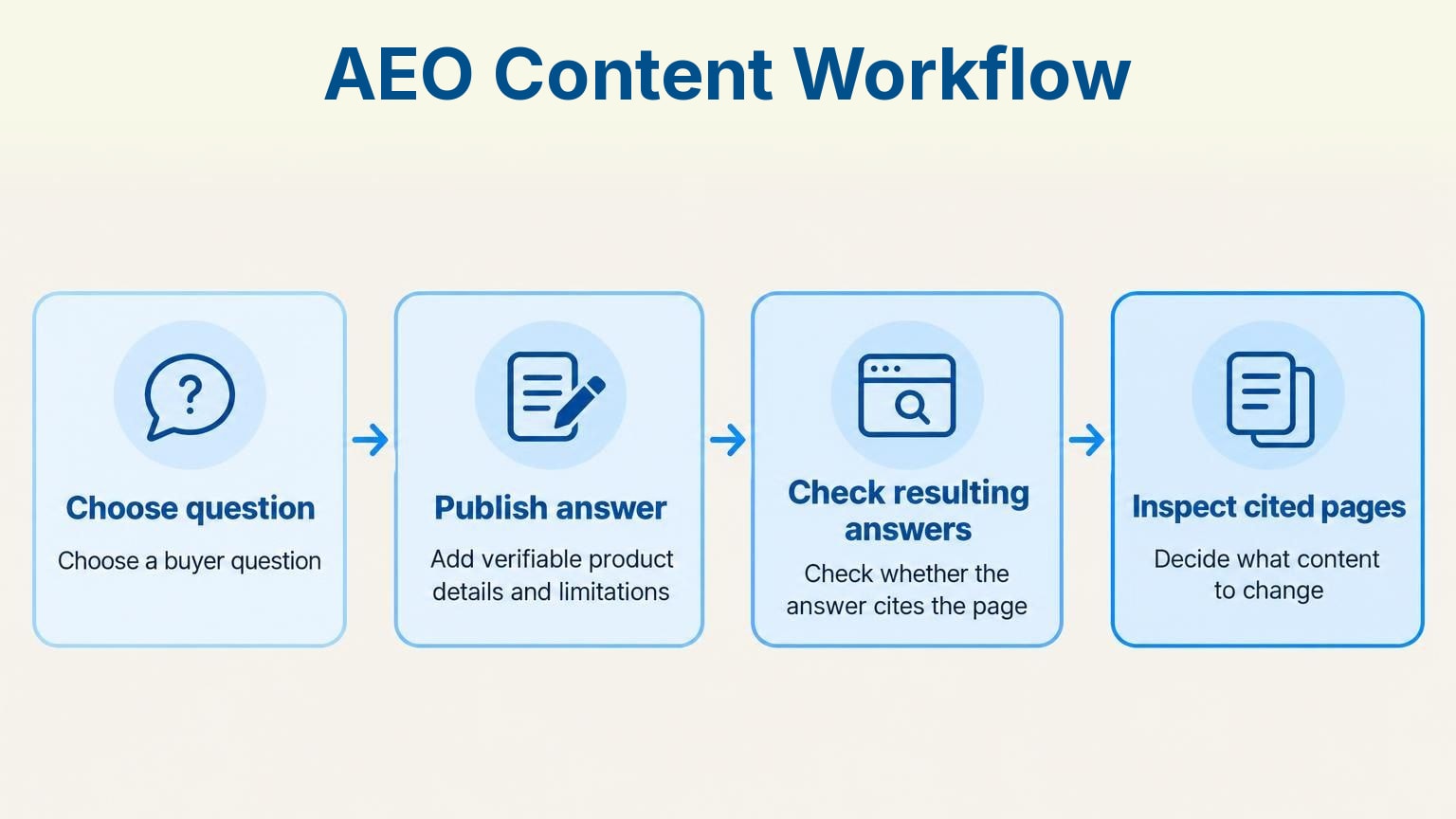
Process infographic: AEO Content Workflow – Choose question, Publish answer, Check resulting answers, Inspect cited pages
- Choose a buyer question, such as “Which project management software supports client approvals?”
- Publish a direct answer with verifiable product details and clear limitations.
- Check whether the answer cites the page, names the product, or omits both.
- Inspect cited pages before deciding what content to change.
How is AEO different from traditional SEO?
AEO differs from traditional SEO primarily in the outcome measured: inclusion in an answer rather than visibility in a search listing. Google defines SEO around visibility and relevant traffic and describes its main job as making content search-friendly so the right people can find it. AEO keeps that foundation.
Use separate scorecards. The SEO scorecard records organic visibility and visits. The answer scorecard records brand appearances, page citations, and recommendation position. Neither scorecard alone establishes revenue contribution.
When buying services, ask what changes on the website, what gets measured, and which evidence supports the recommendation. An acronym is not evidence of a ranking mechanism.
How does AEO relate to GEO (Generative Engine Optimization)?
AEO and GEO overlap as labels for work on AI-answer visibility. GEO stands for Generative Engine Optimization; AEO stands for Answer Engine Optimization. Compare the proposed work rather than treating the names as separate technical specifications. Require each proposal to identify target questions, content changes, covered platforms, and reporting methods.
An AEO proposal and a GEO proposal should specify citation checks and reporting scope. If both include the same work, compare execution, coverage, and cost. Do not pay for terminology without defined deliverables.
Why has AEO become important now?
AEO matters because AI answer surfaces have measurable reach. Semrush reported Google AI Overviews on 13.14% of searches in March 2025, up from 6.49% in January 2025. These dated observations establish why answer visibility deserves measurement alongside organic rankings. They are not a current coverage estimate.
Pew Research Center reported that 34% of U.S. adults had ever used ChatGPT in 2025; its 2026 reporting put that figure at 44%. “Ever used” measures adoption, not daily usage or purchasing activity.
Google also reported that Preferred Sources users had grown more than 7x since the start of 2026. That measures feature adoption, not AI citation share. Keep these denominators separate when presenting an AEO business case.
How do AI answer engines select and cite content?
AI source selection needs platform-specific inspection; the available evidence does not reveal a universal selection formula. Source counts, organic overlap, and citation interfaces describe observable outputs. They do not explain every source choice. Audit the actual response, then check whether each cited page supports the statement attached to it.
Google AI Overviews
Semrush reported about five linked sources per query on average, with 52% of sources mentioned in AI Overviews also appearing in the top 10 organic results. That overlap supports keeping organic SEO in the workflow. It does not prove that a top-10 ranking guarantees citation.
Google says AI Overviews and AI Mode include clearer inline links and additional ways to explore the web. Open the linked page during an audit. Record the source URL separately from the recommended brand.
ChatGPT Search
OpenAI says ChatGPT search responses may include citations that users can open to review the source. For each check, save the prompt, response date, cited URL, and claim attributed to that URL. Inspect the source rather than treating the presence of a link as verification.
What are the best practices for optimizing content for AEO?
AEO content should answer a specific question and make its claims easy to verify. Define the subject, state the answer, and place limitations beside the claims they qualify. Keep organic SEO work in place. Use observed answer gaps to guide revisions rather than assuming a formatting change will secure a citation.
- Match a buying constraint. Address a specific requirement, such as client approvals, deployment options, or pricing terms.
- Lead with the answer. Put the definition or decision before background.
- Attach evidence. Link product claims to documentation and research claims to the original publication.
- Maintain time-sensitive details. Recheck prices, availability, and feature limits against authoritative sources.
- Inspect the answer. Distinguish missing content from a linked page the system misrepresented.
OpenAI warns that search results can be incomplete, outdated, or incorrect. Check authoritative sources when accuracy matters. That warning does not establish a freshness ranking factor. Correct inaccurate source content, then check the answer again.
What role does schema markup play in AEO?
Schema markup belongs in the implementation checklist, not in a citation guarantee. Keep structured descriptions consistent with visible page content. For an AEO audit, check for conflicting product names, organization details, and claims. Do not treat a markup change as evidence that an answer engine will select the page.
Remove unsupported ratings or product claims from markup. Keep the visible HTML useful without relying on hidden fields to carry the answer. Sightkick’s Articles engine includes schema in its publishing workflow; that capability is not evidence of a citation outcome.
How does AEO connect to featured snippets, voice search, and zero-click behavior?
AEO connects these surfaces through a measurement question: did the user receive an answer without visiting the source? Ahrefs reported featured snippets on 12.3% of queries in its study. Treat that as a study-specific finding, not the current prevalence of every direct-answer format or evidence about voice-search performance.
Ahrefs also reported that AI Overviews reduced position-1 click-through rate by about 34.5% in its March 2024 versus March 2025 comparison. That finding concerns AI Overviews and organic clicks. It does not measure voice-search conversions or prove that every cited website loses traffic.
- Featured snippets: record whether the page supplies the displayed answer.
- AI answers: separate linked citations from product recommendations.
- Voice-oriented checks: ask the question aloud and record the response rather than assuming parity with text results.
How can businesses measure the ROI of AEO efforts?
AEO ROI requires a business outcome and a cost, not merely a visibility score. Track mentions and citations as exposure metrics, then connect identifiable visits to qualified leads or revenue where attribution permits. Keep unattributed outcomes separate instead of assigning every improvement in branded demand to AI recommendations.
Define the denominator before reporting visibility percentage: brand-containing answers divided by all answers checked in the chosen prompt set. Express that ratio as a percentage. Keep prompts and covered platforms consistent between reporting periods. Changing the question set can change the score without changing market presence.
Record the platform, date, brand mention, citation URL, recommendation position, and sentiment for each prompt. For attributable business results, calculate ROI as (attributable gross profit − AEO cost) ÷ AEO cost. Report unlinked exposure alongside that calculation, never as revenue.
What tools help implement and track AEO?
AEO tools should cover two jobs: recording answer visibility and helping teams act on gaps. Evaluate platform coverage before comparing dashboards. Require a clear list of answer surfaces, monitoring frequency, and included models. A broad “AI visibility” label does not identify which answers a subscription checks or what action follows.
Manual checks support source inspection. Recurring monitoring retains comparable observations across a defined prompt set. Choose based on the questions you need answered and the reporting cadence you can maintain.
Before buying, verify add-on coverage, source classification, and whether publishing or outreach is included. Require a baseline and consistent reporting before judging progress.
Sightkick: tracking and acting on AEO signals daily
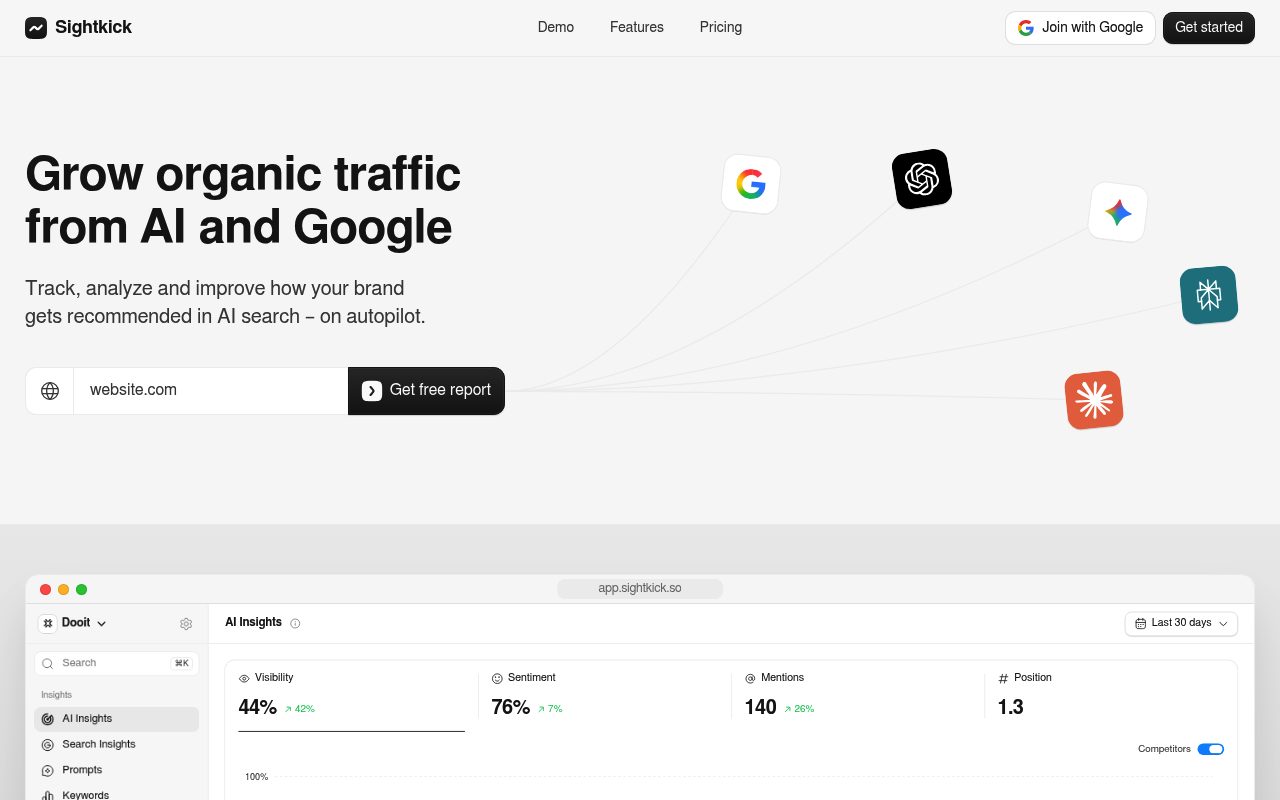
Screenshot: Sightkick homepage, October 2026.
Sightkick connects daily visibility tracking with automated article publishing and backlink outreach. Its coverage includes ChatGPT, Gemini, Google AI Overviews, and Google AI Mode. Sightkick runs every tracked prompt daily in three AI models; a fourth is an add-on. Compare included coverage with the platforms you need to monitor.
Disclosure: Sightkick is our product.
- Establish a baseline. The free Brand Visibility Report shows visibility percentage, sentiment score, mention count, and average recommendation position relative to competitors.
- Inspect recommendation sources. Sightkick records recommended brands and classifies citation sources as UGC, Editorial, Yours, or Competitor.
- Publish supporting content. The Articles engine researches, writes, scores, adds images, links, and schema, then publishes to a CMS daily without manual input.
- Pursue cited-page placements. The Backlinks engine finds pages already cited by AI, verifies owners’ contact details, sends pitches and follow-ups, and confirms live backlinks.
Sightkick states a two-minute setup and offers a three-day free trial. One plan costs $79 per month. Check included coverage and add-ons before comparing subscription costs.
Frequently asked questions
AEO evaluation comes down to scope and evidence: what changed, which answers were checked, and which outcomes can be attributed. Use those questions to assess examples, compare platforms, and interpret traffic changes. Keep implementation work separate from its observed results, and keep observed exposure separate from revenue claims.
What are some real-world examples of AEO in action?
Sightkick’s workflow is a concrete example: track brand recommendations daily, publish supporting articles, and seek backlinks from pages already cited by AI. These are implementation examples, not evidence of guaranteed citation or revenue gains.
Is AEO a replacement for SEO?
No. Keep organic visibility work in place and add checks for answer-level exposure. Use separate reporting for rankings, citations, recommendations, and attributable business results.
Do Google AI Overviews and ChatGPT cite sources the same way?
Do not assume identical behavior. Run the same question on each platform, record the linked URLs, and compare which claims those pages support. A citation observed on one platform does not establish coverage on another.
Does AEO reduce website traffic?
AEO is optimization work, not the answer surface measured in the click-through study. Separate changes in organic visits from changes in brand exposure. Then check whether identifiable AI referrals produce useful business outcomes.
AEO does not establish revenue from an unclicked recommendation. Use it to detect missing recommendations, correct source content, and measure attributable results.
Try Sightkick free to establish a baseline and track your brand’s AI visibility.