 Join with Google
AEO Meaning: What Answer Engine Optimization Really Means

Fabio Bergmann
AEO means Answer Engine Optimization: the practice of making content useful to systems that deliver direct answers. AEO targets inclusion in responses from tools such as Google AI Overviews and ChatGPT. The goal is to make your information usable as an answer, your brand mentionable, and your pages citable.
By Fabio Bergmann, Founder of Sightkick
Key takeaways
AEO adds answer-level measurement to search reporting. Track whether an answer names your brand, which page it cites, and whether that exposure produces a measurable visit or sign-up. Keep those outcomes separate. A recommendation supported by a competitor’s page needs a different response from an answer that omits your brand entirely.
- AEO targets inclusion in direct answers. Traditional SEO targets visibility in search results.
- A brand mention and a linked citation are separate outcomes. Neither proves a visit or sign-up occurred.
- Record citation placement and source ownership, not just link presence.
- FAQPage markup does not guarantee FAQ rich results.
- Measure a fixed prompt set, linked sources, referral visits, and sign-ups separately.
What does AEO mean?
AEO stands for Answer Engine Optimization. In AI search, AEO means preparing content for systems that answer questions directly. The scope includes search features, conversational assistants, and voice answers. The target is usable information inside an answer, rather than visibility only as a standalone search listing.
Ahrefs includes Google AI Overviews, voice assistants, ChatGPT, and Claude in its definition. Backlinko emphasizes structuring and publishing content so Google AI Overviews, AI Mode, ChatGPT, and Perplexity can bring a brand into their answers. Both definitions connect content preparation with answer inclusion.
What is Answer Engine Optimization (AEO) and why does it exist?
AEO addresses discovery when an answer appears before a website visit. The task is to make information usable in that answer, then measure brand inclusion and source attribution separately. Search rankings remain useful, but they cannot show whether an AI response recommends your product or sends readers to someone else’s page.
Ahrefs reported that, in December 2025, Google results with an AI Overview had a 58% lower click-through rate for the top-ranking page than results without one. The same lesson reported 900 million weekly ChatGPT users and AI referral traffic reaching 9.7 times its level a year earlier.
These are Ahrefs’ reported figures, not measurements of your audience. Use them to justify measuring AI discovery. Use your own visits and sign-ups to establish business impact.
How does AEO differ from traditional SEO?
Traditional SEO prioritizes search-result visibility; AEO prioritizes inclusion inside an answer. A software comparison page can rank for a query while its product remains absent from an AI recommendation. Conversely, a product can appear by name while the answer links to a review site rather than the product’s own page.

The foundations overlap. Google identifies query words, relevance, usability, expertise, location, and settings as ranking factors. Its systems operate at page level, with site-wide signals also contributing. Keep the SEO dashboard. Add answer inclusion and linked-source tracking beside it.
How does AEO relate to GEO (Generative Engine Optimization)?
AEO and GEO can share an implementation plan, but define their scope before buying tools or reporting results. Use AEO for direct-answer visibility broadly and GEO for generative-response visibility specifically. That is a working distinction for planning, not a reason to build separate content programs for ChatGPT and Google AI Overviews.
The definitions above already include generative systems within AEO. Ask an agency which platforms, prompts, and outcomes its work covers. Neither label specifies the deliverable. A useful scope names the destination pages, monitored questions, reporting cadence, and outcomes to measure.
How do Google, ChatGPT, and other answer engines decide what to cite?
Google and OpenAI describe different parts of source discovery, not a universal citation formula. Google documents search ranking signals. OpenAI explains how Search retrieves web information and provides cited answers. Neither description establishes that adding a heading, earning a backlink, or applying schema guarantees citation in a particular answer.
What Google says about source selection
Apply Google’s ranking guidance to the exact page being cited. Does that page answer the query? Does its evidence support the recommendation? Inspect the surrounding site next. Treat this as an audit method, not a formula for predicting citations.
What OpenAI says about ChatGPT citations
OpenAI says Search and Deep Research provide access to current or verifiable information; Search retrieves web information for cited answers. OpenAI also warns that results and citations can be incomplete, outdated, or incorrect. Open the source. A citation count does not establish that the linked page supports the answer.
What changed with Google's 2026 AI Mode and AI Overviews updates?
Google’s 2026 updates changed how AI Mode and AI Overviews present sources and research options. For AEO reporting, record where a link appears as well as whether it exists. An official-site link and an editorial citation represent different placements, even when both concern the same brand and appear in the same response.
- May 2026: Google announced article suggestions and direct links, plus website and personal-perspective previews to support research.
- October 2026: Google made citation placement more explicit with clearer inline links, dedicated official-website sections, and visual news carousels.
Compare saved answers before and after a presentation change. A new display opportunity is not evidence of a guaranteed slot or a change to a specific ranking weight.
Mention vs. citation: why AI visibility needs two different metrics
A mention is the appearance of your brand name; a citation is a linked source reference. Track them independently because an answer can name your product while citing someone else’s page. A citation provides a click path, but neither a link nor a brand mention proves traffic or trust.
- Brand named, owned page absent: inspect which review, comparison, or community page supports the answer.
- Owned page cited, brand absent: inspect whether the page supplies information without prompting a product recommendation.
- Brand named and owned page linked: record both events, then measure visits separately.
Source ownership makes the next action clearer. An owned-page gap calls for reviewing your destination page. A third-party citation calls for checking that publisher’s coverage. Neither observation alone proves why the engine selected the source.
What are the best practices for optimizing content for AEO?
AEO optimization should start with the exact question your buyer asks and the page that should answer it. For a SaaS comparison query, publish the decision criteria, supported capabilities, limitations, and current pricing you can substantiate. Put the direct answer before supporting detail, then make each claim independently verifiable.

- Assign a destination page. Choose the product, comparison, integration, or documentation page that addresses the prompt.
- State the answer first. Use a descriptive heading and a short definition or decision rule.
- Expose evidence. Identify the source behind each capability, restriction, or price.
- Maintain changing facts. Review pricing and availability when they change. Retrieval of current information does not establish a universal freshness preference.
- Add accurate markup. Google describes structured data as machine-readable information that can enable search-feature eligibility. Eligibility is not guaranteed display.
What content formats work best for AEO — FAQs, schema, and structured data?
Content format should match the question: a definition for terminology, a comparison for selection, and ordered steps for implementation. FAQ sections are useful for discrete questions, but FAQPage schema is not a general visibility shortcut. Google’s restrictions matter especially for SaaS companies expecting commercial pages to receive FAQ rich results.
Google introduced FAQPage eligibility for displaying questions and answers in Search and the Assistant. In 2023, it restricted regular FAQ rich-result display to well-known, authoritative government and health websites. Google also said unused structured data has no visible Search effects.
Keep useful Q&A content even without a rich result. Content, markup, and displayed results are separate layers. Do not use schema deployment as a substitute for checking what answers actually show.
How do you measure success in AEO?
AEO measurement needs a defined denominator: the completed prompt runs in a specified platform and reporting window. Track answer appearances, brand mentions, linked citations, and business outcomes separately. Label monitored appearances as observed visibility, not platform-wide impressions; a prompt-tracking sample does not reveal how many people saw an answer.
- Freeze the prompt set. Include category, comparison, and use-case questions. Save the platform, date, full response, and source URLs.
- Calculate mention rate. Divide completed runs naming the brand by all completed runs in that reporting slice.
- Calculate owned-citation rate. Divide completed runs linking your domain by all completed runs in the same slice. Classify third-party sources separately.
- Record link placement. Distinguish inline citations, article suggestions, and official-site sections where present.
- Connect observable outcomes. Track identifiable AI referrals and resulting sign-ups in site analytics. Keep unattributed outcomes separate.
Compare like-for-like prompt cohorts. Adding category questions can change visibility rates without improving existing answers. Report failed runs separately rather than silently counting them as brand absences.
Can AEO and SEO be implemented together, or do separate strategies?
AEO and SEO should share a content backlog, with separate outcome reporting. Improve the same destination page for its search query and its answer-engine use case. Keep organic rankings and visits in the SEO view; record mentions, recommendation position, source links, and attributable actions in the AEO view.
Use each dashboard to diagnose a different gap. A ranking without an AI recommendation calls for inspecting saved answers and their sources. A recommendation without visits calls for checking citation presence and placement. Neither result, by itself, justifies duplicating the page for AI search.
Sightkick: tracking mentions, citations, and sentiment across AI answers
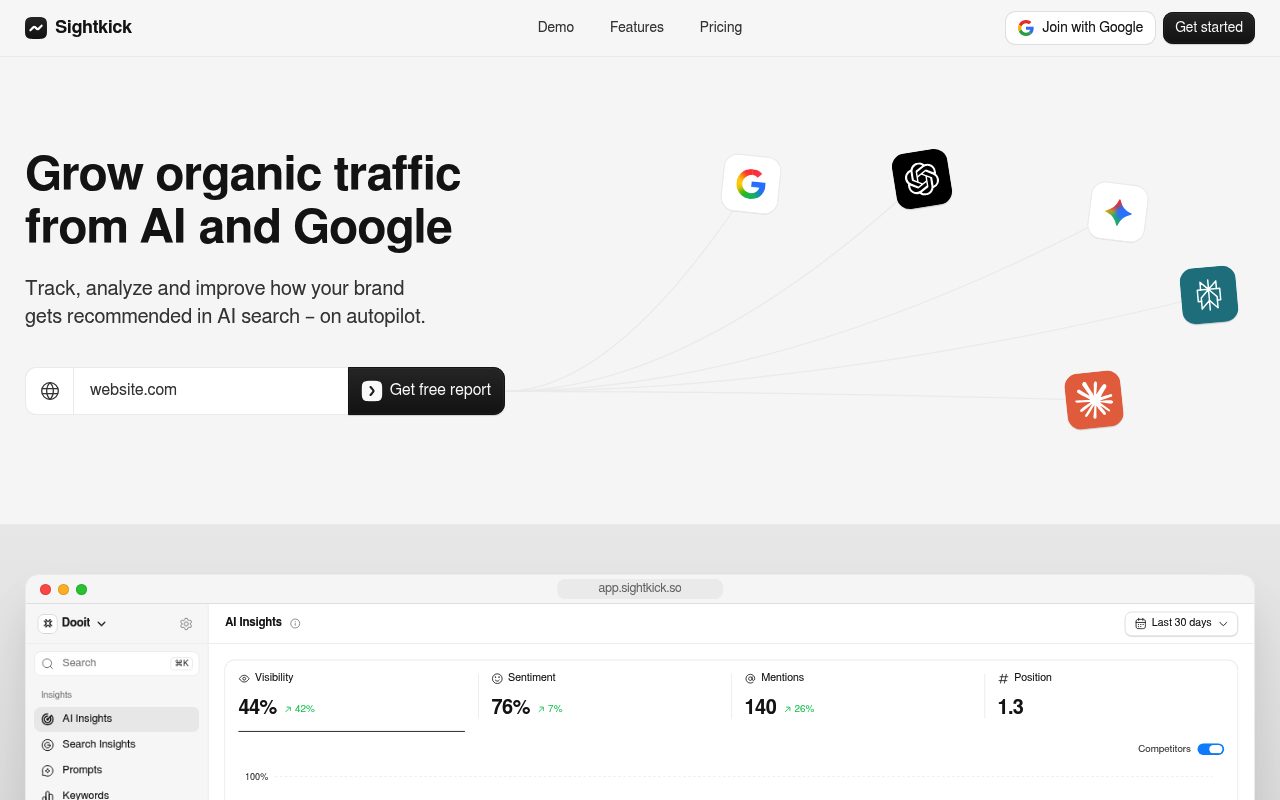
Screenshot: Sightkick homepage, October 2026.
Sightkick combines daily answer monitoring with article publishing and backlink outreach. Its supported visibility surfaces include ChatGPT, Gemini, Google AI Overviews, and Google AI Mode. The platform runs each tracked prompt daily in three AI models; a fourth is an add-on. Define that coverage explicitly before comparing visibility across reporting periods.
Disclosure: Sightkick is our product.
- Establish the baseline. The free Brand Visibility Report shows visibility percentage, sentiment, mention count, and average recommendation position relative to competitors.
- Monitor recommendations. Daily prompt runs record which brands are recommended, enabling continuous competitive benchmarking.
- Inspect citation origins. Source classifications are UGC, Editorial, Yours, and Competitor. Separate owned-source visibility from third-party coverage.
- Run content production. The Articles engine researches, writes, scores, and adds images, links, and schema before publishing to a CMS on a daily schedule without manual input.
- Run cited-page outreach. The Backlinks engine finds pages AI already cites, verifies owner contact details, sends pitches and follow-ups, and confirms live backlinks.
The operational distinction: publishing works on pages you control; outreach targets pages already cited by AI. Monitor mentions and source ownership separately to evaluate both workflows. A published article or confirmed backlink is an output, not proof of a new recommendation.
Sightkick offers a three-day free trial and states a two-minute setup time. One plan costs $79 per month; review the pricing page when choosing coverage.
What tools help track and improve AEO performance?
AEO tools should be evaluated against a saved-answer workflow, not a single visibility score. Require clarity on platform coverage, prompt frequency, source URLs, and the denominator behind each metric. Then decide whether you need monitoring alone or operational features such as content publishing and outreach. Those are separate purchasing requirements.
Ask each vendor to demonstrate the same prompt, distinguish a mention from an owned citation, and explain how historical results remain comparable when prompts change. Require explicit treatment of incomplete runs. If a capability or coverage limit is not published, mark it “Not published” rather than inferring support.
Frequently asked questions
AEO implementation starts with a defined question, a destination page, and an observable outcome. The questions below clarify why answer visibility matters, what the work looks like, and how to interpret changes. Use the answers to set scope, not to infer a guaranteed citation or a separate ranking formula.
Why is AEO important in the age of AI search and chatbots?
AEO matters because direct answers create a discovery surface that search rankings alone do not measure. Track whether those answers include your brand, cite your pages, and generate identifiable visits.
What are common examples of AEO in practice?
Common AEO tasks include publishing a direct definition, documenting product capabilities and limitations, adding accurate structured data, and monitoring whether relevant answers name the brand or cite the intended page. None guarantees inclusion.
Is AEO the same as GEO?
AEO and GEO overlap in generative-answer work. AEO’s cited definitions also include voice assistants and Google answer features. Define platforms and deliverables rather than assuming either label specifies a distinct implementation.
Does AEO replace the need for traditional SEO?
No. Keep the work that makes pages relevant and usable. Add answer-level measurement so a search ranking does not conceal missing recommendations or citations to third-party pages.
Why did my AEO visibility change after Google’s October 2026 update?
The update alone does not establish why an individual brand gained or lost visibility. Compare saved responses, source placements, prompt coverage, and completion rates. Confirm that the tracking method stayed consistent before attributing the change to Google.
AEO means preparing content for direct answers and measuring whether those answers include your brand or link to your pages. Rankings, mentions, citations, and sign-ups remain separate outcomes.
Start with Sightkick’s free Brand Visibility Report. Establish the baseline before changing the workflow.