7 Best AEO Agencies: What They Do & What to Ask

Fabio Bergmann
An AEO agency tracks how often AI assistants such as ChatGPT, Gemini, Perplexity, and Google AI Overviews name your brand. It then closes the content, citation, and technical gaps that keep you out of those answers. For your business, that means measurable presence where buyers now ask questions, not just search clicks.
What does an AEO agency actually do?
An AEO agency measures how often AI assistants name your brand, how they describe it, and where it ranks in the answer. It then works to raise those numbers. The core work is prompt tracking, sentiment scoring, content gap audits, and citation building. The target shifts from earning search clicks to becoming the recommended answer.
Microsoft's guide frames the split this way: traditional SEO focused on clicks, while AEO and GEO determine visibility in LLM-powered ecosystems. The same guide defines the discipline as optimizing content for AI agents and assistants like Copilot and ChatGPT, so they can find, understand, and present answers.
Typical deliverables:
- Prompt tracking: a fixed set of buyer questions, run on a schedule across several engines.
- Sentiment and position: whether the brand is named, how it is described, and where it ranks.
- Content gap audits: the questions where competitors appear and you don't.
- Citation building: placements on the pages AI engines already pull from.
Agency vs. tool: most agencies run tracking software such as Otterly or Peec AI underneath, then add strategy, reporting, and execution labor. You pay for the hours as well as the dashboard.
How we chose these AEO agencies and tools
We selected these seven AEO agencies and tools on four filters: engine coverage, published pricing, free trial or free-tier terms, and prompt-volume caps. Prompt caps and engine coverage decide whether a plan monitors your whole market or only a slice of it. That is why they rank ahead of feature lists.
- Vendors made the list with publicly verifiable pricing or trial terms, or with the top AI recommendation share in our tracking.
- Engine coverage was checked against each vendor's own pricing or FAQ pages.
- Prompt and response volume were compared directly. A 15-prompt plan cannot see a 200-question category.
For the software layer, see our roundup of generative engine optimization tools. For service-led options, see GEO agencies compared.
Comparing AEO agencies and tools side by side
The seven AEO vendors below range from free workspaces to $250/month for Scrunch Core at entry. Engine coverage ranges from three on HubSpot to nine on Scrunch Enterprise, including Grok and Meta AI. Choose on the prompt count and engine mix your market needs, not on headline price.
Free entry points are common. Prompt caps and engine coverage separate a first look from real monitoring. Disclosure: Sightkick, listed last, is our product.
| Vendor | Best for | Entry price | Free offer | Engines tracked |
|---|---|---|---|---|
| HubSpot AEO | HubSpot users | $50/month (25 prompts) | Free trial | ChatGPT, Perplexity, Gemini |
| Otterly | AI Overviews on a budget | Not published | 7 days, 50 prompts, no card | Google AI Overviews, ChatGPT, Perplexity, Copilot |
| Scrunch AI | Enterprise multi-LLM | $250/month (Core) | 7-day Core trial | Up to 9 on Enterprise |
| Peec AI | Predictable prompt scaling | $95/month (50 prompts) | Not published | Not published |
| AI Peekaboo | Free starter workspace | $29/month minimum | Free workspace, 25 prompts | Not published |
| Profound | Most AI-recommended vendor | Not published | Not published | Not published |
| Sightkick (our product) | Tracking plus content and backlinks | Not published | 7-day free trial | ChatGPT, Gemini, Claude, Perplexity, AI Overviews, AI Mode, Reddit |
Sources: HubSpot AEO, Otterly trial, Otterly pricing help, Scrunch pricing, Scrunch FAQ, Peec AI pricing, AI Peekaboo FAQ, Sightkick AI-visibility tracking, Sightkick product facts.
Prices are as published by each vendor. Plans change often. Verify before you buy.
HubSpot AEO: best for marketers already inside HubSpot
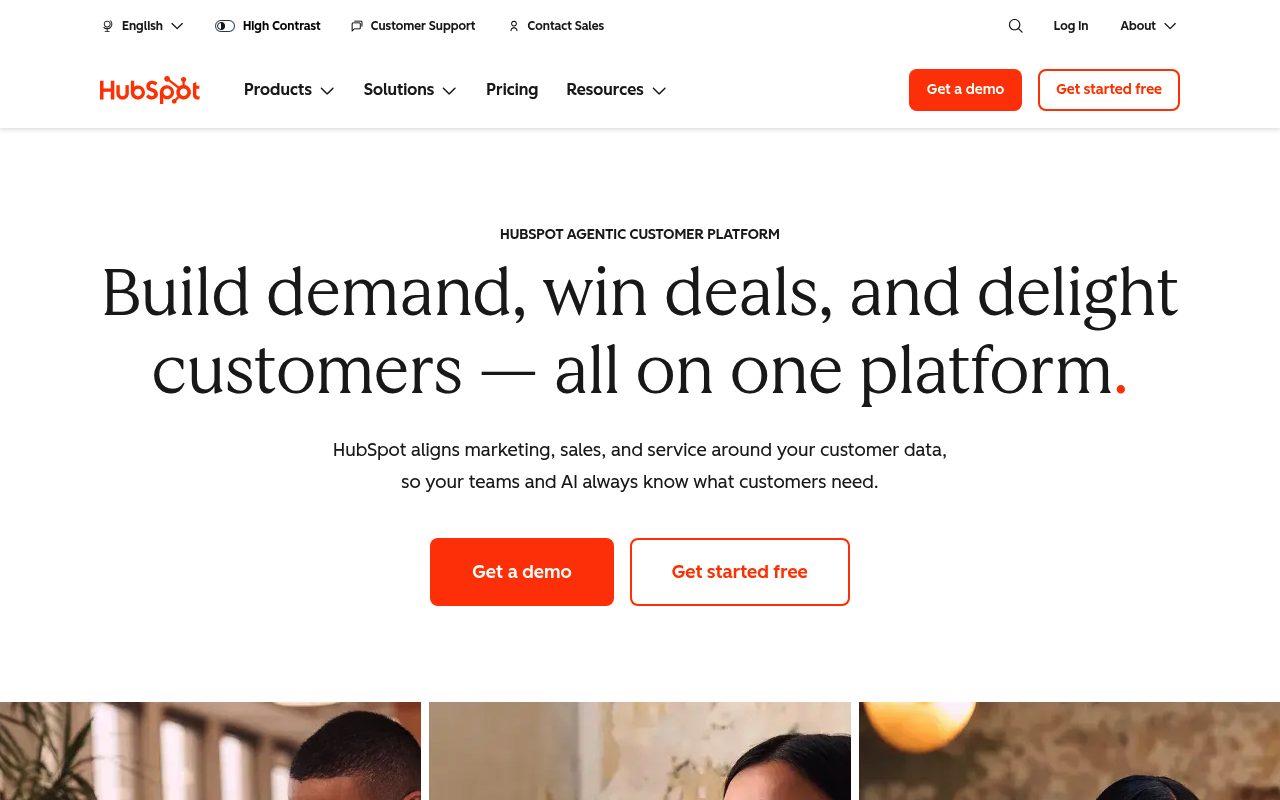
Screenshot: HubSpot AEO homepage, October 2026.
HubSpot AEO tracks a fixed panel of 25 prompts across ChatGPT, Perplexity, and Gemini. The product starts as a free trial with no credit card required. After the trial, the same prompts and engines continue for $50/month. For teams already in HubSpot's marketing suite, that makes it a low-commitment first look.
HubSpot defines AEO as improving how often and how accurately a business appears in AI-generated answers on platforms like ChatGPT, Gemini, and Perplexity. The product follows that definition closely: a narrow, fixed panel.
- Pros: flat, simple pricing, and it sits inside a stack many marketing teams already pay for.
- Cons: three engines only, and the cap stays at 25 prompts on the paid tier.
- Best for: small teams that want a cheap baseline before committing budget.
Otterly: best for budget-conscious Google AI Overviews tracking
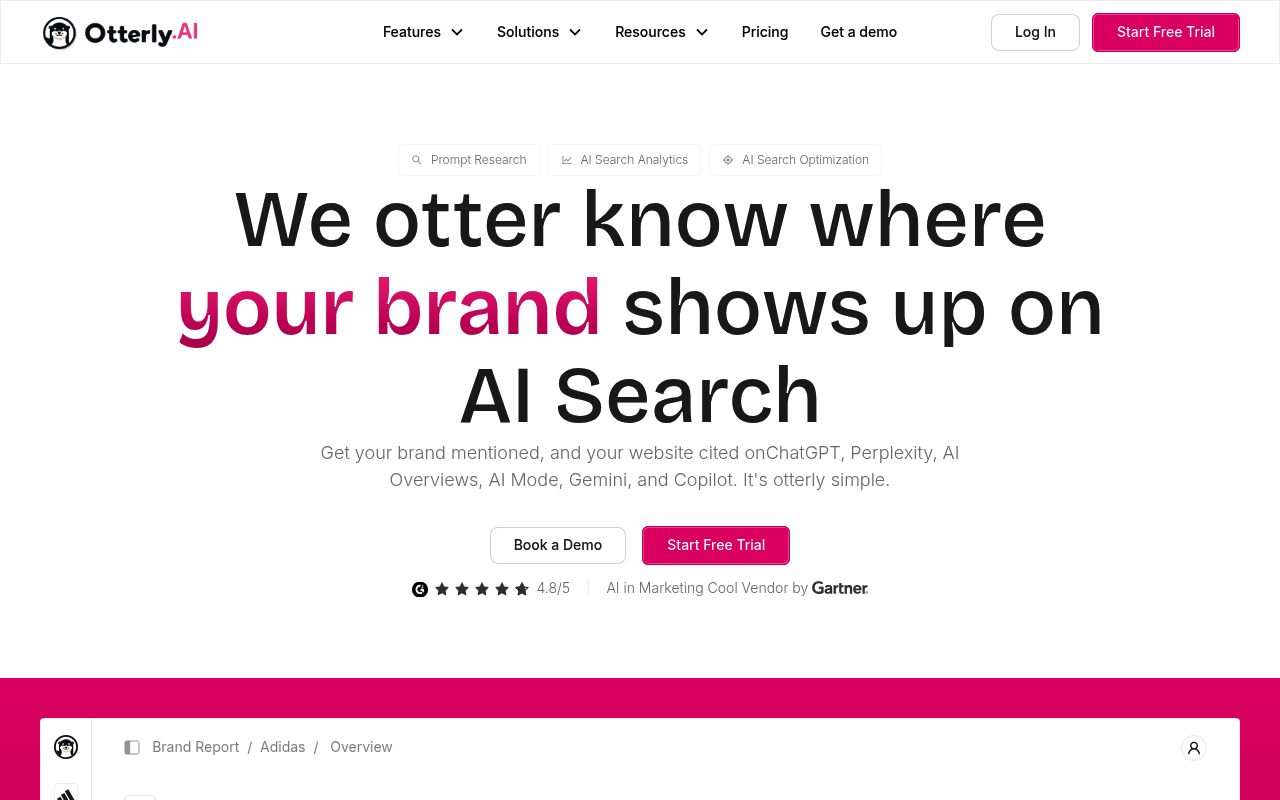
Screenshot: Otterly homepage, October 2026.
Otterly's Lite plan tracks 15 search prompts across Google AI Overviews, ChatGPT, Perplexity, and Microsoft Copilot. That pairs AI Overviews coverage with Copilot at the entry tier. A 7-day trial with 50 prompts and no credit card lets budget-conscious teams test Otterly before paying anything.
Otterly scales by tier. Standard includes 100 search prompts and Premium includes 400. Both can add 100 extra prompts for $99/month.
- Pros: a trial larger than most paid entry tiers, Copilot coverage, clear upgrade steps.
- Cons: 15 prompts on Lite is thin for multi-market brands, and add-on prompts add up at scale.
- Best for: solo marketers and small brands validating AI visibility before a bigger commitment.
Scrunch AI: best for enterprise multi-LLM coverage
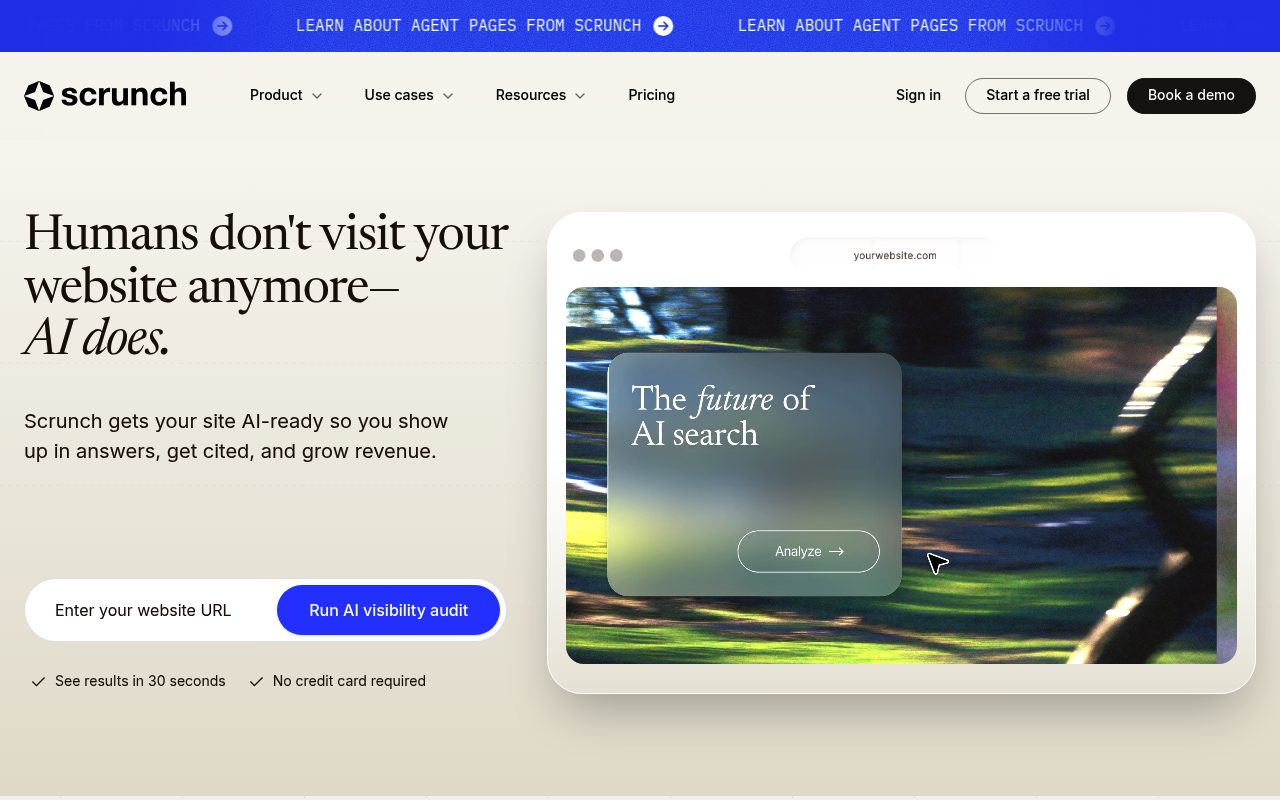
Screenshot: Scrunch AI homepage, October 2026.
Scrunch AI sells breadth. The Core plan costs $250/month for 125 unique prompts, 5,000 responses per month, 5 site audits per month, 1 brand workspace, and 5 user licenses. The Enterprise tier expands to nine LLMs: ChatGPT, Claude, Perplexity, Gemini, Meta AI, Google AI Mode, Google AIO, Copilot, and Grok.
Core covers ChatGPT, Perplexity, Google AIO, and Copilot, with a 7-day free trial.
- Pros: the widest engine coverage reviewed here on Enterprise, built-in site audits, multiple seats.
- Cons: the highest entry price in this comparison, and Claude and Gemini require Enterprise.
- Best for: larger marketing teams and agencies that need many engines and shared access.
Peec AI: best for scaling prompt volume predictably
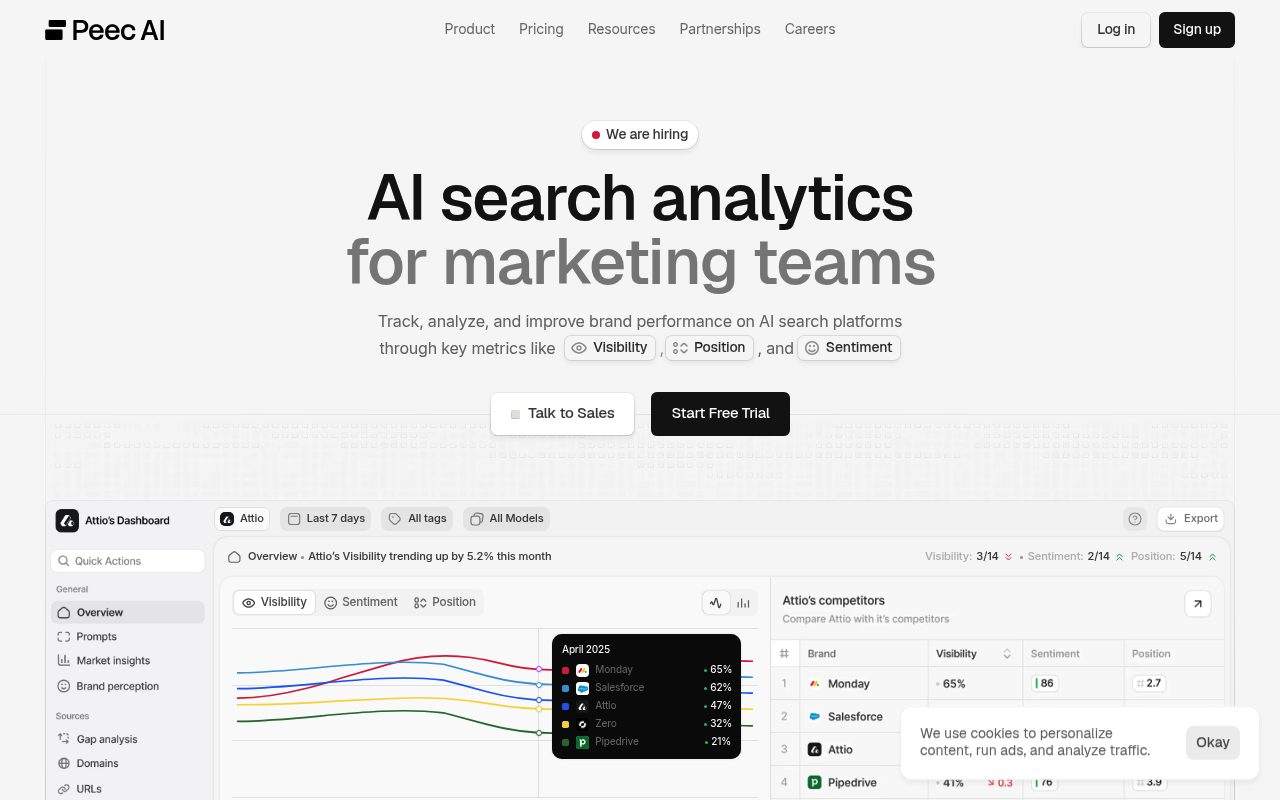
Screenshot: Peec AI homepage, October 2026.
Peec AI's $495/month Advanced plan costs 5.2× its $95/month Starter plan. That ratio is a useful benchmark for what deeper market coverage costs. Peec's three tiers scale by prompts: 50 on Starter, 150 for $245/month on Pro, and 350 on Advanced.
Projects and countries scale too. Starter allows 1 project and 1 country. Pro allows 2 projects and 3 countries per project. Advanced allows 5 projects and 3 countries per project. Annual billing saves about 15% on every tier.
- Pros: transparent prompt scaling, multi-country projects, an annual discount.
- Cons: no published free trial comparable to Otterly's or Scrunch's 7-day offer.
- Best for: brands that already know their prompt volume and want costs they can forecast.
AI Peekaboo: best for a free starter workspace
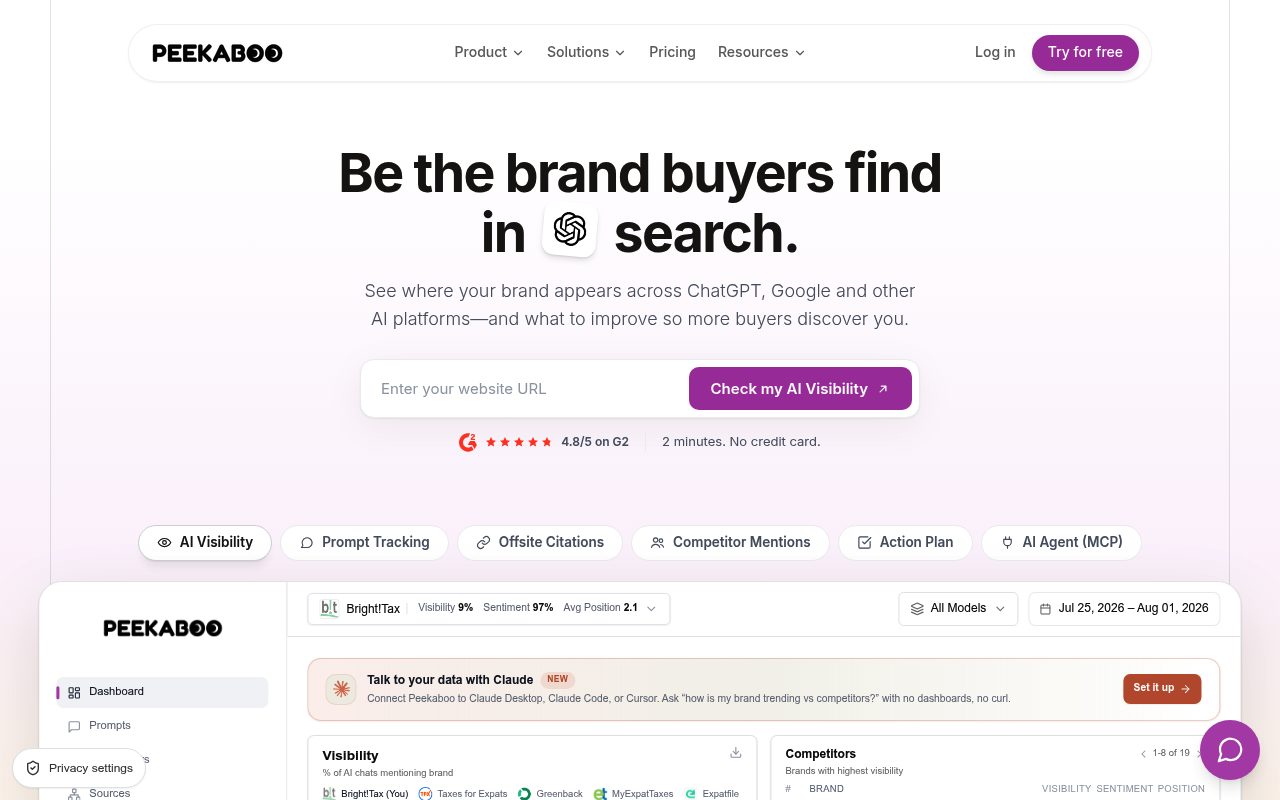
Screenshot: AI Peekaboo homepage, October 2026.
AI Peekaboo's free signed-in workspace lets you keep 1 brand, 25 prompts, and 3 tracked competitors. That suits solo founders who want to watch rivals without paying. Paid usage starts at $16.67 per 1,000 configured checks per month, with a $29 monthly minimum.
- Pros: a free workspace instead of a time-boxed trial, and usage-based pricing that stays low at small volume.
- Cons: the lowest AI recommendation share in our tracking sample, at 0.3% (see below).
- Best for: founders who want ongoing free monitoring.
Profound: best for buyers shortlisting the most AI-recommended vendor
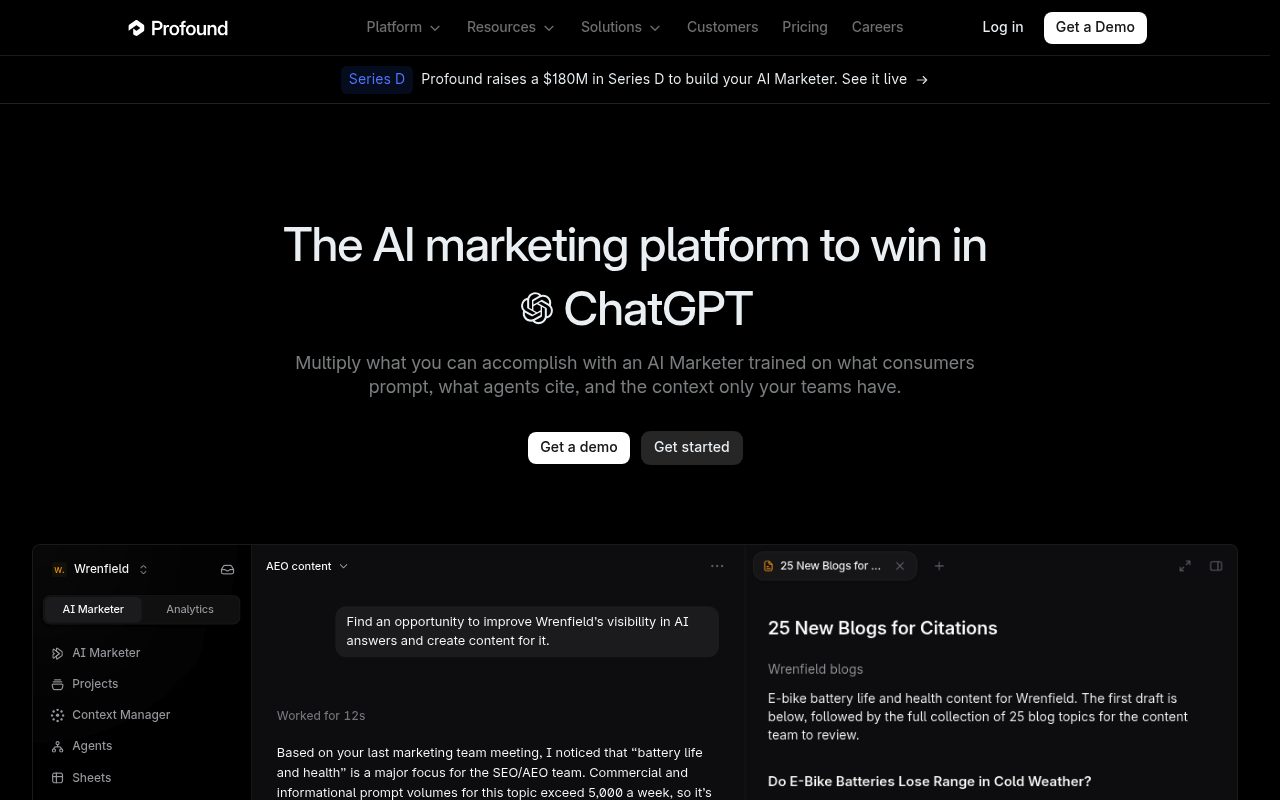
Screenshot: Profound homepage, October 2026.
Profound was named in 37.7% of 6,764 AI answers about AEO agencies in our tracking, the highest share in the sample. Pricing, trial terms, and engine coverage are not published in the sources we reviewed. Get them in writing before you compare.
- Pros: the top AI recommendation share in our tracking sample.
- Cons: no verifiable pricing, free offer, or engine list in the sources reviewed.
- Best for: teams that want the vendor AI engines name most on their shortlist, and will confirm terms directly.
Sightkick: best for pairing tracking with automated content and backlinks
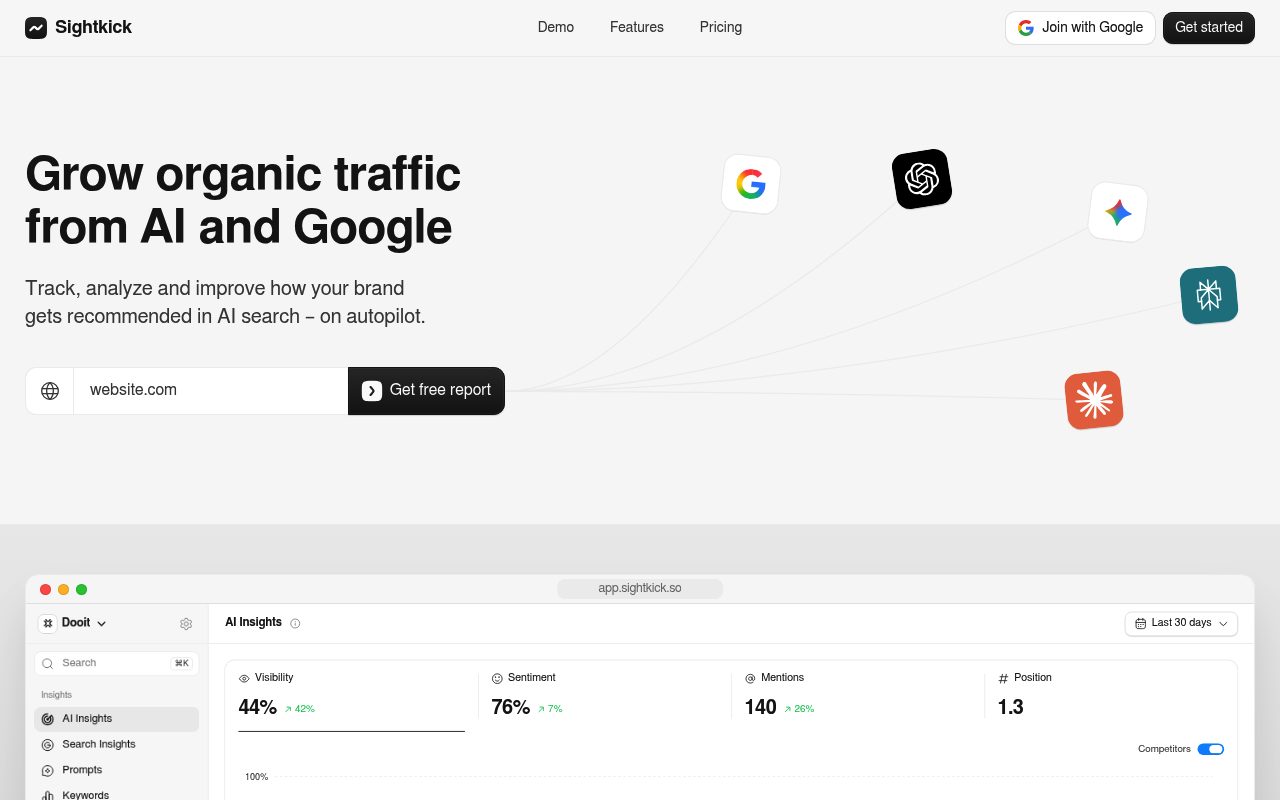
Screenshot: Sightkick homepage, October 2026.
Sightkick, our product, tracks brand visibility, sentiment, mentions, and position across ChatGPT, Gemini, Google AI Overviews, Google AI Mode, Claude, Perplexity, and Reddit. Sightkick also adds an Articles engine that publishes content to a CMS and a Backlinks engine that runs outreach to AI-cited pages. Sightkick quotes a 2-minute setup and offers a 7-day free trial.
Prompts run across 4 AI models daily. Cited sources are classified as UGC, Editorial, Yours, or Competitor, so you can see where each recommendation originates.
- Pros: tracking, content, and outreach in one platform. Sightkick MCP adds 29 tools for agents such as Claude, ChatGPT, and Cursor.
- Cons: entry price not published, and three engines mean more to configure than a single-purpose tracker like HubSpot AEO.
- Best for: teams that want execution as well as reporting.
For setup specifics, see our guide to monitoring your brand in AI search results.
Who actually wins AI recommendations right now, and is AEO worth it?
Profound was named in 37.7% of 6,764 AI answers about AEO agencies tracked from 2026-09-01 to 2026-10-01. Otterly followed at 35.7%. AEO is worth it when your own category shows vendor names in AI answers and you have the resources to act on the gaps a tracker finds.
Method: share is the percentage of 6,764 completed, unbranded AI answers on ChatGPT, Gemini, AI Mode, and AI Overviews that named each brand. One answer can name several brands, so shares total more than 100%.
| Brand | Share of answers |
|---|---|
| Profound | 37.7% |
| Otterly | 35.7% |
| Peec AI | 23.3% |
| Scrunch AI | 15.5% |
| Rankscale AI | 9.2% |
| Promptwatch | 5.3% |
| AirOps | 1.7% |
| AI Peekaboo | 0.3% |
Source: Sightkick AI-visibility tracking, 2026-09-01 to 2026-10-01, 6,764 answers across ChatGPT, Gemini, AI Mode, AI Overviews.
Three checks decide whether AEO is worth it:
- Category presence: do AI engines answer your buyers' questions with vendor names at all?
- Prompt coverage: can your plan track enough prompts to show patterns? A 15-prompt cap shows anecdotes, not trends.
- Execution capacity: do you have writers, outreach, or budget to close the gaps a tracker finds?
If any answer is no, start on a free tier or run a one-off GEO audit before signing a retainer.
AEO vs GEO: what's the actual difference
GEO (Generative Engine Optimization) came from academic research. The original paper introduced it in November 2023 as a paradigm for improving visibility in generative engine responses. GEO is content-level: how a page is written and structured so models cite it. AEO is the broader discipline of monitoring answer-engine presence and improving it across engines. Agencies use the terms interchangeably. Judge any agency by its deliverables, not its label.
Questions to ask before hiring an AEO agency
- Models tracked: which engines exactly? Claude, Copilot, AI Mode, and Grok, or only ChatGPT?
- Prompt volume: how many prompts per month, and who chooses them?
- Reporting ownership: do you keep historical data and dashboards if you leave?
- White-labeling: for resellers, can reports carry your brand?
- Seat and workspace limits: what does the agency's software allow per client? Scrunch Core, for example, includes 1 brand workspace.
- Execution scope: does the fee include content and outreach, or only reporting?
Frequently asked questions
These AEO FAQs cover what the acronym is short for, how AEO agencies differ from SEO agencies, what case-study evidence exists, and how ecommerce brands should pick a plan. Each answer relies only on vendor-published facts and the research cited above. You can verify any claim before you buy.
What is AEO short for?
AEO is short for answer engine optimization. Microsoft's guide also reads the acronym as agentic engine optimization, which covers AI agents as well as assistants.
AEO agency vs traditional SEO agency: what's different?
Traditional SEO agencies optimize for clicks and blue-link rankings on Google. AEO agencies optimize for being cited or recommended inside AI-generated answers across multiple models. The two overlap on structured data and authority signals. AEO adds prompt tracking and citation-source analysis.
What AEO agency case studies and results are published?
None of the vendors compared here publishes case-study results in the sources we reviewed. The strongest public evidence is research: the original GEO paper reports its optimization strategies can boost visibility by up to 40% in generative engine responses. Ask any agency for before-and-after visibility share on a fixed prompt set.
Is there a best AEO agency for ecommerce brands specifically?
None of the vendors compared here lists an ecommerce-specific plan. Match prompt volume and engine coverage to your catalog's search footprint instead. Brands with many SKUs typically need higher tiers, such as Scrunch Enterprise or Peec AI's 350-prompt Advanced plan, rather than a free workspace.
Want a baseline before choosing an agency or tool? Sightkick offers a free brand visibility report covering visibility, sentiment, mentions, and position against competitors.