AI Brand Visibility: 7 Best Tools to Track & Grow It

Fabio Bergmann
To increase brand visibility with AI, track how ChatGPT, Gemini, Perplexity, and Google AI Overviews mention you, then fix what they cite: publish pages that state answers in their first lines, earn links from pages AI already cites, and rerun the same prompts daily. The six tools below track AI visibility. Rankscale AI adds page audits, and Sightkick adds content and backlink engines.
AI brand visibility is how often, how favorably, and in what position AI engines mention your brand. A SaaS can rank on page one for its core keyword while ChatGPT recommends three competitors and never names it.
Why does it feel like your brand is invisible to ChatGPT and Google AI, even when you rank well?
AI brand invisibility happens because rankings and answers are different systems. Google rankings measure blue-link position. AI engines synthesize one answer and cite only a handful of sources. A page-one brand can be absent from ChatGPT, Gemini, or AI Overviews, and closing that gap takes dedicated monitoring on top of better SEO.
Answer engines favor citation-worthy sources: pages already referenced elsewhere, written in extractable claims, and tied to a clear entity. A top-ranking page that buries its answer under a long intro can lose to a mid-ranking page that states the answer in its first line.
Traffic data hides the shift. OtterlyAI reports that 65% of all searches end in zero-click, so a growing share of brand exposure happens inside answers Search Console never logs. You can't fix what you can't see.
How did we choose these AI brand visibility tools?
We compared six AI brand visibility platforms on four points: published pricing, AI engines tracked, prompt or credit limits per tier, and whether the tool stops at monitoring or also ships remediation through content or backlinks. Every figure comes from vendor pricing or product pages, checked in September 2026.
- Engine coverage: ChatGPT, Gemini, Perplexity, Claude, Microsoft Copilot, Google AI Overviews, and Google AI Mode.
- Entry price and plan structure: lowest paid tier and how tiers scale.
- Limits: prompts, credits, or tracked answers per tier.
- Workflow scope: monitoring only, or monitoring plus action.
Where a vendor doesn't publish a number, we left it out rather than estimate.
AI Brand Visibility Tools Compared
AI brand visibility tools in this comparison publish entry tiers from about $29 to $199 per month, and named engine coverage ranges from two engines to seven. The table summarizes starting price, trial availability, engines named, and each platform's differentiator, so teams can cut the field to two or three candidates by budget and scope.
The takeaway: price tracks scope, and most tools here focus on monitoring.
Disclosure: Sightkick is our product.
| Tool | Best for | Starting price | Free plan/trial | Engines named | Key differentiator |
|---|---|---|---|---|---|
| Otterly | Broad engine coverage on a budget | $29/mo (Lite, 15 prompts) | Not published | 4 on paid plans; 7 claimed platform-wide | Used by 40,000+ marketing professionals, per vendor |
| Promptwatch | Agencies needing geo-level tracking | $199/mo (1,000 agent credits) | Not published | Not published | Country and state/city tracking, crawler logs, MCP/API |
| Rankscale AI | Lower-cost entry with page audits | $99/mo (Pro, 1,200 credits) | Not published | Not published | 50 page audits on Pro |
| Peec AI | Tying AI visibility to referral traffic | Not published | Not published | ChatGPT, Perplexity, Claude, Gemini, Copilot | Shows which pages receive AI referral traffic |
| Scrunch AI | Enterprise multi-model monitoring | Not published | Not published | ChatGPT, Perplexity, Gemini, Claude | Consolidated Monitoring & Insights product |
| Sightkick | Pairing tracking with content and backlink fixes | Not published | 7-day free trial | ChatGPT, Gemini, AI Overviews, AI Mode, Claude, Perplexity, Reddit | Articles and Backlinks engines on top of daily tracking |
Sources: OtterlyAI pricing, OtterlyAI features, Promptwatch pricing, Rankscale pricing, Peec AI pricing, Peec AI referrals, Scrunch enterprise; first-party product specs.
Otterly: best for broad AI engine coverage on a budget
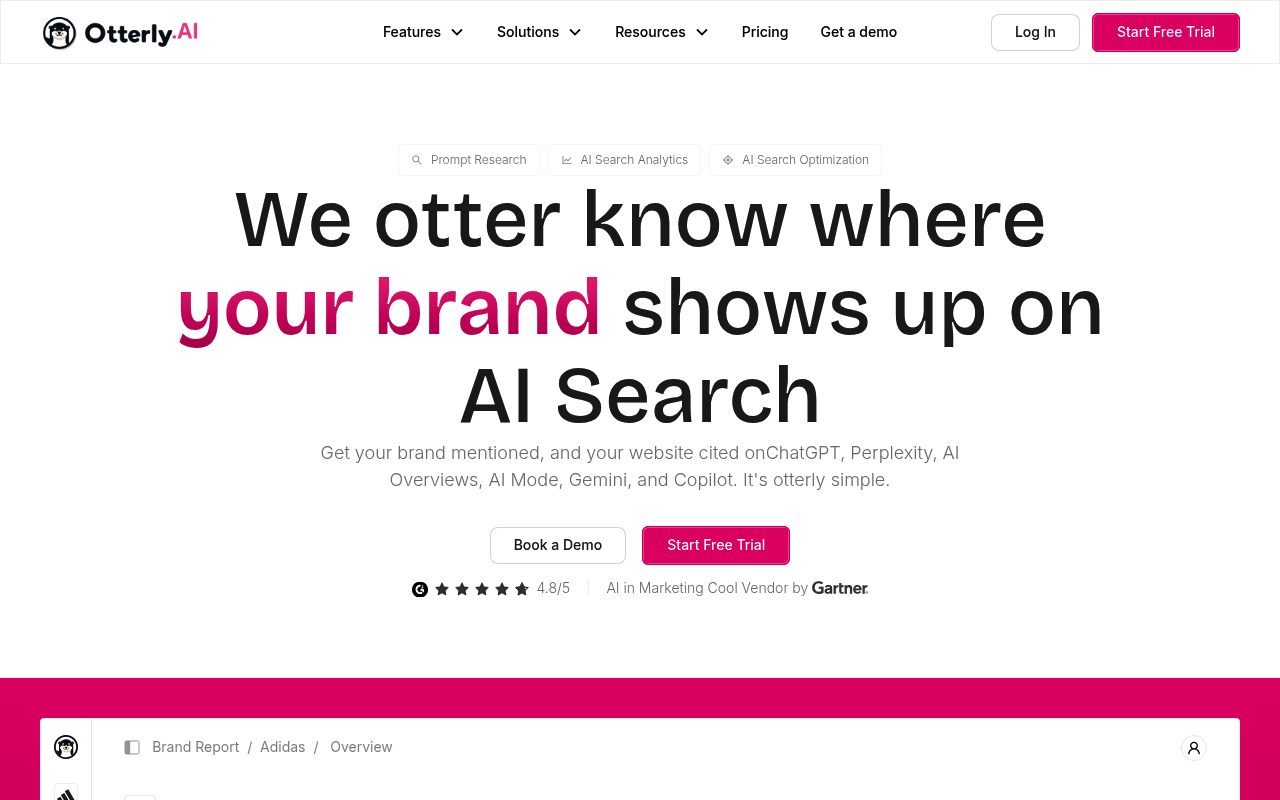
Screenshot: Otterly homepage, September 2026.
At $29 a month, Otterly is the cheapest published entry point in this comparison. The Lite plan includes 15 search prompts, Standard is $189/month for 100 prompts, and Premium is $489/month for 400. Otterly is a monitoring tool for teams that want wide engine coverage without publishing or outreach features.
Read the coverage claim closely. The pricing page lists 4 AI search engines on Lite, Standard, and Premium: ChatGPT, Google AI Overviews, Perplexity, and Microsoft Copilot. The features page claims all 7 major engines, adding Google AI Mode, Gemini, and Claude. Confirm which engines your tier includes before you buy.
- Scaling cost: Premium at $489/month costs 16.9x Lite at $29/month, for 400 prompts instead of 15.
- Adoption: 40,000+ marketing professionals, per Otterly.
- Limitation: monitoring only. No built-in content or backlink remediation.
Promptwatch: best for agencies needing geo-level tracking
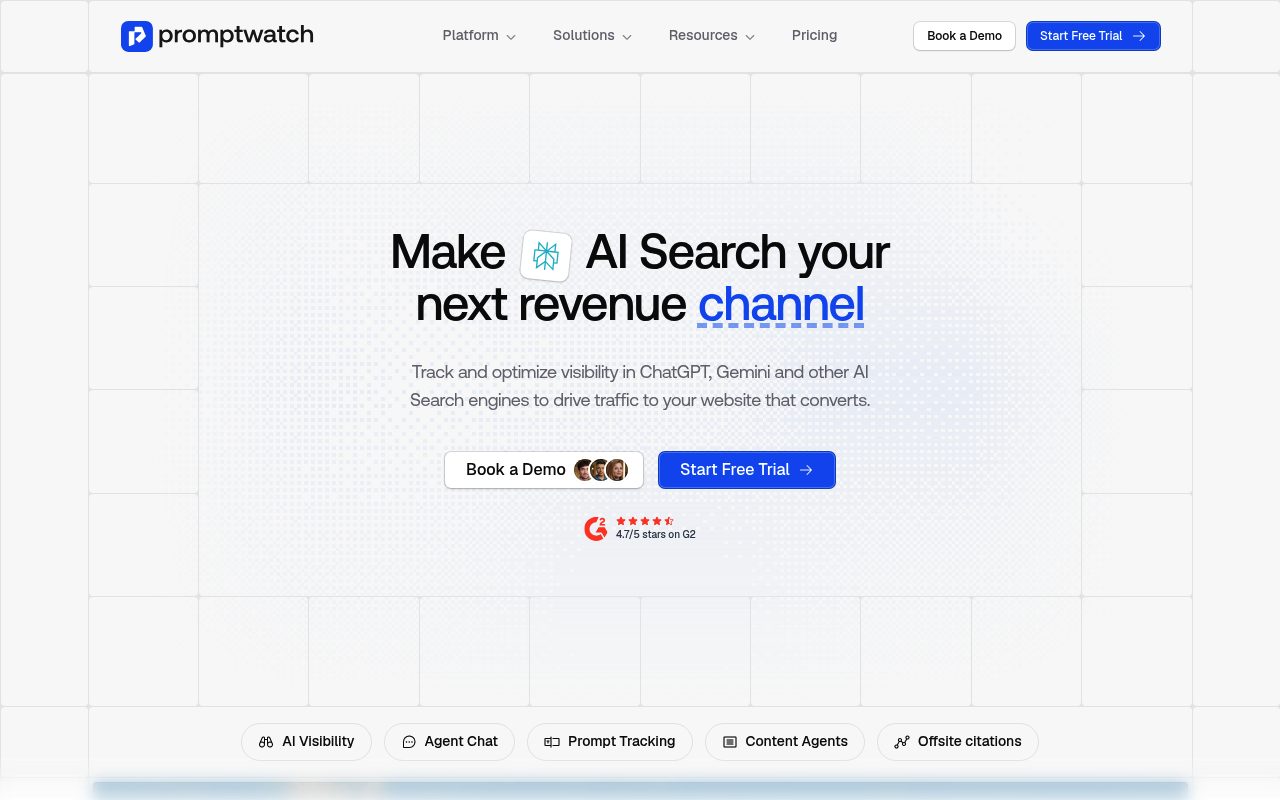
Screenshot: Promptwatch homepage, September 2026.
Promptwatch suits agencies reporting AI visibility for clients in specific markets, with country-level and state/city-level tracking, crawler logs, and MCP/API access. Plans start at $199/month for 1,000 agent credits, rise to $399/month for 2,500, and top out at $799/month for 6,500. Every tier includes unlimited prompts.
Responses range from 10,000 to 65,000 depending on plan. API and MCP access suit agencies piping data into their own client dashboards.
Limitation: the highest published entry price on this list, a harder fit for a single-brand startup that only needs mention counts.
Rankscale AI: best for lower-cost entry with page audits
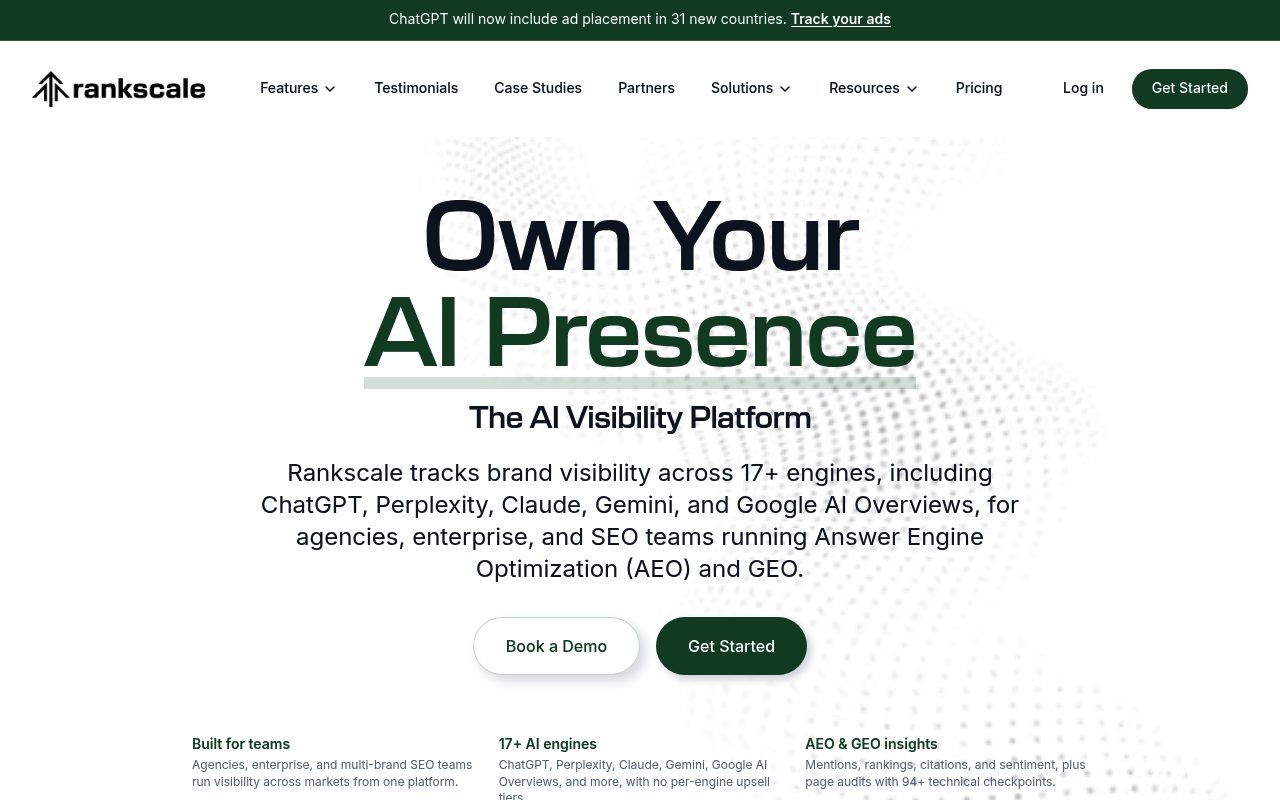
Screenshot: Rankscale AI homepage, September 2026.
Rankscale AI is the pick when visibility data has to turn into on-page fixes. The Pro plan costs $99/month for 1,200 credits and can track up to 4,800 answers from AI engines, with 50 page audits included. Growth costs $385/month for 5,500 credits.
Pairing answer tracking with page audits shortens the loop from "we're not cited" to "here's what to change on this URL." Limitation: Rankscale's pricing page doesn't name specific engines, so check coverage against the engines your buyers use.
Peec AI: best for tracking which pages earn AI referral traffic
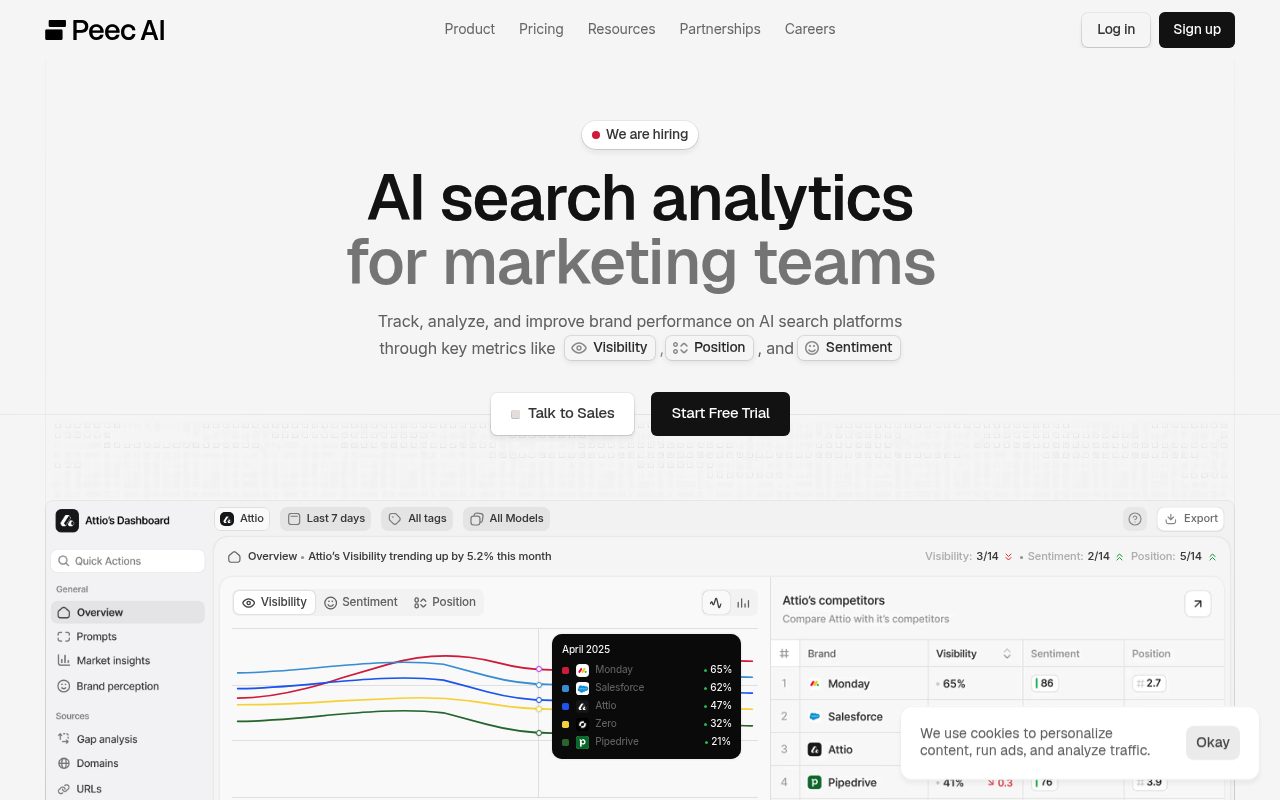
Screenshot: Peec AI homepage, September 2026.
Peec AI connects AI visibility to actual visits. Its referral tracking compares assistants including ChatGPT, Claude, Gemini, Perplexity, and Copilot, and shows which pages on your site receive that traffic. Teams that report on pipeline, not mention counts, get a direct line from citation to landing page.
The brand pricing page names ChatGPT and Perplexity for visibility tracking; the AI referrals feature extends the comparison to Claude, Gemini, and Copilot. Limitation: public pricing detail is thinner than for Otterly, Promptwatch, or Rankscale, so budgeting likely needs a sales conversation.
Scrunch AI: best for enterprise multi-model monitoring
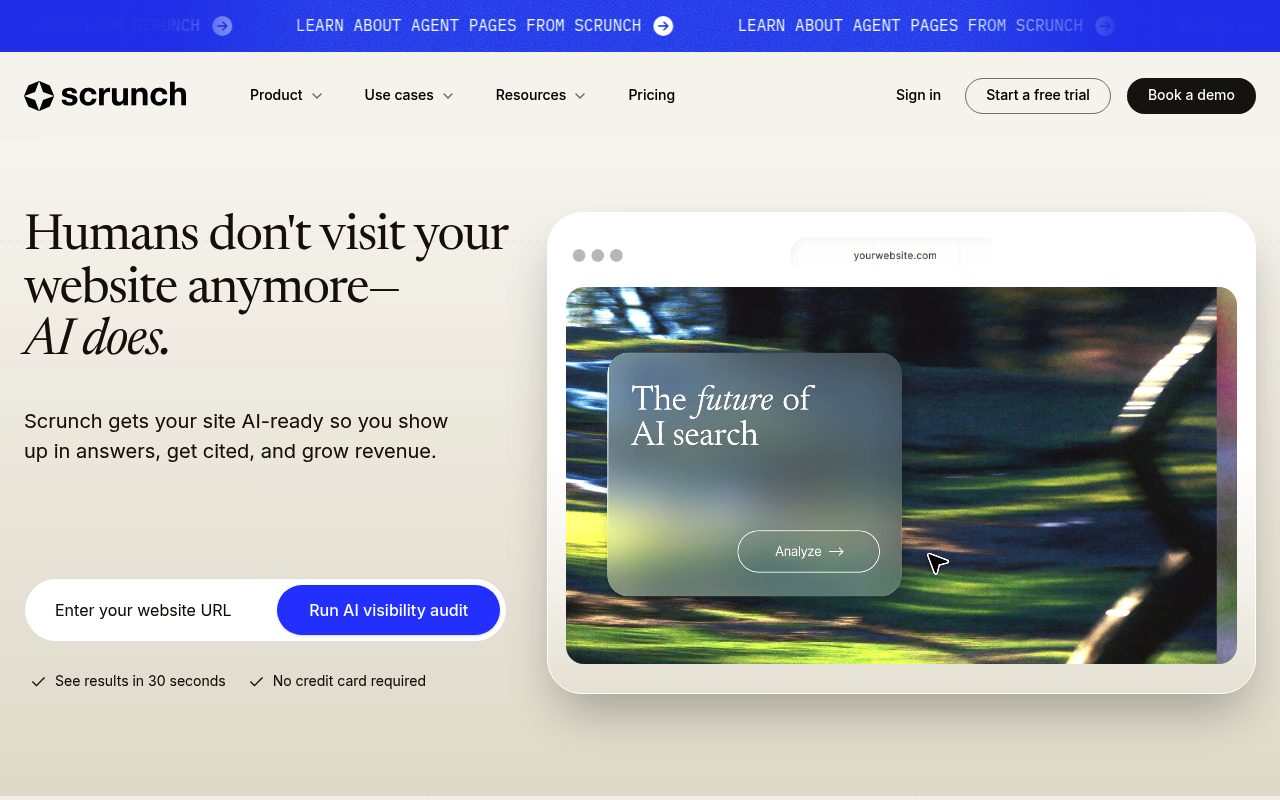
Screenshot: Scrunch AI homepage, September 2026.
Scrunch AI suits larger organizations that want cross-model reporting consolidated in one Monitoring & Insights product. We found no published starting price, which makes it harder to budget against self-serve competitors. The trade-off is enterprise positioning over self-serve plans with public prompt or credit limits.
Scrunch says the product covers ChatGPT, Perplexity, Google Gemini, and Anthropic Claude. Google AI Overviews and Copilot are not named, which matters if Google traffic is your main channel.
Sightkick: best for pairing visibility tracking with automated content and backlink fixes
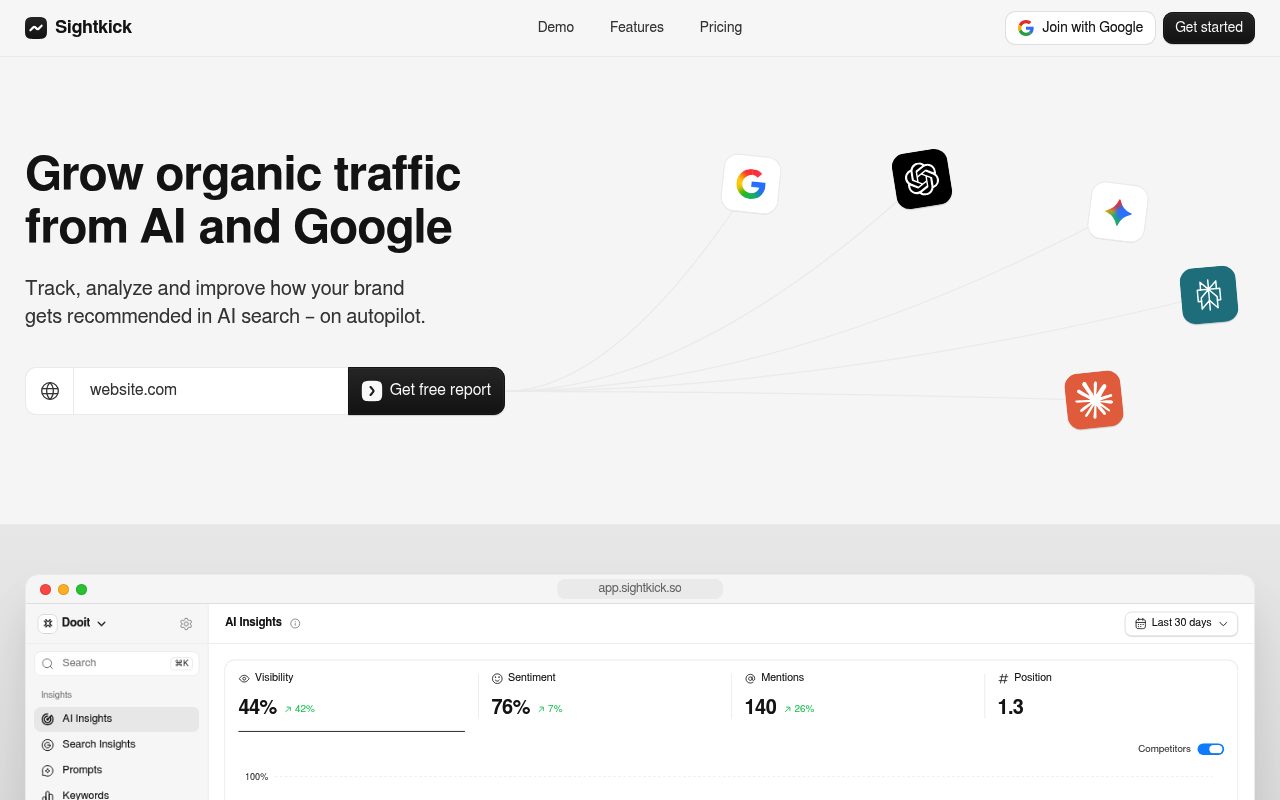
Screenshot: Sightkick homepage, September 2026.
Sightkick suits teams that want tracking and remediation in one system. It tracks visibility, sentiment, mentions, and position across ChatGPT, Gemini, Google AI Overviews, Google AI Mode, Claude, Perplexity, and Reddit, classifies cited sources as UGC, Editorial, Yours, or Competitor, and adds Articles and Backlinks engines.
Limitation: a broader system than a monitoring-only tool. If you only need mention counts, the Articles and Backlinks engines are scope you may never use.
Is Google visibility the same as AI visibility, and how do you audit both together?
Google visibility and AI visibility are separate signals. A page can rank first organically and never be cited by ChatGPT or Gemini, because models weigh topical authority, structural clarity, and existing citation patterns. A complete audit pairs SERP position with daily prompt tracking, citation-type breakdown, and sentiment across engines.
- Fix the prompt set. Write 20 to 50 unbranded buyer questions ("best tool for X") and run the same set daily. Changing prompts breaks the trend line.
- Log every brand named. Record mention, position, and sentiment for you and each competitor.
- Classify the citation source. Tag each cited URL as UGC, Editorial, Yours, or Competitor. Competitor-heavy calls for comparison content. Editorial-heavy calls for outreach.
- Map to pages. Match prompts where you're absent to the page that should answer them, then check that it states the answer in its first lines and carries schema.
- Track share of voice monthly across ChatGPT, Gemini, AI Mode, and AI Overviews. Search Console shows none of this.
Our GEO audit guide covers tooling for each step.
Who is actually winning AI recommendation share right now?
Profound led AI recommendation share in our one-month sample. Across 6,540 AI answers on ChatGPT, Gemini, AI Mode, and AI Overviews between August 31 and September 30, 2026, Profound was named in 37.8% of answers and Otterly in 36.1%, a gap of 1.7 points. AI Peekaboo appeared in 0.3%.
Method: share is the percentage of 6,540 completed, unbranded AI answers in which the brand was named. One answer can name several brands, so shares don't sum to 100%. Data is from Sightkick's own tracking.
| Brand | Share of answers |
|---|---|
| Profound | 37.8% |
| Otterly | 36.1% |
| Peec AI | 23.1% |
| Scrunch AI | 15.6% |
| Rankscale AI | 9.3% |
| Promptwatch | 5.1% |
| AirOps | 1.8% |
| AI Peekaboo | 0.3% |
Source: Sightkick AI-visibility tracking, 2026-08-31 to 2026-09-30, 6540 answers across ChatGPT, Gemini, AI Mode, AI Overviews.
Two tools split the top, Peec AI and Scrunch AI sit between 15% and 24%, and the tail drops fast: Promptwatch at 5.1%, AirOps at 1.8%. Recommendation share is concentrated. Profound isn't reviewed above because we had no published pricing or coverage facts to compare. This is a single-month snapshot; rerun it monthly before reading it as a stable ranking.
Frequently asked questions
AI brand visibility questions usually come down to four things: how visibility is measured, how models choose which brands to cite, whether one tool can both monitor and fix gaps, and what published proof exists. The answers below use only vendor-published facts and our own tracking data.
How is AI brand visibility actually measured, in practice?
Run repeatable prompts against AI models daily and log four things: whether your brand is mentioned, the sentiment of that mention, your average recommendation position versus competitors, and which citation type (owned, editorial, UGC, competitor) drove the answer. Tools differ mainly in engine coverage and reporting depth.
How does an AI model decide which brands to cite in an answer?
Models tend to favor topical authority, existing citations elsewhere, structural clarity (clear claims, schema, organized content), and freshness. A high Google ranking helps but doesn't guarantee citation. The model picks extractable, trustworthy answers, and top links don't always qualify.
Do I need both a monitoring tool and a content/backlink tool, or can one product do both?
Most tools here focus on monitoring; Rankscale AI adds page audits. Content creation and outreach usually sit with separate teams or tools. Sightkick (our product) pairs monitoring with an Articles engine and backlink outreach. Pick by whether your bottleneck is seeing the gap or closing it.
Are there case studies of companies improving AI search visibility?
None of the vendor pages cited here publishes a verifiable before-and-after case study, so we don't cite one. The closest substitute is your own baseline: run a fixed prompt set, log share of answers, make changes, and compare month over month.
One limit applies to every tool here: AI answers vary between runs, so a single month of share data is a signal, not a verdict, and small lifts can be noise. Continuous tracking pays off when a competitor is recommended for prompts your buyers ask every day. Daily data shows which sources to win and when the gap starts closing.