 Join with Google
Otterly vs Peec AI: Which AI Visibility Tool Wins

Fabio Bergmann
Neither Otterly nor Peec AI is an otter conservation tool. Both are AI search visibility trackers that measure how often ChatGPT, Gemini, and Google's AI surfaces name a brand. For a conservation group checking its own visibility, Otterly fits better: 7 engines, 65+ countries, and a free tier. Peec AI suits agencies and e-commerce brands that need crawl and shopping diagnostics.
The choice is breadth versus depth. Otterly starts at $29/month. Peec AI starts at $95/month, tracks 3 models, and adds bot diagnostics and ChatGPT shopping-carousel tracking.
Choosing between Otterly and Peec AI: what's actually at stake
Otterly and Peec AI both measure brand visibility inside AI answers, but they split the problem differently. Otterly covers more engines and more countries at a lower entry price. Peec AI adds crawl diagnostics and ChatGPT shopping-carousel tracking, which suit agencies and e-commerce brands. Pick based on the blind spot you need to close: breadth or depth.
Generative engine optimization (GEO) is the practice of earning mentions, citations, and recommendations inside AI-generated answers. Otterly and Peec AI are measurement layers for GEO. Neither writes content or builds backlinks. Both show where you stand. Closing the gaps takes other tools or manual work. For the wider field, see our roundup of generative engine optimization tools.
Buyers usually weigh three things:
- Engine coverage. Otterly tracks 7 AI search engines in 65+ countries and languages.
- Price per prompt. A prompt is one tracked query. Prompt allowance sets how much of your category you can monitor.
- Account structure. Peec AI runs separate pricing tracks for brands and agencies, documented as of July 2026. Otterly is built around a single brand report.
Otterly vs Peec AI at a glance
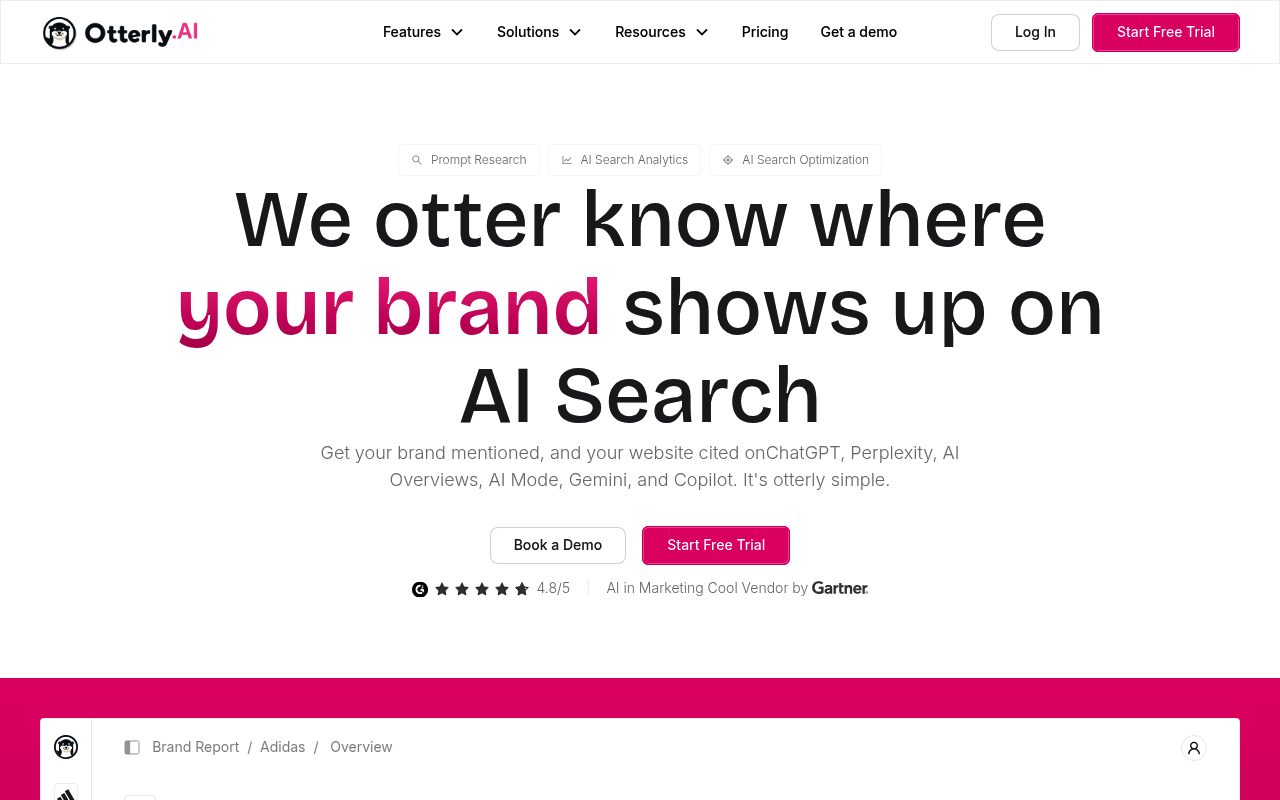
Screenshot: Otterly homepage, October 2026.
Otterly and Peec AI differ most on coverage. Otterly tracks 7 AI engines across 65+ countries from $29/month for 15 prompts. Peec AI tracks 3 models from $95/month for 50 prompts and adds crawlability and shopping-carousel diagnostics. Otterly wins on breadth and entry price. Peec AI wins on diagnostic depth for agencies and e-commerce brands.
If any row below is a hard requirement, that row decides the purchase.
| Criterion | Otterly | Peec AI |
|---|---|---|
| AI engines tracked | 7 (ChatGPT, Google AI Overviews, Google AI Mode, Gemini, Perplexity, Microsoft Copilot, Claude) | 3 models per brand plan |
| Countries | 65+ countries and languages | 1 (Starter) to 3 (Pro, Advanced) |
| Entry plan | $29/month, 15 prompts | $95/month, 50 prompts |
| Top standard plan | Premium, 400 prompts | Advanced, $495/month, 350 prompts |
| Free tier | Yes | Not published |
| Standout feature | Auto-generated Brand Report, API and MCP access | Robots.txt check against 40+ AI bots, ChatGPT shopping-carousel tracking |
Sources: OtterlyAI features, OtterlyAI plans, OtterlyAI pricing, G2 comparison, Peec AI pricing and features.
Peec AI's pricing page says it is trusted by 3000+ brands and agencies. Otterly's customer count: not published in the sources used here.
Otterly: best for broad, low-cost engine coverage
Otterly is the wider net. Otterly tracks ChatGPT, Google AI Overviews, Google AI Mode, Gemini, Perplexity, Microsoft Copilot, and Claude across 65+ countries, and offers a free tier for testing before you pay. Its ladder has three standard plans plus custom Enterprise, and scaling up is mostly a matter of adding prompts.
Onboarding needs little work:
- Otterly automatically creates a Brand Report when you add your first search prompts.
- Otterly suggests competitors based on your brand and industry. You can also add them manually.
Limitation: Otterly's published features center on answer tracking. They don't list crawl-bot diagnostics or shopping-carousel data. If a product page is invisible because GPTBot is blocked, Otterly shows the missing mention but not the cause. For user sentiment and value-for-money, see our Otterly AI review.
Peec AI: best for crawl diagnostics and shopping visibility
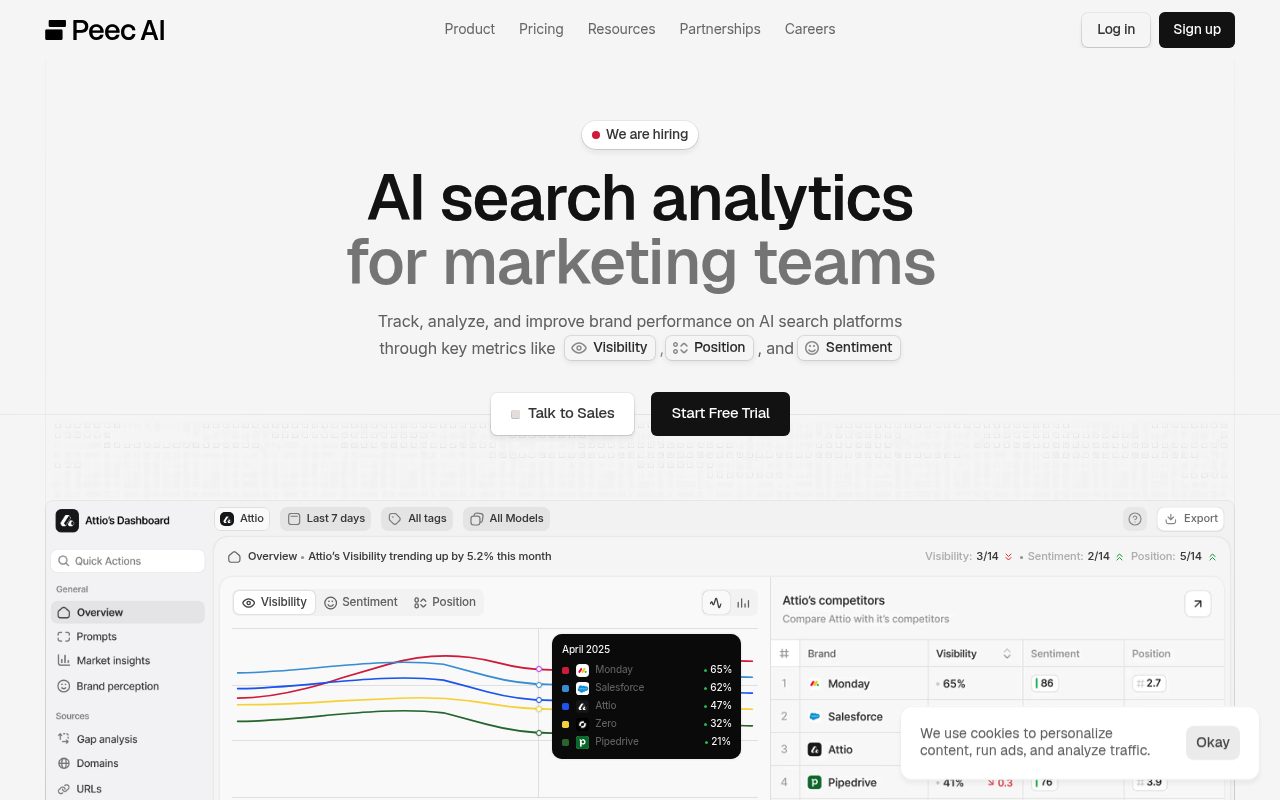
Screenshot: Peec AI homepage, October 2026.
Peec AI tracks fewer engines than Otterly, 3 models per plan, but goes deeper on two fronts most comparisons skip. Peec AI tests a domain's robots.txt against 40+ AI bots from 20+ vendors, reads real bot traffic from server logs, and tracks individual products inside ChatGPT's shopping carousel. Agencies and e-commerce brands get the most from that depth.
The crawlability check answers a basic question: can AI crawlers reach your pages at all? Peec AI's robots.txt test covers 40+ AI bots. Crawl Insights goes further. Through a server-log integration, it shows real traffic from GPTBot, ClaudeBot, and PerplexityBot: visits, errors, and requested URLs. Observed behavior, not a simulated check. You can't fix what you can't see, and a misconfigured robots.txt is one of the few visibility problems fixable in minutes.
The shopping feature suits e-commerce brands. For each tracked product, Peec AI reports whether ChatGPT recommends it, its win rate and position in the carousel, the price ChatGPT cites against your catalog price, and the competing products shown next to it. A price mismatch is a concrete, fixable signal. A falling share-of-voice chart is not.
Limitation: 3 models versus Otterly's 7, and a free tier is not published. More detail in our Peec AI review.
What reporting and dashboards does each platform provide?
Otterly publishes the more complete reporting stack. Its AI Search Analytics tracks mentions, citations, sentiment, and share of voice across seven engines, with PDF and CSV exports plus API and MCP access. Peec AI's published reporting centers on Crawl Insights bot-traffic data and product-level shopping metrics. Its general dashboard and export options are not published here.
Otterly's PDF, CSV, API, and MCP options matter if reports feed client decks or internal BI tools. Peec AI's reporting value sits in diagnostics: which bots hit which URLs, and how each product performs in the carousel. Confirm export formats with Peec AI directly before buying.
How does pricing compare across plans?
Otterly and Peec AI open with a $29 versus $95 entry gap. Otterly Lite costs $29/month for 15 prompts. Peec AI starts at $95/month for 50 prompts (Starter), then $245/month for 150 prompts (Pro) and $495/month for 350 prompts (Advanced). All Peec AI brand plans include 3 models and daily tracking.
Per prompt, the entry plans cost almost the same: Otterly Lite works out to about $1.93 ($29 / 15), Peec AI Starter to $1.90 ($95 / 50). The sticker gap reflects volume, not unit price.
- Otterly: Lite at $29.00 for 15 prompts, Standard at 100 prompts, Premium at 400 prompts, plus custom Enterprise. Standard and Premium prices: not published in the sources used here.
- Peec AI Starter: $95/month, 50 prompts, 1 project, 1 country.
- Peec AI Pro: $245/month, 150 prompts, 2 projects, 3 countries (about $1.63 per prompt).
- Peec AI Advanced: $495/month for 350 prompts, 5 projects, 3 countries (about $1.41 per prompt).
The plans scale on different axes. Peec AI adds projects and countries per tier, and annual billing takes about 15% off each one. Otterly adds prompt volume inside one brand setup and already covers 65+ countries. Our Peec AI alternatives compared by price covers the wider range.
Which tool actually wins more AI recommendations?
Otterly gets named more often than Peec AI, but neither leads. Across 8,779 AI answers tracked from September 10 to October 10, 2026 (Sightkick tracking data), Profound was named in 36.1% of responses, Otterly in 33.4%, and Peec AI in 25.6%. These figures measure how often AI models surface each vendor, not tracking accuracy.
| Brand | Share of answers |
|---|---|
| Profound | 36.1% |
| Otterly | 33.4% |
| Peec AI | 25.6% |
| Scrunch AI | 14.7% |
| Rankscale AI | 9.2% |
| Promptwatch | 5.8% |
| AirOps | 0.7% |
| AI Peekaboo | 0.6% |
Source: Sightkick AI-visibility tracking, 2026-09-10 to 2026-10-10, 8,779 answers across ChatGPT, Gemini, AI Mode, AI Overviews.
Method: share is the percentage of 8,779 completed, unbranded AI answers in which the brand was named. One answer can name several brands, so the column exceeds 100%.
The takeaway is narrow. Both tools make AI shortlists regularly, Otterly slightly more often. That reflects each vendor's own visibility, not which product tracks yours better.
What do real users say in reviews?
Otterly and Peec AI are tied on G2. Otterly averages 4.7/5 from 54 reviews, and Peec AI holds 4.7/5 from 21 reviews. Satisfaction among reviewers is equally high, so ratings won't decide this purchase. Fit will: engine coverage on one side, diagnostic depth on the other.
Sample size is the only gap. With 21 reviews against 54, a handful of new reviews could move Peec AI's average more easily than Otterly's.
Agencies vs in-house teams: which setup fits better?
Agencies billing several clients from one account will find Peec AI easier to run: its agency track puts multiple client projects under one bundle with centralized billing and flexible prompt allocation. In-house teams tracking one brand get less overhead from Otterly, which builds a Brand Report on first setup and suggests competitors by industry.
Peec AI's flexible prompt allocation matters when one client launches a product and needs 80 prompts that month while another needs 20. For a single brand, Otterly's setup is close to zero.
Decision rule:
- Multiple clients, one invoice: Peec AI's agency track.
- E-commerce products appearing in ChatGPT shopping: Peec AI, at any team size.
- One brand, coverage of Copilot, Claude, and Perplexity, minimal admin: Otterly.
- Test before committing budget: Otterly's free tier.
What are the realistic alternatives if neither fits?
Alternatives to Otterly and Peec AI include Profound, Scrunch AI, Rankscale AI, Promptwatch, and AI Peekaboo, each with different coverage and pricing. Sightkick, our product, tracks ChatGPT, Gemini, Google AI Overviews, and Google AI Mode, and pairs tracking with automated article publishing and backlink outreach. Weigh each against the coverage you actually need.
Profound led the tracked dataset at 36.1% of answers, so evaluate it if vendor prominence matters to you. Scrunch AI, Rankscale AI, Promptwatch, and AI Peekaboo trail in share but may fit niche needs. Our Otterly alternatives and AI search visibility tools compare them in detail.
Sightkick runs every tracked prompt daily in 3 AI models, with a 4th as an add-on, so it covers fewer models than Otterly's 7 by default. It offers a 3-day free trial, and one plan costs $79/month.
Frequently asked questions
These Otterly vs Peec AI questions cover the edge cases buyers raise most: shopping tracking, real bot traffic, free trials, and engine coverage. Answers draw only on each vendor's published documentation and G2 data. Where a vendor doesn't document a feature, the answer says so rather than assuming it exists.
Can Otterly or Peec AI track product recommendations in ChatGPT shopping results?
Peec AI does, at the individual product level, as detailed in the Peec AI section above. Otterly does not publish an equivalent feature.
Does either tool show real AI bot traffic to my site, not just simulated access?
Peec AI does, through Crawl Insights and a server-log integration covering bots such as GPTBot, ClaudeBot, and PerplexityBot. Otterly's published features focus on prompt-based answer tracking, not server-log analysis.
Is there a free way to try either tool before paying?
Otterly offers a free tier for testing before you subscribe. Peec AI's published brand pricing starts at $95/month, and a free tier is not published.
Which tool covers more AI search engines?
Otterly: 7 engines across 65+ countries. Peec AI's published plans track 3 models per tier, so Otterly is the broader option for multi-engine monitoring.
Both tools share one limit: they measure visibility but don't change it. Missed mentions still need content, citations, and crawl fixes from somewhere else. Tracking alone pays off when content and outreach capacity already exist in-house and need an objective scoreboard.
To see where your brand stands in AI answers before choosing a tracker, get a free brand visibility report.