Otterly AI Reviews (2026): Is It Worth Buying?

Fabio Bergmann
The best AI tool for content creation depends on scope: a tracker like Otterly AI monitors where AI engines mention your brand but writes nothing, while a platform like Sightkick automates article research, writing, publishing, and backlink outreach daily. For creation plus visibility, pick the platform that runs both on autopilot.
By Fabio Bergmann, Founder of Sightkick
What is Otterly AI, and is it actually good?
Otterly AI is a monitoring tool, not a content generator — worth clearing up front, because buyers searching for an "AI tool for content creation" often land here by mistake. Otterly tracks how AI answer engines mention and recommend your brand. It is good at that job. It does not draft or publish articles.
Otterly runs automated daily prompts across supported engines, so you skip typing queries into ChatGPT or Perplexity every morning. Coverage spans 65+ countries, which matters for agencies juggling international clients. One detail most reviews skip: Claude is tracked via API using Sonnet with web search enabled, not through the consumer app.
What do real user reviews say about Otterly.ai's features?
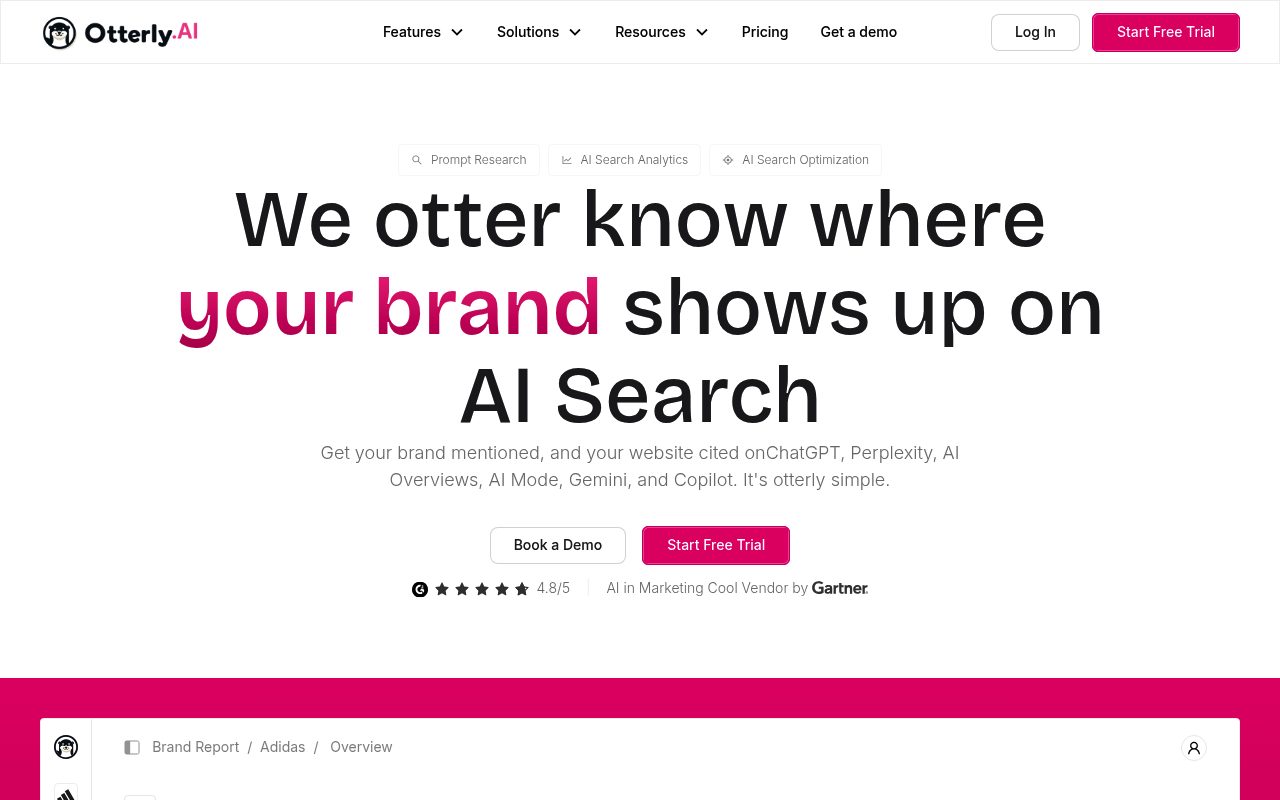
Screenshot: Otterly homepage, September 2026.
Reviews of Otterly AI praise setup simplicity and clear reporting. The loudest complaint is engine access: Claude, Gemini, and Google AI Mode sit outside the base four engines on every self-serve plan — paid add-ons, even at the top tier. Buyers who assumed full coverage feel the pinch.
SEO consultant Ryan Doser puts the pricing math bluntly:
Otterly includes four on every plan. Claude, Gemini and Google AI Mode are rented separately, at every self-serve tier, including the $489 one. So $29 is either a bargain or an opening bid, depending on whether the engines you care about are in the four or the three.
What users like:
- Daily automated tracking removes the manual prompt-checking grind.
- A recent MCP server pulls visibility data straight into Claude, ChatGPT, Cursor, and other MCP-compatible clients.
What draws criticism: the add-on structure means true multi-engine coverage costs more than the headline price implies.
How much does Otterly AI cost, and is it worth it for small vs. enterprise teams?
Otterly AI runs three self-serve plans plus custom Enterprise, all billed monthly or annually by credit card. It is a sensible entry point for small teams watching a handful of keywords, but prompt caps and add-on engine costs strain the value at scale.
Prompt limits are the core lever. Here is how the tiers break down as of September 2026.
| Plan | Prompts included | Best for |
|---|---|---|
| Lite | 15 | Solo founders, single-brand tracking |
| Standard | 100 | Small-to-mid marketing teams |
| Premium | 400 | Agencies with multiple clients |
| Enterprise | Custom | Large teams needing full engine coverage |
Sources: Otterly pricing
Fifteen prompts fit a solo founder tracking one brand. One hundred suit a mid-size marketing team. Four hundred cover agencies running several clients. A self-serve pricing calculator estimates your total before you commit.
What does Otterly's own research say that most reviews leave out?

Otterly's internal GEO study is the most quotable thing about the product, and almost no comparison article surfaces it. Built on 10,000 search prompts and 100,000 cited web pages, it found brands are 6.5x more likely to be cited through third-party sources than through their own domains.
The citation breakdown sharpens the point. Across cited link types, branded pages accounted for 36.5% and news/media for 29.6%, with UGC and editorial splitting the rest. The read: a team optimizing only its own website ignores where AI pulls most of its citations. This is why creation and tracking belong together — writing content is half the job; the other half is landing on the third-party pages AI actually cites. Sightkick's Articles engine publishes daily while its Backlinks engine chases pages already cited by AI. Tracking source type, not just keyword rank, is the difference between guessing and knowing. The 2026 GEO audit guide covers how to classify citation sources.
How does Otterly AI compare to Profound, Scrunch AI, and other alternatives?
Choose an AI visibility tool by which engines you must track natively versus as a paid add-on. Otterly AI competes with Profound, Scrunch AI, AirOps, Rankscale AI, and Promptwatch, each differing on engine depth, pricing model, and whether it extends into content or backlink automation.
| Tool | Primary focus | Notable trade-off |
|---|---|---|
| Otterly AI | AI search mention tracking | Core 4 engines only; Claude/Gemini/AI Mode cost extra |
| Profound | Enterprise AI visibility analytics | Higher price point, enterprise-focused |
| Scrunch AI | Content AI-readiness scoring | Less focused on daily mention tracking |
| AirOps | AI content workflows + visibility | Broader scope, less monitoring depth |
| Rankscale AI / Promptwatch | Budget AI visibility tracking | Narrower engine coverage |
| Sightkick | Visibility tracking + automated articles/backlinks | Wider platform than a single-purpose tracker |
Sources: Otterly supported engines, Ryan Doser review
Profound sits above Otterly on price with deeper agent-analytics reporting. Scrunch AI scores existing content for AI-readiness rather than tracking mentions. AirOps leans toward AI-assisted content workflows alongside visibility. Rankscale AI and Promptwatch are smaller, newer entrants often cited as cheaper starting points with narrower coverage.
Sightkick is worth a look if you want visibility tracking bundled with automated article publishing and backlink outreach in one platform — it tracks ChatGPT, Gemini, Claude, Perplexity, Google AI Overviews, Google AI Mode, and Reddit daily, sets up in 2 minutes, and includes a 7-day free trial. The honest limitation: it is a broader, more automated platform than Otterly's focused monitor, which may be more than teams wanting a lightweight tracker need. For a wider field, see the roundup of AI search visibility tools for 2026.
Frequently asked questions
Is Otterly AI worth the price for a small team versus an enterprise brand?
For small teams tracking one or two brands, the Lite or Standard plan is inexpensive and sufficient. Enterprise teams needing full engine coverage — including Claude and Gemini as add-ons — across many keywords will find self-serve pricing adds up fast, per Ryan Doser's review, making the custom Enterprise plan or a broader platform more cost-effective.
What are people saying about ContentBot AI?
The allowed sources contain no information on ContentBot AI, so we can't publish a verified assessment here.
What alternatives to Otterly AI do users on forums recommend?
Forum discussions most often mention Profound for enterprise depth, Scrunch AI for content-readiness scoring, and Rankscale AI or Promptwatch as cheaper starting points with narrower engine coverage. Some teams also look at broader platforms like Sightkick when they want visibility tracking bundled with content and backlink automation.
Does Otterly AI track Claude and Gemini by default?
No. Claude, Gemini, and Google AI Mode are add-ons on every self-serve Otterly AI plan, including the top Premium tier. The four engines included by default are Google AI Overviews, ChatGPT, Perplexity, and Copilot, per Otterly's own support documentation.
If you'd rather see your own numbers before choosing a tool, start a free Sightkick brand visibility report to check your visibility, sentiment, mentions, and average AI recommendation position across the major engines.