AI Overviews Tracker: How to Monitor AI Search Results

Fabio Bergmann
An AI Overviews tracker is software that re-checks a fixed set of search queries on a schedule to record whether Google shows an AI Overview, whether your brand or URL is cited inside it, and how that citation changes over time. It converts an unstable, frequently rewritten SERP feature into a measurable visibility metric you can compare against competitors.
Key takeaways
- An AI Overview tracker monitors citation presence, sentiment, and source type — not just position.
- Google Search Console now has dedicated Search Generative AI performance reports for impressions in AI Overviews and AI Mode. That's the most direct first-party measurement path.
- AI Overviews change constantly. Ahrefs measured a 70% chance of change between observations, so one-off checks go stale within days.
- Users can't turn AI Overviews off. Site owners got a global inclusion control as of August 31, 2026.
- Google states there are no special technical requirements to appear beyond standard SEO eligibility.
What is an AI Overview tracker?
An AI Overview tracker answers three questions a keyword rank tracker cannot: did an AI Overview appear for this query, was your domain cited inside it, and which type of source won the citation. Position in the blue links is a separate variable. A page ranking #1 can be absent from the Overview entirely.
A tracker exists because the feature is conditional. Google says AI Overviews appear only when its systems judge them additive to classic Search, and they often do not trigger. Two similar informational queries can produce completely different layouts. Without repeated sampling, you're guessing.
The generation process isn't a single ranking lookup either. Google says AI Overviews and AI Mode may use a query fan-out technique that issues multiple related searches across subtopics and data sources before composing a response. So the citation set for one query can draw from pages that never ranked for it.
- Captures presence, not position: Overview present/absent is binary and unrelated to your rank.
- Captures source type: whether the cited page is yours, a competitor's, editorial coverage, or UGC like Reddit.
- Runs alongside classic SEO tracking: it complements rank data rather than replacing it.
How do I track AI Overviews for my search results?
Track AI Overviews by pairing Google's native Search Console reporting with a third-party tracker that re-queries your target prompts daily. Search Console gives you first-party impressions for your own site. The tracker gives you citation source, sentiment, and competitor comparison. Neither alone is complete, and a single snapshot can be outdated inside 48 hours.
Cadence matters more than feature count. The benchmarks below explain why.
| Metric | Value | Source & period |
|---|---|---|
| Chance an AI Overview changes between observations | 70% | Ahrefs, November 2025 |
| Average AI Overview persistence | 2.15 days | Ahrefs, November 2025 |
| Share of Google searches producing an AI summary | ~1 in 5 | Pew Research Center, March 2025 |
| CTR change for top-ranking page when an AIO is present | 58% lower | Ahrefs, February 2026 (300,000 keywords) |
| Clicks on a link inside the AI summary | 1% of visits | Pew Research Center, March 2025 |
Sources: Ahrefs change analysis, Ahrefs CTR study, Pew Research Center.
A workable setup:
- Open the dedicated Search Generative AI performance reports in Search Console for impressions inside AI Overviews and AI Mode.
- Cross-check the overall performance report — Google folds the generative AI data into it to show total Search visibility.
- Layer a third-party tracker running the same prompt set daily to capture what Search Console never reports: sentiment, competitor citations, and whether the cited source is editorial, UGC, or owned.
What is the best AI search tracker?
No single AI search tracker wins every case. Judge vendors on three variables: refresh cadence, how many AI surfaces are covered, and whether citations are classified by source type. Tools in this category range from content-team citation monitors to enterprise dashboards to prompt-driven content workflows, and the labels matter less than the refresh schedule.
Ahrefs makes the cadence argument directly: its tracker refreshes in step with its keyword-database update cycles, because research showing a 70% chance of change means a one-off check goes stale fast. Apply the same test to any tool you shortlist. For a broader field, our roundup of AI search visibility tools for 2026 compares options side by side.
What triggers Google AI Overviews, and how often does the content refresh?

Google triggers an AI Overview only when its systems determine the summary adds something to standard results, and the response is often assembled through fan-out searches across subtopics. Because different models and techniques may be used, Google says the set of responses and links will vary — the same query can return different content session to session.
That variance is measurable. Ahrefs found AI Overviews had a 70% chance of changing between observations and an average persistence of just 2.15 days in its November 2025 analysis. Practically: a monthly audit tells you almost nothing about what searchers saw last Tuesday.
Eligibility is simpler. Google's generative AI features rely on core Search ranking systems to retrieve relevant, up-to-date pages from the index, then show clickable links supporting the response. Being indexed and snippet-eligible is the entry ticket. There is no separate technical gate.
Can I remove AI Overviews, and should I trust them?
Searchers cannot remove AI Overviews — Google is explicit that the features can't be turned off, though selecting the Web filter after a search displays only text-based links. Site owners have more control, and a new lever as of 2026. Neither group should treat an Overview as verified output.
Removing AI Overviews as a site owner
Google now offers a Search generative AI control in Search Console that manages whether a site can appear in AI Overviews, AI Mode, and generative AI features in Google Discover. Google says it rolled out to all websites worldwide as of August 31, 2026. Weigh it carefully: opting out removes a surface, it doesn't recover the clicks.
Whether to trust AI Overview answers
Google states plainly that AI Overviews can and will make mistakes. The design intent is that answers are backed by top web results with links to supporting content, and Google frames those links as a way to help people find information reliably and discover content they hadn't seen. Treat the Overview as a routing layer. Open the linked source before citing anything.
What's the difference between an AI Overview tracker and a rank tracker?
A rank tracker reports a position for a keyword's blue links. An AI Overview tracker reports whether an Overview appeared at all, whether your brand was cited within it, and which source type earned the citation. The first assumes a stable ranked list. The second deals with a feature that is present or absent and can omit ranked pages entirely.
Citation frequency has a simple formula:
Citation frequency = (times cited) ÷ (times checked), over a rolling window, segmented by source type.
Run a fixed prompt set on a fixed schedule, log cited-vs-not-cited per check, then split citations into four buckets: UGC, Editorial, Yours, Competitor. That split is the diagnostic. If competitors win mostly through editorial coverage, the fix is digital PR and backlinks, not another blog post. If Reddit threads dominate, the fix is community presence. A rank tracker shows none of this.
Cadence is the other hard difference. Given a 70% change rate between observations, a tracker that refreshes weekly is reporting history. Rank trackers tolerate slower cycles because positions move slower. Our GEO audit walkthrough covers prompt-set design in more detail.
Why do AI Overviews reduce clicks, and what does that mean for tracking priorities?
AI Overviews reduce clicks because the summary answers the query in place. Pew Research Center found roughly one-in-five Google searches produced an AI summary in March 2025, and users clicked a traditional result link in 8% of visits when a summary appeared versus 15% when none did. Links inside the summary got clicked in 1% of those visits.
Ahrefs measured the same pressure from the ranking side: a 58% lower average clickthrough rate for the top-ranking page when an AI Overview was present, across a February 2026 study of 300,000 keywords split evenly between AIO and non-AIO informational queries.
So priorities reorder. Position one is worth less than it was. Presence inside the Overview — and the sentiment attached to your brand when it appears — now predicts whether you're in the consideration set at all. Track citation presence first, position second, assumed CTR last.
Sightkick: monitoring AI Overview citations across models daily
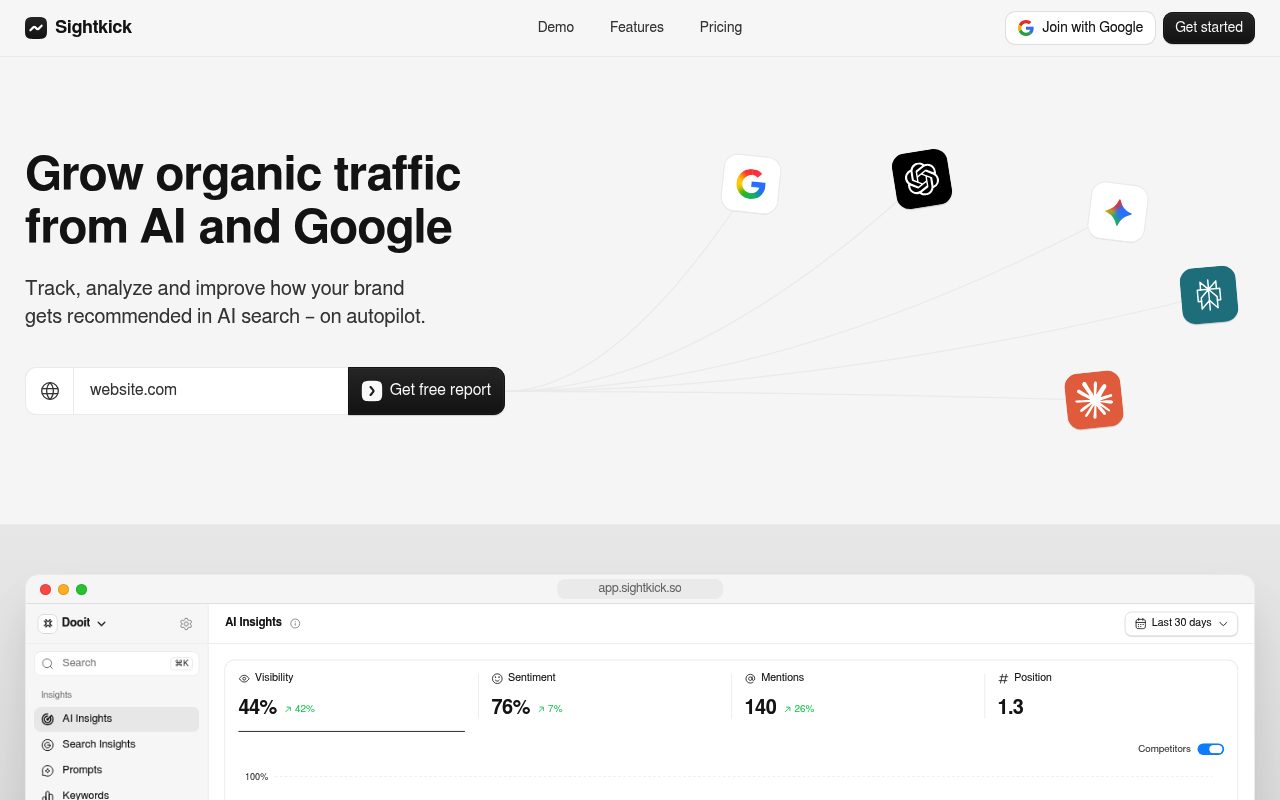
Screenshot: Sightkick homepage, September 2026.
Disclosure: Sightkick is our own product. The evaluation criteria above apply to it too.
Sightkick runs prompts across four AI models daily — ChatGPT, Gemini, Claude, and Perplexity — alongside Google AI Overviews, Google AI Mode, and Reddit, recording visibility, sentiment, mentions, and position in one view. Tracked citation sources are classified as UGC, Editorial, Yours, or Competitor: the exact breakdown needed to compute citation frequency per bucket.
Setup is stated at 2 minutes, with a 7-day free trial and a one-time free brand visibility report covering visibility percentage, sentiment score, mention count, and average AI recommendation position. Two engines act on the gaps — Articles researches, writes, scores, adds images, links and schema, then publishes to a CMS daily; Backlinks finds pages AI already cites, verifies owner contacts, sends pitches and follow-ups, and confirms live placements. Sightkick MCP exposes 29 tools for Claude, ChatGPT, Cursor, OpenClaw, and Codex.
Frequently asked questions
Do I need both an AI Overview tracker and Google Search Console?
Yes. Search Console's generative AI reporting gives first-party impression data, but it covers your own site only. A dedicated tracker adds sentiment, citation source classification, and competitor comparison — none of which Search Console reports.
Does having no AI Overview requirement mean regular SEO is enough?
Google states there are no special technical requirements beyond standard SEO best practices and index eligibility. But eligibility is not appearance. Google's systems only show an Overview when they judge it additive, and fan-out can pull citations from pages that don't rank for the original query — so strong SEO makes you eligible without guaranteeing a citation.
Pick a prompt set, log it daily, split the citations by source. That's the whole discipline.