 Join with Google
Am I on AI? How to Tell If You're Talking to a Bot

Fabio Bergmann
26% of AI-written text was correctly identified by OpenAI’s discontinued classifier in its English challenge set; 9% of human text was falsely flagged. If you’re asking “Am I on AI?”, a detector cannot settle it. Check the conversation’s disclosure, verify its claims, and confirm identity through an independent channel.
By Fabio Bergmann, Founder of Sightkick
Key takeaways
Checking whether you are interacting with AI requires more than a detector score. Separate authorship, identity, and authority. A label can disclose automation without verifying a claim. A convincing conversation can still require an independent check before you send money, share credentials, or accept a consequential answer.
- A detector score is evidence to investigate, not proof of AI authorship.
- Text chat, voice calls, dating profiles, and customer support need different verification steps.
- Fast replies and convincing empathy do not establish whether a human is present.
- An AI disclosure identifies the interface. It does not verify identity, accuracy, or authority.
- For businesses, checking AI-written content and tracking AI search recommendations are separate jobs.
Am I on AI? The short answer
AI detection cannot give you a dependable yes-or-no answer from writing style alone. OpenAI’s historical classifier results illustrate the problem, not the accuracy of every detector today. Separate three questions: who operates the account, whether AI assists the conversation, and whether the requested action is safe.
OpenAI reported 26% true positives and 9% false positives for its older English-language classifier. Those results belong to that tool and test set. Do not treat them as a universal detection rate.
ChatGPT is not an authorship lookup service either. OpenAI says it cannot reliably recognize its own output and may invent an answer when asked. The practical target is verification: confirm the account, source, or action before trusting the exchange.
How can I tell if I'm talking to an AI chatbot instead of a real human?
Start with the chatbot’s label and operator, not its conversational style. The FTC says AI chatbots can simulate human-like communication and relationships. Instant replies, repeated empathy, or scripted answers warrant checking, but none establishes that the account is automated. Request a disclosure and a verifiable route to the operator.
- Check the interface. Look for an AI label, an automation notice, or an explanation in the service’s help pages.
- Ask about the workflow. Use: “Is this response generated by AI, written by a person, or reviewed by a person?”
- Request an accountable handoff. Ask for a support ticket and a route to a human representative.
- Test the actual task. Ask the agent to restate your specific problem before proposing an action.
Repeated wording tells you little about who controls an account. A ticket you can verify through the company’s official support channel gives you something concrete to inspect.
What are the telltale signs that a conversation is AI-generated?
Confident errors and unverifiable citations are reasons to distrust an answer, not proof that AI wrote it. OpenAI acknowledges that ChatGPT can produce incorrect or misleading output while sounding confident, including fabricated quotes, studies, and references. Check the claim before trying to classify the speaker.
Open the cited source. Confirm that it exists, names the claimed author, and supports the exact statement. If the conversation contradicts an earlier detail, paste both statements and request a correction. Generic phrasing and context drift should trigger this check, not an accusation.
Is there a test or trick question to find out if someone is an AI?
No single trick question establishes AI identity. Asking ChatGPT whether it wrote a passage is especially weak: OpenAI says the system has no knowledge of its own authorship and may make up an answer. A better test checks something outside the conversation, such as an official account record or support ticket.
ChatGPT has no “knowledge” of what content could be AI-generated or what it generated.
Source: OpenAI, authorship guidance.
Weather questions, logic puzzles, and requests for personal memories test an answer, not an identity. Instead ask: “Where can I verify this ticket outside this chat?” Open the official service independently. A self-description inside the same conversation is not independent confirmation.
How do I check if a piece of text was written by AI?
Check a document’s provenance before its detector score. Turnitin’s detector requires at least 300 words of long-form prose and does not reliably detect poetry, scripts, code, bullet points, tables, or annotated bibliographies. A result outside those limits should not override drafts, revision history, or source verification.
Our AI writing detection model may not always be accurate (it may misidentify human-written, AI-generated, and AI-paraphrased text), so it should not be used as the sole basis for adverse actions against a student.
That is Turnitin’s stated limit. Running a product snippet, support reply, or code sample through a detector does not remove its format restrictions.
- Request provenance. Ask for drafts, revision history, research notes, and source links.
- Audit the substance. Verify product specifications, quotations, and claims against their original sources.
- Record detector limits. Note the tool, supported format, and input length alongside any result.
- Review before acting. Give the author an opportunity to explain the writing process.
NIST’s 2024 GenAI pilot study evaluates the gap between increasingly human-like generated text and detectors’ ability to distinguish it. That framing does not establish that every detector is improving or declining at the same rate.
For SEO teams, authorship is a different question from usefulness. Google accepts helpful, people-first AI content; creating content primarily to manipulate rankings violates its spam policies. Its 2026 guidance emphasizes valuable, unique, non-commodity content. Review an automated article for original evidence and accurate product details, not merely a low detector score.
Measurement is separate again. A detector estimates authorship. Sightkick runs tracked prompts daily and records brand visibility, sentiment, mentions, and recommendation position. It classifies citation sources as UGC, Editorial, Yours, or Competitor. The useful question changes from “Was this written by AI?” to “Which brands and sources does the answer recommend?” Neither measurement replaces editorial verification.
How can I tell if a dating app match or online profile is run by AI or a scammer?
For a dating profile, assess the scam pattern before trying to detect AI. The FTC describes a sequence involving a move off-platform, inability to meet in person, and eventual requests for money. A human-operated fake account can create the same risk as an automated one.
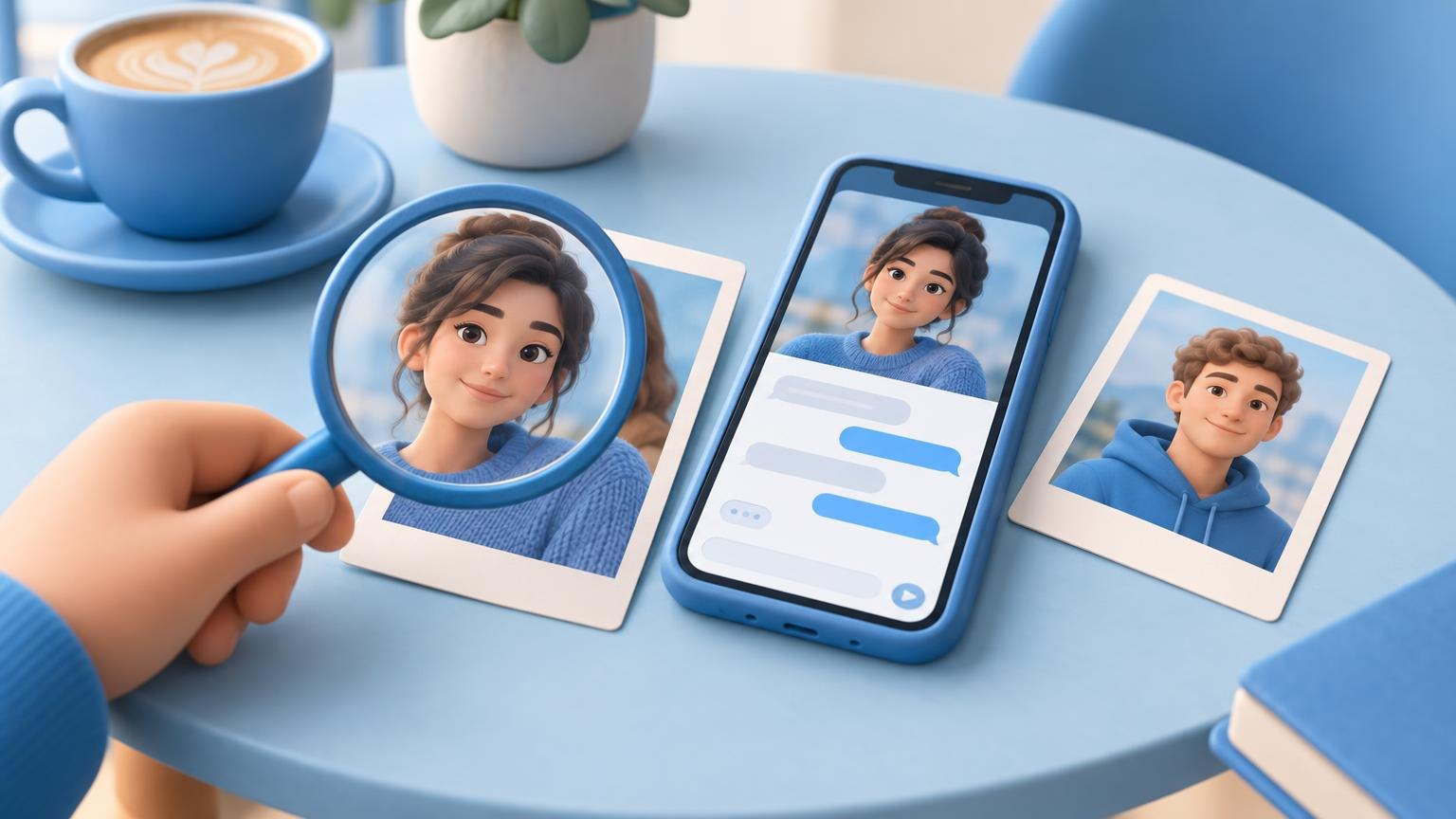
BBB says many romance scams start with fake dating profiles built from stolen photos and text from real accounts or elsewhere. A polished biography does not verify the person behind it. Neither does a consistent writing style.
- Reverse-search the profile image. Look for conflicting names or unrelated accounts. No match is not proof of authenticity.
- Keep the conversation on-platform while checking. Preserve the profile and message history.
- Request a live conversation. Treat the result as additional evidence, not identity certification.
- Stop at a financial request. Do not send money to resolve uncertainty about the account.
An explicitly labeled AI companion and a profile claiming to be a real romantic prospect present different questions. For the companion, inspect the disclosure and data policy. For the claimed person, verify identity independently.
How do voice calls or customer support lines disguise AI as a real person, and is it legal?
Synthetic speech can make a call’s speaker difficult to identify by sound alone. OpenAI acknowledges fraud risks involving impersonation and false information. Legality requires a jurisdiction-specific assessment; a vendor’s disclosure policy is not a universal law. For a consequential call, verify the organization through a separately obtained contact channel.
OpenAI describes a GPT-4o safeguard using a standalone output classifier to detect voices outside an approved list and block the output. That is a system control, not a listener’s verification tool. OpenAI separately requires Voice Engine partners to clearly disclose AI-generated voices to their audience.
A safeguard checks the system’s output. A disclosure tells the listener that speech is synthetic. Neither verifies the caller’s authority to request a payment or account change.
For either request, end the call. Open the company’s official app or website yourself and initiate a new contact. Do not use voice familiarity as authorization.
What's the real difference between a human and AI customer service agent, and why would a company hide it?
Customer service should be judged by authority and accountability, not conversational warmth. A conversation alone cannot establish why a company omits an AI disclosure. Ask whether the agent is automated, who can approve the requested action, how the decision is recorded, and where to challenge an error.
The FTC’s warning about simulated human-like communication explains why empathy is not an identity check. OpenAI’s accuracy warnings explain why a fluent policy answer still needs verification. Neither establishes that a human agent always knows more or has greater permission to act.
Use a task-specific request: “Please link the refund policy, identify who can approve an exception, and record my request in a ticket.” A refusal or repeated script may reveal a workflow limit. It does not prove automation. Save the policy and ticket before relying on a promised refund.
When should I trust a platform's AI disclosure versus verify it myself?
Accept a platform’s AI label as a description of the interface, not a guarantee about its claims. Low-stakes drafting needs less verification than a payment or account recovery. OpenAI’s Voice Engine disclosure requirement identifies synthetic speech; it does not certify the truth of the spoken message or the speaker’s authority.
- Casual chat: read the label and avoid sharing information the service does not need.
- Product or policy advice: check the official documentation and applicable terms.
- Money or account access: verify through a separate official channel before authorizing anything.
- Romantic commitment: verify identity independently rather than treating emotional consistency as evidence.
The FTC is studying disclosures and representations about companion features, capabilities, audiences, negative impacts, and data practices. Use those categories as a reading checklist: what is automated, what can it do, and what happens to your information? An investigation is not certification of any platform.
What should I do if I suspect I'm being deceived by an AI system?
Pause the transaction and preserve evidence before arguing about whether the speaker is AI. Stop sending money or sensitive information, request a human handoff, and verify the account through official support. For suspected romance fraud, the FTC’s fake-profile warning makes financial risk more urgent than identifying the writing tool.
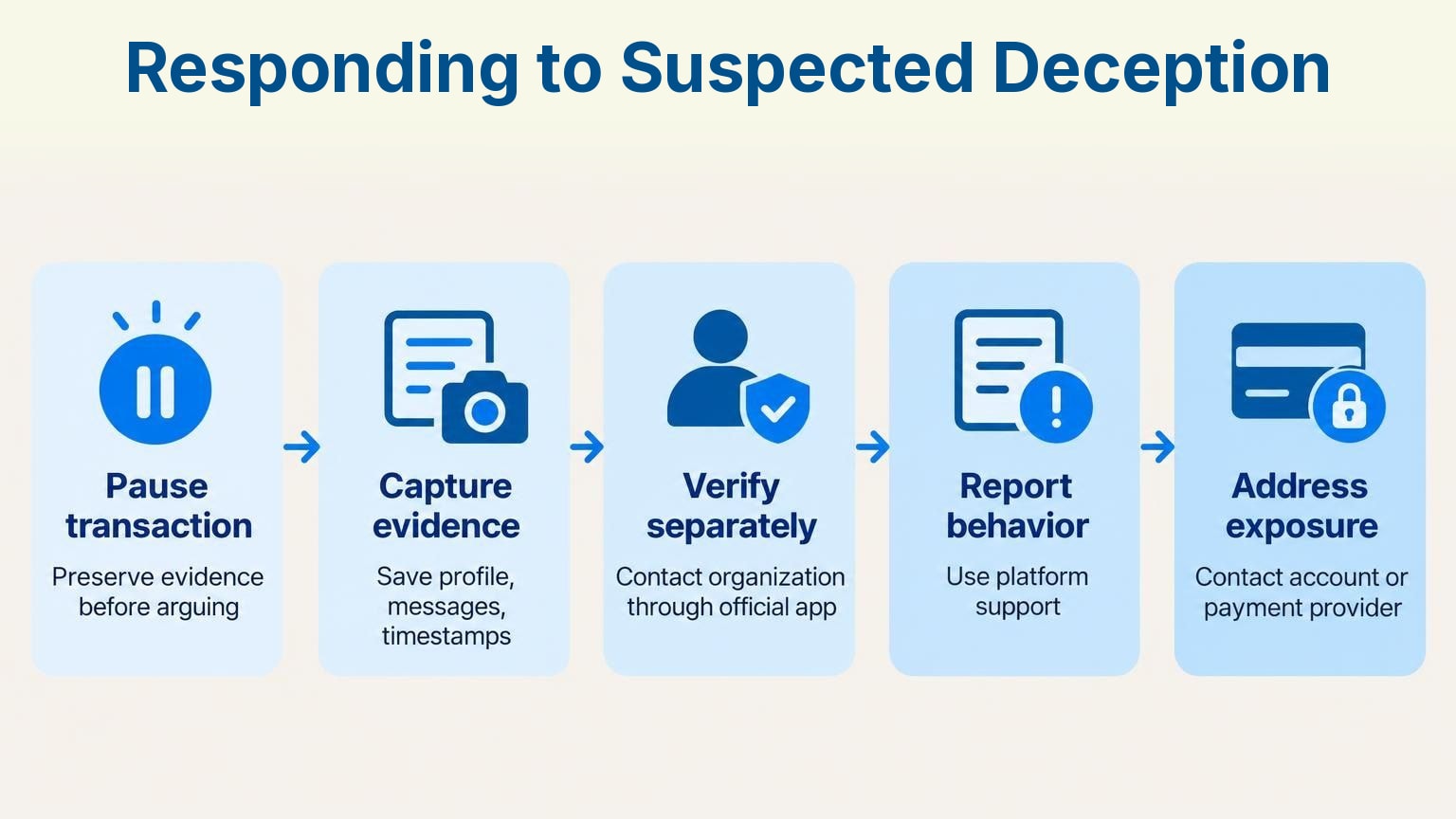
Process infographic: Responding to Suspected Deception – Pause transaction, Capture evidence, Verify separately, Report behavior, Address exposure
- Capture evidence. Save the profile URL, messages, timestamps, disclosure text, and payment requests.
- Verify separately. Contact the organization through its official app or website.
- Report the behavior. Use platform support and an appropriate consumer-protection channel for suspected fraud.
- Address exposure. If you shared credentials or sent money, contact the account provider or payment provider immediately.
Describe observable conduct: a false identity, missing disclosure, unsupported promise, or money request. “A detector said AI” is weaker evidence than the saved interaction.
Can philosophical arguments suggest I myself could be AI?
Personal simulation questions are separate from identifying an automated account or checking a document’s authorship. The detection methods discussed here assess text, interfaces, and verifiable interactions. They do not establish what kind of being you are. A classifier score or chatbot answer cannot resolve a question about your own consciousness.
Keep the practical test concrete: identify the account operator, check the source, and verify the requested action. Philosophical uncertainty does not prevent those checks.
Frequently asked questions
AI verification depends on what you need to establish: authorship, identity, disclosure, or permission to act. The tools discussed here have specific limits. Use detector results to guide review, platform notices to understand automation, and independent records to verify consequential claims. Do not substitute one check for another.
What tools can detect if I'm chatting with a bot or AI assistant?
The text detectors discussed here do not verify who operates a live chat. Turnitin evaluates supported long-form prose; OpenAI’s older classifier was discontinued. Check the platform’s automation notice, then request a ticket you can verify through official support. Asking ChatGPT to identify its own writing is not a reliable test.
Can an AI chatbot legally pretend to be human?
A legal answer depends on the jurisdiction and conduct involved. The FTC’s companion-chatbot inquiry examines company representations and risks; it is not a blanket ruling that all undisclosed chatbots are lawful or unlawful. OpenAI’s Voice Engine partner disclosure requirement is a separate vendor policy.
Is there a free tool that reliably detects AI-written text?
No tool discussed here establishes authorship reliably enough to act as sole proof. OpenAI removed its classifier on July 20, 2023 because of low accuracy and warned against using it as a primary decision-making tool. It also performed poorly on short text, non-English text, and code.
Why would a company use AI without telling customers?
The conversation alone cannot establish a company’s motive. Ask the company to explain its automation, human review, and escalation policy. Response speed and conversational style do not establish why a disclosure is missing.
Independent verification cannot prove who composed every sentence. It pays off when the decision has consequences: confirming an official policy or blocking an unverified payment matters more than winning a human-versus-bot guessing game.
For the separate task of measuring brand recommendations in AI search, contact Sightkick for a Free Brand Visibility Report. See visibility, sentiment, mentions, and average recommendation position relative to competitors—not an authorship score.