 Join with Google
SEO AI Agent: What It Is, What It Costs, How to Choose

Fabio Bergmann
An SEO AI agent is software that connects to live search data and executes SEO tasks toward a defined goal. It can research, draft, monitor, or publish through connected tools. Choose one by its execution permissions, data access, verification process, and total cost, including subscriptions and API usage.
By Fabio Bergmann, Founder of Sightkick
Key takeaways
SEO AI agents should be evaluated by completed work, not chat quality. Check their data access, execution permissions, evidence, and total cost. Keep visibility measurement separate from revenue attribution. Start with a bounded workflow and inspect the result before granting publishing, outreach, or broader website access.
- SEO AI agents carry tasks through to completion. A recommendation dashboard alone is not an execution agent.
- Google’s Search generative AI control rolled out worldwide on August 31, 2026. Its scope includes AI Overviews, AI Mode, and generative features in Discover.
- Budget separately for subscriptions, model usage, tool calls, and hosted execution environments.
- Connected search tools and citations support verification. They do not establish accuracy against human experts.
- Assign agents bounded tasks. Keep strategy, publishing permissions, and acceptance criteria under human control.
What is an SEO AI agent and how does it work?
An SEO AI agent connects to live search data and carries an SEO task through on its own. Ahrefs distinguishes doing the work from describing it. The practical test is completion: can the software retrieve evidence, execute permitted actions, and deliver the specified result without repeated manual handoffs?
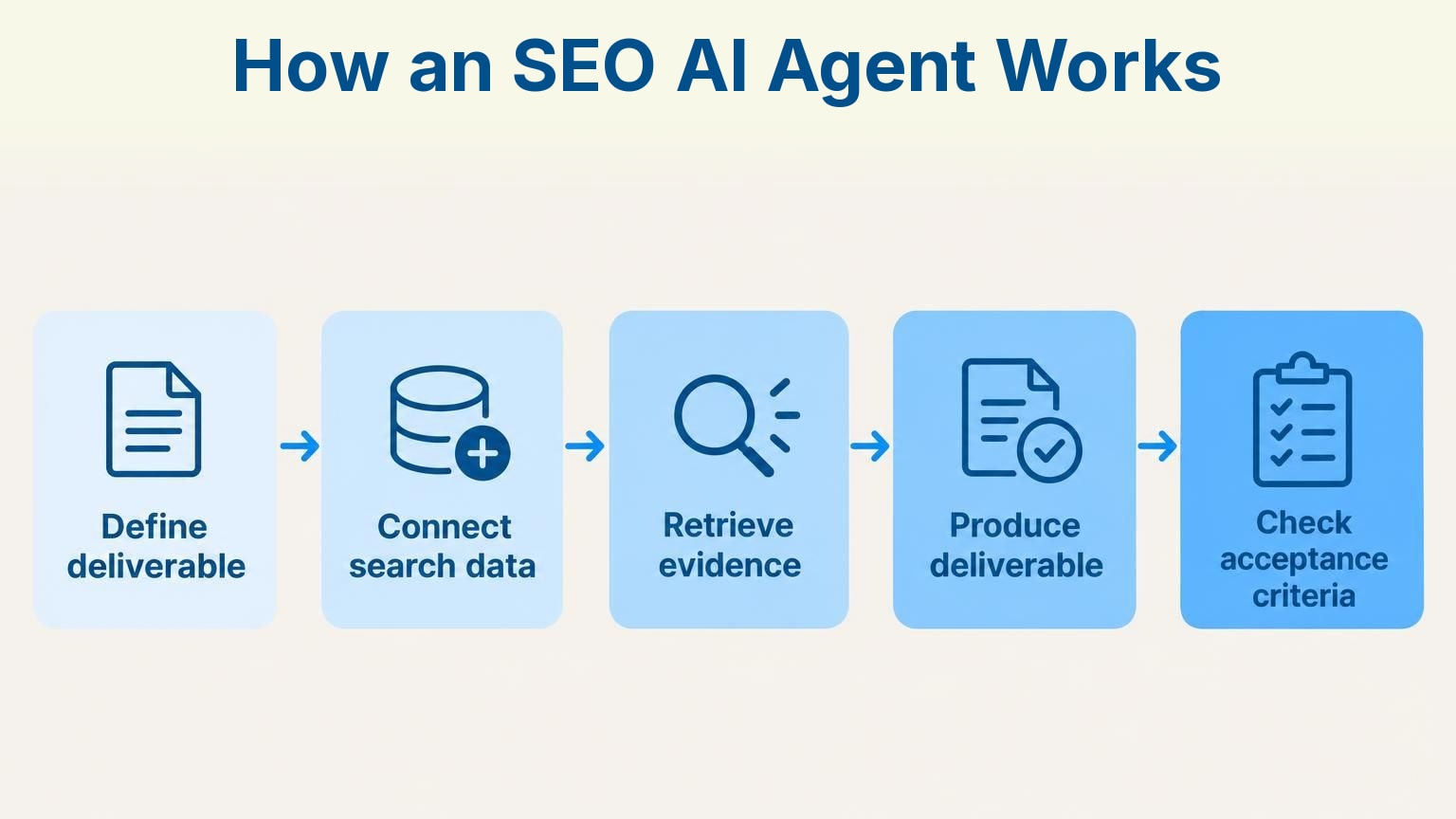
Process infographic: How an SEO AI Agent Works – Define deliverable, Connect search data, Retrieve evidence, Produce deliverable, Check acceptance criteria
OpenAI describes agents as a model, tools, and guardrails. Its example tools include browsing, API search, document analysis, and citation sourcing. Tools supply inputs and actions. Guardrails set boundaries: which sources the agent may use, which systems it may change, and when approval is required.
- Define the deliverable: for example, a sourced content brief for a specified product category.
- Connect the required search data and documents.
- Have the agent retrieve evidence, produce the deliverable, and check acceptance criteria.
- Require approval before actions outside its permitted scope.
How does an SEO AI agent differ from traditional SEO tools or software?
An SEO AI agent differs from a reporting tool by completing actions. A keyword report supplies information; an agent can use that information to execute a connected workflow. Test the endpoint: does the system stop at recommendations, or produce the approved deliverable without repeated manual handoffs?
OpenAI’s Agents API beta supports an OpenAI-managed Codex agent working across multiple steps in the same session. That is an execution architecture, not evidence that every application built on it can publish articles or change a website.
Botify Assist illustrates another boundary. Botify describes a conversational feature powered by an LLM and specialized agents for keyword research and analysis. A chat interface can contain agents while still focusing on answers. Ask vendors to demonstrate the exact task you need completed.
What tasks can an SEO AI agent automate?
SEO AI agents automate tasks allowed by their connected tools and permissions. Documented examples include Botify’s keyword analysis, Conductor’s content generation and performance reporting, and BrightEdge’s internal linking and CMS updates. Research access does not confer publishing access. Evaluate the inputs, permitted actions, and completion criteria for each task separately.
Research and tracking
Botify Assist supports rapid keyword research and search-related analysis. Its documentation recommends integrating Google Search Console data for accurate performance results. Request analysis of your connected property, not a generic keyword answer.
Technical and on-page
BrightEdge’s Site Agents Suite can automatically build internal links and push recommended title tag, meta title, and H1 updates into WordPress, Drupal, and other major CMS platforms. Test a bounded page set. Inspect the live changes before expanding permissions.
Content and outreach
Conductor combines AI content generation, AEO and SEO performance reporting, website monitoring, and AgentStack workflows. Define completion precisely: a saved draft, published CMS page, sent pitch, and confirmed backlink are different endpoints.
Content workflows should cover more than text. Google says its AI search features can surface relevant images and video. Include relevant media in the brief and review process rather than treating publication as a text-only task.
What are the best SEO AI agents or tools available right now?
The best SEO AI agent depends on the workflow you need executed. Semrush and Clearscope document research and AI-visibility features. Ahrefs Agent A emphasizes autonomous marketing tasks. Conductor combines reporting with agent workflows. BrightEdge documents direct technical changes. Compare completion boundaries, not interchangeable lists of AI features.
- Semrush: Its Starter plan includes keyword research, competitor analysis, AI visibility reports, prompt monitoring, and AI sentiment monitoring. Evaluate it for research and visibility measurement.
- Clearscope: Its product plans include query tracking across ChatGPT and Gemini, brand visibility tracking, query fan-out awareness, topic exploration, and AI drafting. Evaluate it for content work tied to query-level mentions.
- Ahrefs Agent A: Ahrefs states that Agent A has unrestricted dataset access and can execute marketing tasks autonomously. Request a demonstration against your research goal.
- Conductor: Its AgentStack suite sits alongside AI content generation, AEO and SEO reporting, and website monitoring. Its developer documentation also describes connections to external assistants and dashboards.
- BrightEdge: Evaluate Site Agents Suite when internal linking and CMS updates are the bottleneck. Its documented execution scope matters more than a generic promise of AI assistance.
For a comparison focused on monitoring rather than execution, see the AI search visibility tools guide.
SEO AI agent pricing: what does it actually cost?
SEO AI agent costs divide into platform subscriptions and metered execution. Clearscope lists Essentials at $129/month and Business at $399/month. OpenAI bills model usage and applicable tools separately. Compare the recurring platform bill with the cost of completing your workload. A subscription price alone is not a complete budget.
- Clearscope: Essentials costs $129/month; Business costs $399/month. Enterprise is custom-priced.
- Conductor: Essentials, Growth, and Enterprise plans use usage-based pricing, not seat-based pricing. Request a quote against your expected workload.
- OpenAI web search: $10.00 per 1,000 calls, plus search content tokens billed at model rates.
- OpenAI Agents API: The selected model’s API rates apply, with applicable tool and container rates for OpenAI tools and hosted sandboxes.
Build the budget from a task inventory. Record expected executions, searches per execution, token usage, and sandbox requirements. Ask which costs are included and which pass through. Do not assume a platform subscription requires a separate API bill. Include human review when comparing cost per accepted deliverable.
How accurate and reliable are SEO AI agents compared to human experts?
SEO AI agent accuracy cannot be inferred from autonomy or a feature list. Browsing, API search, document analysis, and citation sourcing provide ways to gather and inspect evidence. They do not establish comparative accuracy against SEO experts. Evaluate the agent on your own tasks with explicit, inspectable acceptance criteria.
- Research: Open cited pages. Confirm that each passage supports the claim and applies to the correct product or date.
- Content: Check prices, product specifications, and named claims against approved source material.
- CMS changes: Compare proposed and live title tags, H1s, and internal-link destinations.
- Multi-step work: Inspect the final deliverable, not a message saying the task finished.
OpenAI’s Agents API is a beta offering. Treat that status as a deployment consideration. Run a bounded evaluation before granting production write access.
Can an SEO AI agent fully replace an SEO specialist or agency?
An SEO AI agent can take over a defined workflow; documented capabilities do not establish a blanket replacement for specialists or agencies. Your team still owns goals, evidence, and acceptance criteria. Google says SEO best practices remain foundational for its generative AI features. Automation changes execution, not responsibility.
Google recommends unique, non-commodity content. Give the agent approved product documentation, original examples, and verified customer evidence where available. Have a specialist decide which evidence belongs on the page and whether the output answers the buyer’s question.
Replace a task before replacing a role. Specify the handoff: the agent produces the draft or proposed change; the specialist approves scope, evidence, and release.
What are the risks and limitations of using an SEO AI agent?
SEO AI agent risk grows with granted permissions. A research error can remain contained in a draft; publishing or outreach can make the same error public. Separate read access from write access. Define approval boundaries and inspect completed actions before treating an automated workflow as a permanent configuration.

Google describes AI agents as a quickly emerging and evolving space and includes initial guidance in its generative AI Search resource. Check current guidance. Do not assume settled rules for every agent workflow.
- Publishing: Require approved sources for product claims and a way to inspect changes.
- Outreach: Review recipient relevance, pitch accuracy, and follow-up rules before enabling sends.
- Search configuration: Record the generative AI control configuration before changing it. Evaluate affected surfaces separately.
How do Google's new AI controls change SEO measurement and ROI?
Google’s Search generative AI control adds configuration context to SEO measurement. Google says it rolled out worldwide on August 31, 2026 and applies to AI Overviews, AI Mode, and generative AI features in Discover. Record the configuration before interpreting changes in visibility or commercial return.
The control’s documented scope is specific. Do not extend conclusions about Google’s configuration to ChatGPT or Gemini monitoring. Keep configuration changes visible in reporting so they are not confused with the effects of content or agent activity.
- Record the control configuration and the date of each change.
- Keep AI recommendation monitoring separate from website visits and conversions.
- Compare visibility and business outcomes over the same reporting period.
- Include subscriptions, API usage, and review effort in the cost side of ROI.
A brand mention is a visibility result, not a sale. Use connected performance data to assess visits and conversions. Do not claim that a mention caused revenue without supporting attribution.
How do you integrate an SEO AI agent with Google Search Console, Analytics, or a CMS?
SEO AI agent integration starts by separating data access from action access. Connect Search Console for site-performance evidence, verify the analytics connector, and grant CMS permissions only for intended changes. Test the full path from retrieved data to a reviewable deliverable or controlled website update before expanding access.
- Search Console: Follow Botify’s recommendation to integrate the property’s data before relying on its performance analysis.
- Analytics: BrightEdge lists CMS, analytics, and third-party integrations, alongside site audit, SEO Copilot, and site agents for technical SEO automation. Confirm the specific connector and available fields.
- CMS: For BrightEdge, verify WordPress or Drupal access against the intended title, H1, and internal-link changes.
- Agent environments: Conductor documents connecting SEO and AEO intelligence to external tools and agents, including ChatGPT, Claude, Copilot, BI dashboards, and custom agents.
Test with a known page and reporting period. Confirm property identity, returned data, permitted actions, and final output. A working connector is not proof that the full workflow works.
How do you choose the right SEO AI agent for your business?
Choose an SEO AI agent by the task consuming your team’s time, then test its completion boundary. Compare Semrush for research and visibility monitoring, Ahrefs Agent A for autonomous dataset-backed tasks, and Conductor for connected content, reporting, and agent workflows. Require a demonstration against your actual deliverable.
- Define completion: Specify a report, draft, published page, technical update, or outreach action.
- Check data scope: Verify site data, competitor coverage, and access to required sources.
- Check integrations: Semrush’s Advanced plan adds API data integration and SEO share of voice. Plan selection can affect the workflow.
- Price the workload: Compare subscription scope with expected execution costs and human review.
- Inspect the output: Judge evidence, completed actions, and remaining manual handoffs.
Sightkick: setting up automated AI visibility tracking and content in minutes
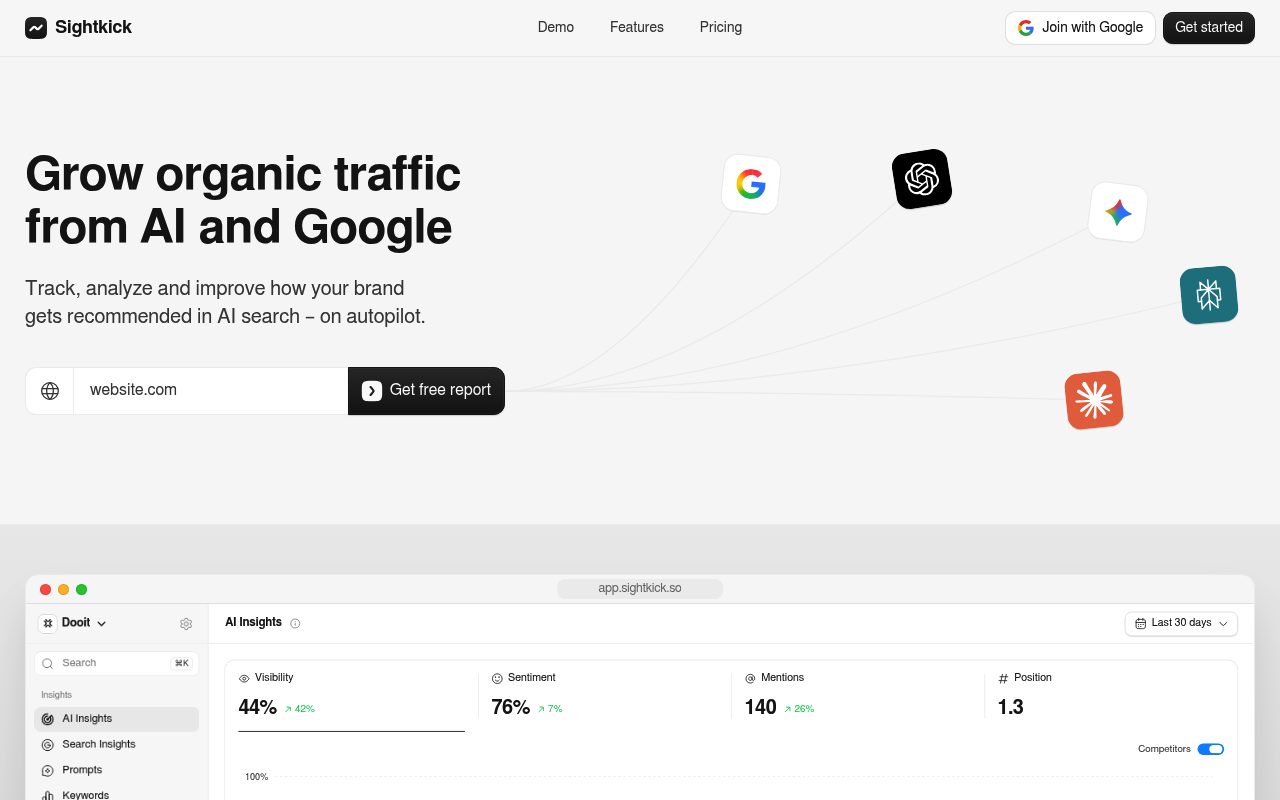
Screenshot: Sightkick homepage, October 2026.
Sightkick combines daily AI visibility monitoring, automated article publishing, and backlink outreach. Sightkick states a setup time of 2 minutes and offers a 3-day free trial. Every tracked prompt runs daily in 3 AI models; a fourth is an add-on. The workflow connects recommendation tracking with content and outreach execution.
Disclosure: Sightkick is our product. Setup, trial, pricing, and capability details are first-party product claims.
- Establish the baseline. Get the free brand visibility report for visibility percentage, sentiment score, mention count, and average AI recommendation position relative to competitors.
- Track recommendations. Configure prompts for continuous benchmarking. Sightkick tracks visibility, sentiment, mentions, and position across ChatGPT, Gemini, Google AI Overviews, and Google AI Mode.
- Schedule content. The Articles engine researches, writes, scores, adds images, links, and schema, then publishes to a CMS on a daily schedule without manual input.
- Run backlink outreach. The Backlinks engine finds pages already cited by AI, verifies owner contact details, sends pitches and follow-ups, and confirms live backlinks.
- Connect your agent environment. Sightkick MCP provides 56 tools for Claude, ChatGPT, Cursor, VS Code, and OpenClaw.
Sightkick classifies citation sources as UGC, Editorial, Yours, and Competitor. Use that split to choose the next action: review owned content, evaluate cited pages for outreach, or inspect competitor sources. Then distinguish execution evidence—a published page or confirmed backlink—from subsequent changes in recommendations. Completed work is not proof of visibility lift.
Sightkick lists one plan at $79/month. Check pricing against your intended configuration, including the optional fourth model.
Frequently asked questions
SEO AI agent evaluation comes down to evidence, permissions, and measurable completion. Citation categories help identify where recommendations originate. Compliance depends on the actual content and actions, not the agent label. Verify execution milestones when delivered, then measure visibility and commercial outcomes against a baseline without assuming causation.
How is citation source type (UGC, editorial, owned, competitor) useful for evaluating an SEO AI agent's reporting?
Citation categories show where recommendations originate. Sightkick classifies sources as UGC, Editorial, Yours, and Competitor. Use those categories to separate owned-content work from editorial or community outreach, rather than treating every mention as the same acquisition channel.
Does using an SEO AI agent risk a Google penalty?
An agent label alone does not establish compliance or a penalty outcome. Google says foundational SEO practices remain relevant to generative AI search. Evaluate actual content and website changes against that guidance. Review automated actions before granting wider publishing permissions.
What results or ROI timeline is realistic with an SEO AI agent?
Separate execution milestones from commercial outcomes. A completed report, published article, or confirmed backlink can be verified when delivered. Visibility changes and revenue require subsequent measurement. Set the reporting period before deployment. Assess results against a baseline, including software costs and review effort.
Try Sightkick free for 3 days to test daily visibility tracking and automated workflows in your own configuration.